OM in the News: Queuing Up at Airport Customs This Summer


Automated passport control kiosks for arriving passengers at JFK

Extremely long lines, which in 2013 stretched beyond four hours at times, are forecast to return again for the busy summer travel season, writes The Wall Street Journal (June 11,2014). In May, Washington Dulles, New York Kennedy and Miami International airports all experienced occasional maximum waits over 2½ hours. At San Francisco International’s Terminal A, the average wait time at Customs during the peak 1-2 p.m. hour was still 40 minutes, though that’s far better than the May 2013 average of 57 minutes at the same hour. “The cavalry is on the way, but they won’t arrive in time for this summer,” said the CEO of the U.S. Travel Association. “We just don’t have enough officers right now, and it’s like having one cashier at Costco.”

Budget issues have left staffing largely unchanged for years. As international travel has surged in the U.S., queues at passport control and Customs checkpoints at airports have backed up. Last year, 70 million international passengers arrived in the U.S., up from 55 million in 2009. And last summer the issue boiled over, with airports having to rush in water, chairs and cots for arriving passengers, many of whom got stranded when they missed flight connections.

The Customs department began letting airports and airlines pay to install the new Automated Passport Control kiosks for travelers who aren’t in Global Entry. (Global Entry lets travelers who have undergone fingerprinting, a background check and an in-person interview use a kiosk and bypass long lines.) Travelers scan their passports and answer questions on the kiosk while waiting in line. When they reach a Customs officer, the information can be quickly pulled up on a screen rather than entered manually by the officer. Shaving seconds off the inspection process has significantly sped up lines. At some airports, such as New York’s JFK, Chicago O’Hare, Dallas-Fort Worth and Orlando International, kiosks have helped reduce wait time as much as 40% despite increases in the number of people arriving.

Classroom discussion questions:

1. What options do OM managers have to speed up the Customs queues?

2. Why are airlines very concerned about the long waiting times at Customs?

OM in the News: Queuing Theory at Goldman Sachs?

goldmanGoldman Sachs’ cafeteria has been described as something out of Gattaca, the 1997 science fiction film, reports The Washington Post (Oct.18, 2013).  It’s a wide-open space full of furniture that looks like it was smuggled from a utopian future in which nothing is ever dirty, broken or unintentionally asymmetrical. It isn’t just the physical design of the 11th-floor space that creates this impression. It’s the way Goldman administers it with a clever policy designed to economically engineer efficient eating.

The most crowded time of the day to eat lunch is, naturally, during lunch time. For most people, this falls around noon. This creates the phenomenon of the lunchtime rush hour. Goldman didn’t like the idea of its people waiting on long lines to get their lunch. People are capital to Goldman. It wants to use its capital efficiently. Standing on line waiting for a burger is not an efficient use of Goldman’s capital. So the cafeteria has a set of timed discounts. If you show up before 11:30 or after 1:30, you get a 25% discount on your food.

As it turns out, Goldman folks are both especially attuned to economic incentives and ruthless about capital efficiency. Some take pride that they’ve never eaten lunch inside the “cost penalty window,” as one trader referred to the 2 hours when the discount isn’t in effect. In the cafeteria around 1:20 pm, the lines at the pay registers are empty. So are many of the tables. But the area between where the food is collected and where you pay is quite crowded. The Goldman lunchers are chatting with each other, waiting for the final minutes to tick down until they can save a dollar or two.   When its spokesman was called about Goldman’s lunch market manipulation, neither he nor anyone else in his office was available around 1:30. “Goldman approves of employees using their capital efficiently,” he said later.

Classroom discussion questions:

1. What other restaurants incentivize diners like this cafeteria does?

2. Why is this system not as effective as it could be from the firm’s perspective?

Guest Post: A Teaching Tip for Visualizing Waiting Line Flows and Interarrival Times

steve harrodWhile Jay and Barry attend the INFORMS meeting in San Antonio, Dr. Steven Harrod, Assistant Professor of Operations Management at the University of Dayton provides this, his 5th Guest Post for our blog.

I find in teaching Waiting Line Models in Module D of the Heizer/Render text that the definitions and relationship of rates of flow and inter-arrival times are frustratingly difficult for some students to grasp. Here is a classroom exercise that may help:

Introduce the following video (http://youtu.be/O84FlZnP0qs ), explaining that it shows traffic starting after a red light turns to green. Start the video at 0:17 (prepare the video in advance so you don’t have to watch the commercial during lecture). Draw the students’ attention to the second lane of traffic, headed by the Range Rover.

Explain that this flow of traffic may be described either by how many cars cross the white stop line in a period of time, or by how long each car takes to cross the line. Either way, the traffic flow described is identical. Play the video, and count ten cars across the line (ignore the car that changes lanes). Car number ten is a yellow cab, so stop the video with the eleventh car at the white line. You should find the video counter at 0:42, or 25 elapsed seconds. This is a flow of 10 cars in 25 seconds, or 10/25 cars per second, or 1440 cars per hour.

Restart the video at 0:17. Now, count the seconds between each successive car at the white line. They are, approximately, 5, 3, 2, 1, 3, 2, 2, 3, 2, and 2. The average time between cars is then 2.5 seconds. Now, since in both cases we have witnessed the same traffic flow, make the argument that these two measurements are equivalent. Indeed they are, after you explain that the inter-arrival time of a flow and the rate of flow are inverses of each other. In this case in particular, (1/2.5) = (10/25) and [1/(10/25)] = 2.5.

For some students, this is a difficult concept, and I  repeat this approach multiple times in the course.

OM in the News: Eliminating the Waiting Line at Hotel Check-In

Concierge registering guest at Andaz West Hollywood

Hotels are changing the way guests check in to their rooms, writes The New York Times ( March 19, 2013), eliminating the traditional stop at the front desk to speed up, simplify and personalize the process. When guests arrive at citizenM, a boutique European hotel chain, they check in at a kiosk and go straight up to their rooms. The kiosk was designed to be easy to use because most travelers are encountering it for the first time.

“The hospitality industry is moving toward more automated check-in systems,” says NCR’s VP for kiosk systems. “Customers are used to A.T.M.’s at the bank instead of tellers, checking in for airplane flights online, and they are now looking for that same efficiency when they arrive at a hotel. No one wants to wait in line for the front desk anymore”.

Automated hotel check-in is expected to expand rapidly. In a typical system, guests check in by computer or phone before they arrive and enter their expected arrival time, which helps the housekeeping staff with the room cleaning schedule. A bar code is sent to the traveler to print out or display on his or her phone. At the hotel, the guest scans the bar code at a kiosk. The machine assigns a room and spits out the number of plastic key cards requested, and the guest can head upstairs.

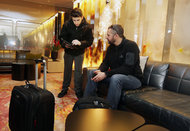
Hotels are also using new technologies to eliminate the front desk check-in line — with personal greeters who shepherd guests through the check-in process in a more comfortable setting. Andaz West Hollywood has combined its front desk staff, bellmen and concierge functions into “hosts,” who greet guests as they enter the lobby and sit with them on comfortable couches to check in using an iPad with a credit card reader.

This article is a nice complement to the Winter Park Hotel case study in Module D.

Discussion questions:

1. What is the benefit to hotels in implementing kiosk check-in?

2. Will these systems be widespread in a few years?

OM in the News: The $1,000,000,000 Queue

The newspaper in your town probably doesn’t run its lead story about queues and wait times. But this is Orlando, and when Disney World (with its 62,000 local employees) announces a $1 billion program to improve wait times with “interactive queues”, it is the headline (Orlando Sentinel, March 26,2011)!  Queues alone consume 10-20% of Disney’s capital budget.

Queues are a delicate balance at all of Disney’s theme parks, especially at Magic Kingdom, which hosts more than 45,000 visitors daily. Guests paying $85 to get in have long complained about the lines as their #1 beef. “Where are you going to put all those bodies? Well, some of them have to be in a queue”, says a UCF prof.

Here are some of the ways Disney’s “Next Generation Experience” project is spending its massive budget: interactive queues at Space Mountain, Winnie the Pooh, Haunted Mansion, and Epcot’s Soarin’. After 40 years of slowly shuffling towards the Haunted Mansion, for example, waiting riders now move through a graveyard filled with elaborate crypts. When you touch the tomb of a composer, instruments carved in the stone play music.

Disney has always paid attention to ride queues, with lavishly themed “pre-shows” that help establish the attraction’s story line.  Disney added giant video screens in the Soarin’ queue, equipped with sensors that allows big groups of guests to play collaborative games while waiting. Now it has placed 87 video-game stations in the Space Mountain queue and play areas for kids in the Winnie the Pooh line.

“Guests were willing to wait 12% longer because of the interactive experience”, says a Disney exec. That’s about 7 min. in an hour-long line. (To read our 2 earlier blogs about Disney and queues, click here).

Discussion questions:

1. Disney’s “NextGen” will also let guests book ride times from home and by-pass lines entirely. Is this a good OM idea?

2. Why is Disney willing to spend $1 billion to make its lines more fun?

Teaching Tip: Queuing Up at Disney on Thanksgiving

Having lived in the Orlando area for over 2 decades, everyone assumes my family and I are regular visitors to the Magic Kingdom and the 5 other  Disney World properties here. After all, Disney World is a powerhouse,with over 62,000 local employees (called “cast members”)  and 48 million visitors last year. So when they find I have yet to take my 13 year old son to the Magic Kingdom, I appear to be some sort of ogre. (To my defense, my kids have been to Universal, Sea World, Wet n’ Wild, Blizzard Beach, Animal Kingdom, and on and on). To overcome this pressure, we all went to Disney today, Thanksgiving, 2010.

Here is what we learned. Thanksgiving is one of the  busiest days of the year. And Disney has a clear plan for dealing with this capacity situation (Supp.7): All free passes are cancelled, all cast members are called in, extra parades are scheduled, more refreshment booths are opened, and hours are extended…the Park didn’t close till 1am!

But the queues–oh the queues! Where else would a rational family of 4 pay $340 in entrance fees, $12 to park, and $50 for water and ice cream, only to wait in a series of 45 minute lines for 5 or 6 rides and shows…and then walk away happy as can be?

Here is the secret to the psychology of queuing theory…something Disney’s flock of Ph.D.s in OR and IE have mastered: (1) Keep your customers informed of how long each queue will take,with signs posted frequently…and overestimate, don’t underestimate. (2) Entertain them while they wait, with videos, music, and cartoon characters. (3) Keep the lines moving so progress seems to be taking place. And (4), make people walk long distances between the most popular features, with plenty of interesting activities en route.

I hope this leads to some useful class discussions about how how queues can be managed. Happy Thanksgiving to all!

OM in the News: Waiting Lines in the Doctor’s Office

My internist of many years, Dr. Gulden, never ceased to amaze me before he retired. For every scheduled appointment, I was seen within 5 minutes of my arrival!  This led to research I did in 1994, when I found that the average wait time in doctors’ offices in the US was 20.6 minutes, costing about $15 billion per year in lost productivity.

I guess this topic was of interest since the finding made the front page of papers around the country, from the Boston Globe to the Miami Herald.  Yesterday, The Wall Street Journal (Oct.19,2010), with the headline “The Doctor Will See You Eventually“, announced that the “average  time patients spend  waiting to see a health care professional is now 22 minutes, and some waits stretch for hours”. Are any of us who teach OM shocked?

This is a great article to discuss when you cover waiting line models in Module D. But it may also be useful in Supp.7, Capacity and Constraint Management, because the Journal   talks about cutting cycle time. In one doctor’s office, patients helped measure their times from arrival until departure. By identifying bottlenecks, the doctor was able to cut 12 minutes from the typical 40 minute stay.

So why was Dr. Gulden so successful in keeping on-schedule? I think there was  one main reason: he made all his staff  understand that each patient’s time was as valuable as his was.

Discussion questions:

1. Ask your students to rank the seven methods the article discusses in terms of  what they think are the best for time savings payoff.

2. Many hospitals now advertise their ER wait times. What have they done to improve their process flows?

3.What kind of queuing models can be used in a doctor’s office?