OM in the News: Britain Promotes Apprenticeships to Help its Industrial Base

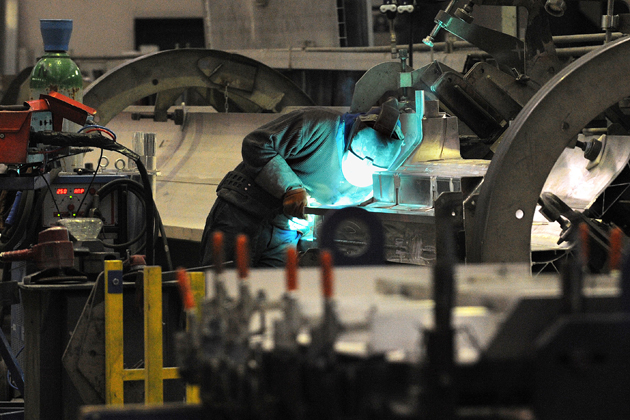
British apprentice learning high-integrity welding

Despite relatively high unemployment in Britain, especially among young people, there is a marked shortage of skilled manufacturing workers, writes The New York Times (Jan. 20, 2014). The problem is so acute that the government and industrial companies are behind an unprecedented push to get teenagers into apprenticeships to close that gap. The British government is trying to catch up with Germany and Switzerland, which have retained their competitive edge with the help of well-honed apprenticeship programs.

 A third of employers across Europe say that the lack of skills is causing major business problems in terms of higher costs, insufficient quality and lost time.  27% of the 2,600 companies surveyed by McKinsey note they have left an entry-level vacancy unfilled over the past year because there were no eligible applicants. Statistics like that, and the fact that about a quarter of people under 25 are jobless in Europe, prompted Britain to act, committing £1.57 billion to apprenticeship training last year. About 2.7 million new jobs in British manufacturing are expected by 2020, of which 1.9 million will require engineering skills. Companies will need to double both the current number of qualified recruits and of apprenticeships to fill those positions.
Britain is among the worst in the developed world at equipping its young people with numeracy and literacy skills. The career aspirations of high school students showed them to be heavily skewed toward jobs in acting, media and professional sports. Part of the challenge for Britain is turning around the bad reputation that apprenticeships can have, often being associated with dull, menial tasks that evoke images of Oliver Twist, the Dickens character who faced life as an apprentice to a chimney sweep. Britain has a record of apprenticeships back to medieval times, when boys were hired as young as 7 and often worked in brutal conditions.

Classroom discussion questions:

1. What are your student’s views towards apprenticeships?

2. Why is such training as important in the US as in Europe?

OM in the News and Video Tip: Factory Apprenticeship Is Latest Model From Germany

BMW's plant in S.C. employs 7,000
BMW’s plant in S.C. employs 7,000

For Joerg Klisch, hiring the first 60 workers to build heavy engines at his company’s new factory in South Carolina was easy, writes The New York Times (Dec. 1, 2013). Finding the next 60 was not so simple. “It seemed like we had sucked up everybody who knew about diesel engines,” said Klisch. So he did what he would have done back home in Germany: he set out to train them himself. Working with local high schools and a career center in Aiken County, S.C.—and a curriculum nearly identical to the one at the company’s German headquarters–Klisch now has 9 juniors and seniors enrolled in its apprenticeship program.

Inspired by a partnership between schools and industry that is seen as a key to Germany’s advanced industrial capability and relatively low unemployment rate, projects like this one are practically unheard of in the United States. But experts in government and academia, along with those inside companies like BMW, which has its only American factory in S.C., say apprenticeships are a desperately needed option for younger workers who want decent paying jobs, or increasingly, any job at all. And without more programs like Klisch’s, they maintain that the nascent recovery in American manufacturing will run out of steam for lack of qualified workers.

“As a nation, over the course of the last couple of decades, we have regrettably and mistakenly devalued apprenticeships and training,” said Thomas E. Perez, the secretary of labor. But S.C.’s emphasis on job training has also been a major calling card overseas. The state lured BMW here 2 decades ago and more recently persuaded France’s Michelin and Germany’s Continental Tire to expand in the state. Apprenticeship Carolina started in 2007 with 777 students at 90 companies. It now has 4,500 students at more than 600 companies and aims to add 1,400 more companies by 2020.

The New York Times article link contains an excellent 3 minute video clip, called “Creating Skilled Workers,” that you may wish to show in class.

Classroom discussion questions:

1. How do such programs affect productivity? (See pages 15-17 in Chapter 1).

2. Why are there so few apprenticeship programs in the US?

OM in the News: From Alaska to Allegiant–Airlines Differ in Efficiency

airline fuel efficiencyAirlines are always obsessing over fuel costs. It’s a crucial aspect of their business, after all, and accounts for 1/3 of their operating expenses. So you might think that all the major airlines do roughly the same things to minimize their fuel use. But that doesn’t seem to be true. The Washington Post (Sept. 21, 2013) reports that there’s actually a surprising amount of variation in how airlines burn fuel. It ranked the 15 biggest U.S. airlines by fuel efficiency and found very large disparities, as seen in the attached graph.

The least efficient airline, Allegiant Air — a low-cost carrier that targets smaller airports — used 26% more fuel than the most efficient, Alaska Airlines, to achieve a similar level of transport.

So why is there such a huge disparity? Here are a few possibilities:

— Differences in technology: About 1/3 of the variation likely comes from the fact that different airlines use different technology — they don’t all deploy the most advanced, efficient aircraft. Allegiant, for instance, has a fleet of McDonnell Douglas aircraft that dates back to the 1970s. Alaska Airlines, by contrast, uses newer Boeing planes that have technologies like “winglets” to reduce fuel burn.

— Differences in operations: Technology can’t explain all the disparity in fuel efficiency. Some airlines, like Southwest, manage to operate older aircraft quite efficiently. Other airlines, like Virgin, have newer aircraft but are relatively inefficient.

— High oil prices don’t necessarily drive fuel savings. The most efficient airlines aren’t necessarily the most profitable. Allegiant was the least-efficient airline in 2010 but also the most profitable. That’s because it tends to serve airports that other airlines neglect, giving it more leverage to raise prices on routes.

Classroom discussion questions:

1. What is the difference between efficiency and effectiveness? (see p.13 in Chapter 1)

2. Why does this issue matter?

OM in the News: Detroit’s Last Car Plant Standing

The last auto plant in Detroit generates $2 billion in annual profit for Chrysler

There is a section of Detroit that sums up the city’s decline, a grim landscape of boarded-up stores, abandoned homes and empty lots that stretch all the way to the river. And in the middle of it stands one of the most modern and successful auto plants in the world. More than 4,600 workers staff Chrysler’s sprawling Jefferson North factory nearly around the clock, writes The New York Times (July 16, 2013), making one of the most profitable vehicles on the market, the Jeep Grand Cherokee.       

“Everything is aligned there,” said one auto analyst. “You have a hot-selling, high-profit vehicle, a flexible labor agreement and a facility that the company has invested in instead of abandoned.” Annual production has skyrocketed from fewer than 100,000 vehicles a year in 2009 to more than 300,000. And a work force that had dwindled to 1,300 people has more than tripled. In June, Grand Cherokee sales rose 33%, as buyers paid as much as $50,000 for the model.

The profits and productivity at Jefferson North put it on par with the most efficient luxury car plants in Germany and the best factories operated by Japanese automakers in the southern US.  Today, Jefferson North stands as the last auto assembly plant in Detroit’s city limits, which once had nearly a dozen of them.

The company has taken advantage of the groundbreaking 2007 labor agreement with the United Automobile Workers union, to bring on new employees at an entry-level wage under $16 an hour, compared with the $28 earned by longtime union workers.  Since its bankruptcy, Chrysler has hired two full shifts of new workers, over 2,200 people, at the lower wage.

Discussion questions:

1. Why is this plant successful?

2. What operations decisions have helped Chrysler?

Guest Post: A First Day of Class OM Exercise

steve harrodDr. Steven Harrod is Assistant Professor of Operations Management at the University of Dayton. Today, he shares a tip on teaching critical thinking.

For many students, OM is an intimidating field of study–the first course that blends mathematical methods with qualitative decisions. For example, queuing theory is clearly mathematical, but choosing which queue structure is often a subjective decision. Today’s hot topics of “big data” and analytics require problem formulation skills, so I begin the OM course with an exercise to promote critical thinking. In particular, I seek to train my students to formulate decision questions in quantitative terms. I pose the question repeatedly, “What are the measurements?”

I motivate this discussion with a news story on health care, specifically, whether a surgically inserted stent or drug therapy is a better choice for patient care. First, I introduce the topic and instruct the students to think carefully about the news story. I ask them: Who are the stakeholders? Who are the decision makers? What are the objectives? What are the measurements?  And finally: What defines success? I then play the news story audio (which is found here).

Almost invariably, initial student answers will be vague, such as “improve the quality of health care” or “provide high quality care.” But drill the students to focus on tangible measures. Ask: “How do I measure that?” After some dialogue, you should reach agreement on more precise measures such as life expectancy, death in surgery, cost of treatment, cost of drug, duration of treatment, etc.

The news story presents this question as an argument between a Dr. Teirstein and a Dr. Topol, but after working through these discussion questions, you will find the real conflict between these doctors is over the choice of objectives and measures. Dr. Topol’s primary objective is lower cost, but Dr. Teirstein’s is fast treatment. This discussion is in fact a prelude to future topics in the course. In so many areas of OM, cost and speed are fundamental tradeoffs. No where is this more evident than in the study of queuing theory (Module D). Thus the debate over healthcare is at its root a debate over the balance between fundamentally opposed performance measures.

A detailed teaching note for this lesson is available here.

Guest Post: Operations Management on Vacation

Howard WeissOur Guest Post today comes from Prof. Howard Weiss, at Temple University. Howard is the developer of the POM for Windows and Excel OM problem solving software that we provide free with our OM texts.

I went on vacation last week to Florida. I enjoyed seeing Barry in Orlando for dinner and loved taking my grandson to the theme parks. But as an Operations Management professor, I can’t help but to be alert to possible system improvements.

Layout: I stayed at a hotel that had a buffet breakfast that was arranged in a straight line. The first process was a milk dispenser followed by the cereal followed by the bowls. You do not need to be an operations expert to realize that this will cause problems. And it did!

Aggregate Planning: The hotel’s breakfast capacity was based on a normal day where demand was spread out from 6:30-9:30. However, on this rainy day, guests were in no rush to visit the amusement parks and there was a large demand for breakfast from 9:00-9:30. The hotel could have prepared more food in the previous production period of 8:30-9:00 and held it until 9:00 to lessen the backlog.

Reliability: At another hotel the extension cord that was used for the waffle irons became defective. The kitchen had no backup extension cord.

Process Design: At the Miami Airport the moving walkways have signs that say “Stand on right, walk on left.” This made the process much more efficient than other moving walkways or the DC Metro that do not have the signage. For an interesting read see http://www.welovedc.com/2010/07/20/dc-mythbusting-stand-to-the-right/

Operating Costs: We saw an escalator that was not functioning. This reminded me that many escalators in Europe run only when someone approaches them. This saves energy. If an escalator is not running in the US it is because it is broken.

Safety: When we exited the plane we saw that a passenger who had been sitting in the emergency row, now on a wheelchair by the plane’s exit, waiting to be wheeled away. You would think that the airline’s information system would flag a passenger who needs a wheelchair from sitting in the exit row.

OM in the News: Manufacturing’s Mirage

These are good times for Libbey, a 125-year-old American glassmaker that nearly went bankrupt 4 years ago, reports The New York Times (April 2, 2013). Its sales are at a record high and its energy-intensive factories saved more than $5 million in 2012 as natural gas prices fell. Despite all the upbeat news, however, Libbey recently announced it would lay off 200 workers at its Louisiana plant. Libbey’s decision is just one example of why manufacturing is likely to fall far short of the claims that millions of new factory jobs are about to be created in the U.S. because of the unlocking of abundant supplies of domestic energy.

“Even though the U.S. is more competitive globally, manufacturing doesn’t give you the kind of direct job creation it did in years past,” says one expert. “At the end of the day, there aren’t as many people on the factory floor.” Indeed, while the sector has added 500,000 jobs since the recession ended and the value of what the nation’s factories churn out is close to a high, there are nonetheless 2 million fewer manufacturing workers today than in 2007. The share of jobs in manufacturing has been on a nearly uninterrupted downward slope for 50 years, now accounting for less than 9% of all employment.

A recent study by the American Chemistry Council (ACA) estimated that increased gas production could create 200,000 jobs in the broader manufacturing sector, including several thousand in the glass industry. “It’s resulting in a renaissance in manufacturing,” says their economist. But glass industry veterans say cheaper natural gas isn’t a game changer in terms of jobs, however beneficial the cost savings are. Pressure from inexpensive imports remains intense, and labor in Mexico and China is still cheaper than here.

Other industries identified by ACA as potential winners from the energy boom, like paper producers and foundries, have continued to lose jobs. But nearly all of the U.S. manufacturers that survived the lean years of the last decade are globally competitive companies that depend on high productivity and advanced technology for their success more than masses of assembly line workers.

Discussion questions:

1. Will manufacturing job levels ever return to the 1960s levels? Why?

2. Which is more important–job creation or productivity?

OM in the News: Productivity Increases Are Driving the Trucking Industry

Average distance travelled by trucks is declining because of increased productivity

The road ahead for the nation’s 18-wheelers is shrinking, reports The Wall Street Journal (March 21, 2013), as rising fuel, driver and equipment costs have led shippers to devise ways to operate more efficiently. Truckers are driving fewer miles, allowing operators to squeeze more years out of vehicles already on the road and lessening the need to buy new trucks or expand fleets. While railroads have taken some freight from long-distance truckers, greater productivity is having a bigger impact. Lighter weight and smaller packages, better routing and fewer empty trucks on the road have affected productivity. Last year, the average distance traveled by tractor-trailers in the U.S. fell to 110,614 miles, a 12% decline from the late 1990s.

“We’ve been working through a period of super-productivity gains in trucking,” says the president of ACT Research. “Everybody has been trying to take costs out of transportation. If your productivity is strong enough, you don’t need a lot of new trucks.”

Hillyard Inc., for example, a Missouri cleaning products manufacturer, clocked 2.8 million miles of driving last year with its 21 trucks. But less than 10% of those miles were with empty trailers, compared with 25% four years ago. Increased use of smart phones has improved Hillyard’s ability to locate drivers on the road and dispatch them on the fly to pickup and delivery sites. “Nobody makes money sitting still,” says the firm’s transportation manager. “We’re doing more work with the same amount of trucks.”

This leaves truck makers pinning their hopes on more fuel-efficient vehicles to stimulate replacement demand. A loaded tractor-trailer typically uses a gallon of fuel every 5-6.5 miles. Getting just 1 mpg more saves thousands of dollars a year on the fuel cost for a single truck. Cummins and Peterbilt are developing a new model getting 10 mpg, using a high-efficiency engine and a more aerodynamic trailer and cab that reduce wind drag.

Discussion questions:

1. Using Equations (1-1) and (1-2) in Chapter 1, what are the productivity factors (inputs and outputs) in this story?

2. Why is productivity in trucking such an important OM issue?

OM in the News: Alaska Airlines’ Operations Success

alaska airAlaska Airlines is puny compared to the major carriers, says The New York Times (March 3, 2013): it has 124 planes, while United has more than 700 and four times as many passengers. But because of the state’s topography and extreme weather, it was the first to develop satellite guidance, a navigation technique that has transformed landing at Alaska’s tricky airports. The technique is now at the heart of the FAA’s plan to modernize the nation’s air traffic system.   The technology works much as GPS does in cars: it allows pilots to chart a precise course in the air and safely navigate hazardous terrain, weaving through valleys and around mountains with perfect accuracy right up to the edge of the runway. It opened a new landing approach for Juneau in 1996, allowing flights to come through the thickest fog. Jet wingtips practically graze the trees on the final stretch to the airport.

Largely because of that technology, flying in Alaska is now remarkably reliable — even in the dead of winter, when it is snowing, when there are just two hours of daylight, when runways are icy, when winds blow at more than 50 mph, and pilots can barely see out the windshield. Alaska Airlines, in fact, had the industry’s best on-time performance for the third consecutive year in 2012, with 87% of flights landing on time. And unlike carriers that have faced bankruptcy or acquisition, Alaska has turned a profit for 33 of the last 39 years.

The airline can keep costs down in part because it measures obsessively. It has established 50,000 points of data to improve its on-time performance, from the time bags are loaded and passengers board to when the pilot pushes back from the gate. Alaska also figured out that if it could shave just a minute of taxi time from each flight, it could save 500 minutes, or over 8 hours, a day — the equivalent of flying an extra plane daily, said COO Ben Minicucci. If such small efforts allowed the carrier to free up a plane, it could generate $25- $30 million in revenue a year.

Discussion questions:

1. How has technology helped drive Alaska Airlines’ success?

2. Why is productivity an important OM factor at Alaska?

Good OM Reading: GE’s American Manufacturing Comeback

For much of the past decade, GE’s storied Appliance Park, in Louisville, appeared less like a monument to American manufacturing prowess than a memorial to it. Six factory buildings, each one the size of a large suburban shopping mall, line up neatly in a row. The parking lot in front of them measures a mile long and has its own traffic lights, built to control the chaos that once accompanied shift change. But in 2011, Appliance Park employed not even a tenth of the people it did in its heyday.

Back in 1951, GE didn’t build an appliance factory so much as an appliance city–a facility so large it got its own ZIP code (40225). By 1955, Appliance Park employed 16,000 workers and by the 1960s, the workforce was turning out 60,000 appliances a week. Employment peaked at 23,000 in 1973, but by 1984, it had fewer employees than it did in 1955. Former CEO Jack Welch suggested shuttering it. Current CEO, Jeffrey Immelt, tried to sell the entire appliance business in 2008, but as the economy nose-dived, no one would take it. In 2011, the number of employees bottomed out at 1,863.

atlantic monthlyYet this year, writes The Atlantic (Dec., 2012)– in a great cover story article you may want your students to read–something exciting has begun to happen! Appliance Park opened an all-new assembly line (its 1st in 55 years) in Building 2— dormant for 14 years—to make low-energy water heaters, which had previously been made for GE in China. Then GE opened a 2nd new assembly line, this one in Building 5, to make new high-tech French-door refrigerators that had been made in Mexico.

Another assembly line is under construction in Building 3, to make a new stainless-steel dishwasher. Building 1 is getting an assembly line to make front-loading washers and matching dryers; GE has never before made those in the United States. And a new plastics-manufacturing facilities is now making parts for these appliances.

In the midst of this revival, Immelt made a startling assertion. Writing in Harvard Business Review, he declared that outsourcing is “quickly becoming mostly outdated as a business model for GE Appliances.” Just 4 years after he tried to sell Appliance Park, believing it to be a relic, he’s spending some $800 million to bring the place back to life.

OM in the News: Why It’s Hard to Find Qualified Employees in France

Employers in the U.S. complain they can’t find qualified workers. But, as BusinessWeek (July 23, 2012) reports, the problem is not unique to American industry. While French  unemployment rose to 10% recently, about 43% of French companies were unable to recruit the workers they need. In some industries, 2/3 of the companies encountered difficulties hiring. It’s not just high-level engineers who are in short supply. The shortfall for home nursing and cleaning jobs was the highest, at 67%; it was 62% for engineers, 61% for cooks, and 58% for nurses.

The skills mismatch reflects France’s inability to adapt its educational and vocational training to business needs, as neighboring Germany has done. Every year, half a million German businesses take on teenage apprentices to teach them a trade: The apprentices supplement their on-the-job training with classes at vocational schools. In Germany, not only are vocational training firms obligated to provide details to the government on their job placements, but trainers’ pay is partly dependent on how many trainees find a job, which forces them to build classes around well-identified needs. The result: Youth unemployment  in Germany is 8.5%; France’s is 22%.

France’s educational system, somewhat like ours in the U.S., looks down on vocational training (a topic in Chapter 1), perpetuating the notion that intellectual jobs are more worthy than manual work.  “For years, there has been a deep hatred in the education system regarding manufacturing,” says an industry leader.  The lack of mobility among factory hands even inside France adds to the skills mismatch. French employees are rarely willing to move, compared with the U.S. and the U.K., because the French housing market lacks fluidity. While France spends a bigger piece of its national income on education than Germany—6% compared with 4.8%—it gets less bang for its buck.

Discussion questions:

1. Why don’t we have more apprentice programs in the U.S?

2. Where are there shortages of skilled workers in the U.S., and why?

OM in the News: Germany Exports Jobs Training to the US

Germany’s transplant-factories, like the sprawling VW complex in Chattanooga, aren’t just cranking out cars, machinery and chemicals. They are also bringing, writes The Wall Street Journal (June 14, 2012), a German training system that could help narrow America’s skilled labor gap. VW, which will graduate its first class of U.S. apprentices next year, is one of dozens of companies introducing training that combine German-style apprenticeships and vocational schooling.

These programs are winning adherents as manufacturers grapple with a paradox: Though unemployment remains stuck above 8%, companies can’t find enough machinists, robotics specialists and other highly skilled workers to maintain their factory floors. An estimated 600,000 skilled, middle-class manufacturing jobs remain unfilled nationwide, even as millions of Americans search for work.

“In the U.S. we’ve evolved to the point where we think the only thing people should strive for is a four-year college education, and factory work is seen as dirty, dangerous and repetitive,” says the director of the Aspen Institute’s Manufacturing and Society program. “In Germany, the work that is done on the factory floor and prepared by its vocational education system is highly valued.”

In Germany, 2/3 of the country’s workers are trained through partnerships among companies, technical schools and trade guilds. Last year, German companies took on and trained nearly 600,000 paid apprentices. In the U.S., such close cooperation doesn’t often exist. One stumbling block has been companies’ fear of spending on training, only to see apprentices go elsewhere. Siemens spends approximately $165,000 an apprentice in its new three-year mechatronics training program in Charlotte.  VW warns that without training its own skilled workers, it will struggle to expand: As it ramped up production this year, it needed a nationwide advertising campaign to fill 100 of the more specialized new jobs at the Chattanooga plant.

Discussion questions:

1. Why is VW willing to invest so much money in an apprentice?

2. Why are these programs more popular in Germany than in the US?

OM in the News: Manufacturing Jobs Begin the Long March Back (From China)

For more than a decade, deciding where to build a manufacturing plant to supply U.S. markets was simple: China was the  answer. But the International Business Times (June 2, 2012) estimates that in the next 10 years, increased production from manufacturing re-shored from China will add  $20-$55 billion annually to the U.S. economy. And in 5 years, U.S. exports could increase by  $65 billion annually, creating  1.8-2.8 million new manufacturing jobs here.  In the next few years, rising Chinese wages, higher U.S. productivity, a weak dollar, and other factors will virtually close the cost gap between the U.S. and China.

The article, a good starting point for the semester, looks at 4 issues:

Labor Costs. In 2000, factory wages in China averaged just 52 cents an hour,  3% of what average U.S. factory workers earned. Since then, Chinese wages have risen by double digits each year, while costs for U.S. production workers increased by less than 4% annually. Since wages account for 20- 30% of a product’s total cost, manufacturing in China will soon be only 10-15% cheaper than in the U.S. — before inventory and shipping costs are considered. After those costs are factored in, the total cost advantage will drop to single percentage digits or be erased entirely.

Logistics. Logistical issues — such as shipping costs, the time it takes get a manufactured product to the market, and the proximity of production lines to engineering and design teams — are big factors in comparing China vs. U.S. manufacturing.

Supply-Chain Threats. There are the many costs and headaches of relying on extended supply chains. These include inventory expenses, quality-control problems, and the threat of supply disruptions. For example, the floods in Thailand last year left Apple with a shortage of  hard drives.

Currency Risk. In the past, the risk of currency fluctuation was minimal in China because the central bank kept the yuan rigidly pegged to the U.S. dollar. But in 2005, Beijing allowed the yuan to fluctuate. Since then, the yuan has appreciated about 30% against the dollar.

Discussion questions:

1. How can OM help the US recapture manufacturing jobs?

2. What advantages does China retain in manufacturing, and what are the advatages of producing here?

OM in the News: Flat US Wages and the Manufacturing Rebound

After a 35% decline in the number of U.S. manufacturing jobs between 1998 and  2010, the total since has risen by 4.3% to 11.9 million. But The Wall Street Journal (May 29,2012) writes that “wages for many manufacturing workers aren’t keeping up with inflation. The absence of wage growth may make manufacturers more likely to hire. For workers, though, it means less income, and thus less to spend.”

This wage lag is a key factor contributing to the rebounding competitiveness of U.S. industry. The  uptick in factory employment and the return of some production to U.S. shores from abroad both added jobs that probably otherwise wouldn’t exist. The U.S. has held manufacturing wages in check while there has been strong wage growth in China and moderate wage growth in Mexico.

At American Axle & Manufacturing Holdings Inc.’s plant in Three Rivers, Mich., new hires for assembly start at $10 an hour. Those hired before 2008 get a “legacy” rate of about $18 an hour. Similarly, at the Big Three U.S. auto makers, veteran workers make  $29 to $33 an hour in base pay; recent hires earn $16 to $19. Some unions are agreeing to the use of lower-paid temporary workers. The temporary, or “casual,” assembly workers at the Harley Davidson motorcycle plant in Kansas City get about $14 an hour while union members get $22 an hour. GE announced plans to move production of electric water heaters to Louisville, Ky., from Mexico after U.S. unions agreed to a $13-an-hour starting wage for new hires, $8 to $10 or more an hour below the previous contract.

The sluggish wage growth coincides with an impressive burst of rising factory productivity. Output per hour in American manufacturing has increased by 13% in the past five years and 21% in the five years before that.

Discussion questions:

1.What are the negatives of slow wage growth in the manufacturing sector?

2. How have lower wages helped US manufacturing?

.

OM in the News: How to Recoup American Manufacturing Jobs

Businessweek (April 15-22, 2012) reports that Gene Sperling, director of the National Economic Council, recently spoke before the Conference on the Renaissance of American Manufacturing,  making the case for manufacturing in the US.  Sperling  argued that manufacturing deserves special attention because it produces “positive spillovers” for the economy. (New research shows that when a factory locates in a county, the productivity of other plants in the county rises.)

Manufacturers also account for most innovation. And innovation tends to wither when it’s separated from production. “For example,” Sperling said, “when we lost consumer-electronics manufacturing, we gave up a claim on future innovation. We lost in follow-on products like advanced batteries, flat-panel display technology, and LED lighting. When we lost consumer-electronics manufacturing, we also lost the capability to make and design the batteries, including lithium-ion batteries, used in computers, cell phones, and other consumer devices.”

The U.S. lost 34 percent of its manufacturing jobs from 2000 through 2009, and employment in manufacturing has risen only about 4 percent since. Some experts claim  manufacturing employment is in an unstoppable downtrend because fewer workers can produce more. Sperling argued that higher productivity, far from being a job killer, can lower prices, thus increasing demand for the products and saving jobs. The problem, he said, is that output is down. The physical quantity of goods made in the U.S. declined 5 percent from 2000 to 2010.

To Sperling, the solution is to boost output—which will require faster productivity growth, not slower. His plan includes denying companies a deduction for moving costs when they shift jobs abroad; making the research and development tax credit permanent; funding manufacturing training programs in community colleges; and building regional hubs for manufacturing innovation that bring together industry, government, and academia.

Discussion questions:

1. Why are some industry leaders opposed to Sperling’s plans?

2. Why are manufacturing jobs important to the US economy?