Good OM Reading: The Sustainability Embracers

Here at the  POMS meeting in Reno we see 14 paper sessions just on the hot topic of sustainability. But today’s blog is also influenced by some new material by MIT on sustainability. Earlier this week, I sat in on a live webcast on the subject and then the next day received a copy of the MIT Sloan Management Review research report called “Sustainability: The ‘Embracers” Seize Advantage” (Winter,2011). The webcast featured Peter Grof, SAP’s Chief Sustainability Officer, who was also quoted in the report.

This 27 page study compares two broad categories of companies–those that have embraced sustainability and those that have not (called cautious adopters). Who are the embracers and what practices do they share? As businesses increasingly turn to sustainability for competitive advantage, here are MIT’s 7 conclusions:

1. Embracers tend to be bold, see the importance of being an early mover, and are ready to act even before they have all the answers.

2. They balance their aims with narrowly defined projects in, say, supply chain management, which allow them to produce early, positive bottom-line results.

3. They drive sustainability not only from top down, but also involve  employees (who are often much more aware of sustainability challenges and solutions than management).

4. They do not treat sustainability as a separate function, but have a culture in which sustainability is applied to all business processes.

5. They establish baselines and set up assessment methods that can be identified and can measure progress.

6. They value intangibles as meaningful competitive benefits of their strategy.

7. They do not overstate motives or set unrealistic expectations, and they communicate their non-successes as well as their successes. For example, when Nike started producing labor supply chain reports 6 years ago, they announced that they had encountered noncompliance in numerous standards.

This report makes for interesting reading by providing a snapshot of how the future of the management of sustainability will look.

Good OM Reading: Manufacturing in a Two-Speed World

A recent article published by Knowledge@Wharton raises the fascinating  OM topic of how companies are dealing with a “two-speed”  world. This world has 2 types of markets, each with different characteristics.  High-growth economies (such as China, India, Brazil) have growth rates of 8-12% and some 2.6 billion people with low average incomes. Slow-growth economies (US, Western Europe, Japan) have growth rates of 1-4%, but higher average incomes. What are the key challenges that global manufacturers face as they try to synchronize their worldwide operations to meet the demands of these 2 markets? The article interviews a series of Wharton profs and Boston Consulting Group execs to reach these conclusions:

1. In either market, companies need to have lean products and systems. In slow-growth world, “you need low costs and the ability to respond quickly to customer needs”. In the high-growth world, “you need to be lean to customize your products and create capacity to grow”. GE, for example, is making a $750,000 version of its MRI for emerging markets, while the sticker price of  a slightly more sophisticated model in the US is $1.6 million–see The Wall Street Journal (April 26,2011)

2. Companies need to have a shared platform for production of high-end and low-end products, often at the same factory. With cars, common components can be partly completed chasses.In pharma, it can be intermediate chemicals. In mobile phones, its partially kitted parts.

3. Networks  need to be restructured to serve local markets. “The global market means more languages, more rules, and different duty, tax, and patent issues–a new level of complexity. It’s a think local, act global thing”.

4. Companies need to balance the low-cost of labor with added logistical costs and risks inherent in lengthier supply chains. Although firms in slow-growth developed markets are tempted to manufacture in high-growth, low-cost markets and sell to both markets, “customers don’t just want the lowest cost, they want their products quickly too”.

 The bottom line in the article is that companies that are thriving in this two-speed world are really good at managing both mass production and JIT production.

Good OM Reading: What Great Projects Have in Common

Every once in  a while, a “great” project comes along. The last one I have memories of was the rebuilding of the Pentagon after the 9/11 terrorist attacks. Jay and I wrote about “Project Phoenix” in Ch.3, describing how the estimated 3-year, $3/4 billion  project was completed in 11 months for only $501 million with handshake contracts, creativity, teamwork, and ingenuity.

So when the MIT Sloan Management Review article (March 23,2011), “What Great Projects Have in Common”  just came out, it caught my eye as a good teaching tool. Authors Dov Dvir and Aaron Shenhar use the creation of the IBM AS/400 computer and the Apple iPod as their examples of “great projects”, and then ask:  “Why are such projects so rare”? 

Their answer after analyzing 400 projects: 7 managerial characteristics were held in common.

Here they are: (1)They all created a unique competitive advantage or exceptional value for stakeholders. (2) They had lengthy periods where the project was defined. (3) There was a revolutionary (and different)project culture. (4) The project leader was highly qualified and had support of top management. (5) The project maximized use of existing knowledge, often with the cooperation of outside organizations. (6) The projects had integrated development teams with fast problem-solving capability. (7) The teams had a strong sense of partnership and pride…which was indeed the case when the Pentagon was being rebuilt.

This 3-page article is short enough to ask your students read it when you cover Chapter 3 and it complements our coverage of this important topic.

To see other articles in MIT Sloan Management Review go to sloanreview.mit.edu.

Good OM Reading: Safe Patients, Smart Hospitals

After reviewing The Checklist Manifesto for our blog a few months ago, I wondered how Dr. Peter Pronovost’s  book, Safe Patients, Smart Hospitals would add to the important role  OM plays in hospital quality. Simple and avoidable errors in hospitals around the world are made each day that cost the lives of patients. Inspired by 2 tragic medical mistakes —  his father’s misdiagnosed cancer and  sloppiness that killed  an 18-month old child at Johns Hopkins– Pronovost has made it his mission, often swimming upstream against the medical culture, to improve patient safety and prevent deaths.

He began by developing a basic 5-step checklist (see Ch.6) to reduce catheter infections. Inserted into veins in the groin, neck, or chest to administer fluids and medicines, catheters can save lives. But every year, 80,000 Americans get infections from the central lines and 30,000-60,000 of these patients die.  Pronovost’s checklist has dropped infection rates at hospitals that use it down to zero, saving 1,000’s of lives and tens of millions of dollars.

His steps for doctors and nurses are simple: (1) wash your hands, (2) use sterile gloves, masks, and drapes, (3) use antiseptic on the area being opened for the catheter, (4) avoid veins in the arms and legs, and (5) take the catheter out as soon as possible. He also created a “central line cart”, where all supplies needed for the procedure are stored.

Provonost believes many hospital errors are due to lack of standardization, poor communications, and a non-collaborative culture that is “antiquated and toxic”. Whereas safety in the airline industry is a science, and where every crew member works as part of the team, he writes: “doctors think they are infallible”.

This is an inspiring book which shows how one person, with small changes, can make a huge difference in patient care. Your students in the health care areas will appreciate the OM insights provided. An interview with Dr. Pronovost appears in The Wall Street Journal (March 28,2011).

Good OM Reading: Lean Culture… The Leader’s Guide

For those faculty with some background in management theory, leadership, and organization behavior, Larry Miller’s new book, Lean Culture, The Leader’s Guide, is an excellent refresher in a very applied way…. that is, how to build lean organizations. For faculty (and students) with limited exposure to these topics, it is a great survey book.  The strong applied nature of the book makes it good supplemental reading regardless of background.  Miller has done a great job of tying management literature to lean literature. One can tell from the presentation that Miller has fought the culture wars necessary to bring about organizational change.  And successful implementation of lean often means fighting those wars. Miller, has indeed, provided the ‘leader’s guide’ for the battle.

The book is an easy read and full of great figures, many of which focus on lean topics, while others deal with management and behavioral issues.  The lean topics of his text are excellent reinforcement of material covered in the Heizer/Render text. Supplementing your course by adding the structure and applied approach of Lean Culture, either as outside reading or via lectures, may help students identify  what is to be done and how to do it. There is no way to be an effective manager or a change agent as we seek lean organizations without understanding leadership, organization culture, and the tools of lean. Here is the plan.

I think you will find that the book really is  The Leader’s Guide  for implementing lean and that it will help you and your students make lean work.

OM Reading: A 40 Year View of Operations Management

Jay, our colleague Jeff Heyl (at Lincoln U. in New Zealand), and I just wrote a short article for OR/MS Today (Feb., 2011) that appears on-line today. The title is “A Four Decade View of Changes in OM”. We look back on 12 topics that have had a major impact on texts and the teaching of OM over our careers.

The changes include: (1) viewing OM through a strategy lens; (2) how quality and TQM have permeated the course; (3) Goldratt’s influence with the Theory of Constraints; (4) the movement from manufacturing to services; (5) the globalization of OM; (6) integration of marketing/finance into OM topics; (7) JIT’s role ; (8) how process analysis and re-engineering have played a role; (9) the surging impact of Supply Chain management; (10) the spread of Ethics in our courses; (11) Lean’s impact; and (12) how green manufacturing and Sustainability have entered our course and books.

The teaching OM has definitely seen an evolution over the decades and we hope you enjoy our look back.

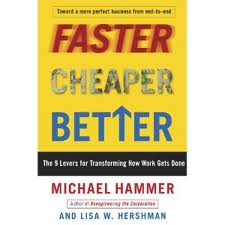
Good OM Reading: Faster, Cheaper, Better

I know I have finished a good book about OM when I see just how many pages I have highlighted in yellow marker. Faster, Cheaper, Better, by Michael Hammer and Lisa Hershman (Crown Business,2010), is such a book. Hammer, you may recall, was coauthor of the 1993 blockbuster, Reengineering the Corporation, which galvanized companies to rethink every aspect of operations. He was a rare genius, whose recent death was a major loss to our field.

Faster, Cheaper, Better focuses on end-to-end processes, how to shed tasks that don’t add value, and how to let workers make decisions. This is not a book for undergrads, but I would recommend assigning it if you are teaching a class of EMBAs.

The strength of the book is its real-world case studies (Tetra Pak, Clorox,  Gamesa, to name a few). For a quick overview, just read the 1st four chapters and some of the cases. Here are 2 good quotes:

From the Shell Oil CEO regarding the transformation process: “We are going on a journey. On this journey we will carry the wounded and shoot the stragglers”.

About the automated factory of the (near) future: “There will be only 2 living creatures in it: a man and a dog. The man’s job will be to feed the dog, and the dog’s job will be to make sure the man doesn’t touch the equipment”.

My favorite story in the book, though, is about how precisely to perform a step in a process. Hammer gives the example of hospital bills that go on for pages, with reams of line items, including such things as tissues and pills. “Pareto was an optimist”, he writes. “His 80-20 rule is really more like 95-5 for a hospital”. After Hammer finished his process analysis, the hospital stopped collecting data on, or bill for, items costing less than $25. This reduced nurse overtime, and the hospital simply averaged the misc. costs into the basic room rate.

Good OM Reading: Make It in America

Andrew Liveris’ new book, Make It in America (Wiley,2011) is certainly timely. The author, CEO of Dow Chemical, calls for  a national strategy to revive manufacturing, a plea repeated by President Obama in his State of the Union talk last night. Liveris wants the government to draw a  plan to encourage more manufacturing, to cut taxes, and to make regulations uniform, as in Europe and Asia.

No economy as large as the US can sustain itself without manufacturing, he writes. “Accepting such a future (as a nation of great innovations, and not as a manufacturing society), means accepting a level of joblessness that would make recent years look like a warmup”. This is a good point. If we look at a Top 10 of big time innovators (say Amazon, Apple, Dell, Facebook, GE, Google, HP, IBM, Intel, and Microsoft), we see they only employ an average of 61,000 workers. Since there are 29 people working at Wal-Mart and 2 at Disney for every one at a big time innovator, it becomes clear that we cannot count on innovators for job creation.

Being passive, as we have been for 4 decades, is not a growth strategy, Liveris adds. China has a strategy  to be more than the world’s low-cost toy manufacturer. Brazil is moving beyond its role as an agricultural leader. Some Americans imagine we can thrive by dreaming up new Kindles and iPods, while the Chinese make them. But when we move our capacity to make high-tech products overseas, we lose skill for whole sets of products.

Liveris gives the example of the Kindle. Amazon invented it, but couldn’t find the screen-making expertise and capacity to produce it in the US, so it went to Taiwan. He closes by writing: “Manufacturing is America’s future. Not just its past. Manufacturing is the foundation upon which our economic  prosperity, our growth and wealth and jobs depends.”

Click here to read excerpts of this excellent book.

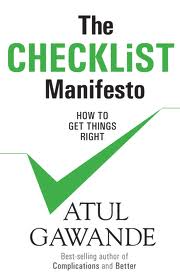
Good OM Reading: The Checklist Manifesto

Here is a popular book that deals with quality issues (Ch.6) in medicine by extolling the use of checklists. Dr. Atul Gawande’s The Checklist Manifesto: How to Get Things Right (Metropolitan Books,2009) will add to your TQM lecture with some interesting examples. Gawande points out that just as airline pilots use checklists before takeoff,  surgeons need checklists, which are proven to reduce mortality from operations.

The medical culture, unfortunately, often includes doctors who are just plain rubbed the wrong way by such a tool. Surgeons, in particular, view themselves as individuals whose skill and reputation are all that is needed in the OR. Gawande uses a WHO study to show that surgical complications dropped by more that one-third when checklists were used.

The checklists includes such items as: making sure everyone in the OR knows everyone else’s name; that blood for a transfusion is on-hand; and that the pre-op was performed correctly. Medicine, he says, has become so incredibly complex that mistakes are virtually inevitable.

The Huffington Post (Jan. 6,2011) has a quick review of the book, followed by a 6 minute video clip of Gawande being interviewed recently on the Steven Colbert show. (Note that you have to scroll down about 6″ to get to the video link). I am not a huge fan of the show, but somehow I think your students will find it hilarious. They seem to understand his humor, and at the same time, Gawande does make  his point about checklists.

Good Holiday Reading: MacroWikinomics

It’s the day after Christmas and you didn’t receive a copy of the new John Grisham novel you were hoping to find under the tree. There are 2 more weeks before classes resume and you are looking for a good book. I just finished MacroWikinomics: Rebooting Business and the World, by Don Tapscott and Anthony Williams (Portfolio/Penguin,2010,424 pp). This is an update of their best-selling Wikinomics published 4 years ago ,which predicted the mass internet-enabled collaboration that lies behind such phenomena as Wikipedia and the Linux open-source operating system.

Basically, this is a book proclaiming a new world in which innovation and problem-solving are accomplished through networked intelligence.  Tapscott and Williams use examples of real companies to illustrate the reshaping of the worlds of green energy, transportation, education, health care, media, and government. Many of these industries seem stuck in the past and unable to move forward. Yet people with drive, passion, and expertise are taking advantage of web-based collaboration to revolutionize  the way we work, learn, create, and govern.

Here are a few examples:

P&G’s  “Connect and Develop”  research project, which basically used internet connections to 200,000 scientists world-wide to get new ideas for products, paying fees from $10,000 to $2 million for over 1,000 new technologies.

An Iraq war veteran whose startup car company (called Local Motors) is “staffed” by 4,500 competing designers and supplied by factories around the world.

An on-line community for people with life -altering diseases.

An astronomer who is mapping the universe with the help of 250,000 citizen scientists.

This is not a short book, so I would recommend reading the 1st four chapters, the last 2 chapters (18 and 19), and any of the middle chapters that interest you (these talk about specific industries).  It might be worthwhile  for profs to read Ch.8’s controversial ideas about education, called “Rethinking the University: Collaborative Learning”.

If you did get the Grisham book, please send it to me when you are done and we can swap!

Good OM Reading: The Spread of Industrial Engineering in China…By an American

Most all of us know the story about how Dr. Edwards Deming became the father of quality control in Japan. With their factories and infrastructure destroyed, Deming  helped rebuild post-war Japan into the industrial powerhouse we know. Deming’s reputation is so strong in Japan that the awarding of the annual Deming Prize for quality is broadcast live on TV.

Most of don’t know, however, the story of how China’s productivity revolution began some nine years ago. The improbable tale, written in a fascinating Wall Street Journal article (Nov.6-7,2010), describes Gavriel Salvendy, a 72 year old Hungarian-Israeli-American  professor who is the father of Industrial Engineering in China. Dividing his time  between China’s MIT (Tsinghua University in Beijing) and Purdue, Salvendy tore up the traditional Chinese academic hierarchy. Now more than 200 IE programs have sprung up around China mimicking that at Tsinghua.

I hope you can take 5 minutes to click on the link to the WSJ article and enjoy it as much as I did.

Good OM Reading:Lean Hospitals

If there was ever a field in need of our knowledge, consulting, and experience as teachers in OM, it is our hospitals. If you have had the unfortunate experience of spending time in an ER, an OR, or an overnight stay, you will really appreciate this book.

Or if you are just  looking for great examples of OM and TQM in the health care field, I highly recommend it. Lean Hospitals, by Mark Graban (Productivity Press, 2009, 252 pages) is simply excellent. Each chapter is full of stories and data you can use in class. Graban describes, in real hospitals, how lean improves patient outcomes, increases employee and physician satisfaction, all while saving money.

Lean is not new in hospitals, as Graban traces auto production methods back to a Michigan hospital in 1922.

Chapters 1 and 2 are introductory, Chapter 3 deals with Value and Waste, Chapter 4 with Value Streams , Chapter 5 with Standardized Work, Chapter 6 with Visual Management, 5S and Kanban, Chapter 7 with Root Causes, Chapter 8 with Error Proofing, Chapter 9 with Improving Flows, and Chapter 10 with Engaging Employees.

I found myself taking notes in every chapter. Graban’s writing style makes this a very readable book. Mark also keeps a  useful web site  that is worth visiting.

Good OM Reading: A Start Up Nation

I just finished a book that is a bit outside my usual OM-oriented reading.  Start-Up Nation (by Dan Senor and Saul Singer, Twelve, 304 pages) is about the entrepreneurial nature of the State of Israel.  I had co-founded the Rollins College Center for Entrepreneurship about a decade ago, so this is a topic of personal and academic interest.

          The authors describe Israel as the world’s “techno-nation”, a tiny state torn by war that attracted as much venture capital in 2008 as Germany and France combined.  In 2009, there were 63 Israeli firms on NASDAQ, more than any foreign country.

          So why did Cisco buy nine Israeli start-ups?  Why did British Telecom put up a $3.5 billion plant to make chips?  And why did Buffet pay $4 billion for part of a high-tech tool maker?  The authors’ answer:  The culture of the military.  “You have minimal guidance from the top,” they write.  “It’s the leadership, teamwork, and mission oriented skills and experience Israelis receive.”  Ever soldier is expected to improvise, even if this means breaking some rules.

          An easy, one day read that can help us be better, more innovative managers