OM in the News: A Devastating Fire at a Major Ford Supplier

A late-night fire leveled a key part of a New York aluminum plant in hours. Its absence is going to disrupt business at Ford Motor  and other automakers for months to come.

The plant’s operator, Novelis, supplies about 40% of the aluminum sheet used by the auto industry in the U.S. Novelis said a major portion of its Oswego, N.Y., plant has been knocked offline until early next year.
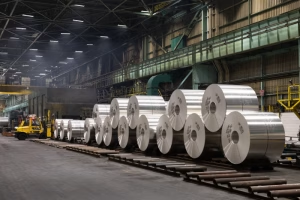
Novelis produces more than 350,000 metric tons of sheet aluminum annually for the automotive industry

Ford is the biggest user of the plant. Its F-150 pickup, the top-selling vehicle in the U.S. and the automaker’s main profit driver, is one of the industry’s biggest users of aluminum, writes The Wall Street Journal (Oct. 7, 2025). The setback is severe.

“This represents a serious question for the production of F-150 because that’s the aluminum that comes out of Oswego,” said an industry analyst. Ford switched the F-150’s exterior to aluminum from steel a decade ago.

“Since the fire nearly three weeks ago, Ford has been working closely with Novelis, and a full team is dedicated to addressing the situation and exploring all possible alternatives to minimize any potential disruptions,” stated Ford.

It is the latest supply-chain snafu for the global auto industry, roiled in recent years by trade wars, a global semiconductor shortage and a potentially crippling reliance on China for rare-earth magnets used in vehicles.

Though automakers and other major industrial manufacturers worked to diversify their supply chains in the wake of the coronavirus pandemic, which shut off access to Chinese factories, companies often remain largely dependent on one or two makers for critical parts because of the high cost tied to employing multiple suppliers.

 Around a dozen automakers get aluminum from Novelis, including Ford, Toyota, Hyundai, Volkswagen and Jeep maker Stellantis.

Classroom discussion questions:

  1. Which tool(s) in Supplement 11 could be used by Ford in this situation?
  2. What do other major car manufacturers do ?

OM in the News: EV Jitters Over a Rare Earth

Mining of rare-earth minerals in China

Caught in the middle of the U.S.-China trade war is a paper clip-size magnet that is vital to every new electric vehicle on the road. The magnet is made with dysprosium– a rare-earth mineral. More than 90% of refined dysprosium comes from China, and it is used in magnets that power everything from medical equipment to EV motors. (The magnets are used in the spinning portion of the EV motor that turns the wheels).

In its retaliation against U.S. tariffs, China slowed exports of several rare-earth minerals and magnets this month, setting off a panic among U.S. automakers. Rare earths, by the way, are used in almost everything that turns on. So far no other country has been able to produce them at the same scale and cost as China.

“You cannot build the motor without the magnet. If we want electric-vehicle production to continue to happen in the U.S., this has to be solved,” said one auto exec. Nearly 900,000 EVs were built in the U.S. last year.

The minerals are abundant in nature but difficult to refine into their pure form. They are the essential building blocks of much of modern technology, forming parts of everything from satellites and jet fighters to CT scanners and iPhone speakers.

The potential chaos related to the slowing of one link in the automotive supply chain illustrates how dependent the modern car industry is on global trade, writes The Wall Street Journal (April 28, 2025).  America’s disadvantage is twofold: There is currently only one large-scale dysprosium mine in the U.S., and processing facilities are only now coming online. The development of a new mine takes an average of 29 years in the U.S.

China’s head start on mining and extracting the precious elements makes it difficult to build alternative sources. A mine in China, to produce from an ore to oxide, costs $11 to $15 a kilogram. For a mine in Brazil, it’s $35 to $40 a kilogram, and even higher in the U.S. or Australia.

Classroom discussion questions:

  1. Why are rare earths so important? Name several products that require them.
  2. What are the alternatives that U.S. auto supply chain managers have?

OM in the News: EV Supply Chain Headaches

Makers and suppliers of electric cars are dealing with diminishing cash and weak sales. Hurdles are ripping through the automotive supply chain, crunching demand for batteries and materials such as lithium that power them, reports The Wall Street Journal (Dec. 1, 2024). “It’s a whole ecosystem that is collapsing. It’s just a disaster out there with consumer demand going down,”  said the CEO of a clean-energy investment bank.

Rivian, which has burned through more than $19 billion since 2021, is facing a shortage of copper wiring for its electric motors, which caused it to slow or shut down assembly lines

Several high-profile companies, including electric SUV maker Fisker, bus manufacturer Arrival, and Swedish-based battery maker Northvolt recently filed for bankruptcy. At least a dozen other startups, specializing in EVs or batteries, are also at risk.

Many of these young companies have been hammered by cooling demand for EVs, rising costs and supply-chain obstacles that have hindered their ability to put out new products quickly. And established Western automakers such as Ford and GM, which have pledged billions of dollars to expand their EV lineups, are now delaying or pulling back some future investment as sales haven’t materialized.

Northvolt was among the industry’s most stunning implosions. The startup, which sought to make batteries with a lower carbon footprint, had raised $15 billion from backers including VW and Goldman Sachs. But the weakening EV market resulted in BMW cancelling a major order.

 Li-Cycle Holdings, a firm that has promised to turn recycled batteries into useful materials, had an approved $475 million government loan to help build out a plant in Rochester, N.Y. But it now only has enough cash on hand to sustain operations through March, 2025 and has paused construction on the factory.

Electric truck maker Canoo is also burning through cash and has laid off a quarter of its workforce in Oklahoma. It had received a $113 million incentive package from the state to create 1,300 jobs at its vehicle and battery plants and had promised to quickly hit $1.4 billion in revenue this year.  “It feels like being punched in the face every morning trying to develop vehicles that have all their components for so long been outsourced to China,” said Canoo’s CEO.

Classroom discussion questions:

  1. What issues are EV component suppliers facing, and how can they deal with them?
  2. What are the implications for operations managers?

OM in the News: Retreating EVs and the Impact on Supply Chains

“Ford Motor’s decision this week to kill a highly touted future electric vehicle is a sign that the industry’s pullback on EVs is deepening,” writes The Wall Street Journal (Aug. 23, 2024).  It is canceling plans for an electric SUV once touted as a “personalized bullet train.” The move added to the drumbeat of news from carmakers of delayed or scrapped investments into EV models, factories and battery projects.

Dealers’ lots are getting pretty crowded as EVs from Tesla, Ford, Mercedes, and more fail to move.

GM, VW, Mercedes and other automakers also have curbed their EV ambitions in recent months. Taken together, the walked-back plans are an acknowledgment that the big investments outlined at the start of the decade got ahead of the consumer’s appetite for a full switch to EVs.

Delaying some EV investments will conserve cash and buy automakers time to lower their battery costs and other EV-related expenses.  EV startups including Rivian, Lucid and Polestar are laying off workers, and Fisker has declared bankruptcy.

But cuts to planned EV output have hurt the parts supplier base, which has had to adjust its business. Magna, one of the world’s largest auto-parts suppliers, had been gearing up to make battery trays, seats and other parts for Ford’s now-scrapped electric SUV. Dana, another large supplier serving Ford and Stellantis, had expected sales of battery-cooling systems and other EV-related components to jump by 1/3 this year. “Like most things that are new or disruptive, a lot of times forecasts and expectations can get ahead of some of the practicalities,” said Dana’s CFO.

The cost of batteries is so high that most big automakers are in the red on their electric offerings. Ford’s EV business is on pace to lose $5 billion this year, with losses averaging $44,000 per electric vehicle sold!

Instead of offering the electric SUV, Ford plans to produce hybrid, gas-electric versions. It also delayed for a second time the opening of a new EV truck factory, the largest investment in its history, which is now set for a 2027 opening, two years later than initially planned.

New emissions rules from the Biden administration will in effect require a heavy dose of EVs in the late 2020’s. To comply, automakers will need to introduce more plug-in hybrid vehicles. Car companies are likely to focus on fully electric systems for small- and midsize vehicles, and hybrids for larger ones.

Classroom discussion questions:

  1. Why has the shift to EVs cooled?
  2.  What is the impact on 1st and 2nd tier suppliers?

OM in the News: The UAW Strike and Supply Chain Tiers

As the United Auto Workers strike continues, risks of disruption are compounding for automotive supply chain managers, reports Supply Chain Dive (Sept. 20, 2023).

The union has already idled production lines at three plants in response to failed negotiations with Ford, GM and Stellantis. As the UAW threatens further work stoppages, supplier health may be at risk.

“Depending on how deep this strike goes, it can be really challenging for the suppliers to stay afloat. Risk is particularly focused on the Tier 2 and Tier 3 suppliers,” said one industry expert. He added: “Tier 1 firms should be talking to downstream suppliers, asking: ‘How are your financials? When we do get out of this, are you going to be able to ramp back up?’”

To be proactive, supply chain managers can streamline various processes which include order intakes, raw material and labor planning.

Order cancellations from the affected assembly plants can bottleneck the entire supply chain. Suppliers can continue to build parts regardless of canceled orders, but if the customer refuses to accept deliveries, then suppliers need to pay to store those parts. Demand for the parts and materials will decrease or even cease as the automakers cancel firm orders for parts and future orders in the coming weeks and even months, depending on the duration of the strike.

As a result, the supply chain will likely feel lingering impacts even when the strike eventually ends. For instance, suppliers who may have furloughed workers might take a while to get operations up and running. If more automaker plants get impacted, downstream suppliers may need to reboot their systems.

Ripple effects will move across the entire supply chain. Tier 1 suppliers with strong balance sheets will be fine. But Tier 2 and Tier 3 suppliers may struggle with cash flow as orders are canceled. Secondary effects are already being seen. GM is temporarily laying off employees at its Fairfax plant — which is not included in the first wave of strikes — as that facility’s operations are disrupted from a lack of stamping parts from the Wentzville facility, which is on strike. While supply chain managers may be able to keep things moving, operations get tricky if the UAW goes after engine plants. Shutting down plants where engines are built will cripple other plants across the U.S., Canada and Mexico.

Classroom discussion questions:

  1. What are Tier 2 and Tier 3 suppliers? Give an example of each.
  2. What are the issues underlying the UAW strike?

OM in the News: EV Plans Hinge on Made-in-America Batteries

Companies and the U.S. government are shelling out billions of dollars to establish a supply chain for batteries in North America, a manufacturing effort that is critical to the auto industry’s long-range plans to put more electric vehicles on the road.

Batteries are the most expensive component in an electric vehicle, accounting for about one-third of its cost, reports The Wall Street Journal (Feb. 7, 2023).

Lithium, produced at this site in Nevada, is among the minerals that are crucial battery components.

American electric-car makers traditionally haven’t assembled batteries themselves. They rely on a far-flung supply chain. The raw materials are mined primarily in countries such as Australia, China, Congo and Indonesia. Chemical processing, battery components and assembly are mostly done by Chinese companies.

A recently passed law provides incentives for North American-built batteries and penalizes car companies that source batteries abroad, is spurring a wave of new projects in the U.S.—from cell-making factories to new ventures to mine the raw materials.

The U.S. also announced awards totaling $2.8 billion to about 20 companies in more than 10 states to help expand domestic manufacturing of batteries for electric vehicles and the electrical grid. The money will go to projects that process lithium, graphite and other battery materials, manufacture components and demonstrate new approaches, such as producing components from recycled materials. The projects will specialize in building up the supply of particular materials and components, with a goal of lowering U.S. battery manufacturers’ reliance on foreign supply chains.

Assembling the battery cells that are embedded in vehicles is only one part of a process that typically involves multiple companies and can be geographically dispersed across continents. In the first step, mining companies extract raw materials such as lithium, nickel and other minerals, which have risen in value as demand for green energy grows. Then, other companies—often in other countries—process the minerals. Next, other specialized companies build components such as anodes, cathodes, separators and electrolytes. A fourth step involves the production of battery cells that house the components, including electronics and sensors that help manage a battery. These specialized companies that make components such as anodes and cathodes are crucial to the industry’s growth in the U.S.

Classroom discussion questions:

  1. Why is the transition to U.S. production of batteries slow and expensive?
  2. Why does the E.U. oppose “made in the U.S. ” battery limitations?

OM in the News: Is the EV Supply Chain Ready?

“The car industry is staging a revolution,” writes The Wall Street Journal (Nov. 14, 2022)—a transition from the gas engines that have powered vehicles to a battery-propelled future.  But a key part of the reinvention remains unfinished and filled with risk: the supply chains for the parts needed to assemble electric vehicles.

The guts of EVs— batteries, electric motors and the electronics that mesh them together—are nothing like the engine blocks, transmissions and drive shafts that move today’s cars. “This industry is going through a transformation like it hasn’t seen since World War II. The whole supply structure is going to change,” says an industry expert.

On the upside, EVs require vastly fewer parts: An EV motor has only about 20 moving parts, compared with 200 in an internal combustion engine. Yet the industry is young, and finding reliable sources for EV parts is daunting.

Some pinch points: The batteries and most of the EV motors rely on unusual metals that can be costly and hard to obtain. The vehicles’ electronics require new chips from a semiconductor industry still working through pandemic-era backlogs. (EVs require more than twice as many chips as internal-combustion vehicles— 1,300 versus 600). Even the aluminum trays that hold batteries beneath the floors of electric vehicles can be scarce. There are supply chains within supply chains.

One of the biggest potential problems is finding sufficient and affordable supplies of key raw materials, including lithium, nickel, manganese and cobalt. Much of the mining and processing of these metals is based in just a few countries. Two-thirds of cobalt is mined in the Congo, where workers face dangerous conditions. Australia mines about half the lithium, while nickel is centered in Indonesia. The refining of these materials for use in batteries is even more concentrated: China processes 70% of the world’s lithium and cobalt, and 99% of the manganese.

Some car makers are already predicting battery shortages. “Put very simply, all the world’s battery cell production combined represents well under 10% of what we will need in 10 years,” says the CEO of Rivian Automotive. He added that “90% to 95% of the battery supply chain does not exist.”

Finally, the majority of motors used in today’s EVs rely on permanent magnets which require costly rare-earth metals. The dominant supplier is again China, and producing the metals can cause pollution and environmental damage.

Classroom discussion questions:

  1. What positive supply chain issues does the EV industry expect?
  2. What supply chain constraints are expected and how will they be addressed?

OM in the News: Finding an Airbag in Russia

Western sanctions brought Russia’s car industry to a screeching halt earlier this year, writes The Wall Street Journal (Nov. 1, 2022). As it restarts, it is emerging smaller, technologically backward and more isolated—a foreshadowing of what could be in store for the rest of the embattled Russian economy.

Within weeks of Russia’s invasion of Ukraine, most Western car companies curtailed operations in the country. Sanctions cut off the supply of parts and, one after another, Russian car plants stopped production, with car production down 97% compared with a year ago. But as some Russian plants are now reopening, the restart features cars that were a far cry from prewar models, lacking air bags, anti-lock braking-system sensors or electronic stability-control technology, an industry standard.

Russia’s biggest carmaker can’t find airbags

“Such key factors of a modern car as an automatic transmission, four-wheel drive and a modern engine— but these tasks can’t be solved quickly and require serious funding,” said the CEO of AvtoVAZ, maker of the iconic Russian Lada auto brand. Lada workers wrote that their plant couldn’t restart due to the lack of components. At the moment, Russia’s best car is only 40% Russian. The rest used to be imported from abroad.

The auto industry is shaping up to be an early test case for how successfully Russian industry can recover from the greatest shock to the country’s economy since the dissolution of the USSR. Russian executives are scouring other countries for missing Western components or trying to produce them at home, a process that can take years to master. Meanwhile, they are producing cars partly based on designs decades old.

 The war is undoing decades of Western investment and know-how, heralding a period of adjustment ahead across industries. “The impact on the industry will be indicative of what awaits other sectors of the Russian economy: less technologically advanced products, poorer quality and a limited variety of goods,” said an expert in London.

To resume production of cars with anti-lock brake systems next year and electronic stability control by 2024, AvtoVAZ will need to develop its own homegrown technological capability. The development of an automatic transmission will cost about 30 billion rubles, while creating an all-wheel drive system for cars will cost another 20 billion rubles. Locked out of their main suppliers, like Bosch in Europe, Lada is turning instead to Chinese suppliers, but Chinese versions aren’t expected until next year.

Classroom discussion questions:

  1. In Chapter 2 (see page 33) we list 6 reasons businesses globalize. How does each of these apply to the Russian auto industry today?
  2. What should Lada do at this point?

OM in the News: The Looming Electric-Vehicle Battery Shortage

 The auto industry could soon face a shortage of battery supplies for electric vehicles—a challenge that he says could surpass the current computer-chip shortage, reports The Wall Street Journal (April 18, 2022). Car companies are trying to lock up limited supplies of raw materials that are key to battery making, and many are constructing their own battery plants to put more battery-powered models in showrooms.

A Rivian truck being assembled at the company’s factory in Normal, Ill.

Rivian’s CEO  states: “All the world’s cell production combined represents well under 10% of what we will need in 10 years. Meaning, 90% to 95% of the supply chain does not exist.” His comments are the latest alarm bell to go off across both the auto and battery sectors as the fast-rising demand for EV parts and a shortfall of critical materials and production could result in an acute supply crunch. (Rivian is sharply curtailing factory output this year, cutting its forecast in half to 25,000 vehicles because of constraints on getting parts and materials).

Building enough batteries will be among the biggest hurdles in trying to boost EV sales from a few million today to tens of millions within the decade. The shortages will occur everywhere from the mining of raw materials, to processing them, to building the battery cells themselves. Already, demand for lithium-ion batteries, which are the core power source for EVs, has surged to 400 gigawatt hours in 2021—up from 59 gigawatt hours in 2015—and it is expected to jump another 50% in 2022.

The semiconductor shortage that is disrupting the auto industry was a relatively small supply-demand imbalance that then led to aggressive overbuying and stockpiling, putting the car sector in the difficult position it is in now. With batteries, the problem is expected to be much, much worse.

The race to secure raw materials is growing increasingly competitive, in part because they are becoming more costly for battery makers. Raw materials account for 80% of the cost of a battery, up from 40% in 2015. Materials for the battery cathode, such as lithium, cobalt and nickel, have gained about 150% in the past year. Some companies, such as GM, are joining with mining firms to secure access to critical ingredients such as cobalt and lithium. Others are bringing more of their battery-cell production in-house, aiming to have more control over this core component for EVs.

Classroom discussion  questions:

  1. What can Rivian’s operations managers do to secure more battery cells?
  2. What are the major OM issues facing EV makers?

OM in the News: GM’s Strike and the Auto Supply Chain

Companies that supply parts to General Motors are being forced to idle plants and lay off workers, as a result of the national strike called by the United Auto Workers. Nearly 46,000 GM workers walked off the job last week after the UAW and GM were unable to agree on a new 4-year labor agreement. The strike is now the longest nationwide strike against GM since the 1970s.

By stopping all production at GM’s U.S. plants, the strike is also beginning to affect the web of manufacturers that produce parts that go into the company’s cars. With no vehicles being made, those companies can do little but wait until the strike ends. Every automotive assembly job impacts between 5 and 8 other jobs, reports The Wall Street Journal (Sept. 20, 2019). The companies most affected so far are those that operate on a “just-in-time” basis, delivering difficult-to-ship parts like seats and door panels to GM’s assembly plants from factories located nearby.

At least three companies around Lansing, Mich., have shut down their plants that supply the two GM assembly plants nearby. Already there are signs that the work stoppage is rippling beyond just those nearby plants and into the broader automotive supply chain. A typical finished vehicle is made from roughly 30,000 individual parts manufactured by hundreds of different companies, and companies that provide products to GM will themselves have networks of suppliers.

The strike is having cross-border implications as well. GM laid off 1,200 workers at an assembly plant in Oshawa, Ontario, on account of a shortage of necessary parts that would come from the company’s U.S. plants. In the U.S., given the importance of the automotive supply chain to the country’s Midwest, a prolonged strike of more than a month could have serious implications for the region’s economy.

Classroom discussion questions:

  1. What are the OM implications of a long strike?
  2.  Which suppliers are most affected?