OM in the News: A Restaurant Without Servers, Registers or Visible Cooks

Eatsa is aiming for a more efficient and less expensive experience like the automats found in Japan and Europe (and like the old Horn & Hardart automats in NYC, which closed in 1991).

There’s a new quinoa restaurant in San Francisco, one where customers order, pay and receive their food and never interact with a person, writes The New York Times (Sept. 9, 2015). The restaurant, Eatsa, the first outlet in a company with national ambitions, is almost fully automated. There are no waiters or even an order taker behind a counter. There is no counter. There are unseen people helping to prepare the food, but there are plans to fully automate that process, too, if it can be done less expensively than employing people. Whether a restaurant that employs few people is good for the economy is another question. Restaurants have traditionally been a place where low-skilled workers can find employment.

Automation is transforming every industry. Business owners look to substitute machines for human labor. It happened to blue-collar workers in factories and white-collar workers in banks and even law firms. With self-driving vehicles, it may happen in the taxi and trucking industries. Robots are expected to transform health care. Automation is already part of many restaurants. Reservations are made online, orders arrive at the kitchen electronically, and bills are paid with a swipe on an iPad. Chains like Chili’s use tablet computers for ordering and paying, to speed the process and cut personnel costs.

Eatsa is one more example of how rapidly machines have moved beyond routine jobs like clerical and manufacturing work to knowledge jobs and service jobs — like waiting tables.  “The objective is over time we want to automate more and more to increase speed and reduce cost, so we create a food product that’s much cheaper and also happens to be healthy,” said the founder. “By not hiring people to work in the front of the restaurant,” he said, “they save money on payroll and real estate.”

Classroom discussion questions:

  1. What are the advantages and disadvantages of Eatsa‘s approach?
  2. What technologies do other restaurants use already?

OM in the News: Worker at Volkswagen Plant Killed By Robot

robot A technician was killed by a robot at a VW plant in Germany yesterday, reports The Financial Times (July 2, 2015), in a rare accident that touches on concerns about the spread of automation and its impact on jobs. The 21-year-old was installing the machine when he was struck in the chest by the equipment and pressed against a metal plate. The fatality comes as concerns spread about the effects of automation, including fears about whether robots can be controlled when they become more intelligent than humans.

Deaths in factories caused by automated equipment date back decades, but robot-related fatalities are rare as heavy robots are kept behind safety cages to prevent accidental contact with humans. In this incident, the worker was standing inside the safety cage when the accident occurred. VW said the robot did not suffer a technical defect. The machine was not one of the new generation of lightweight collaborative robots that car manufacturers are installing to work alongside workers. Collaborative robots do not have a safety cage but their force and speed can be limited by the way they are built. They also have sensors to detect human movement. Some are also designed to stop if a human gets too close.

VW said last year it planned to use more robots to cope with a shortage of new workers as baby boomers retire in coming years. These robots would take over monotonous tasks, while humans would focus on more highly skilled jobs. The car industry has by far the highest density of robots, but such automation is increasing rapidly in other industries as their cost falls and capabilities increase.

Fatality rates in manufacturing are below the average for the economy as a whole, and have been falling as automation has increased. There were 2.1 fatal injuries for every 100,000 full-time equivalent employees in manufacturing in the US in 2013, down from 2.7 in 2006. (It is about 8 times more dangerous to work in a bar  where the fatality rate there is 16.4 deaths per 100,000 employees.)

Classroom discussion questions:

1. Why are robots an important part of production at VW?

2. What is a collaborative robot?

OM in the News: OM Technology Makes for Happier Diners

Making the list of “Most Innovative Companies” at FastCompany (March, 2015) are two firms whose goals are to make for happier diners. Here is how E la carte and Panera Bread won the recognition:

 fast company 1E la Carte

For selling restaurants on an upselling machine.

E la Carte offers a quick tech solution for any restaurant: a tablet at each table, which it sells or charges a fee to operate. Johnny Rockets, Applebee’s, Genghis Grill, and other chains embraced it after they saw happy customers tapping away and ordering more. (1) Tap to eat. Customers order food on the tablet–and then some. Checks are an average of 25% higher. (2) Wait and play. Diners can play trivia or memory games, or add music to the restaurant’s communal queue. (3) Pay and leave. No checks. Johnny Rockets says the tablets helped cut bill paying from 8 to 2 minutes.

fast company2Panera Bread

For using tech to improve everything–including the food. The $4.5 billion soup-and-sandwich chain is rolling out what it calls Panera 2.0 to all of its 1,845 North American locations. It’s an Internet of Things reboot, with new ways to order and a kitchen that’s updated to manage more customized orders. (1) Order in advance. Place an order via app up to 5 days in advance, then grab the food from a designated shelf. (2) Food finds you. An RFID system identifies where diners are seated, so employees can easily deliver food to them. (3) Make a meal. Order at kiosks (or Panera’s app), where food is customizable and preferences are stored.

Classroom discussion questions:

1. How do these two technologies differ? Are similar?

2. In what other ways can technology be used in restaurants?

OM in the News: Jobs and the Clever Robot

robot graph“From steam engines to robotic welders and ATMs,” writes The Wall Street Journal (Feb. 25, 2015), “technology has long displaced humans—always creating new, often higher-skill jobs in its wake.” But recent advances—everything from driverless cars to computers that can read human facial expressions—have pushed experts to look anew at the changes automation will bring to the labor force. They wonder if automation technology is near a tipping point, when machines finally master traits that have kept human workers irreplaceable.

In the Australian Outback, for example, mining giant Rio Tinto uses self-driving trucks and drills that need no human operators at iron ore mines. Automated trains will soon carry the ore to a port 300 miles away. The Port of Los Angeles is installing equipment that could cut in half the number of longshoremen needed in a workplace already highly automated. Computers do legal research, write stock reports and news stories, as well as translate conversations; at car dealers, they generate online advertising; and, at banks, they churn out government-required documents to flag potential money laundering—all jobs done by human workers a short time ago.

Bill Gates said last year that automation threatens all manner of workers, from drivers to waiters to nurses. Gartner, the technology research firm, has predicted 1/3 of all jobs will be lost to automation within a decade. And in 2 decades, forecast Oxford University profs, nearly 1/2 of the current jobs will be performed with machine technology.

The first time automation spawned fears of a jobless future was in the 19th century, when English textile workers attacked the first mechanical knitting machines. They were right to fear the contraptions, which eventually replaced them. Some new machines are so efficient they push down prices and create more demand—which in many cases spawns more jobs, not fewer. The invention of the automobile threw blacksmiths out of work, but created far more jobs building and selling cars. Displaced workers with obsolete skills are always hurt. but the total number of jobs has never declined over time.

Classroom discussion questions:

1. What fields do you think will be most impacted by robots/automation in this decade?

2. Will jobs decline?

OM in the News: Cows Now Milk Themselves With Farm Robotics


Robotic milker at a NY farm

Something strange is happening at farms in upstate New York, reports The New York Times (April 23, 2014). The cows are milking themselves. Desperate for reliable labor and buoyed by soaring prices, dairy operations across the state are charging into a brave new world of udder care: robotic milkers, which feed and milk cow after cow without the help of a single farmhand. The view is improved as well. “Most milking parlors, you really only see the back end of the cow,” says one farmer. “I don’t see that as building up much of a relationship.”

The cows seem to like it, too. Robots allow the cows to set their own hours, lining up for automated milking 5 or 6 times a day — turning the predawn and late-afternoon sessions around which dairy farmers long built their lives into a thing of the past. With transponders around their necks, the cows get individualized service. Lasers scan and map their underbellies, and a computer charts each animal’s “milking speed,” a critical factor in a 24-hour-a-day operation. The robots also monitor the amount and quality of milk produced, the frequency of visits to the machine, how much each cow has eaten, and even the number of steps each cow has taken per day.

Farmers say the machines allow them to do more of what they love: caring for animals. “I’d rather be a cow manager, than a people manager,” adds a farm owner. The machines cost up to $250,000 for a unit that includes a mechanical arm, teat-cleaning equipment, computerized displays, a milking apparatus and sensors to detect the position of the teats.  Some owners expected a dip in production as their cows got used to the machines. But the cattle were quick learners. “It just clicked,” said one. “One day we came in and they had started milking themselves.”  We think your students will enjoy this very down-to-earth 3 minute video embedded in the article.

Classroom discussion questions:

1. Why is this an OM issue?
2. What other technologies noted in Chapter 7 can be employed in this industry?

OM in the News: The Changing Workforce

jobsIN 1930, John Maynard Keynes worried of a new disease: “technological unemployment…due to our discovery of means of economizing the use of labor outrunning the pace at which we can find new uses for labor.” Now, 2 Oxford professors are arguing that jobs are at high risk of being automated in 47% of the occupational categories into which work is sorted. That includes accountancy, legal work, technical writing and a lot of other white-collar occupations.

Automation processes have steadily and relentlessly squeezed labor out of the manufacturing sector in most rich economies, writes The Economist (Jan. 18-24, 2014). As we note in Chapter 1, the share of U.S. employment in manufacturing has declined sharply since the 1950s, from almost 30% to less than 10%. At the same time, jobs in services soared, from less than 50% of employment to almost 70% (see chart). It was inevitable that firms would start to apply the same automation to service industries.

jobs2The case for a highly disruptive period of economic growth is made by MIT profs in “The Second Machine Age.” Like the first great era of industrialization, they argue, it should deliver enormous benefits—but not without a period of uncomfortable change. They write that the amount of progress computers will make in the next few years will equal to the progress they have made since their very beginning!

The combination of big data and smart machines will take over some occupations wholesale; in others it will allow firms to do more with fewer workers. Some jobs—especially those currently associated with high levels of education and high wages—will survive (see table). Rich economies seem to be bifurcating into a small successful group of workers with skills highly complementary with machine intelligence, with the rest of workers less successful.

Classroom discussion questions:

1. In what service jobs will automation be a major factor?

2. Will manufacturing reverse its downward slope of employment?

OM in the News: Eliminating the Waiting Line at Hotel Check-In

Concierge registering guest at Andaz West Hollywood

Hotels are changing the way guests check in to their rooms, writes The New York Times ( March 19, 2013), eliminating the traditional stop at the front desk to speed up, simplify and personalize the process. When guests arrive at citizenM, a boutique European hotel chain, they check in at a kiosk and go straight up to their rooms. The kiosk was designed to be easy to use because most travelers are encountering it for the first time.

“The hospitality industry is moving toward more automated check-in systems,” says NCR’s VP for kiosk systems. “Customers are used to A.T.M.’s at the bank instead of tellers, checking in for airplane flights online, and they are now looking for that same efficiency when they arrive at a hotel. No one wants to wait in line for the front desk anymore”.

Automated hotel check-in is expected to expand rapidly. In a typical system, guests check in by computer or phone before they arrive and enter their expected arrival time, which helps the housekeeping staff with the room cleaning schedule. A bar code is sent to the traveler to print out or display on his or her phone. At the hotel, the guest scans the bar code at a kiosk. The machine assigns a room and spits out the number of plastic key cards requested, and the guest can head upstairs.

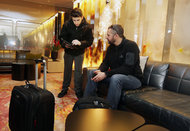
Hotels are also using new technologies to eliminate the front desk check-in line — with personal greeters who shepherd guests through the check-in process in a more comfortable setting. Andaz West Hollywood has combined its front desk staff, bellmen and concierge functions into “hosts,” who greet guests as they enter the lobby and sit with them on comfortable couches to check in using an iPad with a credit card reader.

This article is a nice complement to the Winter Park Hotel case study in Module D.

Discussion questions:

1. What is the benefit to hotels in implementing kiosk check-in?

2. Will these systems be widespread in a few years?

OM in the News: More Jobs For Machines–Less For People

Yesterday’s New York Times (Oct.24,2011) reports that a faltering economy explains much of the job shortage in America, but advancing technology has sharply magnified the effect . “Many workers are losing the race against the machine”, state two MIT researchers. Adds the current issue of the McKinsey Quarterly: “Technology is quickly taking over service jobs, following waves of automation of farm and factory work. This last repository of jobs is shrinking–fewer of us in the future may have white-collar business process jobs”.

Technology in production and  services is an important topic in Chapter 7, and this Times article can contribute to your class discussion of the issue. The MIT profs argue that the pace of automation has picked up in recent years because of robotics, NC-controlled machines, computerized inventory control, voice recognition, and e-commerce. Their new e-book, “Race Against the Machine”, states that automation is moving rapidly beyond factories to jobs in call centers, marketing, and sales, which are the parts of the service sector providing most jobs in the economy.

Since the recession started , corporate spending on equipment and software has increased 26%, while payrolls have been flat. Corporations are expected to report record profits of $927 billion this year, a 50 year high.

But technology has always displaced some work and jobs. As early as 1930, the economist John Maynard Keynes warned of a “new disease” that he called “technological unemployment”, the inability of the economy to create new jobs faster than jobs were lost to automation. Yet computers tend to be narrow and literal-minded, good at assigned tasks, but low at intuition and creativity. The key, writes the Times, “is not to compete against machines but to compete with machines”.

Discussion questions:

1. Is this a major change in business, or just a slow, continuing trend towards automation?

2. Do students believe that less and less service-oriented jobs will be available to them?

OM in the News: The Rise of the (Orange) Warehouse Robot

If you remember back a decade ago, the e-grocery firm Webvan outfitted warehouses with 4.5 mile long mazes of conveyor belts and carousels meant to sort, box, and deliver groceries. The idea and company was a bust, going belly up in 2001. But its founder, Mick Mountz, decided  that what was missing was robots. So in 2003, he founded Kiva Systems to provide warehouses so automated that any e-commerce firm could compete with Amazon. “Now you can get  Amazon in a bottle”, says Mountz. “Everyone can have what Amazon has”.

According to this week’s Businessweek (Nov.10,2010),Kiva’s technology provides the backbone of Diapers.com, Zappos.com, and a dozen other retailers. Its squat orange robots scurry around warehouses and bring shelves of clothes, car parts, electronics, or whatever the product, to packing stations. There, humans pack and ship. The cheapest system ($1 million), comes with 30 robots and 2 packing stations. Most systems cost $4-6 million.

 Kiva  integrates with existing inventory management software and is smart enough to continuously reorganize inventory based on order flow. If there is an uptick for one SKU, the robots place that item closer to workers.

Here is an entertaining 4 minute video of the robots at work.

Discussion questions:

1. Why did Webvan fail?

2. What did Kiva do to change warehouse management?

3. What other kinds of firms could benefit from this approach?