Guest Post: Build It and They Will Learn–Introducing OM at DePaul U.

Dr. Lori Cook is Associate Professor of Management at DePaul University’s School of Business. In her Guest Blog, she describes how important  experiential learning is to her Operations Management classes. You can see her syllabus by clicking here.

I absolutely love the first day of my OM class! As my students enter the classroom, sometimes dreading the start of a new term, I can feel the nervous energy in the air.  After teaching thousands of students, I know with certainty that from day one I need to grab my students’ attention and immediately get them to understand why OM is key to understanding business environments.

On the first day, I use the Paper Puppet activity (see Games and Exercises for Operations Management, by Heineke and Meile, Prentice Hall) to help set the stage.  Upon completion of this exercise, students have an experience they can directly relate to the challenges operations managers are forced to struggle with everyday. It can also be directly linked to the 10 critical decisions of operations introduced in the Heizer and Render OM text. Without the use of the Paper Puppet activity, the majority of the lecture would cover only the basic levels of knowledge. 

Throughout the term, I use a variety of experiential learning activities to simulate “real world” applications of OM.  Research has shown that actively involving students in demonstrations enhances their fundamental understanding of the concepts. My activities tend to level the playing field by providing students with a common understanding of the subject matter.  Each exercise is designed to either introduce or reinforce the lecture topic with the goal of enhancing overall student learning.  If you are looking for experiential activities, I would encourage you to explore the teaching briefs in the Decision Sciences Journal of Innovative Education. 

The classroom environment is a fundamental building block in the learning process. It is critical to create a classroom experience which is both engaging and enjoyable.  It must be an environment that provides motivation to assist the students in grasping the real world relevance of the material. To see fundamental change in your classroom environment, you will often have to change your process.  While most of us are fearful of change, the long-term rewards far outweigh the short-term costs.

OM in the News: How Operations Management is Helping United and Continental Merge

The “productivity challenge”  that we discuss in Chapter 1 comes to the forefront in the merger last October of two mega air carriers, United and Continental. Now the world’s largest airline (with more frequent flyer members than France has citizens), United Continental has turned to OM to lead the integration efforts. Shaving a half-cent off per-mile operating costs can boost profits by $260 million per quarter–something Wall Street was promised with the merger.

Businessweek (July 4-11, 2011) reports how “33 integration teams are making thousands of decisions, ranging from the fastest way to clean 1,260 airplanes and board passengers to which perks to offer in the frequent-flier program“. Most of the decisions are OM-related and team members come from technology, labor, fleet management, and network planning. In technology alone, the carriers have 1,400 separate systems, programs, and protocols. (Continental had 600 programs for tasks such as crew scheduling, dispatching planes, and managing cargo, while United had 800).

Economies of scale favor big airlines, but mismatches complicate every detail. Workers, for example, come from different labor unions with dissimilar work rules. United has 1st class cabins, while Continental has just business and coach. And history has not been kind. Pilots and flight attendants at US Airways (the merger of US Air and America West) are still operating under separate contracts with different pay, schedules, and work rules–6 years after their marriage!  Delta has been bogged down in a labor dispute over pay and work rules since its merger with Northwest in 2008.

That’s why United Continental execs are so focused on the minutiae of the operations integration. “It’s not important how many things come from United and how many from Continental”, says the VP-Integration Management. “Keep the emotions out of it and don’t keep score”.

Discussion questions:

1. Why does OM drive a successful airline merger?

2. Why have other mergers run into problems?

OM in the News: Obama vs. ATMs and Technology vs. Jobs

In headlines last week, President Obama linked technology to job losses when he stated:  “There are some structural issues with our economy where a lot of businesses have learned to become more efficient with a lot fewer workers. You see it when you go to a bank and you use an ATM, you don’t go to a bank teller”. The Wall Street Journal (June 22,2100), however, says: “We usually call it progress. It isn’t exactly a new phenomenon. Businesses relentlessly look for ways to replace workers with machines”.

It’s true that telephone operators lost jobs to automated switching, toll collectors are being replaced by E-Z Pass, and that auto workers lose jobs to robots. The Journal gives 2 great examples of productivity increases that benefit society with lower priced goods. The 1st is the textile industry where 50 years ago, one N. Carolina worker operated 5 machines at once, each running a thread through a loom 100 times a minute. Now machines run 6 times as fast, and one worker overseas 100 of them. That’s a 120 fold increase in productivity!

The 2nd example is how 2 workers can now manage an egg laying operation of 1 million chickens laying 240 million eggs a year. The two keep an eye on the highly-mechanized, computerized process that no one could even imagine 50 years ago.

 The result of such productivity gains is a higher standard of living for all of us, in which we work fewer hours to afford enough money to buy  a dozen eggs, a flat-screen TV, or new shoes. Our blog a few months ago discusses why productivity increases are such a plus to society.

Discussion questions:

1. How do new jobs get created to replace the old ones?

2. Why do productivity increase help our society?

OM in the News: Is the Pentagon Harming US Manufacturing?

It was easy to miss the announcement in The Federal Register (the US’s little read journal of record) that the US Air Force was asking for a waiver on the “Buy American” requirement for 37 items it needed at its Eielson  Base in Alaska. The products  included screws, ceiling fans, light fixtures, towel rods, shower rods, and handrail brackets. The Air Force got its exemption on buying American with this statement: “Extensive market research and thorough investigation of the domestic manufacturing landscape” showed these items were made almost exclusively in China.

 Is this shocking? We know that over 57,000 factories disappeared in this country between 1999 and 2009 (see Businessweek, May 9,2011). But the Pentagon may have actually accelerated this trend. According to Businessweek, flat-panel displays, machine tools, and advanced electronics and IT goods are now also obtained from non-US suppliers. Further, armor-plate steel, defense-specific integrated circuits, and night vision goggles are among the items the  DOD says it must obtain overseas. The goal of  cost-cutting has ended up increasing the military’s reliance on overseas suppliers. It may also mean the US may be opening itself to the danger that an overseas manufacturer could place a “Trojan horse” component in to critical equipment. (Does this sound  like what happened to Iran’s nuclear reactors)?

Of 16 manufacturing sectors that underpin America’s military, 13 suffered erosion between 2001-2008, as measured by decreased employment, output, and number of factories. These industries, which include foundries, forging and machine shops, have wide applications in civilian industry as well.

We all know that some decline in America’s low-end manufacturing is to be expected. Imports, for example, make up more than 95% of sales of silverware, men’s clothes, and woman’s shoes. But according to the National Research Council, “the movement of manufacturing offshore is weakening American R&D capability” in some areas.

Discussion questions:

1. How has the military affected US manufacturing, according to this article?

2. Should we be making towel bars in the US?

OM in the News: A Shortage of Factory Workers in the US?

Would your undergrad or MBA students be interested in a manufacturing job if they knew it paid $50,000-$80,000 a year? Maybe not, but such jobs are available and often unfilled. The Wall Street Journal (May 6,2011) reports that manufacturers , despite 9% unemployment rates, are struggling to find skilled workers. Large and small manufacturers of everything from machine tools to chemicals are scouring  for potential hires and poaching each other’s employees. Some are even hiring former prisoners who learned machinists skills behind bars.

Its a confluence of 3 trends, says the Journal. First, after falling for a decade, manufacturing jobs are now growing, albeit modestly. Second, baby-boomer retirements are sapping the most experienced workers (1/4 of all factory workers are 55 or older). Third, the US educational system isn’t turning out enough people with the math and science skills needed to deal with sophisticated computer-controlled factory equipment.

“We get people coming in here all the time who say ‘I can weld’. Well, my grandmother could weld”, says the Lehigh Heavy Forge Corp  HR director in Bethlehem, PA. We need “people who understand the intricacies of $1 million lathes”. Likewise, technicians at  Houston’s Bayer AG’s plant need math/science skills for such tasks as calculating the rate at which dyes need to be added for special batches of plastics. After screening, Bayer finds that few people are qualified. Some jobs at Bayer have been open 6-9 months, laments the CEO.

Manufacturers say it’s the educational system. Only about 5% of bachelors degrees in the US are in engineering, compared to 20% in Asia. In the most recent comparison of math and science test scores of 15-year olds by the OECD, American students trailed far behind those in China, Japan,South Korea, Canada, and Germany.

Discussion questions:

1. Do your students have any interest in high paid jobs running sophisticated equipment?

2. What system does Germany use (see Ch.1) that works better to fill this demand?

OM in the News: Chip Makers Bet the Farm on Future Demand

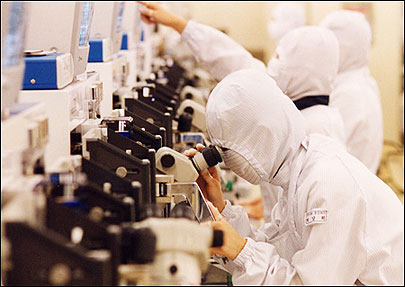
The New York Times (May 3, 2011) has just reported some good news for US manufacturing, namely, the massive expansion of chip makers who are counting on continuing heavy demand for chips in smartphones, tablet computers, refrigerators, cameras, and GPSs. Samsung, the huge Korean chip maker, is betting $3.6 billion in expanding  its US factory to make logic chips for iPhones and iPads. The plant in Austin, scheduled to be completed next month, will be 2.3 million sq.ft., about the size of 40 football fields and one of the biggest factories in the country. Samsung chose Austin because of “the infrastructure and support system here–you can’t get that from anywhere else”.

Intel, the world’s largest chip maker, is spending $13 billion to build 2 new factories and upgrade 4 others in Oregon and Arizona, with the work to be complete in 2013. “When you make an investment in a factory, you’re essentially placing a bet on a manufacturing process that’s not yet done, for products that are not yet designed,  to sell in market that is not yet there”, says Intel.

Global Foundries, a contract maker (also called a foundry) of chips, is investing $4.6 billion in a new plant near Albany, NY,  that will build 28-nanometer chips for customers. (Small companies cannot afford the $ multibillion investment in making their own). Its 1.5 million sq. ft. plant will also open in 2013. “The appetite for tablet computers is a huge part of this move” to become the biggest contract chip producer in the world, says the  Milpitas, CA, company.

The chip industry “is a risky business that’s not for the faint at heart. Its like putting down $1 billion on the craps table”, adds an industry analyst.

Discussion questions:

1. The NYT article focuses on new chip plants in the US. But chip makers are also expanding this year in China, Germany, Japan, S. Korea, and Taiwan. Why the global move?

2. What happens to plants that are out-of-date?

OM in the News: US Productivity and Some Misconceptions

President Obama recently stated that the US can out-compete any other nation on Earth if only we “unlock the productivity of American workers”. Indeed, getting more or better value for each hour worked may be the key to competitiveness, according to two McKinsey execs in today’s Wall Street Journal (Feb.16,2011). Here are 4 of their main points in addressing  common misconceptions about the importance of productivity growth:

1.The US now relies more than ever on productivity gains to drive GDP growth. Productivity generated 80% of GDP growth in recent years compared to 35% in the 1970’s. “If productivity increases at an average of 1.7% annual rate posted since 1960, annual GDP growth will fall to 2.2%, from its historic average of 3.3%. Americans on average would experience slower gains in living standards than did their parents and grandparents”, the authors write.

2. Productivity does not destroy jobs in a dynamic economy. “More than 2/3 of the years since 1929 have seen gains in both”.

3. Productivity is not just for laggard sectors and companies. “Even the best-performing companies can boost productivity by emulating the best practices of others and developing new innovations of their own”. Hospitals have just started to embrace efficient practices and lean techniques in supply chains. And boosting public-sector productivity is critical in reducing the budget deficit without slashing services.

4. Our productivity engine is not running out of steam. “By applying best practices across the economy and tapping into the next wave of innovation”, we can match historic growth rates, they conclude.

This is an important topic covered in Ch.1, but it is timely enough to discuss throughout the semester.

Discussion questions:

1. Why do some argue that productivity is a “job-killer”?

2. How did retail contribute to productivity gains in the 1990’s?

3. What happens when productivity gains fall?

OM in the News: Some Good News for American Manufacturing

Desperate for good news on the economic front, The Wall Street Journal’s  lead story (Jan.19,2011) reports that last year, manufacturing created more jobs than it lost  for the 1st time in a decade.  As our semesters begin, this is an important topic to address in class (and in Ch.1).  Indeed, this is good news as we stress how important manufacturing is for any country that expects to maintain a high standard of living for its citizens.

But before we get too carried away with projections of 300,000 new manufacturing  jobs next year, let’s remember that we lost 6 million factory jobs in the past 13 years. This puts manufacturing  jobs at about 12 million, or about 9% of all US non-farm jobs.  We also don’t  forget that  manufacturing accounts for 11% of US economic output, down from 27% in 1950. After the steep recession slump, however, we need the growth. Manufacturing  jobs pay about $22/hour, twice the average of service jobs.

The other good news is that companies are becoming more efficient, increasing productivity 7.1% from a year earlier while hours worked grew just 3%.

And yet more good news: Whirlpool just decided to spend $120 million to open a new appliance plant  in Cleveland, instead of lower-cost Mexico. (The reasons include a better trained workforce, lower freight costs, and $30 million in incentives). And Caterpillar is building a $120 million plant in Texas to produce machines currently being shipped from its plant  in Japan to N. American customers. Finally, The Journal states that Dow is building a massive new plant in Michigan to make batteries for hybrids and electric cars. Dow claims that every new job there will have a multiplier effect of 5  jobs at suppliers.

Discussion questions:

1. Why are companies starting to create new manufacturing jobs?

2. What will affect long-term growth in such jobs in the US?

3. What are the risks facing these jobs?

OM in the News: GE Decides Making Stuff is the Future

An interesting way to end this semester–or start next semester– is through a series of quotes from GE CEO Jeffrey Immelt in a major story in the New York Times (Dec.5,2010). GE, as you probably know, lost 3/4 of its market value with the recent financial crisis–hit harder than any company not in the banking sector, because of its finance arm called GE Capital. With a heritage of industrial innovation going back to Edison’s light bulb, GE lost its way to GE Capital’s cash machine that bolstered the bottom line for over a decade.

GE, according to Immelt, “must rely more on making physical products and less on financial engineering–a path that …is also necessary for the American economy as a whole.…Many bought into the idea that America could go from a technology-based, export-oriented powerhouse to a services-led consumption-based economy–and still expect to prosper. That idea was flat wrong”.

“Technology-based manufacturing of all sorts has to be the central part of reinvigorating the economy”, he adds. A White House advisory board has called for doubling US manufacturing employment, to 20% of the workforce. (Refer to Figure 1.4 and Table 1.3 in the text). GE, by the way, is the 2nd largest US exporter, after Boeing.

The products where GE has competitive advantage and a strong manufacturing presence are: next generation jet engines, power turbines, locomotives, nuclear plants, water-treatment systems, medical-imaging equipment, solar panels, and windmills. GE plans to add 4,000 manufacturing jobs in the US.

GE  is stating what is becoming increasingly obvious. We must get back to basics in this country, creating not just services, but goods as well. Nations that do not produce goods sought by others will not be able to compete in the competitive global economy.

Discussion questions:

1. What if  we do continue to become a service driven-economy, with fewer and fewer jobs in manufacturing?

2. Why the change in GE’s attitude?

3. Can we ever revert to making most of the goods we consume, or will China be our biggest supplier for decades to come?

OM in the News: Starbucks’ Lean Teams Slowing Down

I always like to use Starbucks examples in class. Its the kind of “hip” company that students can relate to. Over the past few years , Starbucks has been applying lean manufacturing techniques to study every move its baristas make in order to shave seconds off each order. Chapter 1 in our text has an OM in Action box describing these productivity improvements.

But The Wall Street Journal (Oct.13, 2010)  just reported that Starbucks now wants to reign in its baristas, an act that will result in longer lines and waits.   Baristas are being told to stop making multiple drinks at one time, to steam milk one drink at a time instead of a pitcher at a time, to rinse pitchers after each use, and to use 1 espresso machine instead of 2.

Why would the company do this?  The new methods have “doubled the amount of time it  takes to make some drinks” says one employee. But the company  is concerned  about quality, with customers indicating that Starbucks espresso drinks are just “average”.

It is definitely an interesting class topic to see the lean techniques being reversed and I am sure many students will have a comment about such changes.

Discussion questions:

1. Why would baristas be opposed to slowing down the process?

2. What are some of the lean techniques the company has introduced over the years?

3. What other changes has Starbucks made recently in product and process?