OM in the News: Using AI to Inspect Fruit at Albertsons Supermarkets

Albertsons Companies just announced the launch of Intelligent Quality Control, an artificial intelligence-powered tool designed to improve the assessment process and consistency of fresh produce in stores, reports Fresh Portal (May 20, 2026).

The solution, developed by the company in collaboration with Google Cloud, uses computer vision and the  Gemini platform to support quality inspectors in distribution centers.

The system can analyze uploaded images of fresh produce and automatically assess visual characteristics against the retailer’s internal quality standards. The system then provides a rating of the product as well as recommendations to support decision-making.

Albertsons developed this tool to support its quality inspectors and increase consistency in evaluations, which is fundamental for fresh products.

The technology is currently in use to inspect strawberries and red and green grapes. The next step will be to expand the solution to the rest of the berry category and subsequently to more fresh products throughout the U.S.

Among the benefits observed, Albertsons emphasized greater uniformity in assessments across inspectors and shifts, a faster inspection process, and enhanced data collection for continuous analysis and improvement.

The new tool is part of Albertsons’ digital transformation strategy, which in recent years has incorporated AI and data science into both internal operations and consumer-facing platforms.

Classroom discussion questions:

  1. How else could vision systems and AI be used in the grocery industry?
  2. What are the advantages to Albertson in using AI?

OM in the News: Drones Gain Manufacturing Altitude

Drones, in the headlines every day from Russia, Iran and Hezbollah, are also real manufacturing tools that can add valuable context and support. “They provide clear value in activities that are traditionally labor-intensive, disruptive or difficult to perform safely,” writes Industry Week (May 7, 2026).

Drones are making inroads in manufacturing in these two areas:

Inventory tracking:  Indoor drones equipped with barcode scanners and computer vision systems can perform inventory scans with minimal disruption. In large warehouses or storage areas, they can significantly reduce cycle-count time and increase count frequency. The real-time data can be integrated into corporate software platforms, reducing excess stock and decreasing production delays due to stockouts.

Inspection: Conventional industrial inspections often require scaffolding, rope access, shutdowns or travel. They expose workers to heights, to confined spaces or to environmental hazards. Drones can transform this activity. High-resolution visual, thermal, ultrasonic and lidar payloads allow inspection of hard-to-reach areas, including storage tanks and silos, pipe racks, roof structures and overhead utilities. For remote manufacturing facilities, a drone mission can eliminate days of logistics and increase safety performance.
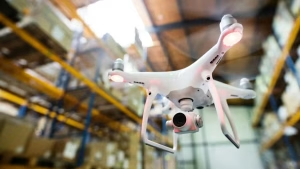
The business impact is measurable: reduced downtime, lower mobilization costs, reduced safety risk and faster response to problem detection. In the energy and utilities sector, drone-based inspection has been estimated to reduce inspection costs by 70% and downtime by 90%.

Future innovation: The next stage in drone deployment is autonomous operation. Drones will increasingly operate from fixed docking stations, launching automatically to perform scheduled inspection missions. Data collected during these flights can be transmitted to AI-enabled analytics platforms and integrated into operational systems in near real-time. Coordinated drone swarms may be used to conduct large-scale inspections and surveys across a large infrastructure.

Challenges: Concerns about workforce displacement are common, and the increased adoption of drones is no exception. But drone programs typically augment skilled labor rather than replace it. Technicians can become certified drone pilots, remote inspection specialists, data analysts or AI-assisted defect reviewers.

Modern industrial drones are connected devices and must be treated as operational technology nodes within the broader cybersecurity architecture. A compromised drone platform presents a risk that goes beyond simple device failure. It may expose critical infrastructure data or provide a means to compromise enterprise networks.

Still, a fully scaled drone program that makes good use of its data is a significant strategic asset.

Classroom discussion questions:

  1. What other industries are already commonly using drones?
  2. Discuss their use in modern warfare.

Teaching Tip: Why Quality Inspections Often Fail

We all know that students have trouble staying focused for a long lecture, even with the great job we all try to do. So try to find a short activity that will make a teaching point, break up the class for a few minutes, and get all the students enthused.  Here is something you may want to try in Chapter 6, Managing Quality. It takes about 10 minutes.

In this chapter, we have suggested that building quality into a process and its people is difficult. In the old days, inspection was the main form of quality control. But inspection may not catch all the errors, and it may be expensive. To indicate just how difficult inspections can be, ask your students to turn to the OM in Action box on page 234, called “Inspecting the Boeing 787”.

Ask them to each count the number of E’s (both cap and lower case), including those in the title. This should be a pretty easy inspection job, I think, and I offer a crisp $10 bill to the first student to give me the correct count. That usually gets their attention!

As they each finish, I ask them to shout out their count and I do a tally on the board. There is amazing variation and I only have to shell out the reward in maybe one out of five classes. The answer, by the way, is in the Instructor’s Solutions Manual, as discussion question #18.

If you can share a class exercise of your own, we would be very happy to publish it as a Guest Post.

OM in the News: The Use of Drones Grows

A drone hovers over a home, capturing detailed images of the roof

“Building inspectors who used to rely on binoculars and ladders are turning to drones to check property exteriors for signs of damage or deterioration that could lead to injuries,” writes The Wall Street Journal (Feb. 21, 2018). But their lower cost and greater thoroughness is coming into conflict with another public safety concern: the danger drones pose to other aircraft or people on the ground. In New York City, which has thousands of old skyscrapers, drone use is prohibited for property inspection.  Yet buildings over 5 stories must be regularly inspected in NYC, forcing inspectors to go out with binoculars, field notes, a pen and paper.

Drones, which had early applications in warfare and surveillance, increasingly are being adopted by a wide range of businesses—from package delivery to underwater exploration. Business applications have grown significantly since 2016, when an FAA ruling made it easier to become a drone operator. Since that ruling, technological developments have made drones smaller, more reliable and easier to fly, causing a growing number of  building inspectors to embrace them.

Take the inspection of a cathedral in Long Island. Using a drone, inspectors could examine the chimney without having to erect scaffolds—the difference between a $1,000 inspection and a $10,000 scaffolding inspection. Using a drone also can shorten a weekslong inspection to a day. “It is realistic that a $10,000 drone inspection could cost over $100,000 of hanging scaffolding,” said one engineering consultant.

About 8% of the 21,000 certified home inspectors in the U.S. now use drones for inspections. Four years ago, there were virtually zero.

Classroom discussion questions:

  1. What are the advantages and disadvantages in drone usage for building inspection?
  2. How else might drones be used in OM?

OM in the News: Quality Control and the Boeing 787

American Airlines supervisors check the rudder and inspect the paint on a new 787. The tail has 13 different colors and is tricky to paint, so it gets close inspection

“Imagine you’re buying a $270 million car. You’d want to kick the tires pretty hard. That’s what airlines do with new airplanes,” writes The Wall Street Journal (Aug. 31, 2017). Delivering one widebody airplane is a big deal—each plane has a list price roughly the cost of a high-rise hotel.

Carriers like American Airlines station their own engineers at Boeing factories to watch their flying machines get built and check parts as they arrive. Then they send flight attendants, mechanics and pilots for what are called shakedown inspections.

“The rubber meets the road here,” says an American manager, as he begins checking a brand new Boeing 787. “It’s inspected and it’s inspected and it’s inspected. And yet we still find things.” American is taking delivery of 57 new planes this year.  Boeing does its own testing, but buyers do their own extra inspection–and note an average of 140 items on a plane’s punchlist.

Five flight attendants, a couple of mechanical experts and an American test pilot attack the 285-passenger plane. All the doors and panels are opened for inspection. Flight attendants shake each seat violently, grab the headrest and pull it up and jerk the cord on each entertainment controller. They test power ports, USB ports, audio jacks and the entertainment system. They open all tray tables, turn all lights on and off. They recline each seat with knee-knocking force. They flush all the toilets, blow fake smoke into smoke alarms, make sure all prerecorded emergency messages sound when required.

Inside the cockpit, an American test pilot flies the jet to its limits, making sure alarms sound when he increases air speed or slows the plane down to stall speed. He turns it sharply until “bank angle” warnings sound. Each engine gets shut down and restarted in the air. Every backup and emergency system is put into use to make sure it works.

Classroom discussion questions:

  1. Why do airlines feel the need to make the quality inspections?
  2. What tools that we see in Chapter 6 could Boeing use to improve quality even further?

OM in the News: Takata Lacks Processes for Tackling Air-Bag Defects

The panel’s report found Takata lacked its own program for spotting defects in air bags once they’re installed in vehicles

Takata Corp., the supplier behind defective air bags in millions of recalled vehicles, lacks clear processes for tackling potential safety defects and needs improved manufacturing methods, an independent panel found. Takata employees tasked with raising safety concerns also don’t have well-defined roles and rely on reports from auto makers about quality problems instead of ferreting out problems themselves. In addition, Takata often has employees load air-bag-inflater propellants by hand and lacks enough automated manufacturing processes that can better ensure consistent products, the report found.

Takata’s CEO said the company planned to implement all of the panel’s recommendations. “Takata’s products play a critical role in protecting the driving public, and we understand that the quality of our operations needs to be beyond question,” he said. Car companies are recalling more than 24 million vehicles in the U.S. equipped with the air bags, which can explode and spray shrapnel.

Regulators also cited Takata for misleading and inaccurate testing reports.  “I don’t think they lived it and breathed it the way other people do,” noted the report’s author in The Wall Street Journal (Feb. 2, 2016). The report outlined a series of recommendations to improve Takata’s approach to quality, and suggested employees working on quality be able to not only intervene in manufacturing, but stop product designs when raising concerns.

The report concluded: (1) Testing data must be recorded and reported accurately; (2) Takata should develop its own standards for air-bag-inflater testing as opposed to relying on specifications from auto makers, regulators and others; (3) employees should be paid based on how the address quality issues to incentivize reporting concerns; and (4) Takata should create a dedicated quality team to implement the recommendations.

Classroom discussion questions:

  1. What were the weaknesses in Takata’s quality program?
  2. What tools in Chapter 6 could the firm employ?

OM in the News: Molecular Sensors Revolutionize Quality Control

A chocolate bar undergoing testing with SCiO technology to detect fake or mislabeled ingredients

The recent food outbreaks of norovirus at Chipotle Mexican Grill are a reminder that one in six people in the U.S. experience food poisoning every year, and 128,000 are hospitalized for it. Add to that all the other hazards in our food—carcinogens, pesticides, mislabeling of everything from seafood to meatballs—and you realize that in the U.S., the price of cheap and bountiful food is an array of unsavory compromises. “But what if you could know exactly what you’re putting in your mouth, down to the last bite? What if we all had the ability to inspect our food in a way previously accessible only to chemists with costly laboratories”, asks The Wall Street Journal (Dec. 14, 2015)?

The $250 Nima from 6SensorLabs is an organic-chemistry lab small enough to carry in your pocket, and able detecting gluten in foods at minuscule concentrations, as little as 20 parts per million. In the near future, Nima will recognize all manner of proteins—including ones that would allow it to recognize bacterial contaminants such as E. coli and salmonella. Nima is typical of a new breed of sensors that are cheap and fast enough to add more layers of inspection to our food system, for suppliers, restaurants and even individual consumers.

Another such technology, by Safe Catch, offers the world’s lowest mercury-contaminated canned tuna fish. This process allows Safe Catch to inspect every single fish as soon as it comes off the boat, rather than sampling just a small percentage of them. Then there is SCiO from Consumer Physics of Israel, which can identify substances by measuring the spectrum of light they reflect. Its sensor has the advantage of being so small—it is basically a camera technology—that it could be incorporated directly into cellphones. These and similar electronic products will almost certainly create whole new applications, markets and billion-dollar businesses.

Classroom discussion questions:

  1. Why are these new sensors so important to operations managers?
  2. What other applications can you envisage for such products?


OM in the News: Flawed Inspections of Factories Abroad

Factory inspection checklist audit form

A major New York Times (Sept. 2, 2013) investigation reveals how the factory inspection system intended to protect workers abroad and ensure manufacturing quality is riddled with flaws. The inspections are often so superficial, writes The Times, that they omit the most fundamental workplace safeguards like fire escapes. And even when inspectors are tough, factory managers find ways to trick them and hide serious violations. There is little enforcement or follow-through to guarantee compliance.

Inspectors, for example, came and went from a Walmart-certified factory in China, approving its production of more than $2 million in specialty items. But unknown to the inspectors, none of the items had been manufactured at the factory. Instead, Chinese workers sewed the goods at a rogue factory that had not gone through the certification process set by Walmart for labor, worker safety or quality. A subcontractor just moved the items over to the approved factory. Soon after the merchandise reached Walmart stores, it began falling apart.

As Western companies use low-cost foreign labor for manufacturing, factory inspections have become a vital link in the overseas supply chain. One expert said little had improved in 20 years of factory monitoring, especially with increased use of the cheaper “check the box” inspections (click on attached graphic) at thousands of factories. “The auditors are put under greater pressure on speed, and they’re not able to keep up with what’s really going  on,” he said.

Monitoring companies have established a booming business in the 2 decades since Gap, Nike, Walmart and others were tarnished by disclosures that their overseas factories employed underage workers and engaged in other abusive workplace practices. Each year, these companies assess more than 50,000 factories that employ millions of workers. Walmart alone commissioned more than 11,500 inspections last year. But unauthorized subcontracting is very common, and audits can be very brief. A single inspector might visit a 1,000-employee factory for 6-8 hours.

Discussion questions:

1. If monitoring systems are failing, what is the next step?

2. Why have overseas manufacturers resisted major changes?

Teaching Tip: Teaching Quality Inspection Using Chickens

In Chapter 6, our favorite line when discussing inspection is: “Quality cannot be inspected into a product.” What better way to discuss this important topic with your students than the controversial move by the USDA last week to streamline chicken inspection by cutting by 75% the number of government inspectors who eye chicken carcasses for defects. The Los Angeles Times (June 6, 2012) reports that the USDA move to let  chicken slaughterhouses run production lines 25% faster is angering food safety advocates and poultry plant workers.

The USDA says it can  eliminate  800 inspector positions and save the federal government $30 million a year. Consumer advocates said the rising rates of salmonella infection in recent years should give pause to any plans to cut the number of inspectors. But in testing its relaxed rules at 25 poultry slaughterhouses, the USDA found little difference with conventional plants in the instances of salmonella and other diseases. “The test plants performed exceptionally well”, the department said. (In other words, more inspection did not equal more quality.)
Under existing rules, the production line can move as fast as 140 birds a minute. Four federal inspectors positioned along the line inspect carcasses and remove those that have visual defects. No single inspector inspects more than 35 birds a minute. The relaxed rules allow lines to speed to 175 birds per minute while relying on plant employees to spot defective carcasses and pull them from the line. They then move past a single line inspector.

The CDC estimates that there are 1.2 million incidents of salmonella illness each year–and growing.  When Consumer Reports tested 382 broiler chickens bought from grocery stores, 14% were found to contain salmonella. The union that represents poultry workers said the new rules would mean “more danger on the job.” The industry’s worker injury rate already is about a third higher than the average for all manufacturing industries. They often are prone to back problems, and  59% of line workers already have carpal tunnel syndrome — at line speeds of 70 to 91 birds a minute.

This story can make for a good Ethical Dilemma exercise as well.

OM in the News: How Alaska and Delta Airlines Reengineered Quality Control

If you fly a lot, you will want to read this article in The Wall Street Journal (Jan.5, 2012) and use it in class when you cover the topic of Managing  Quality (Ch.6). It begins by dealing with American Airlines, which ranked dead last (again) in customer service in the Journal’s annual analysis of major air carriers. The score card ranks airlines on on-time arrivals, delays, cancelled flights, missing bags, bumped passengers , and complaints filed with the DOT.

Alaska  Airlines, which overhauled its operations in 2007 after several dismal years of reliability came in 1st in 4 of the 7 key operational areas. What did it do to change? For one thing, Alaska has set 50 internal quality checkpoint standards on a timeline for each departure. Flight attendants have to be on board 45 min. before departure; agents must board the 1st passenger 40 min. before departure; 90% of passengers need to be boarded 10 min. before departure; the cargo door must be opened 3 min. after arrival; the 1st bag has to be on the conveyor belt within 15 min. of arrival; and so on with 45 other measures for which data are collected on every flight.

Similarly, Delta engineered a major operational turnaround last year after coming in 2nd worst in punctuality and baggage handling and worst in cancelled flights and customer complaints. It has opened maintenance operations in 9 new cities to keep more its fleet ready to fly. It has also invested in a new baggage system and new technology in its operations control center. “There are a lot of side benefits of running a good, clean operation”, says Delta’s VP-Operations.

Discussion questions:

1. Why do some airlines, like Jet Blue, have a terrible problems with delayed flights, while others, like Alaska, do not?

2. What quality measures would students select to monitor besides the ones mentioned here?