OM in the News: The Critical Last Mile at eBay

eaby nowThere’s a hot new job in tech: delivery guy. As the holiday shopping season gets underway, same-day delivery has become a new battleground for e-commerce, reports The New York Times (Nov.24, 2013). For all the sophisticated algorithms and proprietary logistics software involved, many services come down to “valets,” who race to a store, scan the aisles for the requested items, buy them and rush them to the customer. The app for eBay Now, the company’s local shopping service, promises that valets will complete a shop-and-drop-off not just in the same day but “in about an hour,” a timetable crucial to the company’s intensifying efforts to one-up Amazon in the delivery game.

It wasn’t so long ago that overnight delivery seemed amazing enough. Then Amazon started building huge “fulfillment centers” near major U.S. cities to be as close to customers as possible. With 40 such centers encompassing more than 80 million square feet and employing 20,000 full-time workers, Amazon offers same-day delivery in 11 cities.

EBay, which last month announced plans to expand eBay Now to 25 cities, has a different model: use existing stores or “retail partners” as distribution centers and beat Amazon in the race against the clock. The personal, labor-intensive valet approach doesn’t translate easily into profit. “You just can’t get any hourly worker to do this — you need someone with a work ethic and a willingness to go out of the standard operating procedure to delight the customer,” said a Forrester Research analyst. “It is an H.R. issue, not a tech issue. Many of these companies are coming at it from a tech standpoint. One thing Amazon has done very successfully, is they’ve owned the entire value chain. They’ve owned the last mile, the moment when the package arrives. Once you can own the moment that matters, you build a loyal customer base.”

There is a 2 minute video attached to the article which illustrates the eBay Now system.

Classroom discussion questions:

1. What has happened to earlier quick delivery companies?

2. What are the OM issues involved in eBay Now?

OM in the News: Sustainabilty in Trucking Logistics

waste mangaement truckHere is a great article that ties into our new chapter, “Sustainability in the Supply Chain” and its Example S2 (see p. 195) dealing with life cycle ownership/break-even analysis.  The Wall Street Journal (Oct.30, 2013) writes: “Operators of some of the largest U.S. truck fleets, including Lowe’s , P&G, and UPS are accelerating a shift to natural gas fueled trucks, betting on new engine technology that promises to drop the cost of shifting from diesel fuel.”  Lowe’s wants its delivery company to shift all of its several hundred trucks to natural gas by 2017. P&G already has 7% of its trucks on gas and could reach as much as 20% within two years. UPS says it plans to buy 1,000 natural gas trucks by the end of next year. FedEx plans to shift 30% of its long-distance trucks to natural gas over the next decade.

The nation’s supply of relatively cheap natural gas is helping spur this shift. So are new natural gas engines that can power heavy-duty trucks that weigh up to 80,000 pounds. About 5% of all heavy-duty trucks sold next year will run on natural gas, up from 1% this year. Barriers to wider use are coming down, driven by the relatively low-cost of compressed natural gas, or CNG, which sells for about $1.50 less a gallon than its equivalent in diesel fuel, which averages about $3.87. Natural gas also produces less carbon dioxide, carbon monoxide and sulfur-based pollution than diesel or gasoline per mile driven. Diesel-engine trucks get 5-7 mpg and average 100,000 miles a year.

Waste Management, Inc. has converted 15% of its 22,000 truck fleet to natural gas, and  90% of its future purchases will be natural gas fueled, helping it save $15,000-$20,000 a year per truck, a 2-year payoff. The cost of the natural gas vehicles is still an issue. CNG trucks cost $40,000-$50,000 more than a diesel truck, which costs about $120,000. In large fleets, that premium could add millions of dollars to equipment cost.

Classroom discussion questions:

1. Why is the switch to CNG trucks an OM issue?

2. What factors are driving the change?

OM in the News: GM Discovers the Importance of Logistics

GM's stamping plant is now next to the existing Arlington TX assembly plant
GM’s stamping plant is now next to the existing Arlington TX assembly plant

For years, General Motors pounded out hoods, fenders and doors for its Tahoe and Yukon SUVs at plants in Ohio and Michigan and shipped them to its assembly plant in Arlington, Texas. Yesterday, reports The Wall Street Journal (Oct. 14, 2013), the auto maker officially opened a $200 million metal-stamping plant adjacent to the Arlington factory that reduces that travel to about 20 feet from machine to welder. Estimated savings: about $40 million a year in shipping costs.

The new plant, is part of a broader rethinking of logistics by GM CEO Dan Akerson to generate hundreds of million of dollars in new profit. “Any savings I can get by cutting my logistics bill goes right to my bottom line and makes us more competitive,” says Akerson.  GM now sees logistics as representing the biggest potential opportunity to squeeze new profit from operations.

Co-locating parts-making and auto assembly promise higher quality and greater profit. GM and other auto makers say they can no longer put up with parts that arrive scratched or dented and have to be repaired.  “Now, with the reset of labor costs, especially in the U.S., more efficiency in the plants and the importance of quality, we can finally evolve,” adds the CEO of GM’s largest parts supplier.

“The best way to describe logistics is waste,” says GM’s manufacturing chief. “It is moving productive materials from point A to point B. It has no value and guess what; it doesn’t mean anything to the customer. If you can squeeze that waste of the system then you can tactically improve your profit margins.” In addition to moving its own production, GM is encouraging parts makers to move or build new facilities closer to GM assembly plants.

Classroom discussion questions:
1. Why is logistics so important to auto makers?

2. What does “co-locating” mean?

Good OM Reading: The Box That Built the Modern World

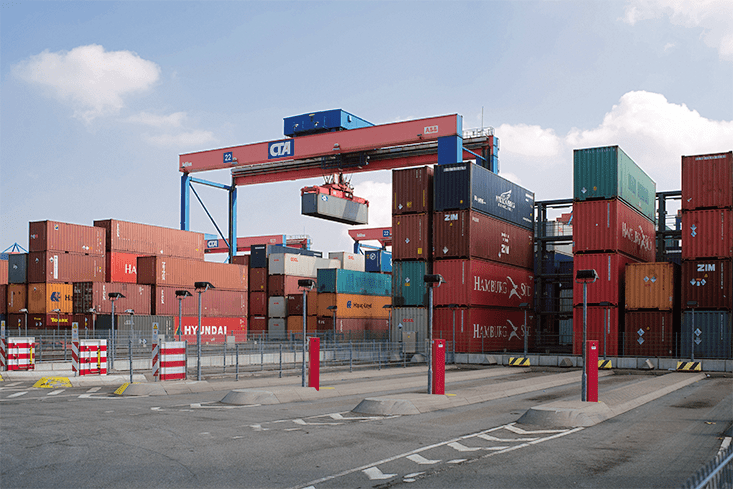
shipping containersFor a fascinating story called “The Box That Built the Modern World,” enjoy this article in In Transit (Issue 3, 2013). The piece follows the Hong Kong Express, docked at Hamburg’s Container Terminal for 33 hours. “Already, the ship was half empty. Cargo from Asia was stacked in neat rows of shipping containers on the dock. The ship is nearly a quarter of a mile long; from side to side it’s 157 feet. It can carry 13,167 20-foot-long containers, the standard box used in commerce around the world.” In less than 2 months the Hong Kong Express will call at 11 ports and travel more than 12,500 miles. Circling the world 4-5 times a year, it can move 1.4 million tons of cargo annually.

More than any other single innovation, the shipping container epitomizes the enormity, sophistication, and importance of our modern transportation system.  Fundamental to how practically everything in our consumer-driven lives works, it is the Internet of things. Just as email is disassembled into bundles of data you send, then re-assembled in your recipient’s inbox, the boxes are designed to be interchangeable, their contents irrelevant.

Once they enter the stream of global shipping, the boxes are shifted and routed by sophisticated computer systems that determine their arrangement on board and plot the most efficient route to get them from point to point. The exact placement of each box is critical: ships make many stops, and a box scheduled to be unloaded late in the journey can’t be placed above one slated for offloading early.

The In Transit article traces a T-shirt sewn at a factory near Beijing. Tagged, folded, and boxed, the T-shirt is stuffed into a container with 33,999 identical shirts at the factory. The merchandise passes through 36 steps before arriving at a discount clothing retailer’s distribution center near Munich. There’s the trucker who moves the box to a waiting ship in Xinjiang, the feeder ship that moves it to Singapore to be loaded onto a bigger Europe-bound freighter, the crane operator in Hamburg, customs officials, train engineers, and more. The total time in transit for a typical box from a Chinese factory to a customer in Europe might be as little as 35 days. Cost per shirt? “Less than one U.S. cent,” says a shipping exec. “It doesn’t matter anymore where you produce something now, because transport costs aren’t important.”

Guest Post: Trends and Strategies in Logistics and Supply Chain Management

Dr. A. Wieland
Dr. A. Wieland
Dr. R. Handfield
Dr. R. Handfield

Our Guest Post today comes from Andreas Wieland (http://scmresearch.org/)  and Robert Handfield (http://scm.ncsu.edu/blog/). Andreas heads the Kühne Foundation Center for International Logistics Networks at the TU Berlin. Rob is director of the Supply Chain Resource Cooperative at North Carolina State University.

Some months ago, BVL International engaged us to find the most important trends that are currently going on in logistics and supply chain management and also the most powerful strategies to cope with these trends.

Our general observation, derived from both over 60 interviews and the analysis of over 1,700 international survey responses, is that complexity in the form of consumer demands for customized solutions, increased product variations, and fragmented channels has increased. We found that high customer expectations, an increasingly networked economy, intense cost pressure, as well as ongoing globalization, shortage of talents, and pronounced volatility are dominating trends in logistics and supply chain management. Other important trends are sustainability, risks and disruptions, and new technologies.

How should organizations prepare themselves to deal with these emerging trends? The top performing companies are not only preparing themselves for these trends; they are even seeking to exploit them for advantage. First, people are the core of any organization, and strategies to find and keep talented logistics managers and warehouse/transportation workers are crucial. Second, a strong core set of processes is needed, and these processes should be adaptive and flexible to accommodate different local and regulatory conditions. Third, technology must be leveraged to provide insights, visibility, and promote an action-oriented culture. Fourth, end-to-end integration will become an increasingly important logistics and supply chain strategy in the next five years. Finally, to pursue ethical, social and ecological standards, organizations will increasingly need to work both vertically and horizontally with suppliers, service providers, local agencies, and governments.

Our report, coauthored by Drs. Frank Straube and Hans-Christian Pfohl,  “Trends and Strategies in Logistics and Supply Chain Management,”  is available on BVL’s website.


OM in the News: Wal-Mart vs. Amazon Logistics

This Wal-Mart hub sends supplies out to physical stores

Few have done better than Wal-Mart when it comes to retail logistics—the art of ordering, transporting, stocking and tracking merchandise, writes The Wall Street Journal (June 19, 2013). Wal-Mart pioneered a sophisticated hub-and-spoke distribution network which uses warehouses to service stores less than a day’s truck drive away so it could remove middlemen, quickly replenish shelves and reduce costs. At its distribution centers, scanning technology tracks merchandise as it flows at 6 miles per hour on 12 miles of conveyor belts onto trucks. Some items spend less than 45 minutes in warehouses.

Supply trucks crisscross the country and arrive daily at Wal-Mart’s more than 4,000 U.S. stores. Shipments are based on real-time data of shopper purchases, transmitted by the second as employees scan items at store checkouts. But with its e-commerce operations, which began in the late 1990s, Wal-Mart has been less exacting, instead relying on makeshift spaces carved out of store-serving warehouses and third-party operators to handle the load. Electronics ordered from Walmart.com are often delivered by companies like Ingram Micro which transport Apple tablets or Samsung phones to shoppers without ever going through Wal-Mart’s warehouses.

By contrast, Amazon has spent 15 years building its e-commerce network, with more than 40 U.S. warehouses within 35 miles of major cities. “As Amazon’s bets on infrastructure pay off, it can sell products at lower costs and puts even more pressure on other retailers,” says one industry expert. Wal-Mart now plans to spend roughly $430 million this year on e-commerce investments, including a logistics system tailored for Web orders. It is building distribution centers, but also will use stores as mini distribution centers. While logistics costs account for 3% of the price of an average “shopping basket” in stores, they make up 15% of the price of online orders.

Discussion questions:

1. What is Amazon’s logistics advantage?

2. How did Wal-Mart stumble in the move to electronic shopping?

OM in the News: Fill ‘Er Up…With Natural Gas

LNG pump at Blu filling station in Salt Lake City

If you drive down I-15 in Beaver, Utah, you’ll see a 30-foot-tall silo with white letters that spell out “Blu.” Next to it is a truck stop. It is no ordinary truck stop. The silo contains liquefied natural gas (LNG) chilled to -200° F and ready to fuel specially outfitted 18-wheelers. The facility is owned by Blu Transfuels, which expects to build 50 natural-gas filling stations nationwide this year, according to Fortune (May 20, 2013).

Drawn to the vast potential of America’s fracking boom, Blu plans to convert natural gas into a liquefied form and use it to power the country’s fleet of 8 million heavy and medium-weight trucks, which account for 15% of U.S. oil consumption. The company’s partner, ENN, already operates 238 natural-gas stations in 59 cities in China. Blu’s VP of sales says, “LNG will allow our transportation fleet to save money and at the same time reduce its carbon footprint by 25%.”

Blu is not alone. Clean Energy, a company backed by T. Boone Pickens, says that it will have about 150 natural-gas stations in 33 states by year-end. Shell’s first LNG station opened in April in western Canada. Shell’s president says, “LNG has the potential to transform the transportation sector in a big way.”

The new LNG trucks should cost only $30,000 to $40,000 more than diesels. Given that a typical 18-wheeler travels 100,000 miles a year at 5 mpg and that LNG is about $1 to $1.50 a gallon cheaper than diesel, a driver can save as much as $30,000 a year in fuel — a one-year payback. Many trucking companies lock in their fuel costs for five years, which would provide a total savings of $120,000 over the life of the contract.

Discussion questions:

1. Why is LNG a supply chain topic in operations?

2. What major US shippers have announced plans to convert to LNG-powered fleets?

OM in the News: The Last 60 Minutes of On-line Holiday Shopping

Time is money. And in the fierce holiday-season battle between online and offline sales, a single hour can be worth millions of dollars, says The Wall Street Journal (Dec.19,2012).

GSI shipping facility

GSI Commerce, a division of e-Bay that handles online shipping for 70 brands including Godiva, Aéropostale, and Estée Lauder, has been counting workers’ steps and even tweaking the way it prints labels with a single goal: Push back the cutoff time for Christmas delivery by 60 minutes. This year, GSI’s customers let shoppers order as late as 11 p.m. on Dec. 22 and still get their orders by Christmas Eve. That’s 8 more hours than shoppers get on Amazon.com, and an hour later than GSI’s deadline last year. “It’s beyond critical,” says the COO of one on-line retailer. “Having a few hours over a competitor could be a seven-figure event.”

As soon as last Christmas ended, GSI’s OM execs began huddling with customers and UPS to figure out how to speed up the time it takes for an order to be processed.  GSI spent more than $25 million to improve its operations and speed since then. One of the OM changes: saving steps for employees–who can walk nine miles a day–by putting the most popular goods closest to the people who pick them. This cut employees’ walking time by 60%.

The company then placed 7,000 big box storage containers closer to the front of the warehouse. To figure out what to put in the boxes, GSI’s OM team tracked order patterns and worked with retailers to know what is being promoted heavily. Those calculations were rerun every hour.

To further cut down walking time, GSI  moved  smaller storage boxes on their shelves closer together. Fire insurers required the warehouses to maintain a few inches of space between the boxes so that water from overhead sprinklers can drain down between them. Across miles of shelves, those gaps add up. So GSI  decided to drill holes into the boxes, proving that could accomplish the same firefighting goal as the spaces.

Discussion questions:

1. Why was it important for GSI to improve its warehousing operations?

2. How did GSI decide what processes to change?

OM in the News: Union Pacific R.R. in a High-Tech Economy

“Can a 150-year-old company be part of the modern economy,” asks Fortune (Oct.29, 2012). Apparently so. Union Pacific, America’s largest railroad, touches all parts of the economy, even globally — 30% to 40% of its shipments originate or terminate outside the U.S. In its intermodal business, where it takes containers off trucks and put them on the railroad, it had a record year– a bellwether measure for what’s happening in the economy.

Union Pacific has also started moving shale oil by rail– 2 or 3 times faster than a pipeline (and able to come out wherever companies want it). In 2010 it moved 4,400 carloads of crude oil. In 2011 it was 25,000, and 2012 will be 140,000. CEO Jack Koraleski’s take is: “If the United States can convince manufacturers that low energy prices are here to stay, then all of a sudden the U.S. starts to look a lot more attractive as a place to build that next plant. We’ve already seen manufacturers announce that they’re bringing some manufacturing back to the U.S.”

With 8,000 locomotives pulling hundreds of thousands of cars over 32,000 miles of track, Union Pacific is also an infotech company. Technology controls the movement and safety of the trains. There are 4,000 pieces of detection equipment throughout the network. As trains go over, they’re measuring the temperature of the bearings, the impact of the car as it rides on the rail and whether there’s a bump to it, the sound of the wheels on the rail for anomalies and patterns–all part of predictive maintenance on when to pull that car out and have it inspected.

Union Pacific has also tried to move up in its customer supply chain. With Shipment Vision,  Chrysler assigns a car a VIN on a manufacturing line, then Union Pacific tracks and controls that vehicle all the way to the showroom. The railroad takes technology it uses to control trains and gives it to customers to help them control their supply chain more effectively.

Discussion questions:

1. Why are railroads critical to the OM function in many firms?

2. Why has Union Pacific moved into the infotech sector?

Good OM Reading: The Power of Logistics Clusters

Everyone understands the concept of industrial clusters that have developed around the world:  Silicon Valley (for information technology), Hollywood (for entertainment), and Boston (for life sciences). Strong clusters are ecosystems of venture capital resources, universities, research centers, employers, highly skilled workers and institutions for collaborations.

The MIT Sloan Management Review (Fall, 2012), however, introduces the concept of logistics clusters local networks of businesses that provide a wide array of logistics services, including transportation carriers, warehousing companies, freight forwarders and third-party logistics service providers. They also include the distribution operations of retailers, manufacturers and distributors. These clusters attract companies for whom logistics is a critical element of their service offering or a large part of their overall costs.

Logistics clusters are located strategically to enable efficient transportation and delivery services to large populations. They are positioned in mode-changing locations such as busy seaports (Rotterdam, Shanghai, Los Angeles), airport hubs (Hong Kong, Seoul, Memphis) and major intermodal yards where freight shipments transfer from railcars to trucks (such as Chicago, Dallas and Kansas City). Some of the world’s largest logistics hubs, including Singapore, São Paulo and Memphis, bring together multiple elements at once. The economics of transportation means that cargo has to travel long distances in bulk, while demand from retailers and JIT manufacturers means that final distribution must be handled locally in small quantities in response to the ups and downs of customer demand.

The Sloan article notes 3 major advantages of logistics clusters:

1. Value additions. For example, UPS repairs Toshiba laptops at its facility in Louisville, next to the UPS Worldport air hub, reducing service turnaround times from 2 weeks to 4 days.

2. Facilitating returns.  Miami’s Neptune Lines specializes in refurbishing secondhand pieces of heavy equipment for Caterpillar and Komatsu. It handles about 5,000 pieces of equipment per year.

3. Attracting other industries and jobs. Indianapolis has some 1,500 logistics and related services companies, including distribution centers for Amazon.com, Hewlett-Packard, and CVS Caremark.

This is a nice article to ask your students to read before you discuss the topic of logistics in Chapter 11.

OM in the News: The Shipping Revolution

Fortune (May 21, 2012) carries a fascinating analysis of the global shipping industry that fits nicely into a discussion of logistics in Chapter 11. We find in the article that nearly 90% of all goods traded across borders travel at some point by sea.The fastest growing routes are between ports in Asia, accounting for 43% of all maritime trade., with the most heavily trafficked route being between China and the US West Coast. Unfortunately for the trade deficit, 4 times as many goods travel to the US than make the return trip. New, faster routes are opening with the Northeast and Northwest Passages ice-free every summer since 2008.

The real revolution has been in the ships themselves. Back in  the 1956-1970 era, cargo vessels were 443 feet long and hauled 500 twenty-foot “equivalent container units” (called TEUs). Next year, Maersk, the Danish shipping giant, will launch its EEE-Class, the largest cargo ship in history. Length: 1,312 feet. capacity: 18,000 TEUs. Cost: $190 million/ship.

As ships have gotten bigger, economies of scale have improved, and the cost of shipping has dropped dramatically. Here are some typical ocean-crossing costs: TV, $10; DVD player, $1.50; vacuum cleaner, $1; barrel of oil, 80 cents; 6-pack of beer, 6 cents; 100 pounds of coffee, $6.80. (Oil, grain, and iron are more expensive because ships make the return trip empty.)

And the containers themselves are no longer just a steel box. They have doubled to 40 feet, and are often fitted with RFID chips to let ports and owners keep track of them. Some  containers are built to be folded up when empty. Others can float if lost at sea and  come with GPS satellites to make them easier to find in the ocean.

Discussion questions:

1. Why are the ships getting bigger and bigger?

2.  What are the dangers facing the shipping industry?

OM in the News: The Panama Canal’s “Fat Lane” and US Supply Chains

What do Warren Buffet, the Panama Canal, and products from Asia  to Wal-Mart  have in common?The Wall Street Journal (Nov.11, 2011) writes that they are all part of the complex calculus of changing  global supply chains. Right now, about 70% of US imports from Asia arrive by ship to the West Coast, with much of those goods transferred to Buffet’s Burlington Northern RR for transit to the rest of the nation.

But in 2014, Panama will rock the world of logistics with the opening of its new “fat lane”– a game changer  that  creates a threat to western ports and railroads. It takes about 18 days to make the ship and train journey from Asia to West Coast and then across the country. The all-water route through the canal takes 22 days. But the ship-to-rail route costs 10-25% more.

With the expanded Panama Canal, the Wal-Marts and Targets of the world are planning to ship more product to East Coast ports on huge ships that can carry 12,000 standard 20-foot containers–3 times the current capacity. This avoids labor strife in the past decade that clogged West Coast ports, and helps diversify  logistics systems. It has also triggered a raft of upgrades at East Coast ports to accommodate the bigger vessels.

The reaction from western ports:  Our speed of delivery and superior facilities will stem any loss of business. Many customers don’t want time-sensitive inventory sitting on ships traversing all-water routes. If your goods are stuck in the supply chain, they’re not passing the cash register. Besides, future ships (already being ordered) will carry 18,000 containers, which will not fit through the expanded canal.

But the Journal concludes that the expansion will be good for all ports. It will facilitate rising trade with Latin American for commodities, create round-the-world service by larger ships, and make the US logistics system more competitive globally.

Discussion questions:

1. How does the expansion impact East Coast retailers?

2. What are the OM advantages of the wider canal?

OM in the News: Apple’s Supply-Chain Secret?

 Businessweek (Nov.4-10, 2011) describes the “world of manufacturing, procurement, and logistics ” in which Apple excels.  “Apple has built a closed ecosystem where it exerts control over nearly every piece of the supply chain, from design to retail store”, writes the magazine. “The iPhone maker spends lavishly on all stages of the manufacturing process, giving it a huge operations advantage”.

This is a great article to ask students to read, as it describes the critical role of OM in one of their favorite companies. “Operations expertise is as big an asset for Apple as product innovation or marketing”, says the former head of SCM at HP. With its volume –and ruthlessness–Apple gets big discounts on parts, manufacturing, capacity, and air freight. This enables the company to handle massive product launches without maintaining huge inventories, all the while earning 25% profit margins.

As one example of details in the supply chain, Apple bought up all the available holiday air freight space  to ensure its new translucent blue iMacs would be widely available before Christmas–paying $50 million to do so. The move handicapped Compaq when it later wanted to book air transport.  Apple also decided to fly iPods directly from Chinese factories to consumers homes, allowing the buyer to track the phone’s progress around the world on its web site.

The company recently announced it plans to double capital expenditures on its supply chain to $7.1 billion next year, while committing $2.4 billion in prepayments to key suppliers. The tactic ensures availability and low prices. Because it  locked up all available screens to use in its iPhone4 debut last  year, competitors like HTC couldn’t buy the screens it needed. 

 While life as an Apple supplier may be lucrative because of volumes, Apple  does squeeze prices to the bone, and may require suppliers to keep 2 weeks of inventory within a mile of Asian assembly plants.

Discussion questions:

1. In what ways do Apple’s retail stores provide an OM advantage?

2. How does Apple use SCM as a strategic weapon?

OM in the News: Logistics and The Port of Savannah

Although logistics is one of many topics in Chapter 11 (Supply Chain Management),  USA Today (Oct.3, 2011) details its critical role in an article about the Port of Savannah, the nation’s fastest growing shipping port. The bustling 1,200 acre site touches the lives of 44% of the US population, serving as a supply line to 15 states, and is one of the few ports handling more exports than imports (only the Port of LA is bigger). But Savannah is at an important crossroads, as the Panama Canal completes  (in 2014)  its first major expansion in 100 years. When that project is done, the canal’s locks will be able to hold cargo ships 3 times the current capacity. This means that cargo currently unloaded at West Coast ports, and shipped by rail across the US, will be able to dock directly at East Coast ports like Savannah.
The only problem is that Savannah (and most other Eastern ports) do not have channels deep enough to handle these larger vessels (called “post-Panamax” ships). A long sought channel-deepening project would result in 15-20% cheaper shipping costs. For example, Home Depot, which imports about 20% of its goods through Savannah, says: “The deepening of the port creates efficiency and lowers the cost of doing business. We can pass the savings on to our customers”.

The holdup: the federal government. The Port asked for permission to start the harbor project in 1996. Congress authorized a study in 1999. But approval for the $569 million expansion  requires the signoff of the Secretary of Commerce, Secretary of Army, Secretary of Interior, and the EPA. Port officials complain that this ” is one of the longest studied projects in history”.

Discussion questions:

1. Why is the dredging of the Eastern ports an important topic in OM?

2. Why is Savannah a major port for product exports? (Other Eastern ports include Miami, Jacksonville, Ft. Lauderdale, Charleston, Baltimore, Wilmington, Philadelphia, NY, and Boston).