OM in the News: Polyester Is Driving Up Fashion’s Emissions

Greenhouse gas emissions from clothing companies are mounting, reports The Wall Street Journal (July 24, 2025).  The spike is fueled by supercharged apparel production, as well as a mounting reliance on virgin polyester. Virgin polyester, a material made from fossil fuel-created plastic, is the latest industry trend.

Polyester now makes up 57% of total global fiber production. The market share of recycled polyester used in clothing has recently dropped, pointing out that the material costs more than its virgin counterpart.

Environmental concerns about apparel have proliferated since the arrival of ultrafast fashion companies, which churn out low-cost clothes direct-to-consumer to satiate lightning-quick trend cycles.
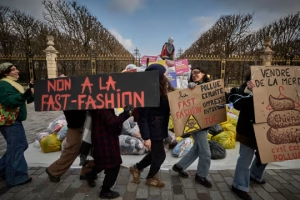
Activists hold banners as they gather in front of bags of textile waste delivered in Paris

Recycling clothing can be especially tricky when fibers are woven together, for example cotton and polyester, which are often blended to lower costs and provide stretch in fabric.

But consumers are growing worried about clothing shedding microplastics that could harm human health and the environment. There’s also been concern about “forever chemicals” in textiles used to make workout gear.

New technologies including artificial intelligence are helping brands to get a better handle on their clothing stock, piloting made-to-order methods that significantly reduce waste by producing only what is needed.

Some countries are taking swift action to try and blunt the harms of fast fashion. France recently adopted a bill to tax each fast fashion item €5 ($5.87 ) which will increase to €10 by 2030.

Classroom discussion questions:

  1. Why is fast fashion an OM issue?
  2. How else might AI be used to improve sustainability in the fashion industry?

Guest Post: Pollution as an Operations Management Issue

Prof. Howard Weiss raises an interesting issue that is in the forefront of many student’s minds.

Recently,
 Shell was sued for air pollution from its plastic plant outside of Pittsburgh
 The German government is being sued for allowing high levels of air pollution
 Monsanto paid $100M dollars to settle a pollution suit for contaminating streams and lakes in Pennsylvania.
Your Heizer/Render/Munson textbook has a graphic (Figure 1.5) on transforming Inputs to Outputs– but perhaps one more output should be added – pollution.

Pollution is an ever-growing global concern that adversely affects the environment and human health. Reducing pollution should be part of the feedback loop. Here are 8 different types of pollution:
1. Air Pollution is one of the most widespread and harmful forms of pollution. Sources include industrial processes, vehicular emissions, agricultural activities, and natural events like wildfires and volcanic eruptions.
2. Water Pollution occurs when contaminants enter water bodies, such as rivers, lakes, oceans, and groundwater. It can stem from various sources, including industrial discharges, agricultural runoff, improper waste disposal, and sewage.
3. Soil or Land Pollution involves the contamination of the Earth’s soil with hazardous substances. This can result from improper disposal of industrial waste, agricultural chemicals, and improper landfill practices. Soil pollution negatively impacts plant and animal life.
4. Noise Pollution is the excessive or disruptive noise that interferes with normal activities, causing stress and potential health issues (and is a topic in Chapter 10). It often originates from transportation, industrial processes, urban development, and recreational activities.
5. Thermal Pollution  occurs when there is a significant alteration of water temperature in natural bodies like rivers or lakes. It commonly results from the discharge of heated water from industrial processes, power plants, or nuclear facilities.
6. Light Pollution involves excessive or misdirected artificial light, which interferes with the natural darkness of the night sky.
7. Plastic Pollution is caused by the improper disposal and accumulation of plastic waste. Plastics persist in the environment for extended periods, harming wildlife and marine ecosystems.
8. Radioactive Pollution  involves the presence of radioactive substances in the environment, often from nuclear power plants, nuclear accidents, or improper disposal of radioactive waste.

Addressing and mitigating these various types of pollution is crucial for safeguarding the environment and public health. Implementing sustainable practices, adopting cleaner technologies, and enforcing regulatory measures ( all topics of Supplement 5) are essential steps toward a cleaner, healthier planet.

Classroom discussion questions:

  1. How can operations managers address each of these concerns?
  2. Clearly industrial processes create many different types of pollution. What types of pollution do service organizations create?

OM in the News: New York City Chokes on Deliveries from On-Line Orders

An Amazon order starts with a tap of a finger. Two days later — or even in a matter of hours — the package arrives. It seems simple enough. But to deliver Amazon orders and countless others from businesses that sell over the internet, the very fabric of major urban areas around the world is being transformed. And New York City, where more than 1.5 million packages are delivered daily, shows the impact that this push for convenience is having on gridlock, roadway safety and pollution.

The average number of daily deliveries to households in NYC tripled to more than 1.1 million shipments from 2009 to 2017, writes The New York Times (Oct. 27, 2019), With households receiving more shipments than businesses, trucks are pushed into neighborhoods where they had rarely ventured. About 15% of NYC households receive a package every day.

Delivery trucks double-park on streets and block bus and bike lanes. UPS and FedEx alone racked up more than 471,000 parking violations last year. The main entryway for packages into NYC, leading to the George Washington Bridge from New Jersey, has become the most congested interchange in the country. Officials are racing to keep track of the numerous warehouses sprouting up, to create more zones for trucks to unload and to encourage some deliveries to be made by boat or at night as the city struggles to cope with a booming online economy.

Amazon is now moving toward 1-day delivery rather than 2 days for Prime customers and plans to spend $1.5 billion this quarter to reach that goal. As the delivery armada has ballooned, so, too, have the complaints.  “There is just not enough room for all the trucks that need to make deliveries, the cars that need to get past them and the people who live here,” said a NYC councilman.  From 1990 to 2017, carbon dioxide emissions from automobiles and trucks in the NYC area grew by 27%, making the region the largest contributor of driving-related carbon dioxide emissions in the country.

Classroom discussion questions:

  1. What are the impacts from the surge in on-line deliveries in metropolitan areas?
  2.  Ask students who live in high-rises how the deliveries have affected them. Solutions?

OM in the News: Audi’s Pollution Tricks

An Audi production line in Germany.

“After more than $30 billion in fines, numerous indicted executives and a guilty plea in the U.S, you wouldn’t think there was much more to learn about the Volkswagen emissions scandal,” writes The New York Times (July 26, 2019).

Wrong. Four years after VW confessed to systematically evading pollution rules for a decade, new documents show that VW’s Audi luxury-car unit was more deeply involved in developing the emissions cheating scheme than previously known, and continued to sell vehicles with illegal software even after the scandal became public. The documents show that Audi managers and engineers were just as willing as their VW counterparts to cheat in pursuit of the company’s goal of becoming the largest carmaker in the world.

Audi execs bluntly discussed what was in effect a criminal conspiracy, using terms like “defeat device” or “cycle beating” that clearly connote illegal attempts to defeat the testing procedures used by regulators. “We won’t make it without a few dirty tricks,” wrote an employee. Trapped between corporate aspirations and the laws of physics, Audi engineers devised an ingenious but illegal workaround. They installed software in the engine that could recognize the telltale signs of an official emissions test. If regulators were looking, the software would temporarily ramp up pollution controls to be compliant. In everyday use, the cars produced emissions far above legal limits, resulting in estimates of 1,000s of pollution-influenced deaths.

A 2008 Audi Powerpoint presentation noted that the approach was a form of cycle beating, the automotive equivalent of cheating on an exam. “Highly critical in the USA!” the document warned.
As VW later admitted in a plea agreement, Audi deployed illegal software anyway. So ingrained was the use of illegal software that Audi continued to use it even after the U.S. formally accused it of emissions cheating in 2015.

Classroom discussion questions:

  1. Why is this a sustainability issue?
  2. What exactly did VW do that was wrong?

OM in the News: Tesla’s Secret Source of Cash

For years, Tesla has hauled in revenue by selling credits to other carmakers that needed to offset sales of polluting vehicles to U.S. consumers. “These sorts of transactions have largely been shrouded in secrecy — until now,” reports Industry Week (June 3, 2019). GM and Fiat Chrysler just disclosed that they reached agreements to buy federal greenhouse gas credits from Tesla.

The deal with GM will come as a surprise to those who thought years of sales of plug-in hybrid Chevrolet Volts and all-electric Chevy Bolts would leave GM in the clear with regard to regulatory compliance. But demand for its battery-powered vehicles will still be dwarfed by its gas-guzzling trucks and SUVs in coming years. Fiat Chrysler disclosed agreements to buy credits from Tesla that were reached in 2016, 2018 and earlier this year. Fiat says that “U.S. standards are getting stricter at a pace that far exceeds the level of consumer demand for electric cars that is required for compliance.”

Tesla has generated almost $2 billion in revenue from selling regulatory credits since 2010. Its home state of California has a mandate that requires carmakers to sell zero-emission vehicles in proportion to their share of the state’s auto market, which is the largest in the country. If manufacturers don’t sell enough non-polluting vehicles, they have to purchase credits from competitors like Tesla to make up the difference.

GM’s credit purchases illustrate how challenging the U.S. fuel efficiency requirements are getting, even for automakers that are adding more zero-emission vehicles to their lineup. While all automakers complied with U.S. rules in model year 2017, most large manufacturers cashed in credits to get there.

Classroom discussion questions:

  1. The cost of purchasing greenhouse gas credits is a direct cost to those purchasing standard internal combustion engine cars. Is this a fair cost to those customers?
  2.  Tesla’s owners also purchase less gasoline per mile traveled and therefore pay fewer taxes to maintain roadways. Should this disparity be addressed?


OM in the News: The Tiny Plastics in Clothes Are Becoming a Big Problem

Makers of sportswear and fleece jackets are trying to address concerns about tiny plastic particles from synthetic clothing finding their way into seafood and drinking water. While the plastics backlash has focused on single-use products like straws, bottles and coffee cups, synthetic clothing is gaining attention because such garments shed plastic every time they are washed.

Each year, more than a half-million metric tons of microfibers—the equivalent of 50 billion plastic water bottles—enter the ocean from the washing of synthetic textiles, reports The Wall Street Journal (March 8, 2019). While all clothing sheds fibers when washed, synthetic particles—unlike wool and cotton—don’t biodegrade. Most conventional washing-machine filters aren’t designed to trap such tiny particles, and while wastewater-treatment plants capture a big slice, they don’t trap everything. The problem is worse in countries that use lots of synthetic clothing and have fewer wastewater-treatment plants.

The number of microfibers entering the ocean is forecast to accelerate as demand for clothes rises. More than 22 million metric tons of microfibers are estimated to enter the ocean between 2015 and 2050. Microplastics have turned up in seafood, drinking water, beer, honey and sugar, but the impact on human health is unclear. Research shows that ingesting microplastics can hurt the ability of planktonic organisms to feed and the ability of fish and marine worms to gain energy from food.

Pending bills in New York and California would require labels on clothes made from more than 50% synthetic material to tell consumers that these shed plastic microfibers when washed. Patagonia found fabrics shed lots of microfibers on the first wash, but few in subsequent washes. That suggests pretreating garments before they are sold could potentially capture and recycle what otherwise goes down consumers’ drains. H&M said it is exploring whether clothes can be designed to minimize shedding. The brand is monitoring the development of alternative biodegradable fibers.

Classroom discussion questions:

  1. Is this a primarily a sustainability issue or a product design issue?
  2. Are your students aware of the problem?

OM in the News: Making Packaging Recyclable

Mouth of the Los Angeles River, Long Beach

By now most people are aware of that a lot of plastic is floating in our waterways. One study estimated that 8 million tons of plastics are swept into waterways annually — equivalent to a garbage truckload every minute. In the marine environment, plastics break down into indigestible particles that marine life mistake for food. If no actions are taken, oceans are expected to contain more plastic than fish by 2050.

In an effort to reduce waste, many companies are reviewing their packaging plans, reports IndustryWeek (Oct.11, 2018). And they have been pushed to do this over the past several years by an activist group called As You Sow.This month, food and beverage giant Mondelez International committed to making all of its packaging recyclable by 2025. Mondelez packaging was the fifth most frequently found brand waste collected as part of more than 200 audits done in 42 countries by environmental groups working on plastic pollution.

In 2014, P&G agreed to make 90% of its packaging recyclable, and Colgate-Palmolive pledged to make packaging recyclable in 3 of 4 operating divisions, both by 2020. In 2017, Unilever agreed to a similar commitment by 2025, Target agreed to engage with its suppliers to phase out the use of harmful polystyrene foam for e-commerce packaging, and Unilever agreed to make 100% of its packaging recyclable, reusable, or compostable by 2025. This year, McDonald’s agreed to stop using polystyrene foam cups globally by year end, and made a bold, unprecedented commitment to recycle all packaging in its restaurants worldwide by 2025. At the same time, Dunkin’ Brands publicly committed to a schedule for phasing out foam coffee cups. And KraftHeinz agreed to make all packaging recyclable, compostable, or reusable by 2025.

Classroom discussion questions:

  1. Why is sustainable packaging an important OM issue?
  2. What more can be done to eliminate plastic garbage?

OM in the News: Volkswagen and Ethics

While VW cheated behind the scenes, it publicly espoused virtue, using the Super Bowl to run a commercial showing its engineers sprouting angel’s wings.

Volkswagen just got caught cheating, writes The New York Times (Sept. 27, 2015). The global auto giant finally admitted last week that it had installed software in 11 million diesel cars that misstated emissions tests, allowing the vehicles to spew far more deadly pollutants than regulations allowed. About 500,000 of the cars were sold in the U.S., including Passats made in Chattanooga. Disabling the emissions controls brought major advantages, including much better mileage — a big selling point in the firm’s push here.

In 2013, a nonprofit group proposed testing on-road diesel emissions from cars — something never done before, teaming up with California regulators. It was only by chance that the group’s testing of 3 vehicles began with 2 VWs and a BMW. Researchers hit the road, traveling 5 routes with varying terrain and traffic. Almost immediately, the 2 VWs set themselves apart from the BMW with much higher emissions. It was difficult to know what was going on: When the two VWs were placed on a “car treadmill,” they performed flawlessly.

By 2014, the California regulators alerted the E.P.A., which opened an investigation. VW fired back. “They tried to poke holes in our study and its methods, saying we didn’t know what we were doing,” said a researcher. “They were very aggressive. Meeting after meeting, they would try to explain it away.” For a year VW continued to maintain that there was a problem with the testers.

Then the regulators changed tack, examining the company’s software. Modern cars operate using millions of lines of computer code. The regulators made a startling discovery: A subroutine, or parallel set of instructions, was secretly being sent by the computer to what seemed to be the emissions controls. The revelations were stunning and VW’s push to dominate in America may have collapsed in one big lie.

Classroom discussion questions:

  1. Discuss the ethical implications of this case.
  2. How could so many VW engineers and executives have allowed the cover up to last for so long?