Thank you to all our friends who joined Jay, Chuck, and Barry at the DSI Meeting in D.C. Here are just a few photos of the gathering.


Thank you to all our friends who joined Jay, Chuck, and Barry at the DSI Meeting in D.C. Here are just a few photos of the gathering.
 It was the tale of a successful, long-distance beer run. A robotic truck coasted driverless 120 miles down Interstate 25 in Colorado on its way to deliver 51,744 cans of Budweiser. “Driverless vehicles threaten to dramatically reduce America’s 1.7-million trucking jobs,” writes the Los Angeles Times (Nov. 23, 2017). It is the front end of a wave of automation that technologists have been warning for years. Some predict it could rival the impact of the economic globalization and the resulting off-shoring of jobs.
At California start-up Embark, there already are indications of how trucking jobs are about to change. The company has made test-runs in which it is using self-driving trucks to ship refrigerators from a warehouse in Texas to a distribution center in Palm Springs. There is a driver in the cab, but for the bulk of the ride, when the truck is on the I-10 Freeway, that person is not driving. Eventually, there could be nobody in the cab for legs of the trip. Embark’s CEO says truck drivers still will have jobs and their quality of life will be much improved. Instead of making long hauls thousands of miles, he says they could stay in their communities and handle the more-complicated short hops at the beginning and end of the trips, along with loading and unloading.
Teamsters executives are skeptical, particularly as many pilot programs exhibit a diminished role for blue-collar workers. Volvo, for example, boasts how the autonomous garbage truck it developed doesn’t need a driver in the cab to navigate the route, freeing up that person to load the trash bins. Two jobs appear to become one. Many of the new positions created by such technology look nothing like the stable trucking jobs that are a staple of blue-collar America. They involve coding, data analysis and operation of complicated computer systems.
Classroom discussion questions:
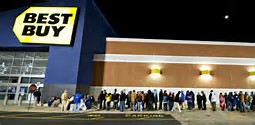 “Standing in line is a pain. At the post office. At the box office. At a restaurant. But on Black Friday, it’s an experience,” writes The New York Times (Nov. 24, 2017). The first spot outside some Best Buy stores is usually claimed weeks in advance, often by a person in a tent. Shoppers at Walmart will print out maps of the store, with circles around their primary targets. Someone, somewhere, will try to cut in line at a Target, arousing the wrath of the cold, cranky people who played it fair.
“These queues are quite different from the usual annoying ones we encounter day-to-day at the A.T.M. or in the subway,” said MIT prof Richard Larson. “People’s willingness to wait is, in some sense, proportional to the perceived value of whatever they’re waiting to acquire. Even if they don’t know what the line is for, they reason that whatever’s at the end of it must be fantastically valuable.”
Lines test patience, personal space and principles of fairness and rationality, especially on Black Friday, when the crowds can be overwhelming. Still, the promise of a once-a-year score lures hordes of shoppers to queues that start before sunrise.
Queuing theory examines why lining up by yourself induces more anxiety than being in a group, why choosing between multiple lines is more aggravating than standing single file and even how music and scent can improve the wait. Black Friday’s preordained opening hours mean that the time the line should start moving is predictable, which can sometimes cause customers to become more agitated as the end approaches. In 2008, a crowd of more than 2,000 shoppers waiting at Walmart store on Long Island began pounding on the glass doors a few minutes before the scheduled 5 a.m. opening time. The doors shattered and shoppers stampeded through, fatally trampling a worker.
Classroom discussion questions:

Robots aren’t just for sale in the toy aisle, they’re gliding down them. “Bossa Nova Robotics is sending its shelf-scanning robots out to 50 Walmart stores in a real-world use of technology to help one of the planet’s largest retailers keep its aisles stocked and ready for customers,” writes the Pittsburgh Post-Gazette (Nov. 9, 2017).
The Bossa Nova uses sensors similar to those on self-driving cars to navigate — taking photos of shelves, as well as recording data about products’ prices, locations and if they’re out of stock. The 2 foot tall white robot simply scans, passes information to the cloud, communicates that data to Walmart’s back-end system and relays that knowledge to store associates.
With e-commerce sales growing exponentially each year, brick-and-mortar chains need to operate near-perfectly to retain customers. A lost sale in a physical retail store has always been an inefficiency, but now the stakes are higher. “The information the robot is capturing is whether there’s an out-of-stock, because that is the biggest frustration of shoppers,” said a Bossa Nova exec. “If they don’t have it, you’re going home without it — or maybe you go to a different store.”
The Bossa Nova Robot employs a number of sensors, including light detection and ranging (lidar) technology, a critical element in self-driving cars. Gliding slowly down a store aisle — at about 0.4 meters per second, or a rather lax walking pace — the robot scans its environment with depth sensors to avoid collisions with shelves, or more importantly, people. As soon as a customer gets close, the robot moves out of the way and shuts off its high beams.
Embedded in the article is a short (1.5 minute video) you may wish to show in class when discussing inventory management in Chapter 12.
“Boeing has begun a push to streamline its supply chain, reducing overlap between existing divisions and cutting layers of management and bureaucracy,” writes the Seattle Times (Nov. 10, 2017). The firm’s enormous global supply chain delivers more than a billion parts to its assembly plants every year, everything from buckets full of fasteners to entire wings for its 787 Dreamliner. The management of that global network is the focus of Boeing’s plan.
One tool it has turned to is increasing its use of modern information technology and digital analytics to track supplies and identify blockages in the pipeline. Boeing’s current supply chain has grown organically over many decades with multiple internal divisions all using separate tracking systems. The extended study, currently under way, will also help Boeing better determine which suppliers are working well and which are underperforming — so that it can allocate contracts accordingly, and in some cases take work in-house.
 Boeing expects the first organizational pieces of the streamlining initiative — bringing together supplier management, raw-material management and elements of engine systems supply — to be in place by year end.
Classroom discussion questions:

Spirit Airlines, at least, is honest about the tight quarters on its planes. “We’re a cozy airline,” it says on its website. “We add extra seats to our planes so we can fly with more people. This lowers ticket prices for everyone, just like a car pool.” It’s not news that airlines have been squeezing more — and smaller — seats into the backs of their planes. The people who run revenue departments — want more seats on planes. They’re up against the marketing people, who are trying to act as their passengers’ advocates.
“To accommodate the airlines, seat manufacturers have been skimming and trimming from just about every dimension, relocating the seatback pocket, replacing padding with elastic mesh and whittling down the armrests,” writes The New York Times (Nov. 7, 2017). While low-cost airlines like Spirit have narrowed the distance between rows of seats to as little as 28 inches, most of the big carriers have kept the distance (seat pitch) at 30 inches. Anything less pushes already travelers to their limits.
“We’ve been using a lot of advanced materials, a lot of composite materials, to allow the actual physical structure to get smaller,” said the VP of a seat manufacturer. “We’ve also removed a lot of the hard points in the seat and gone to fabric suspension systems, leading to seats more akin to ergonomic desk chairs. The less size that the seat structure itself takes up, the more space that’s left over for the passenger.” Or, as the case may be, for more passengers.
Airlines contend that improved ergonomics and, in some cases, slightly wider seats make up for a tighter pitch. But passengers have been getting taller and wider, and regulations still stipulate that planes have to be able to be evacuated in just 1.5 minutes. The seats were originally designed for men who averaged 5′ 10″ and 170 pounds. Right now, the average man is just under 200 pounds.
Classroom discussion questions:
1. How is ergonomics an OM issue?
2. Make the case for more space–then for tighter seats.
 “With foot traffic at their stores in decline, department stores that would have stocked up for the biggest shopping season of the year months ago are still in the process of placing new orders,” writes Supply & Demand Chain Executive (Nov. 8, 2017). The strategy is aimed to keep their inventory costs down and avoid the experience of previous holiday seasons, when large piles of unsold stock led to deep markdowns that eroded profits. But these retailers risk losing sales if supplies run out at a time when many are struggling to keep up with Amazon and the shift towards online shopping.
Macy’s, J.C Penney, Kohl’s, Nordstrom, Dillard’s, Lord & Taylor are among the retailers buying in smaller batches with shorter lead times this year and relying on a more dynamic demand forecasting process than in the past. Keeping inventory levels low helps manage costs, and may also instill urgency in consumers to spend now rather than hold off on purchases in search of a better deal. But it also risks alienating customers who may end up having less choice, and is also putting strain on vendors to deliver on shorter lead times.
The high-stakes strategy takes a page from the playbook of Zara, H&M, and other “fast fashion” retailers that consistently keep low inventories of trendy clothes and try to win customers with cheap prices. Traditionally, retailers lock in most of their purchases 9-12 months in advance. This year, retailers started placing a large portion of their holiday orders 3-4 months before the holiday season, and are refreshing fast-selling items within as little as 6-8 weeks.
The risk: Department stores rely on vendors whose traditional supply chains are not built for a fast turnaround, because they handle orders for several brands. Fast-fashion chains, on the other hand, have designed their supply chain to shift on a week to week basis and work with vendors who can deliver quickly on private label items they stock. So far this year, retailers have been willing to sacrifice some orders for tighter inventory management and higher margins.
Classroom discussion questions:
 As consumers demand ever-quicker and convenient package delivery, the US Postal Service wants to boost its business this holiday season by offering what few e-commerce retailers can provide: cheap next-day service with packages delivered Sundays to your home. Retail giant Walmart says it is considering the Sunday option, which could reshape weekend shopping trips to the mall.
The program, available in 20 major US cities, allows consumers to place online orders with participating retailers before a cutoff time Saturday. Postal carriers pick up merchandise from local stores for delivery the following day, similar to the Sunday package deliveries it now handles almost exclusively for Amazon in much of the US.
“The next-day weekend service is part of the Postal Service’s aggressive push into the parcel business at a time when its more lucrative first-class mail is declining in the digital age,” writes the Boston Globe (Nov. 4, 2017). With Amazon continuing to raise the bar of ‘‘free shipping’’ conveniences, from 1- or 2-day package arrivals to keyless in-home delivery via couriers, the financially beleaguered post office is billing itself as the trusted, low-cost carrier already serving every US household.
Bolstered by e-commerce growth and its Sunday operations, the Postal Service will reach new highs this year in holiday package delivery, with nearly 850 million parcels delivered from Thanksgiving to New Year’s. That 13% increase from 2016 would exceed the single-digit growth for UPS and FedEx, putting the post office on track to capture 45.6% market share in peak holiday deliveries. The post office’s growth is due in large part to its established network in the ‘‘last mile,’’ the final and usually most expensive stretch of a package’s journey to a customer’s door. UPS and FedEx already subcontract a chunk of their last-mile deliveries to the post office.
Classroom discussion questions:
 For many profs, student assessment is one of the most labor-intensive components of teaching a class. The work continues as the tests are scored, papers read, and comments shared. Performing authentic and meaningful student assessment takes time. Consequently, some instructors construct relatively few assessments for their courses.
Unfortunately, this practice limits our ability to reliably assess student learning. If a course grade is a mosaic, then each assessment is a tile. A mosaic with just a few tiles only presents a part of the picture. “We can improve the quality of our assessment mosaic by increasing the number of performances we assess,” writes Faculty Focus (Oct. 30, 2017). These smaller and more frequently administered snapshots of student learning are called “formative assessments.” The integration of frequent formative assessments improves the validity of course assessment and has been demonstrated to have a variety of benefits, including improving student achievement and helping students develop more agency over their own learning.
Our MyOMLab assessment tool allows for automatic grade responses to algorithmic homework and test questions, to multiple choice questions, and to video and OM in the News questions. In addition to simplifying formative assessment, the use of this tool has been shown to amplify student engagement. Tech-enhanced formative assessments produce actionable data that can help students learn more efficiently. (MyOMLab also automatically calculates means and medians for every assignment and exam, and, in fact, metrics for every question are summarized, including number who attempted it, number correct, number with partial credit, number incorrect, and average time spent. Plus, that information can be retained in the MyOMLab system for several years as long as the course hasn’t expired yet).
Over 60% of our text adopters have implemented MyOMLab into their OM courses. It’s easy to do (learning takes less than an hour) and Pearson’s reps are always available for one-on-one training. Here is a link to locate your local Pearson representative: http://www.pearsonhighered.com/educator/replocator/.

Waymo, one of the leading forces in self-driving technology, is enlisting the largest auto retailer in the U.S., AutoNation, to maintain and repair the growing number of driverless vehicles Waymo is testing around the country. Waymo — a unit of Google’s parent, Alphabet — is moving a step closer to putting driverless vehicles into ride-hailing fleets that would serve the general public, not just its own employees. Maintaining expensive and technology-packed self-driving vehicles is a main challenge for using them in moneymaking businesses, like ride-hailing fleets, writes The New York Times (Nov. 3, 2017).
Says AutoNation’s CEO. “In most cases, driverless vehicles in such fleets will have to be on the road almost around the clock to offset the cost of the sensors, computer chips, software and other systems that allow them to drive safely and reach their destinations without human operators. These vehicles need to be in service for hundreds of thousands of miles, much more than personal-use vehicles, to make them economically viable. To do that, you have to do much more proactive, preventative maintenance than what a normal person would do on a car.”
Because the vehicles are intended to operate without drivers, breakdowns have to be avoided and parts replaced when signs of wear first appear, not when they fail or when a warning light comes on. They need to work not 99% of the time, but 100% of the time.
Auto dealers, like AutoNation, sell cars, but a big chunk of their profits comes from servicing vehicles. They are looking for ways to become more relevant if car usage becomes more of a shared service.
Classroom discussion questions:

It might seem strange, but UPS delivery vans don’t always take the shortest route between stops. The company gives each driver a specific route to follow and that includes a policy that drivers should never turn through oncoming traffic unless absolutely necessary. This means that routes are sometimes longer than they have to be. So, why do they do it?
Every day, along with thousands of other companies, UPS solves versions of the vehicle routing problem (see Online Tutorial 5). In these mathematical problems, you are given a set of points and the distances between them, and you have to find the best route(s) to travel through all of them. Best is usually defined as the route with the shortest overall distance. Vehicle routing problems are used to organize many things, from coping with more delivery trucks in cities and hailing taxis to catching chickens on a farm.
UPS has designed its vehicle routing software to eliminate as many left-hand turns as possible. Typically, only 10% of the turns are left turns. As a result, the company uses 10 million gallons less fuel, emits 20,000 tons less carbon dioxide and delivers 350,000 more packages every year. The efficiency of planning routes this way has even helped the firm cut the number of trucks it uses by 1,100, bringing down the company’s total distance travelled by 28.5 million miles – despite the longer routes. The TV series Mythbusters tested this idea and confirmed that, despite many more turns, the policy of only turning right does save fuel.
Here is an entertaining 1 minute video illustrating the point. You could show it when discussing sustainability (Supp.5) or process analysis (Ch.7).

When the robots came to online retailer Boxed, dread came too: The fear that the machines would take over, leaving a trail of unemployed humans. Yet this did not come to pass. When the new warehouse opened this spring, workers found that their jobs were less physically demanding than at the previous, manual warehouse in Edison, NJ. And rather than cutting jobs, the company added a 3rd shift to keep up with rapidly growing demand.
“What happened at Boxed – and elsewhere – suggests that widespread fears about automation and job loss are often misplaced,” reports The Orlando Sentinel (Oct. 31, 2017, page A9). Automation has actually helped create jobs in e-commerce, rather than eliminate them. By accelerating delivery times, robotics and software have made online shopping an increasingly viable alternative to bricks-and-mortar stores, and sales have ballooned at online retailers.
The surge in e-commerce has required the rapid build-out of a vast network of warehouses and delivery systems that include both robots and human workers. Even if the robots replace some people in each warehouse, the proliferation of new warehouses should still generate hiring for years to come. Jobs have been lost at storefront retailers, which have suffered under the e-commerce onslaught.
But worries about a “retail apocalypse” wiping out many of the nation’s 16 million retail jobs have missed a more important trend: E-commerce leads to more jobs, by paying people to do things we used to do ourselves. Amazon accounts for much of the additional employment. Yet it’s also at the vanguard of automation. Since 2014, Amazon has deployed 100,000 robots in 25 warehouses worldwide. It’s tripled its hourly workforce, from 45,000 to 125,000. At Amazon’s Baltimore warehouse, employees called “stowers” are needed to stock the shelves that are carried by robots. And that requires human judgment: Software suggests to workers where each item should be placed. But it’s an employee’s responsibility to make sure the shelves, which are tall and narrow, remain balanced.
The explosion of online commerce is also building demand for higher-paying jobs in software and robotics, with 14% of software job listings are now posted by retailers.
Classroom discussion questions:
1. Why can’t warehouse such as these be totally automated?
2. What is the future of storefront retailers?