OM in the News: Disney Service Quality Spreads to Medicine

Disney has been long respected for excellent customer service and for treating its “guests” with the personal touch that improves the theme park visit. Disney’s “on-stage” and “off-stage” approach to separating public and private areas is well-known, with “cast members” (employees) always maintaining a magic image to the public. The Orlando Sentinel (July 16, 2011) now reports that Disney has designed a program for health-care professionals to assure that patients are as satisfied with a trip to the hospital or doctor’s office as they are with a trip to the theme park.

For $3,500 each, health-care workers spend  3 1/2 days at Disney, learning to pay closer attention to the patient experience. “Oftentimes in health care, the patient in the bed is almost secondary”, says a consultant. “Everyone comes in looking at their task instead of the patient”.

When Disney worked with Florida Hospital to open a new children’s pavilion a few months ago, the plan includes simplified name tags, new uniforms, a ban on cell phones, greeting patients with a smile, and kneeling down to talk to children at eye level. (Our Table 6.5 in the Managing Quality chapter relates to these “determinants of service quality”).

“By exceeding expectations, doctors can attract new clients through referrals from satisfied patients”, says Dr. Chris Smith, a S. Carolina family doctor who attended the Disney program. At Smith’s office, the receptionist is now a “greeter”. And he has established off-stage private break rooms for staff to relax, vent, or do things a patient should not see. Just like other industries, doctors are learning that every service activity matters.

Discussion questions:

1. Ask students to describe a positive and a negative medical service experience.

2.  What other quality tools can medical professionals employ from non-medical fields?

Good OM Reading: What Really Happened to Toyota?

Consumers in the US were surprised in Oct., 2009, by the 1st of a series of highly publicized recalls of Toyota vehicles. It began with 3.8 million cars brought back  for uncontrolled acceleration. Over the next 4 months, 3.4 million more  recalls followed for gas pedal and software glitches. Then from Feb.-Aug., 2010, 13 more recalls followed. Just as things seemed to be settling down, 2 more recalls were announced in Jan.-Feb., 2011. The total had now reached 20 million vehicles!

How could this happen to the company that shaped the modern approach to quality improvement, asks UC-Berkeley Prof. Robert Cole  in his excellent article in MIT Sloan Management Review (Summer, 2011). Had auto execs all over the world “been chasing after the wrong manufacturing model”? And to what extent did the problems originate with product design and assembly and to what extent to Toyota’s manufacturing systems?

One factor Cole found was a “reverse halo effect”. Toyota buyers in 2010 had heard a barrage of negative news and became far less forgiving about minor quality flaws than previous owners. A 2nd factor was that competitors’ products were improving to the point that Toyota didn’t look as outstanding by comparison as it had in the past.

Cole’s analysis found 2 root causes for Toyota’s problems: (1)management’s ambitious plans for rapid growth (which did not focus on quality issues already arising), and (2) the increasing complexity of the actual auto product.

I think this is an article that you will enjoy reading and that you will be able to use in your OM class.

Teaching Tip: What Can You Expect From Your Hotel?

When you are teaching  TQM in services (Ch.6), you might ask your students to consider how they would rate the quality of hotels they have stayed at. We write in the chapter about the intangible differences between products (hotels) and the intangible expectations customers have of these products. Certainly, we all have lower expectations of service quality when we stay at a Motel 8 versus when we are guests at a Ritz Carlton or Four Seasons. (See in our video case study “Quality at the Ritz”).

I bring this up because my family and I  just returned from our big vacation of the summer– a 3-night stay at what some claim to be the premier resort hotel in the Caribbean. The “product” was really on the  expensive side, so our expectations ran high. World class facilities, food, service, and activities were all on the list.  The people/services were extraordinary. Every single employee we came in contact with was gracious, smiling, helpful, and courteous.

But one of the reasons we came in contact with so many hotel staffers was that so many things went wrong with the tangibles. My wife counted over a dozen repair people (all warm and friendly) in our rooms during the 3 days– yet the problems kept coming. First the broken shower head was replaced. Then a deadbolt that locked my 13-year-old in and us out (which had to be drilled out). Then no sound on the TV, as well as a missing remote. To boot, the sink was dirty (brown) when we arrived. But the real issue was the unflushable toilet! After 4 visits to first replace the insides, then to repair it over and over, the toilet still ran all night long. I worked on it myself a few times, then gave up and put 4 towels and a bathrobe over it to mask the noise.

How did the manager handle service recovery? The LEARN routine was followed perfectly, and a discount was even applied. But would we return to a hotel that had such problems? Very doubtful.

Teaching Tip: Why Did the Chevy Steering Wheel Fall Off?

Imagine speeding along the roadway in your brand new 2011 Chevy Cruze, turning your car’s steering wheel, and the wheel breaks off from the steering column!  It’s an interesting story (in The Wall Street Journal, April 10,2011) that certainly ties in with our discussion of quality in Chapter 6. 

Of course, it’s every driver’s nightmare, but in particular to the person who it happened to a few weeks ago. As a result, GM is recalling 2,100 new cars and facing an unwelcome development while it rides high on the compact Cruz’s sales success.

According to the NHTSA (Nat’l Highway Transportation Safety Admin.), the wrong wheel was put in this particular car, then replaced later with the correct one. But the new wheel was not attached properly.

This raises some good issues to discuss in teaching quality in class. First, how did the wrong wheel end up on the assembly line? (JIT delivery gone awry?  What was the root cause of this defect?) 

 Second, why was it that a wrong wheel could fit on the column? (No poka-yoke system in place?)

 Third, was there no Andon call signal to alert supervisors that such a problem had popped up? (Could it have happened before and no one pointed it out?  Had it happened at a different plant? Is there a struggle to change from the old Detroit mentality that the line should never be stopped?)

Chevrolet says “it has changed the production process to make sure the machine used to attach the steering wheel can accommodate only the correct one”.  I like this story because it raises several teachable issues.

Good OM Reading: Safe Patients, Smart Hospitals

After reviewing The Checklist Manifesto for our blog a few months ago, I wondered how Dr. Peter Pronovost’s  book, Safe Patients, Smart Hospitals would add to the important role  OM plays in hospital quality. Simple and avoidable errors in hospitals around the world are made each day that cost the lives of patients. Inspired by 2 tragic medical mistakes —  his father’s misdiagnosed cancer and  sloppiness that killed  an 18-month old child at Johns Hopkins– Pronovost has made it his mission, often swimming upstream against the medical culture, to improve patient safety and prevent deaths.

He began by developing a basic 5-step checklist (see Ch.6) to reduce catheter infections. Inserted into veins in the groin, neck, or chest to administer fluids and medicines, catheters can save lives. But every year, 80,000 Americans get infections from the central lines and 30,000-60,000 of these patients die.  Pronovost’s checklist has dropped infection rates at hospitals that use it down to zero, saving 1,000’s of lives and tens of millions of dollars.

His steps for doctors and nurses are simple: (1) wash your hands, (2) use sterile gloves, masks, and drapes, (3) use antiseptic on the area being opened for the catheter, (4) avoid veins in the arms and legs, and (5) take the catheter out as soon as possible. He also created a “central line cart”, where all supplies needed for the procedure are stored.

Provonost believes many hospital errors are due to lack of standardization, poor communications, and a non-collaborative culture that is “antiquated and toxic”. Whereas safety in the airline industry is a science, and where every crew member works as part of the team, he writes: “doctors think they are infallible”.

This is an inspiring book which shows how one person, with small changes, can make a huge difference in patient care. Your students in the health care areas will appreciate the OM insights provided. An interview with Dr. Pronovost appears in The Wall Street Journal (March 28,2011).

Video Tip: Darden Restaurant’s Quality “From Farm to Fork”

What I really like about this 12 min. video on Darden Restaurants (Olive Garden and Red Lobster) is that the VP-Quality comes right out and says “we use SPC charts, Pareto charts, process flow diagrams, fishbone charts, and scatter charts”. When you are teaching Ch. 6 and Supp. 6, it’s good for your students to hear that a real company is employing all the tools they see in the text (as in Figure 6.6).

Darden calls its quality program “From Farm to Fork”, since the inspection process begins at the food source (be it farm or pond), continues with inspections throughout the supply chain, and ends with a final check by the chef and server before the customer is served. Fifty scientists and health specialists work in QA throughout the world, most close to the food source outside the US. With 50 million pounds of seafood coming into the US for Darden each year, it is clear that quality cannot be considered just at the end of the supply chain.

The video presents real data in the form of x-bar and R-charts and capability histograms and shows what happens when specs are not met on products like steaks, salmon fillets, and chicken breasts.

Before showing the film, you may want to ask students where they think inspections are taking place on a fish that is caught in Thailand and served 48 hours later in say, Dubuque, Iowa.

OM in the News: Quality Tales– Dogfish Beer and Zappos

If you are looking for a few interesting examples of companies choosing quality of service over quick money, here are two firms that I discovered in the news today: Dogfish  Head Beer and Zappos.

The Delmarva Daily Times (March 15,2011) reports that Dogfish, a well-known Delaware  brewery, just decided to stop its explosive growth by pulling out of markets in four states. Sales of  “off-centered beers for off-centered people” had grown into 30 states in the past 9 years. Founder Sam Calagione, a Discovery Channel minor celebrity, decided that Dogfish ramped up production too far, too fast, to guarantee quality. The expansion even resulted in shortages in the firm’s home state. Fans may be frustrated in Tennessee, Rhode Island, Indiana, and Wisconsin, but the company’s reputation for quality will be preserved.

Meanwhile, Next Montreal (March 16,2011) is reporting,  very unhappily, that Zappos is shutting down completely in Canada. Here is the message that the shoe e-tailer has just posted on its website:

We have made the difficult decision to shut down the canada.zappos.com site and stop shipping to Canada. One of our core values is to “deliver WOW through service”. That means the best selection of brands and products that can meet just about every individual’s needs as well as fast, free shipping and free returns, all at competitive pricing. Our Canadian customers know that we have not lived up to these service levels.
  
Zappos has struggled with uncertainty and unpredictability of delivering orders to Canada, given customs and other constraints. Considered by many to be  one of the best on-line retailers, it was not willing to risk its reputation for quality in a market where it could not meet its own standards.
 
In today’s economy, it is indeed unusual to see firms cede market share in order to maintain such high quality.
 
Discussion questions:
 
1. Refer to Table 6.5, Determinants of Service Quality, and relate Zappos’ decision to the 10 items.
 
2. What did Dogfish view as the danger of rapid expansion?

OM in the News: Tylenol, J&J, and a Quality Disaster

A timely topic to bring to your students when discussing quality (Ch.6) is an embarrassing and expensive problem currently facing Johnson & Johnson. It’s a tale that has been making news for months now,  but just ended with the US government taking over 3 Tylenol plants a few days ago (New York Times,March 10,2011). This follows a blizzard of drug recalls and an FDA criminal investigation into safety issues at the factories. The government also indicted two execs, the VP-Quality and the VP-Operations, for failing to comply with manufacturing standards.

The scathing report on 20 manufacturing violations and criminal investigation follows eight recalls of Tylenol, Benadryl, and Motrin that have been ongoing since  2009. J & J was warned over a year ago about the unsanitary and unsafe practices in the plants (one in Puerto Rico and two in Penn.), but the company was slow to fix them. Now, all drugs recalled must be destroyed, a “consent decree” allows independent experts to control the plants until safer manufacturing processes are in place, and one of the Penn. plants will remain closed until the FDA stamps its approval. Fines will also be levied at $15,000 per day up to $10 million annually until the FDA clears the company.

Production is expected to be hurt while the corrective actions take place. But as Philip Crosby wrote in his 1979 classic, Quality is Free, “What costs money are all the actions that involve not doing it right the first time”.

Discussion questions:

1. What happened in Tylenol’s 1982  famous recall?

2. What did Crosby mean when he wrote “quality is free”?

3. What is the role of OM in this dilemma?

OM in the News: Service Quality and The Four Seasons

When we talk about service quality at hotels, the first brand that usually comes to mind is the Ritz Carlton. As a matter of fact, we have a video case study in Ch.6 that highlights how the Ritz earned its Baldrige Award. But every bit as superb in quality standards is the Four Seasons, which just this week opened its latest hotel, the London Park Lane. And by coincidence, Fortune magazine this week ranked the Four Seasons #53 in its “Best 100 Companies to Work For” (Feb.7, 2011), making it the top hotel chain on the list. ( Marriott was the only other to made the grade).

An article in today’s issue of Four Seasons Magazine  provides several insights. “We’ve identified that our key competitive difference is our people”‘ says the London manager. “We spend a great deal of time finding the right people”. First, most management positions were filled by Four Seasons managers from existing hotels—a tactic to infuse the company’s culture.

Then a “mass hire” day was held in London 3 months before opening. A lucky 1,000 people were interviewed, each by up to four company execs, including the London GM. Questions focused on essential Golden Rule character attributes, seeking individuals who are warm, caring, ethical, and well-intended. Existing staff from other locations moved to London for several weeks to train and assist in opening.

Like the Ritz, the stories of the Four Seasons staff are legendary:  loaning  a guest a pair of  jeans, flying to another city to deliver forgotten documents, bringing chicken soup at the mere mention of a cold, sewing on a missing button, bringing a child a teddy bear, and always memorizing guest names. The goal of staff is to also anticipate any possible requests.

Discussion questions:

1. Why would staff rate the Four Seasons so highly as a place to work?

2. What are the major components of service quality and how does this chain address them?

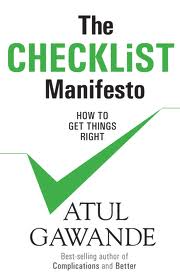
Good OM Reading: The Checklist Manifesto

Here is a popular book that deals with quality issues (Ch.6) in medicine by extolling the use of checklists. Dr. Atul Gawande’s The Checklist Manifesto: How to Get Things Right (Metropolitan Books,2009) will add to your TQM lecture with some interesting examples. Gawande points out that just as airline pilots use checklists before takeoff,  surgeons need checklists, which are proven to reduce mortality from operations.

The medical culture, unfortunately, often includes doctors who are just plain rubbed the wrong way by such a tool. Surgeons, in particular, view themselves as individuals whose skill and reputation are all that is needed in the OR. Gawande uses a WHO study to show that surgical complications dropped by more that one-third when checklists were used.

The checklists includes such items as: making sure everyone in the OR knows everyone else’s name; that blood for a transfusion is on-hand; and that the pre-op was performed correctly. Medicine, he says, has become so incredibly complex that mistakes are virtually inevitable.

The Huffington Post (Jan. 6,2011) has a quick review of the book, followed by a 6 minute video clip of Gawande being interviewed recently on the Steven Colbert show. (Note that you have to scroll down about 6″ to get to the video link). I am not a huge fan of the show, but somehow I think your students will find it hilarious. They seem to understand his humor, and at the same time, Gawande does make  his point about checklists.

Guest Post: Teaching Quality Control with Olive Garden Breadsticks

Here is a great Chapter 6 teaching tip that is sure to make you popular with students – especially if you offer some extra credit.  Send them on a “breadstick quality control” mission.  A number of years ago, I helped the Olive Garden Restaurant chain solve an important problem.  Their breadsticks were inconsistent.  They were varying colors, sizes and shapes.  The breadsticks are a signature item for Olive Garden, so management needed to define the extent of the problem, and to change the quality control.

I will not go into the whole process of solving the problem, but I will tell you that I began by visiting Olive Gardens and observing the breadsticks, even measuring them and recording variations in color and shape.  There was no doubt about it, there was a striking inconsistency, indicating a quality control issue.  After working with their bakeries, and finding a problem in the production chain, the restaurants once again had a delicious, high quality, consistant product.

Are the breadsticks at the Olive Gardens still consistent?  Why not send teams of students to dinner and ask them to record their observations.  With today’s technology, they can even take pictures of “problem breadsticks” and share them with the class. You can also discuss these 3 questions with the class:

  1. Why are breadsticks such an important item in the Olive Gardens?
  2. What are other examples of signature items in restaurants or other businesses?
  3. Before you visit the restaurants to do a quality control survey, what equipment do you need, and what exactly will you be looking for?
  4. 

Prof. Bill Quain currently teaches at Stockton College in NJ. He previously held endowed professorships at the U. of Central Florida and at Florida International U.

Guest Post: Continuous Process Improvement Tools

We welcome  this Guest Post from  Kevin Watson, Asst. Prof. in the Dept. of Supply Chain and Info. Systems, at Iowa State U.

OM students are frequently reminded that data accuracy is a prerequisite to effective inventory management and operation of MRP systems- in fact Barry just blogged about this on November 4th. As professors, we often discuss the application of lean and quality improvement techniques; however, discussion tends to focus on manufacturing processes and students frequently miss that continuous improvement techniques can be applied to non-manufacturing activities. An article I just read, “Continuous Improvement Approach Reduces Errors in Records” , provides an example of continuous process improvement tools utilized to address paperwork errors.

The article discusses a holistic solution to address record errors in shop floor packets traveling with medical devices during manufacturing. MEDRAD, a 2003 Malcolm Baldrige National Quality Award recipient, experienced error rates as high as 20% in the paperwork necessary to track products through manufacturing ,resulting in compliance issues and causing unnecessary rework and delays. The company addressed this issue through the use of a quality improvement project utilizing technology, process, and people based solutions. The project resulted in a reduction of record inaccuracy to 2.2%, saving the company $40,000 and accruing significant non-financial benefits.

Addressing non-manufacturing errors while retaining the familiar touchstone of the manufacturing environment, it is an excellent means to expand student understanding of quality management tools applied to non-manufacturing processes and to begin the discussion of their application in the service/administrative environments. The article would be an excellent complement to the Quality Management chapters (Ch6/S6) and could be touched again during a discussion of inventory record accuracy in conjunction with Material Requirements Planning (Ch 14).

OM in the News: Detroit Moves Up in Auto Reliability, But Asia Still Rules

People buy cars for all sorts of reasons: styling, prestige, safety, and even color. But a reputation for quality and reliability is the one constant to almost every consumer, according to The Wall Street Journal (Oct.27,2010). With this week’s  release of Consumer Reports’  rankings of new auto reliability, there is some good news for Detroit.

Ford and GM have greatly improved the reliability of their vehicles, and in some sectors are ranked better than their Asian counterparts. The Ford Fusion, for example, is now tops in the “family car” segment–bettering  the Toyota Camry, Honda Accord, and Nissan Altima. Ford is the top American company overall.

Chrysler, sadly, has still not taken off and is dead last in the rankings. Toyota’s once sterling reputation was also dinged;  its Prius hybrid fell to “average” from its once high-rating because of recalls and brake problems. BMW ranked only 24 out of 27 brands, underlining how luxury car makers face quality challenges as they insert advanced technologies (that don’t always work perfectly) into their vehicles.

Good quality, as we in OM all know, creates an upward circle: the more reliable the car, the more people are willing to pay, and then the  less discounts are needed. “It doesn’t take very long to lose a good  reputation, but it takes 5 or 10 years to gain one”, says a Consumer Reports director.

Discussion questions:

1. Give some examples of products (cars included) where it took years to rebuild a damaged quality reputation.

2. Why is the Honda family of vehicles ranked consistently high?

3. Ford is now ranked 10th out of the 27 auto makers. What will it take to move to the top of the pack?

Video Tip: Arnold Palmer Hospital’s Culture of Quality

A few weeks ago, I visited my neighbor Artie while he was in the hospital. It was a typical large facility, with long hallways, nice private rooms…some of which had great views of the lake. But when I entered his room, the first thing I noticed was that the trash can was not only filled, it was overflowing!  As I left, I stopped at the nurses’ station to report this “defect”. The response: “Maybe you should call management to let them know”.

I can say that at Arnold Palmer Hospital for Women and Children (APH) this would never have happened. When you show this 10 minute video in class, you will see why. The culture of quality is ingrained deep at APH.

Let me give you a little off-the -record background about our filming experience, which was a fantastic learning exercise that resulted in 7 APH video cases in the text. I first sat through the  new employee orientation period. One of the 1st cultures I learned was that hospital employees always keep a positive face in all public spaces. No one may be heard talking about how bad their day is, problems at home, or troubling patients. The hospital has private staff corridors that parallel the public ones. Only there can staff speak openly. Second, all top administrators at APH are former nurses, who worked their way up. Kathy Swanson, the director, has an MBA, and others also have business training. I believe they have a culture of caring about patients above all else. Note in the film how they each take calls from patients 24/7.

We have 2 videos dealing with service TQM in Ch.6, the other being Quality at the Ritz-Carlton Hotel (7.5 min.). I prefer to show the APH film because the hospital incorporates several Ritz concepts, including empowering any staff member (even janitors) to hand up to $200 in gift cards to any patient with a complaint. My friend Artie could have gotten rich if his hospital had such an attitude!

Jay and I are especially proud of this APH video as it took 1st place in the annual Addy video competition in 2005. Out of 13,000 entries, it won the highest award, the Silver Telly.

Teaching Tip: Helping Your Students Find Jobs

We all know the economy is still weak ( to put it mildly), and this means our students are  in  tough positions to find their first jobs. Where we stand in Florida, it seems as though the alligators are nipping at our economic feet. With a quarter of the economy here in Orlando driven by construction, you can buy a nice condo that sold for $160,000 in 2007 for $20k today!

So what can we do to help our OM students to be more competitive as they enter the job market?  Since everyone graduating already has the same basic set of skills (eg., Excel, Powerpoints, etc.), how can OM  add value?  Here are 2 suggestions:

1.Project management is an interesting topic (Ch.3) that is certainly useful in so many jobs. We cover MS Project lightly towards the end of the chapter. But I am convinced that mastering MS Project can give a competitive edge. Last year, I provided all 75 of my students the chance to build their resumes by offering a 1-credit independent study course called “Using MS Project in Project Management”. All they had to do was find a project with at least 30 activities, and create a series of MS Project charts, along with a 1-page report. Our publisher’s reps at  Pearson will provide you with as many free copies of the full-blown MS Project ( time limited) as you request. It includes an excellent Tutorial, which picks up where the text leaves off. Amazingly, 25 students signed up to build their transcripts/resumes. They produced some impressive reports and picked up a useful skill.

2. The 2nd hot button I like is to get a Six-Sigma Green Belt while in school. My colleague Jim Gilbert offers his TQM course every Fall semester.  As an option, Jim arranges (at an extra lab fee of  $900) for students to get certified as Green Belts. Over 30 students a year take this option and enter the workforce with a wonderful credential.