OM in the News: Trying to Forecast Demand for COVID-19 Tests

Just as stores are discounting once scarce bottles of hand sanitizer, many people have more than enough rapid tests filling up their drawers. That includes the free tests shipped directly to homes by the U.S. government. And now insurance companies will pay for 8 tests per person per month.

Supply chain difficulties have become standard for nearly all businesses during the pandemic. But one of the bigger issues with the COVID-19 testing supply chain is determining demand, especially for at-home test makers, writes Supply Chain Dive (April 14, 2022). Manufacturers would shutter factories, only to scramble to reopen them when new waves of the virus pushed up demand.

Longhorn Vaccines and Diagnostics received an FDA request to massively scale up demand for at-home tests in 2020. The company historically produced at most 100,000 units a year, and the FDA was requesting 3 million units a week. Longhorn was able to make 50 million units that year after ordering large quantities of chemicals from China and working with tube manufacturers to scale up production. In early 2021, the company decided to stock up even more on chemicals to ensure it could last through 2 years of peak COVID. Storage costs were high, but the company couldn’t afford to run short on the chemicals. Then, in February 2021, testing slowed. One week Longhorn was selling 10 million units, and the next week, people were canceling orders. So when orders stopped, the supply chain was already full of tests.

At-home testing is challenging because it’s essentially a new market, as we note in Chapter 4, and it’s hard to find similar products for comparison in forecasting. There is no historical data as a comparison. There is also volatility over what is driving demand. It can be the community infection rate, office or school requirements, requirements for travel, policy issues, port availability, and cost. Predictive analytics (our topic of Module G) can be used to anticipate demand, but these analytics must be taken with a grain of salt due to the volatility.

There are costs of having too many and too few products: If a company estimates a demand for 1 million tests per week, does it expect variability between 900,000 and 1.1 million, or between 500,000 and 1.5 million? That affects production and logistics, with supply procurement, warehousing, and trucking reservations.

Classroom discussion questions:

  1. What forecasting techniques in Chapter 4 might be used in this case?
  2. What are the 3 categories of analytics noted in Module G?


OM in the News: Boeing’s Operations Management Problems

Some 787s are even being stored in the desert.

How would you like to be in charge of operations at Boeing? There are forecasting problems, capacity issues, quality failures, and supply chain snarls. The result: Boeing’s commercial airplanes unit delivered an operating loss of $472 million in the quarter, says The Wall Street Journal (July 28, 2021).

This follows two all-consuming crises. Its MAX jets had been grounded for nearly two years after two fatal crashes that took 346 lives, and the pandemic had sapped demand for new airplanes as passengers stayed home and airlines retrenched. The company has also grappled with production-quality problems on its 787 Dreamliner. Global airline capacity remains 30% below pre-pandemic levels and industry executives expect it to take until 2024 to catch up.

U.S. aerospace companies last year announced plans to shed more than 100,000 jobs, including many at Boeing’s 12,000 suppliers. Boeing itself has plans to cut its own workforce by almost 1/5 to around 140,000 by the end of this year. While the return of the 737 MAX has bolstered sales and cash, Boeing has recently slowed Dreamliner production while it addresses new issues with the planes. The company has delayed deliveries to fix defects that emerged about a year ago and is awaiting regulatory approval for a plan to inspect aircraft. With customers unwilling or unable to receive deliveries of their new 787s, Boeing has 50 undelivered widebodies scattered around its facilities and is running out of space to park them.

The new 787 problem surfaced on the forward pressure bulkhead at the front of the plane. It involves the skin of the aircraft and is similar to a previously disclosed Dreamliner issue found elsewhere on the planes. Engineers at Boeing and the FAA are trying to understand the defect’s potential to cause premature fatigue on a key part of the aircraft’s structure.

Further, the firm needs orders from China to participate fully in a stronger-than-expected recovery in air travel. Boeing hasn’t secured a direct new jetliner order from China in almost 4 years, and has been pushing for improved trade relations with the U.S.  Boeing’s payroll depends on U.S.-China trade relations, says its CEO.

Classroom discussion questions:

  1. How can Boeing forecast jet sales in the coming years? What techniques in Chapter 4 of your Heizer/Render/Munson text are applicable?
  2. Why is Boeing facing continuing quality problems?

OM in the News: Fighting Pandemic Stockouts

Plenty of retailers and supply chains are still suffering from stockouts. From cleaning products, to kettlebells, to appliances, to meat, retailers, manufacturers and suppliers are coming up short. Forecasts need fixing in a period of severe economic upheaval such as a pandemic–and this article in Supply Chain Dive (Sept. 8, 2020), has 4 ideas for making the changes.

  1. Supply chain managers should plan more often. Companies normally planning on a monthly cycle should switch to every 2 weeks; those on a 2-week cycle should shift to weekly. As demands related to coronavirus mash up with those of the upcoming holiday season, it is critical to have more data points and more sophisticated methods around demand planning to account for some of that volatility and surprises.
  2.  Focus on core products and customers. Companies can learn from how home improvement retailers operate during natural disasters. Instead of trying to keep everything in stock, they focus on the most in-demand items. Several large brands and retailers have employed the core product tactic during the pandemic, cutting back SKUs and, in some cases, entire product lines.
  3. Shift more manufacturing to the U.S.  A domestic U.S. industrial company with 2-3 factories with 4-5 distribution centers has a lot more ability to flex up and add shifts, even with the new social distancing and safety measures that are required because of COVID.
  4. Give something new a shot. If items are in short supply, and not coming back on board anytime soon, companies can  try a new brand or a new product — maybe one they have considered bringing in. Those items may be easier to get, and customers are more likely to be receptive to having an alternative option rather than nothing at all.

Classroom discussion questions:

  1. Which of these would be most critical to a sports equipment manufacturer today?
  2. How must forecast methods change?

OM in the News: A Forecasting Nightmare for Farmers

In early July, S. Carolina farmer Jeremy Storey dropped off an order of eggs at a restaurant’s back door as planned and continued on his way. But 6 hours later, he got a call  that the eggs were never collected — the restaurant had suddenly closed because a staff member tested positive for Covid-19, and nobody canceled the order. After half a day in the hot sun, the eggs could no longer be eaten.  “Half the restaurants we’re going to now, we find out upon delivering to them that they’re closed,” he said. He’s now sitting on a surplus of about 24,000 eggs, with no idea when, or if, things will stabilize.

The unpredictability is a major problem for farmers. If they can’t forecast what demand for eggs (and other products) will look like tomorrow, much less months out, they run the risk of overproducing — which would leave them with expensive surpluses — or underproducing, which would prevent them from having enough product on hand to meet demand.
Now, just as restaurants began to resume dine-in service, a new surge of coronavirus cases has paused reopening plans and put farmers back in limbo — and made it even more difficult to forecast. Planning is essential to farmers because they have to anticipate their customers’ demand months, and sometimes years, ahead of when they deliver so that they have enough time to grow crops or raise animals, writes CNN Business (July 16,2020).
Uncertainty “is really what’s causing the problem,” said a union exec. “There’s no end in sight. That makes it “really hard to plan for the future.” If the uncertainty drags out for another year or two, he said, some farms and restaurants will go out of business. It also means that some restaurants that make it through this dark period won’t have a steady source of supply at the other end.
Classroom discussion questions:
1   Should demand during the pandemic be excluded from future time-series forecasts?
2.  With so much uncertainty, is it better to raise or lower production for the next agricultural cycle?

OM in the News: The Wine Supply Chain

Combined with a decreased demand for wine, drinkers can expect to get better value for every drop they drink this year. The cheaper prices may even last up to 3 years. Vineyards in Northern California began planting thousands of acres of new vines in 2016, and with more efficient harvesting methods, it has led to more bountiful harvests of grapes. Having more grapes to make wine sounds good, but if there’s not enough demand to support increased production, the surplus grapes go to waste.

“Since it takes up to 5 years to bring wine to market from the initial planning stages of planting a vineyard, it makes hitting future demand very complicated. In this case, we overshot demand.” said an industry expert. Wine consumption has dropped for the first time in 25 years, with more Americans turning to liquor and ready-to-drink cocktails. “Today, the wine supply chain is stuffed,” says the newest State of the Wine Industry Report. “This oversupply, coupled with eroding consumer demand, can only lead to discounting of finished wine, bulk wine and grapes.”
Prof. Howard Weiss, from Temple U., who sent us this link, has these 3 OM takes on the article:
1. Forecasting. The forecasts did not anticipate the change in the type of alcohol wine drinkers would turn to.
2. Efficiency. We usually think of improved efficiency as a positive, but in this case it led to oversupply.
3. Supply chain. The vineyards have a 5 year lead time in their supply chain between vineyard planning and creating the wine.
Classroom discussion questions:
1. How does this supply chain differ from that in other industries?
2.  Why is forecasting so difficult?

OM in the News: Electric Cars are Here. Buyers Aren’t

Ford unveiled the all-electric Mustang Mach-E last month

“It is no surprise auto executives worldwide have announced nearly 75,000 layoffs this past year,” writes The Wall Street Journal (Dec.7-8, 2019). This downsizing isn’t driven by market-share wars or oil shocks or economic crisis but by the belief that electric cars will soon boom. (Just 2 days ago, our blog spoke of the shortage of EV batteries worldwide).

Stop me if you’ve heard this before. Auto executives say they really, really mean it this time, though, as they point to technological advances, looming regulation and pent-up demand. The trouble is that EVs cost more than their gasoline counterparts, are cumbersome to charge and sell fewer in the U.S. than the Toyota Camry. For every 8 pickups sold there is one pure-plug-in vehicle sold.

Still, companies are preparing for the electric age by cutting workers. This is partly to save money needed for development, but it is primarily to prepare for a vehicle design-and-production process that will be, as they say in Silicon Valley, “asset light.” EVs are less complex than gasoline or diesel rivals, requiring fewer parts, people and suppliers. Ford says 30% fewer hours of labor and 50% less factory space will be needed for EVs.

But even the smartest auto exec doesn’t have a clue when the EV revolution will happen. Could be 2025, or it could be 2050. To date, the customer’s appetite for big trucks and SUVs running on cheap gasoline has ruled the market. Hype for EVs persists even as car makers lose money on them. For instance, amid $4-a-gallon gasoline earlier in the decade, GM predicted it would have 500,000 electric cars on the road by 2017. It missed badly. The U.S. market needed until mid-2018 to hit the 1-million-EV mark, with each sale bolstered by at least $7,500 in tax incentives (that are now ending).

Car makers, at the same time, have raised fuel-economy numbers on conventional cars, trucks and SUVs by using turbochargers, lighter materials, and smaller engines. This has gone a long way toward pleasing regulators and customers demanding better efficiency.

Classroom discussion questions:

  1. What is your forecast for when EV sales will exceed traditional gas rivals.
  2. How is this an operations issue? (Refer to the OM decisions in Chapters 5, 7, 8, 9,10, and 11 in your Heizer/Render/Munson text).

OM in the News: Capacity Planning and the 737 Max Grounding


Grounded Boeing 737 Max airplanes are stored in an area adjacent to Boeing Field in Seattle

The extended grounding of Boeing Co.’s 737 Max planes forced airlines across the globe to scale back growth plans for next summer, putting the airline industry on notice that the crisis is starting to affect longer-term plans. With a return date for the Max still uncertain after two fatal crashes, one  airline, the Irish carrier Ryanair, will receive barely half of the 58 planes it was expecting for the 2020 peak schedule. Ryanair estimates that the reduction will wipe 5 million passengers from its full-year tally.

Although U.S. operators of the Max haven’t yet talked about changing their growth plans beyond this year or readjusted deliveries, it will probably take 15 to 18 months for the carriers to catch up to their original schedules, writes The Los Angeles Times (July 16, 2019). (The timing depends on Boeing resuming its original delivery schedule, after slowing Max production rates to 42 from 57 aircraft a month). American Airlines and United Airlines just pulled the Max off their schedules through early November, in the latest sign the jet may not resume commercial service this year. Carriers will probably limit the expansion of the seat supply until late next year. Capacity growth will likely remain muted until the end of 2020 so that the first ‘normal’ year for capacity growth will be 2021.

Aviation regulators grounded the newest 737 after two crashes killed 346 people. In June, the FAA disclosed a separate software glitch it had found during simulator testing. That issue requires additional work by Boeing and is further delaying the Max’s return to service.

Classroom discussion questions:

  1. How can airlines forecast available capacity in a unique situation like this?
  2. What options do airlines have when planes are not delivered as planned or taken out of service?

Guest Post: Student Perspective on the MyOMLab Forecasting Simulation

Wende Huehn-Brown is Professor of Supply Chain Management at St. Petersburg College in Florida.

This post is a followup on my prior Guest Post (April 15, 2019). Today, I would like to share my students’ perspective on the forecasting simulation in MyOMlab. It deals with the retail industry as operations consultant. The students enjoyed this because of their own experiences in retail and as customers.

I teach this class online and having further online resources in MyOMlab to enable student learning is great! Sure, I have hundreds of pencasts and tutorials on doing the analytics, but the simulations are a practical approach to learning the lessons. Do you remember using a graphing calculator? I don’t, so was surprised to have 40% of the students talking about that old forecasting method! They also commented on how they learned to use ExcelOM and found it more accurate and faster with less steps.

Not only does the simulation provide students with further insight on applying the lesson and using technology for analytics, but also the events that happen during the simulation are realistic. Many of my students commented on connecting this simulation to the real world was quite enlightening to consider how the events may affect supply and demand–such as how external conditions can affect market prices.

They also got quite excited when they saw their accuracy improve, even to 0% error. If you can keep the MAPE relatively low, you even get a $10,000 bonus in the simulation. 60% of the students commented on how this imaginary bonus helped to motivate them and keep them focused on achieving the 10% MAPE goal. I guess even in a simulation incentives are motivating!

Students enjoyed how the simulation made learning fun. Several students commented how they want to plan more time to do it again to further improve. One student reflected on a on a key lesson he learned regarding wasting time with non-algorithmic solutions. The simulation showed him to have more faith in his spreadsheet modeling skills.

OM in the News: How AI Powers Amazon’s 1-Hour Deliveries

Amazon boxes are scanned on conveyor belts. AI systems keep track of all items in the warehouses, which can be as vast as 1 million square feet.

By the time someone clicks “buy” on Amazon, its Supply Chain Optimization Technologies team has probably expected it.  The team forecasts demand for everything sold by Amazon worldwide and  underlies the entire Amazon retail operation. Launching their fastest service, Prime Now, Amazon now delivers household basics within hours, thanks to artificial intelligence.

With AI, computers analyze reams of data, making decisions and performing tasks that typically require human intelligence. AI is key to Amazon’s retail forecasting, writes Supply & Demand Chain Executive (Nov. 28, 2018).  It is also a key to how Amazon speeds up deliveries: The team predicts exactly where items should be stocked so that they are as close as possible to the people who will buy them, an essential process with the race for same-day and even same-hour delivery. Few other retailers have ventured into these speeds, because they’re very expensive. AI is woven through every part of an Amazon purchase, from the website to the warehouses to the actual delivery. The firm calls it the “first mile,” “middle mile” and “last mile.”

In 2013, Amazon got a patent for “anticipatory shipping.” The idea was to get an order as close as possible to the customer’s address before the customer actually click “buy.” Since then, Amazon has built a massive warehousing footprint around the country, with smaller warehouses closer to city centers where Prime Now promotes super-fast delivery.

Amazon is also now rolling out new efficiency-boosting technology that eliminates the need for the handheld scanners we show in the Chapter 12 Global Profile. The new system retrofits workers’ stations with advanced cameras that can automatically scan items that workers hold in their hands. This kind of innovation is a controversial, where retail store layoffs are rampant, just as automation is reshaping the workforce.

Classroom discussion questions:

  1. What are the operations issues discussed in this article?
  2. How is AI used at Amazon?

OM in the News: Making Sense of Supply Chain 4.0

McKinsey, Cap Gemini and the Boston Consulting Group all suggest Supply Chain 4.0, digital transformation, is about applying digital technologies– Artificial Intelligence (AI), Machine Learning (ML), the Internet of Things (IoT) and Blockchain– to operational processes and creating improvements.

 If digital transformation is to “transform” SCM, then it must as efficiently as possible match supply to real demand, writes IndustryWeek (Nov. 2, 2018). In SCM, there are 3 key factors that impact the ability to match supply to demand: (1) Demand uncertainty and the inability to accurately forecast demand; (2) Production uncertainties leading to changes in supply; and (3) Lack of synchronization among supply chain partners.

(1) Traditional forecasting methods can be impacted by one-time events (such as economic changes, special promotions, fashion trends, or a spike in social chatter) that affect the stability of historical sales patterns. Digital transformation can improve traditional forecasting methods in 2 ways. The first is to gather new data, such as sentiment information from social channels, weather inputs, economic performance or information from new IoT or Fog Computing sensors that can provide insights into customer demand. The second is to use ML to continuously “learn” from this data to determine the contributions of these factors in predicting demand.

(2) Digital transformation can use IoT to continuously monitor machines on the shop floor, track key performance metrics and then use predictive analytics to understand what these performance metrics mean for yield, quality or the likelihood of machine failure.

(3) At one end of the supply chain, a retailer may determine a particular demand based on what end consumers are buying. This demand signals the next tier in the supply chain, which sends its own demand signal to the next tier and so on. The end result is a view of demand a few tiers into the supply chain that is very different from the original demand requirement from the retailer. The supply chain, in effect, becomes unsynchronized.  Blockchain is a distributed ledger, with information instantly visible to all parties of the blockchain and ensures a single version of the truth – such as a single understanding of true end-customer demand – in the supply chain. This is what synchronizes all supply chain partners.

Classroom discussion questions:

  1. How does digital transformation differ from traditional forecasting?
  2. What is IoT? Give an example.
  3. What is blockchain and how can it help SCM?


OM in the News: UPS Forecasting Project Will Improve Logistics Planning

Packages at the new UPS hub in Paris

United Parcel Service is working on an ambitious analytics and machine learning project to gather and consolidate data from various applications within the company’s logistics network to better predict package flow, volume and delivery status, writes The Wall Street Journal (July 17, 2018). The predictive analytics tool will gather and analyze more than 1 billion data points per day at full-scale, including data about package weight, shape and size, as well as forecast, capacity and customer data. This allows UPS to know exactly what’s going where, and when it’s going to arrive, much more accurately than before.

The project is an example of how UPS is upgrading technology systems as it faces heavy competition from rivals including FedEx and Amazon as well as ever-growing e-commerce shopping demands. The company still relies on some outdated equipment and manual processes, but it’s opening new automated facilities and working on technology upgrades, such as this one, as part of a $20 billion capital spending plan.

It will give staff more accurate forecasts about the package volume that needs to be processed at UPS facilities on any given day. That will give employees enough lead time to determine whether they need more resources at package and sorting facilities in the event of a higher-volume day. Predictive analytics also could help eliminate bottlenecks in the supply chain because of unforeseen weather or emergency situations. Knowing how upcoming inclement weather will impact the supply chain days in advance will result in better planning.

Developing the tool was an ambitious feat because of how many hundreds of millions of data points needed to be consolidated into one single platform. Until now, forecast, capacity, customer and package data was housed in different applications. The tool is expected to be available to UPS employees by the end of the year via a smartphone, desktop and tablet application.

Classroom discussion questions:

  1. Why is this project so important to UPS?
  2. Why is the forecasting system so complex?

OM in the News: The U.S. Productivity Picture–Good or Bad?

“Perhaps 2018 will be the year productivity finally begins to pick up,” writes The Wall Street Journal (Dec.12, 2017). Technologies such as speech recognition, online chatbots and machine learning are being quickly adopted, capital spending is up, and tight labor markets give companies an incentive to find better ways of working. But productivity defies forecasters, who have wrongly predicted an uptick in productivity for over a decade. The real story is how little anyone really understands about what moves productivity, even though as we write in Chapter 1: “Only through increases in productivity can the standard of living improve.”

The basics are in Equation (1-1): Labor productivity is real economic output divided by the numbers of hours worked. How many gingerbread lattes can each Starbucks barista churn out per hour? Give them a better machine or better training and the productivity rises. Economists say it is years of weak corporate investment, a dire education system, an aging workforce, and a shift from high-productivity manufacturing to low-productivity service sector that have made productivity worse.

The first half of the 1990s had a “productivity paradox” of technological change being highly visible, but not showing up in the economic data. Just as with the past decade’s development of smartphones, apps, financial technology and machine learning, it took time for laptops and PCs to increase output. It happened suddenly, with productivity leaping 2.5% in 1996 and growing that fast on average over the next decade.

So a big problem for forecasters is that technological change comes in unpredictable waves. In the long run productivity is all about innovation. But productivity did leap 3% in the 3rd quarter of this year, and while quarterly data are volatile, it is plausible that a productivity pickup is coming soon. A lesson many economists take from the past 10 years is that productivity has permanently slowed. Perhaps a better lesson is just that it is hard to forecast.

Classroom discussion questions:
1. Why is the productivity rate important to ordinary people around the world?

2. Why is productivity important to operations managers?


Guest Post: Productivity, Forecasting and Excel with Real Data

Our Guest Post today comes from Howard Weiss, who is Professor of Operations Management at Temple University. Howard has developed both POM for Windows and Excel OM for our text.

I often search the web for real data that I can use for forecasting, and just came across data from Lowes 10 – Year Financial Information report that can be used for both productivity and forecasting.

The report has 5 sections, with 2 that are of major interest to OM. The 1st is titled “Stores and People” and lists the productivity inputs and outputs of: (1)Number of stores; (2)Selling square feet; (3)Number of employees; (4)Total customer transactions; (5)Average ticket.

The next section includes the net sales. I have the students perform several exercises using these data. Here are 5 years of past data.

The Exercises

Exercise 1 – Data integrity:  For each of the years the net sales should be equal to the anticipated net sales (my definition) given by the average ticket multiplied by the number of transactions. Of course, the anticipated and reported net sales are not exactly equal. I ask the students to compute the percentage difference between the reported net sales and the anticipated net sales and also to determine the MAPE differences.

Exercise 2 – Productivity:  For each year, there are 3 productivity measures that can be computed comparing net sales to number of stores, selling square feet and number of employees. Unfortunately, there are no multipliers available to compute the multifactor productivity measures for the 10 years.

Exercise 3 – Productivity change: For all years except the first, I ask the students to compute the productivity change for each of the 3 productivity measures. There is one small issue the students need to recognize. The data is given as most recent first.

Exercise 4 –Graph in Excel: I ask the students to graph the 3 sets of productivity measures. If the students create scatter graphs using the dates in row 3 and the productivity measures that they create in a row below the data then the graph will be fine. If the students create a line graph using only the computed productivity measures then the graph will run backwards. That is, the time axis will be backwards. This is important for the final exercise.

Exercise 5 – Regression/Trend Line – I ask the students to draw a regression/trend line for each of the three measures. I have shown my students that right-clicking on the graph is the easiest way to create the line. I also ask the students to find the three average productivity changes based on the slope of the line in each of the three graphs.

The students very much appreciate applying Productivity to real data, using data that has more than 2 periods and having the opportunity to work in Excel, especially with the graphing capability and regression capability within the graph option.

Teaching Tip: Our New Forecasting Classroom Simulation

This Forecasting Classroom Simulation is the 1st of our new classroom gaming exercises. It accompanies Chapter 4, Forecasting, and is free within our MyOMLab learning system.

Activity Brief

As an operations consultant, you have just signed a 2 year contract to provide monthly forecasts of customer demand for a new gas station.  The gas station will sell 3 types of gas: Regular, MidGrade, and Premium. The gas station will have a total of 8 pumps offering all three types.

The gas station will also have a modest convenient store with a standard selection of snacks, beverages, and other miscellaneous items. However, the ownership group believes the station will attract business primarily due to its prime location near a major highway. Pricing for gas will be comparable to alternatives in the area and will predominantly be driven by market conditions relating to the price of crude oil per barrel.

The ability to forecast the next month forecast is critical for the station’s inventory management and other business planning. It will be necessary to gather various sources of information and ultimately analyze data in order to make the best forecast for each of the 24 months of the contract.

Your performance will be based on the collective mean absolute percentage error (MAPE) among the three types of gas. If you are able to forecast at less than or equal to 5% MAPE, you will receive a $10,000 bonus for your work. If your forecast are between 5% and 20% MAPE, you will not receive the bonus, but you will secure the position and receive a contract renewal. If the MAPE exceeds 20%, you will not receive a contract renewal.

Learning Objectives

  • Understand and break down patterns of customer demand
  • Generate forecasting models based on judgement, causal, time-series methods, or seasonal methods
  • Evaluate the quality of a forecast model using error metrics (specifically mean absolute percentage error).
  • Help students understand the distinction between the “signal” and the “noise” (Students are encouraged to also read The Signal and the Noise: Why So Many Predictions Fail, but Some Don’t. by Nate Silver). Many aspects of customer demand variation are explainable – the signal, but there needs to be an acceptance of unexplainable variation – the noise. In other words, students have to make a concession that their models will not predict customer demand with 100% accuracy.

Industry: Retailforecast sim 2forecast sim 1

MyOMLab: Our Four New OM Simulations

We are thrilled to announce that our learning package now includes some pretty sophisticated OM simulations. Here is a bit of background information.

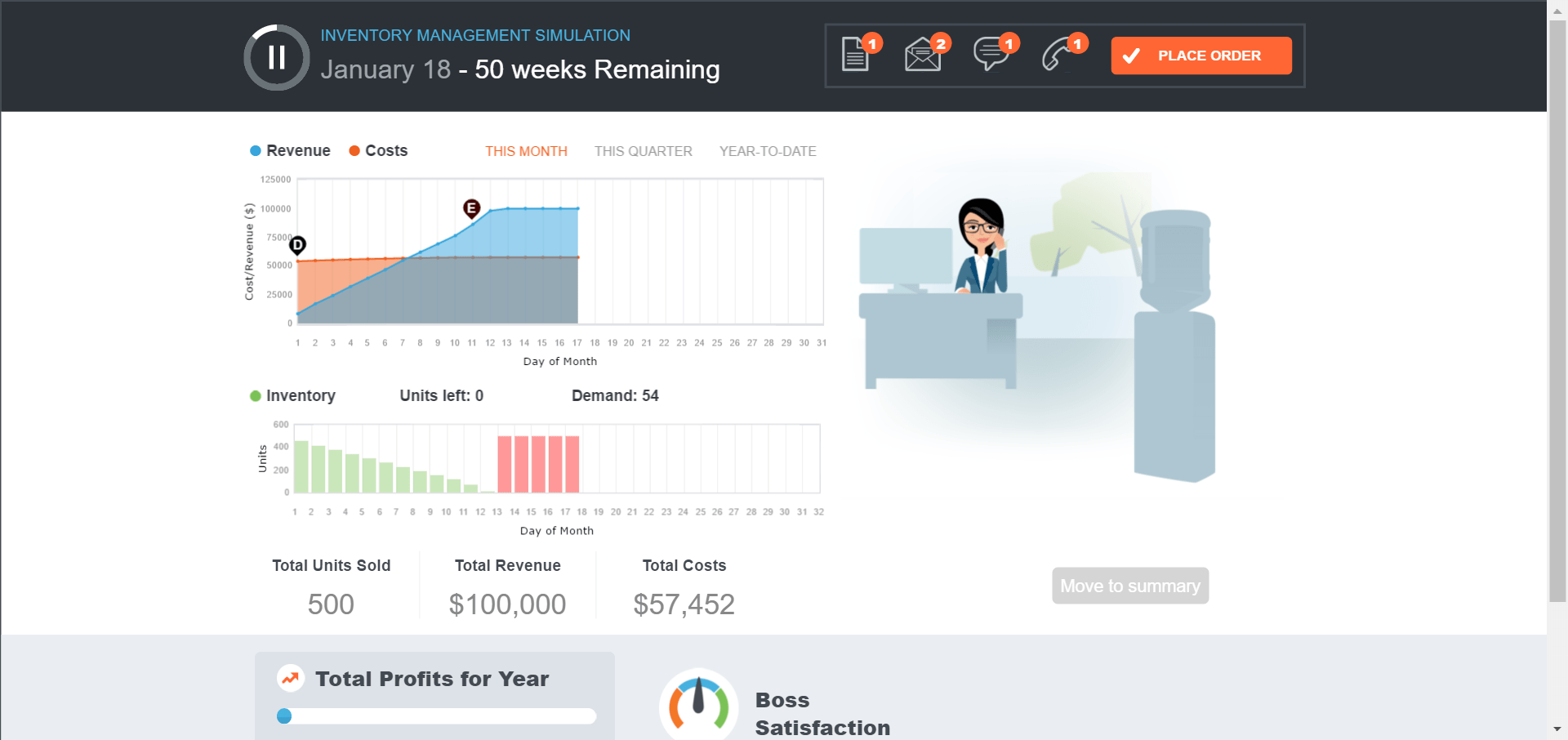
  • How many simulations will be part of OM Simulation?  We have four gaming simulations: inventory management (chapter 12), quality control (chapter 6), forecasting (chapter 4), and project management (chapter 3). A fifth, supply chain management (chapter 11), will be available in late Fall.
  • Are these simulation to be done in class or outside of class?  The OM simulations are fully assignable through MyOMLab, so students could complete this as homework presumably after completing their reading. It would also work as an in-class activity, either working as an individual or as part of a team.
  • Are the OM simulations smartphone compatible?  The OM sims are compatible for mobile devices including smartphones in landscape orientation.  However the simulations are optimized for desktop/laptop devices.  Our research suggests that for activities of this length, most students still prefer desktop/laptop use.
  • Are the OM simulations accessible?  Yes, the OM simulations have been developed with a number of accessibility features including compatibility with screen reader devices.
  • Can you pause the simulations?  Yes, you can pause all of the simulations to review the artifacts (documents, emails, voicemails, texts) or make a decision.
  • What is the price of the OM simulations?  Access to simulations is through MyOMLab and included in that purchase cost. There is no additional fee to purchase these simulations on top of the MyOMLab purchase.simulation