Good OM Reading: The Unlikely Story of Wal-Mart’s Green Revolution

It was clear that Wal-Mart was taking a leadership stand in sustainability when we wrote the Supplement 5 case study Environmental Sustainability at Wal-Mart 2 years ago. However,  an excellent  book called Force of Nature: The Unlikely Story of Wal-Mart’s Green Revolution, by Edward Humes (Harper Business, 265 pages), has just been published that will bring the case alive to your students. If you are to read one book on the company that is leading this unlikely second industrial revolution, this would be it.

That’s because Wal-Mart, long the target of environmentalists who hate its big-box footprint,  and others who feel it has destroyed small town businesses by the 1,000’s, has created nothing less than a green revolution. And as we see in Force of Nature, it is spreading this unprecedented makeover worldwide.  But the real story behind the changes at one of the world’s least earth-friendly companies is when river-guide turned consultant, Jib Ellison, enters CEO Lee Scott’s office.

Ellison singlehandedly persuades Scott that sustainability isn’t just for tree huggers–that it really meant eliminating waste and saving money. Hitting Wal-Mart at just the right moment, when it was plagued by bad PR and a slew of lawsuits, Ellison  convinced the firm’s execs that building sustainability into the business would create a powerful competitive edge. Wal-Mart did not embark, as the author says, on this course out of a sense of doing-good, but started with the attitude that it would give a PR boost…and also be profitable. It also was meant to appeal to a new generation of female shoppers who would leave for Target if Wal-Mart did not embrace sustainability.

Just a few of the recent changes: reducing packaging sizes (saving $3.4 billion a year while reducing trash), installing electric generators in refrigerated trucks (so they don’t have to idle overnight), donating 127 million pounds of food (that would otherwise be destroyed) to food banks, cutting printouts at stores (and saving 350 million pieces of paper and $20 million), making organic, earth-friendly, and natural products widely available, and forcing 100,000 manufacturers who supply products Wal-Mart sells to become more sustainable!

Good OM Reading: The Sustainability Embracers

Here at the  POMS meeting in Reno we see 14 paper sessions just on the hot topic of sustainability. But today’s blog is also influenced by some new material by MIT on sustainability. Earlier this week, I sat in on a live webcast on the subject and then the next day received a copy of the MIT Sloan Management Review research report called “Sustainability: The ‘Embracers” Seize Advantage” (Winter,2011). The webcast featured Peter Grof, SAP’s Chief Sustainability Officer, who was also quoted in the report.

This 27 page study compares two broad categories of companies–those that have embraced sustainability and those that have not (called cautious adopters). Who are the embracers and what practices do they share? As businesses increasingly turn to sustainability for competitive advantage, here are MIT’s 7 conclusions:

1. Embracers tend to be bold, see the importance of being an early mover, and are ready to act even before they have all the answers.

2. They balance their aims with narrowly defined projects in, say, supply chain management, which allow them to produce early, positive bottom-line results.

3. They drive sustainability not only from top down, but also involve  employees (who are often much more aware of sustainability challenges and solutions than management).

4. They do not treat sustainability as a separate function, but have a culture in which sustainability is applied to all business processes.

5. They establish baselines and set up assessment methods that can be identified and can measure progress.

6. They value intangibles as meaningful competitive benefits of their strategy.

7. They do not overstate motives or set unrealistic expectations, and they communicate their non-successes as well as their successes. For example, when Nike started producing labor supply chain reports 6 years ago, they announced that they had encountered noncompliance in numerous standards.

This report makes for interesting reading by providing a snapshot of how the future of the management of sustainability will look.

OM in the News: Recycling Leftover Hotel Soap?

Ever wonder what happens to leftover soap and shampoo at hotels like Sheraton, Westin, Marriott, and Hilton? USA Today (April 26,2011) describes how a non-profit organization called Clean the World recycles used soap for distribution in developing countries and homeless shelters.

Most bars of soap, about a million, are thrown out each day by US hotels. But Clean the World, and other groups, are taking in  1.6 million pounds of soap a year through agreements with about 1,000 hotels. Clean the World charges hotels 65 cents a room to clean and redistribute soap and shampoo bottles. It has built recycling centers in Orlando, Las Vegas, Toronto, and Vancouver. Soap is sterilized in its plants and reformed into 2-ounce bars.

In the past 2 years, Clean the World has distributed more than 8 million bars of soap in the US and 40 countries, including Haiti, Uganda, Zimbabwe, and India. Its efforts have diverted 550 tons of waste from landfills. “Each day, 9,000 children die from diseases that can be prevented by washing with soap”, the organization says.

Sustainability in hotels is a topic we discuss in both Ch.5 and Ch.7. Here is a good example to bring to your students.

Discussion questions:

1. Why doesn’t every hotel practice this recycling strategy?

2. How else can hotels be “green”?

OM in the News: Nike’s Sustainability Push

Stung in the 1990’s by a public campaign against its Asian labor practices, Nike has been working hard in recent years to make itself a sustainability leader. Its goal (according to www.nikebiz.com/responsibility) is to embrace a “future where creation of products isn’t tied to scarce natural resources like water and oil; where manufacturing is lean, green, equitable and empowered; and where everyone, everywhere has access to sport.”

And indeed, here are just a few of Nike’s accomplishments:

1. Introducing sustainability practices into product design (eg., eliminating toxics and waste when possible).

2. Pushing lean manufacturing concepts onto contract manufacturers to create a greener supply chain and to reduce the CO2 footprint.

3. Using recycled materials throughout (eg, the DartVII running shoe is mostly from recyclables).

4. Taking defective returns, counterfeits, and used consumer shoes and turning them into material for resurfacing playing fields (called Nike Grand).

Now Information Age (April 11, 2011) reports that the company is recruiting to hire a Code for a Better World Fellow ( I have idea what this title means)– a person to help lead the effort to bring sustainability to every aspect of the company.

But the firm still does have its detractors. The daily Lean blog called Evolving Excellence, writes:  “According to your own data, 94% of your shoes are made in Vietnam, China and Indonesia.  At last check these countries rank 90th, 84th and 82nd out of 141 on the list of the greenest and most livable countries – compared to numbers like 23rd in the USA, 25th in the UK, and 8th in Australia – the places you sell your shoes.  You ship the shoes about 7,000 miles from where you make them to where you sell them… a pretty deep carbon footprint.  If you want to be sure “manufacturing is lean, green, equitable and empowered,” you might want to quit ducking the environmental regulations in the developed nations where you sell your shoes by having them made in some of the worst polluting places on earth.”

Discussion questions:

1. How important is Nike’s “green” drive?

2. On what grounds can its position be criticized?

OM in the News: GE’s Move to Solar Power

As global demand for solar panels and power continues to explode (from 2 gigawatts in 2007 to 15 gigawatts this year to 75 gigawatts forecast in 2016), GE has just announced that it plans to open the largest solar panel factory in the US in 2013. The company wants its solar energy business to match its $6 billion wind-turbine unit.

Today’s Wall Street Journal (April 8,2011) reports that the new plant will employ 400 people and produce thin-film solar panels sufficient to generate 400 megawatts of electricity annually. This is enough to power 80,000 homes a year. SolarWorld AG (of Germany) currently operates the biggest solar-panel plant in the US (in Oregon) and generates 350 megawatts.

GEs investment of $600 million in solar technology adds to its $3.2 billion deal to buy Converteam, a French power-conversion company. Converteam complements GEs solar effort by converting sunlight into grid-ready electricity. GE says it already has 100 megawatts for its thin-film technology on order.

The move is not only good news for the economy, but means the US will be fighting hard to keep from losing this vast market to China’s government-subsidized solar industry (see our earlier blog on the topic).

Discussion questions:

1. How will GE be able to compete successfully with low-cost Chinese firms?

2. Why is GE entering this market?

3. Why is sustainability an important OM topic (see Ch. 7)?

OM in the News: Recycling Water–“From Toilets to Tap”

I have held off on blogging about USA Today’s cover story (March 3, 2011) for a week because of the yuk factor. Your students will moan you when you bring up the title “From Toilets to Tap”, but sustainability is an important OM topic (which we treat in Chapters 5 and 7). And as the article says: “Water is going to be the oil of the 21st century”.

Clearly something needs to be done. One-eighth of the world (884 million people) still lacks safe drinking water…and its not just in remote/poor regions. Singapore, dependant on Malaysia  for the strategic resource of water, has built recycled wastewater plants that now serve 1/3 of its people. Orange County, CA (which has to import water from the northern part of the state and Colorado), uses treated wastewater to serve 1/5 of its 2.4 million residents. The Northern Virginia suburbs of D.C. use purified sewage for 5% of  the area’s drinking water.

But other parts of the world, from San Diego to Australia, have had to back away from recycling plans amid public outcry. “The gross out factor is a big barrier”, admits a UC prof. Despite the nickname —“toilets to tap”–only about 10% of household wastewater comes from toilets, while the rest is from showers, sinks, and laundry. And the resulting water is often cleaner than what you would buy in a store, as the EPA’s standards are very strict.

Here is briefly how it works: first  microfiltration traps bacteria; then reverse osmosis blocks salt, drugs, and viruses; and finally, ultraviolet light and hydrogen peroxide kill organics. Besides alleviating drinking water shortages, the technology is used  for recycling in factories (see our video on Frito-Lay’s sustainability), for agriculture, and  it means less waste discharged into the ocean.

Discussion questions:

1. Why is recycling water an OM issue?

2. What are the advantages of this method of reclaiming wastewater?

OM in the News: Sustainability in the Global Clothing Supply Chain

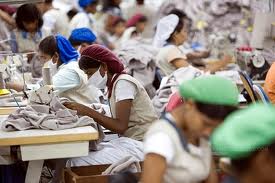
Some day in the not too distant future, the clothes and shoes you buy will not only have a label sewn in with the brand name/size/fabric content, but with a sustainability score as well.  Yesterday’s New York Times (Mar. 1, 2011) reports that the Sustainable Apparel Coalition is developing a comprehensive database of the environmental impact of every manufacturer, component, and process in apparel and shoe production. The coalition includes such names as Wal-Mart, JC Penney, Hanes, Patagonia, and Timberland.

Americans spent  $340 billion last year on clothes and shoes, which is about a quarter of the global market. Amazingly, virtually all of it purchased here99% of footwear and 98% of clothes–came from other countries. And the various parts of any one garment often come from a diverse multinational chain of fabric mills, dye operations, and assembly plants.

This obscure nature of the global supply chain has long been a concern to environmental groups. Greenpeace, for example, using Google Maps, revealed that  a blue jean factory in  Xintang, China, was washing blue chemicals downriver from its textile mill. But  the company whose name appears on the designer label– and surely the end customer–are often unaware of the environmental connection. “The apparel supply chain is long and quite complicated”, states a University of Delaware prof.

The coalition’s tool is a database of scores assigned to all players in the garment life cycle–cotton growers, fabric makers, dyers, mill owners, and distributors–based on measures such as water use, energy efficiency, waste, chemical use, greenhouse gases, and labor practices. “The government has standards for miles per gallon on a car, but we have no real standards for clothing”, adds the CEO of Timberland.

Discussion questions:

1. Are students interested in such a “green score”?

2. What changes will such a database bring about?

3. Why are the biggest retailers signing on?

OM in the News: UPS’ Supply Chain and the No-Left-Turn Rule

For the longest title award, we turn to this week’s Fortune (Dec. 27,2010, pp.44-51) and find Bob Stoffel at UPS. Stoffel is the Senior VP for Supply Chain, Strategy, Engineering, and Sustainability.

With the word Strategy in his title, Stoffel points out that UPS is a lot more than a transportation company. It now has 1,000 engineers who are there just to help customers with their supply chains. Zappos built its whole e-commerce strategy around UPS’ Louisville Worldport. Zappos can take an order for shoes at 10pm and have them in the customer’s hands at 10am the next day.

When a Toshiba laptop comes in for repairs, it is UPS that actually fixes it and has it back to the customer in 24 hours. “It’s a triple win”, says Stoffel. “You’ve saved transportation links, you’ve reduced inventory,… and you’ve reduced your carbon footprint”.

Regarding sustainability, UPS has improved its fuel efficiency by 10% with a fleet of all-electric trucks, hybrids, and natural-gas vehicles. And thanks to telematics, GPS, and other technologies, UPS delivered 350,000 more packages  a day over last year, but drove 53,000 miles less a day. Finally, the firm’s famous “no-left-turn” policy is part of another 20 million miles a year saved through technology by avoiding costly delays from left turns and poor routings. “It drives my wife nuts”, Stossel says. “I won’t turn left (when looking for a gas station).We’ve got to find one on the right”.

My favorite improvement is the new “Eco Responsible Packaging” program to advise shippers how to waste less space in packaging. Just think of all the small items you have received in a big box. “Our vehicles run out of space before they run out of weight capacity”, says Stossel.

Discussion questions:

1. What is UPS’ sustainability strategy?

2. How is UPS part of other firms’ supply chain?

OM in the News: Sustainability Means Emptying Your Own Trash Can?

In my 40 years working in industry, government, and academia, I can’t remember anyone ever asking me to empty my office garbage can. Not that it would have been beneath me, as I am personally in charge of all trash disposal in my own home. But yesterday’s Wall Street Journal article “Memo to all Staff: Dump the Trash”, caught my eye as it was packaged to workers as a sustainability issue (see Ch.7).

Its not just in the State of Texas, the City of Phoenix, and Brewer Science (a Missouri semiconductor company) that  employees are being asked to tote their own trash and recyclables to common bins. The idea has also caught on that professors (yes profs!) at the U. of Washington and at Dartmouth College empty their own baskets as part of an environmental initiative.

There are some savings, of course. Texas saves $825,000 annually on labor costs. Brewer’s janitorial staff is now just a quarter of its original size. But Dartmouth presented the new program as part of a broad sustainability package, whose primary goals “are to increase campus recycling and reduce waste”, according to its  VP.

Some question the college’s  rationale. Psych prof Catherine Cramer is quoted as saying: “The real goals here, however prettily wrapped in sustainability rhetoric, are rather obvious”. She wonders if  “its good use my professional time”.

Just to be clear, though. Not everyone in Texas is in the program. The governor and legislators have kept their original trash service.

Discussion questions:

1. Discuss the economics of transferring work from low-paid employees to higher-paid professionals.

2. What is your own campus doing to enable the sustainability/ recycling efforts?

Video Tip: Green Manufacturing and Sustainability at Frito-Lay

As a Math/Physics undergrad in the late 60s, I somehow took an elective course called FORTRAN. This turned out to be quite a break, as McDonnell Douglas hired me to design jets based on this one, well-timed class. At a time when very few people knew much about computers, this was a great edge.

I think today’s “great edge” is Sustainability.  Hundreds of college are offering courses in the subject now, but it is still in its infancy, with a huge demand building in the coming years for knowledgable grads. Johns Hopkins U. has just started the nation’s 1st B.S. in Sustainability.

With this background, I encourage you to show our newest video, “Green Manufacturing and Sustainability at Frito-Lay”, when you cover Supplement 5, Sustainability. Frito-Lay is a leader in solar, “going green”, moving off the power grid, and conservation/recycling resources. Its Sun Chips, for example,  are produced under full solar power. The firm has received the LEED (Leadership in Energy and Environmental Design) award and has “zero environmental impact” as a long- term goal. Will this help sell potato chips? Can only multi-billion dollar firms step up like Frito-Lay is doing?

Jay and I are especially proud of this video as it won the prestigious Silver Addy as best educational film in 2010. We hope you and your students enjoy the film and the case study in Supp.5.