OM in the News: How Oslo Turns Garbage into Energy

Half of Oslo is heated by burning garbage

Oslo, writes The New York Times (April 30, 2013), is a city that imports garbage. Some comes from England, some from Ireland. Some is from neighboring Sweden.  A British tax on landfill makes it cheaper to send it to places like Oslo. “It helps us in reducing the escalating costs of the landfill tax,” says a spokeswoman for Leeds, England. Oslo even has designs on the American market. “I’d like to take some from the United States,” says the director of one plant that turns garbage into heat and electricity. “Sea transport is cheap.”

A recycling-friendly place where roughly half the city and most of its schools are heated by burning garbage — household trash, industrial waste, even toxic and dangerous waste from hospitals and drug arrests — Oslo has a problem: it has literally run out of garbage to burn. The fastidious population of Northern Europe produces only about 150 million tons of waste a year, far too little to supply incinerating plants that have capacity of more than 700 million tons. The problem is not unique to Oslo, a city of 1.4 million people. Across Northern Europe, where the practice of burning garbage to generate heat and electricity has exploded, demand for trash far outstrips supply.

Garbage may be garbage in some parts of the world, but in Oslo it is very high-tech. Households separate their garbage, putting food waste in green plastic bags, plastics in blue bags and glass elsewhere. The bags are handed out free at groceries and other stores.

Still, not everybody is comfortable with this garbage addiction. “From an environmental point of view, it’s a huge problem. There is pressure to produce more and more waste, as long as there is this overcapacity,” says one Norwegian environmental expert. Retorts the head of Oslo’s waste recovery agency, “Recycling and energy recovery have to go hand in hand.”

Discussion questions:

1. How do some US cities deal with massive amounts of garbage?

2. Why are sustainability efforts such as this of interest to operations managers?

OM in the News: Where Does Your Old CRT or TV Go When it Dies?

Old TVs waiting for recycling in Philadelphia

Last year, inspectors from California’s hazardous waste agency were visiting an electronics recycling company for a routine review when they came across a warehouse the size of a football field, packed with tens of thousands of old computer monitors and televisions. As recently as a few years ago, broken monitors and televisions like those were being recycled profitably. The big, glassy funnels inside these machines —  CRTs — were melted down and turned into new ones. But flat-screen technology has made those monitors and televisions obsolete, writes The New York Times (March 19, 2013), decimating the demand for the recycled tube glass used in them and creating a “glass tsunami” as stockpiles of the useless material accumulate across the country.

Small changes in the marketplace can suddenly transform a product into a liability and demonstrate the difficulties regulators face in keeping up with rapid shifts. The growing stockpiles, much of which contain lead that has zero economic value, find few buyers. The bulk of this waste is being stored, sent to landfills or smelters, or disposed of in other ways that are environmentally destructive. Instead of recycling the waste, many recyclers have been illegally storing millions of the monitors in warehouses. Each CRT includes up to 8 pounds of lead.

In 2000, there were 12 plants in the U.S. and 13 more worldwide that were taking old TVs and CRTs and using the glass to produce new tubes. Now, there are only 2 plants in India doing so. Although the larger solution to the problem is for technology companies to design products that last longer, use fewer toxic components and are more easily recycled, the industry is heading in the opposite direction. CRTs have been largely replaced by flat panels that use fluorescent lights with highly toxic mercury in them.

The federal government, among the world’s largest producer of electronic waste, disposes more than 10,000 computers a week, some of which are dumped illegally in developing countries.

Discussion questions:

1. If you were in charge of sustainability in your firm, how would you deal with discarded computers?

2. Relate the issue to life cycle assessment (see Chapter 5).

OM in the News: Levi’s Turns Recycled Plastic into Jeans

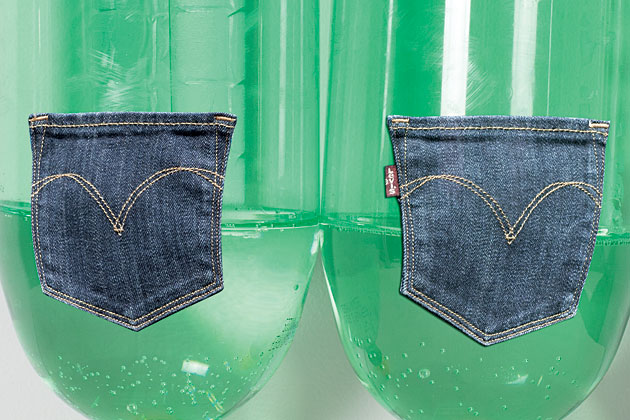
Most apparel companies work hard to give their clothes the sheen of sophistication or whimsy. Levi Strauss is trying hard not to. The upcoming pitch in stores: “These jeans are made of garbage.” Crushed brown and green plastic bottles will be on display nearby. Eight of those are blended into each pair of Levi’s new Waste‹Less jeans, which are composed of at least 20% recycled plastic, reports Businessweek (Oct. 22-28, 2012).

The Waste‹Less collection is part of a bigger push to reduce Levi’s environmental impact throughout the entire process of making jeans. “We want to build sustainability into everything we do,” says the VP- environmental sustainability. Resource scarcity and increasingly volatile prices for cotton make this a necessity more than a choice.

In 2007, Levi’s was among the first in the apparel industry to conduct a life-cycle assessment. It found that 49% of the water use during the lifetime of a pair of jeans occurred at the very beginning, with cotton farmers. (Another 45% of the water was used by consumers to wash their jeans, typically about 100 times.) So Levi’s began to teach farmers how to grow cotton with less water. In 2010, it also began a marketing campaign to encourage people to wash their jeans less often, in cold water only, and line-dry them. This year, Levi’s will ship 29 million Water‹Less jeans, saving 360 million liters of water.

After the Water‹Less project got underway, Levi’s began thinking about plastic and began testing fibers from recycled colored plastic bottles. When plastic bottles are recycled, they’re sorted by color, cleaned, and sold as polyester flakes. Those flakes can be stretched, or extruded, into fiber, which can be spun into yarn and woven into cotton fabric on high-speed machines. The first batch of Waste‹Less jeans used about 3.5 million bottles all together. “Is turning 8 bottles of plastic into a pair of jeans worth it? I think so,” says the CEO.

Discussion questions:

1. Why is sustainability an important OM issue?

2. What other clothing firms in active in environmental sustainability? What does each do?

Good OM Reading: Kimberly Clark’s Drive for Sustainability

The latest MIT Sloan Management Review (May 15, 2012) reports on consumer products giant Kimberly Clark’s efforts towards sustainability, an important topic in our OM courses (Supplement 5). The 140 year old company (57,000 employees in 36 countries)has more than a billion people use its products (which include Kleenex, Huggies, and Kotex) every day!

The company has had 4 global five-year goals, looking at energy reduction and energy efficiency, water use reduction and efficiency gains. For 2000, it addressed chemical issues. For 2005, it addressed packaging, and had a 10% reduction in weight in packaging goal. For 2010, it looked at lifecycle analysis of all product initiatives. For 2015, the focus is broader– on people, the planet and products. “That equates to the social, environmental and economic pillars of sustainability. That’s the triple bottom line for us,” says Peggy Ward, director of sustainability.

“On the planet side, we’re still following our traditional focus on energy, waste and water,” she adds, “but we’re pushing ourselves even further. So, we’ve set an absolute greenhouse gas reduction goal of 5%. On the water side, our goal is a 25% reduction in water use. And in waste, our goal is to achieve zero manufacturing waste sent to landfill. About 48% of our mills are landfill-free currently.”

New products at Kimberly Clark include Scott Naturals Tube Free– bath tissue rolls that do not have that cardboard core ( meaning you can use every single sheet of the roll.) The amount of waste that will be eliminated that’s going to landfills is large — basically it’s enough to go to the moon and back two times.  Huggies Pure and Natural  diapers have a component that has a renewable alternative material in it — instead of a petrochemical-based input. It has organic cotton, it’s fragrance-free and dye-free and it has 20% post-consumer recycled content.

This is a good article to share with your class when you are discussing sustainability.

OM in the News: Leading the Sustainability Charge at Patagonia

Yvon Chouinar, founder and sole owner of the $414 million outdoor-clothing brand Patagonia, has just published a new book, “The Responsible Company,” which  offers detailed checklists for making money without inflicting undue societal harm. And according to The Wall Street Journal Magazine (May, 2012), even megacorporations are paying attention to him these days.

Chouinard has partnered with Walmart—an odd couple if there ever was one, in terms of size (Walmart’s revenue exceeds Patagonia’s 800-fold) and customer base—to advise the retail giant on reducing packaging and water use in its supply chains. Together the two companies teamed up to create the Sustainable Apparel Coalition, inviting other major brands, such as Levi Strauss, Nike, Gap and Adidas to join them in crafting clear, quantifiable standards for environmentally responsible clothing production.

Chouinard looks at everything Patagonia makes, shipped or processed, and resolves to do it all more responsibly. He changes materials, switching  from conventional to organic cotton—despite the fact that it initially tripled his supply costs—because it was less harmful to the environment. He created fleece jackets made entirely from recycled soda bottles.  He also convinced Levi Strauss—with more than 10 times the annual revenue of Patagonia–to embrace efforts to set data-driven benchmarks for improving apparel makers’ environmental practices. Levi’s has spent the past 18 months redesigning processes to save 45 million gallons of water, along with the energy that would have heated that water.
In 1970, Milton Friedman wrote a legendary essay for the New York Times Magazine titled “The Social Responsibility of Business Is to Increase Its Profits.” Friedman pooh-poohed companies’ charitable efforts, arguing that it’s the sole duty of a business executive to maximize profits for shareholders. But Patagonia would disagree over the role of corporate social responsibility—since 1985 it has given 1 percent of revenue (sales, not profit), totaling $41.5 million, to grassroots environmental organizations. Over the years it has convinced 1,400 other companies worldwide to join this “1% for the Planet” initiative.
Discussion questions:
1. Do companies still follow Friedman’s philosophy?
2. How has Patagonia impacted the business world?

OM in the News: Companies Pick Up Used Packaging and Recycling Cost

The New York Times (March 25, 2012) reports : “A growing number of large food and beverage companies are assuming the costs of recycling their packaging after consumers are finished with it, a responsibility long imposed on packaged goods companies in Europe and more recently in parts of Asia, Latin America, and Canada.”  Called “extended producer responsibility”, this is another sustainability task for OM managers to handle as they address the design-to-disassembly decisions  (Chapter 7). There are 3 causal factors:

First, “Environmentally conscious consumers are demanding that companies share their values,” says Starbucks’ director of environmental impact. Second, financially strapped local governments are looking for ways to shift the costs of recycling onto someone, and companies that make the packaging are logical candidates. And third, it is now cheaper to recycle some products (like aluminum cans) than it is to make them from virgin material. (Shredding, melting, recasting and rerolling used aluminum into new can sheet  saves 95% of the energy it takes to make it from raw ore).

Company-sponsored recycling efforts are voluntary in all states, except Maine, at this point in time. But a few big firms are going full-speed ahead. Coca-Cola has a stated goal of recycling 100% of its N. American cans and bottles by 2015 and 50% in the rest of the world. Coke is also trying out nonpetroleum-based packaging material. Dasani and Sprite come in PlantBottles that are 30% plant-based and can go through the same recycling process as oil-based containers.

Starbucks’ goal is to have recycling bins in all its stores in 3 years (it is at 18% right now). It asks customers to throw their cups in the bins, from which they are turned into napkins and new cups. Stoneybrook Farms collected 11 million no.5 yogurt cups last year at collection bins placed in Whole Foods stores. The cups are turned into toothbrushes and razors!

Discussion questions:

1. Why are grocery chains opposed to mandated packaging recycling?

2. What role might Walmart play in the trend?

OM in the News: Recycling Hits the Airplane Industry

In Supplement 5, we point out that the auto industry recycles more than 84% of cars scrapped each year. The new Mercedes S550 sedan is designed to be 95% recycled, years ahead of the EU standards that take effect in 2015. In general, auto manufacturers now design in such a way that materials can be easily reused in the next generation of cars. The same can not be said of the commercial airplane industry.

But the latest Businessweek (March 3-9, 2012) points out that sustainability is now on the minds of airlines for a variety of reasons. Older planes are being disassembled for their parts at an increasing rate, and the average age of planes has dropped by a third, to 18 years, over the past decade and a half. Rising fuel prices have made kerosene-guzzling old-timers unpopular with carriers. (Fuel makes up about 30% of operating expenses). United, which burns $25,000 of fuel every minute, is thinking of grounding the dated Boeing 737-500 and 767-200ER jets from its 1,200 plane fleet.

Older planes such as these used to end up in developing countries from Mexico to Indonesia to Kenya, where they found a home after being retired by Western carriers. But prodded by safety and environmental concerns, more and more countries are choosing new over used planes. Production of single-aisle jets, the most widely used type in the industry, is now at an all-time high. This leaves no shortage of cadavers to be recycled for parts.

Especially popular are engines coming off A320s and 737s.The turbines that house rotating parts (such as disks or blades that operate at 2,700 degrees F) require routine replacement and can cost $4.4 million new. Recycled disks and blades drop the price in half. Since an engine off the older 737-700 can be used in the newer 737-800 model, economic obsolescence has fueled the airplane recycling industry.

Discussion questions:

1. Why is the life cycle of airplanes getting shorter?

2. Why is recycling a major issue for operations managers?

Good OM Reading: The Greening of the Chinese Supply Chain

Given how much of the world’s manufacturing takes place in China, and the damage it has wrought on that country’s environment, more and more multinationals are under pressure to clean their supply chains, writes MIT Sloan Management Review (Winter, 2012). For companies that ignore the problems, the costs can be considerable. Just last August, a group of 5 Chinese environmental NGOs focused attention on our beloved Apple for using suppliers with public pollution problems. The international headlines forced Apple to immediately tackle its–and its suppliers’– act.

This  excellent article says that even industry green leaders such as Nike and Adidas may never completely cleanse their supply chains . But rather than just monitoring Chinese suppliers compliance with health, safety, and environmental standards, top US firms are giving them tools and incentives to improve independently, helping use energy, water, and materials more efficiently. They are also reaching deeper into 2nd and 3rd tier suppliers, where the greatest damage occurs. Nike, for example, sends environmental engineers to 40 footwear suppliers to help them set targets to reduce waste and scrap, and improve efficiency. Instead of auditing, the Nike team spends 80% of its time driving new green initiatives.

The MIT Sloan piece points out that audits alone are very limiting, as factories have become adept at hiding problems from auditors. There is even an indigenous consulting industry designed just for that purpose. (Auditors are also commonly susceptible to bribery.) “Corruption is widespread,” says a former rep for Wal-Mart, which has 20,000 tier 1 suppliers in China alone!

The lengthy article includes a 12 point plan for companies to follow to deal with this major supply chain issue. It makes for valuable reading as you cover Chapter 11.

OM in the News: Meet the Electric School Bus

“Forget the Prius”, says today’s Wall Street Journal (Dec.28,2011). “The future of electric is the school bus”. It seems that Americans just love long drives in fast cars too much for electric cars to be our country’s solution to green transportation.  But the routine runs of electric school buses are another matter. Whereas most current school buses run on diesel fuel, have the aerodynamic profile of a box, and get mileage in the single digits (5-6 mpg), a new generation of zero-emission, hybrid buses may be slowly taking over.

School buses, it turns out, are perfectly suited to be electric vehicles. They cover short distances on daily runs, follow set and predictable routes (making it unlikely their batteries die during the route), and spend a lot of the day sitting in depots, giving them plenty of time to recharge. They also make frequent stops, which while bad for fuel efficiency in a conventional bus, actually helps recharge electric vehicle batteries while  brakes are applied.

Money is the prime obstacle, in that a hybrid costs 60% more than a diesel school bus. But hybrids can improve fuel economy by 65% and if budgets were not hurting so badly in many school districts, fleets would be expanding rapidly.  School districts can recover the $30,000 price differential in 3-5 years through  fuel savings once the investment is made.

Navistar Int’l, Trans Tech, and Smith Electric Vehicles are three of the major players in the electric school bus industry.

Discussion questions:

1. Why is this an OM issue?

2. In what other ways can a school district use sustainability (Ch.7) to actually save money?

Good OM Reading: Sustainability Nears the Tipping Point

Now that your Fall semester is complete and you have some time for holiday reading, we can give you a sneak preview of the upcoming MIT Sloan Management Review (Winter, 2012) article on the  characteristics of companies that are profiting from sustainability practices and the factors that have driven the recent surge in sustainability adoption.The article also highlights the challenges companies face in building a business case for sustainability.

Results from this, MIT’s third annual sustainability survey, indicate that an increasing number of managers and companies are taking sustainable business practices seriously. Two-thirds of respondents said that sustainability is critically important to being competitive in today’s marketplace. And despite ongoing economic uncertainty, many companies are increasing their commitments to sustainability initiatives. In fact, 31% of respondents said their companies are profiting from sustainable business practices. Yet, it should be noted that “green” still ranks only 8th on companies’ agendas for action.

The article also points out that sustainability comes from both internal and external drivers. External factors include regulations, green score cards and other metrics, media, climate change science, resource scarcity, and consumer demand. “Consumers today have higher expectations that brands deliver sustainable products: sustainably sourced, produced and packaged, but remaining competitively priced”, says the head of sustainability at Kimberly-Clark (maker of Huggies and Kleenex).

Yet internal drivers may be more influential than external ones. “I would say the internal drivers are 80% responsible for our sustainability efforts”, states the VP of Clorox, who sees benefits relating to operating costs, revenue growth, brand integrity, and employee engagement.

This is a good article to keep handy when you are teaching Supplement 5, Sustainability.

OM in the News: Shipping Our Batteries to Mexico for Cheaper Recycling

When we discuss the 3R’s of Sustainability in Supplement 5 we emphasize how important it is to build sustainable production processes.  But the  lead article in The New York Times (Dec.9,2011) asks what really happens when our American car battery industry claims to have the highest recycling rate for any commodity–97% of the lead is recycled–and most states mandate that stores take back old batteries. It turns out that spent batteries we turn in are increasingly being sent to Mexico, where their lead is usually extracted by crude methods that are illegal in the US, exposing plant workers and local residents to dangerous levels of a toxic metal.

The rising flow of batteries is the result of strict new EPA standards, making domestic recycling more difficult and expensive. (The allowable lead levels have dropped by a staggering amount in the past 3 years and cost of compliance is about $20 million per plant). So about 20% of batteries (20 million) are being legally shipped to Mexico this year (up from 6% since the new EPA rules), with many more smuggled across covertly. “Along the border, where US vigilance focuses on drugs and illegal immigrants, there is little effort to staunch the flow”, writes the Times.

Whereas lead battery recyclers in the US now operate in sealed, highly mechanized plants outfitted with scrubbers, the vast majority of Mexican plants just break the batteries, releasing the lead as dust and emissions. Spent batteries house up to 40 lbs. of lead, which can cause high blood pressure, kidney damage, abdominal pain in adults, and serious neurological development in children. Lead pollution remains in the ground for decades. The EPA says it “does not inspect, monitor, or verify the Mexican facilities.” Adds a Dallas recycler: “We’re shipping hazardous waste to a neighbor ill-equipped to process it and we’re doing it legally, pretending it’s not a problem.”

Discussion questions:

1. Do your students view this as an ethical dilemma?

2. What other harmful products do we ship abroad for recycling, and why?

OM in the News: Water as a Sustainability Issue

One of my favorite features in Fortune magazine is called The Chartist, a graphical analysis of any number of various topics. This week’s issue of Fortune (Oct 17,2011) deals with the vast amount of water used in manufacturing, agriculture, and by us as individuals. It ties in directly to our treatment of sustainability in Supplement 5 in discussing short-term problems and long-term solutions.

With all the bottled water we swig and all the showers we take, one would think people consume most of the earth’s water. In fact, according to the Chartist’s excellent graphs, agriculture accounts for 71% and industry for 16% of global water use. A pair of blue jeans requires 2,906 gallons, most of it from growing cotton. A car requires 104,000 gallons, most of it from rubber. It takes 252 gallons to make a pair of rubber gloves, while a pound of steel uses 31 gallons. And it takes 71 gallons of H2O to produce an 8 oz. cup of Starbucks. (That company, by the way, plans to cut its water use by 25% in the next 4 years with more efficient machines).

Who uses the most water per capita? It’s the US at 2,057 gallons. Australia uses 1,675: Argentina 1,163: Russia 1,340: Sweden 1,033: China 775: and the Congo 400. The world average is 1,003 gallons per capita  per day.

And who pays the most for 100 gallons of tap water?  Copenhagen is highest at $3.03, followed by Paris at $1.48, London at $0.73, Phoenix at $0.59, Tokyo at $0.46, NYC at $0.39, Moscow at $0.24, Shanghai at $0.07, Mumbai at  $0.04, and Buenos Aires at $0.01.

Expanding populations in developing nations will swell the demand for agricultural water some 42% by 2013. The hope is that OM can find new technologies to grow more with less water by then.

Discussion questions:

1. How can OM help solve the water shortage problems being faced in many parts of the world?

2. Will water be the gold of the 21st century?

OM in the News: Sustainability and eBay Packaging

In Chapter 5 we discuss some of the easiest ways to make products more  sustainable. We can: (1) make them recyclable; (2) use recycled materials; (3) use less harmful ingredients; (4) use lighter materials; (5) use less energy; and (6) use less material. MITSloan Management Review (Aug. 11, 2011–E Newsletter) describes how eBay has made its packing boxes more sustainable by using almost all of these approaches. In doing so, the online auction company has come up with a solution that not only feeds on people’s desire to recycle, but helps brand the business as sensitive to the environment.

The eBay box is made of especially durable cardboard. Covered in graphics of birds and trees, it has text all over that basically says: “this box has been designed to be used over and over”. The inside of the lid even has spaces where users can leave notes where the box has been, essentially inviting recipients to celebrate the fact that the box has been used and reused.

The idea bubbled up internally. The firm’s Green Team is tasked with “inspiring the world to buy, sell and think green every day”. Out of the 250 suggestions submitted to eBay’s annual Innovation Expo, the grand prize winner was the eBay box. The project received a prestigious Clio design award a few months ago.

By May that the company had given away 100,000 of the boxes. The Green Team reports that “each box is made of 100% recycled material, printed with water-based inks, and designed to require minimal tape”. The 1,500 boxes reused so far have “conserved almost 7,000 gallons of water, energy to power 13 homes for a week, and reduced greenhouse gasses equivalent to taking 18 cars off the road for a week”.

Discussion questions:

1. Ask students to pick another product that can be redesigned to be greener.

2. Show the Frito-Lay video on sustainability (in Ch.7) and compare that company’s packing efforts to eBay’s.

OM in the News: Is Wal-Mart’s Sustainability Index Sustainable?

Two years ago, Wal-Mart CEO Mike Duke dropped a bomb on the retailing world when he announced that his firm would be creating a “sustainability index” to measure the environmental and social impact of every product sold in its stores. Wal-Mart had not suddenly turned green (see our blog of  May 17, 2011 )–it turns out that a vast amount of money is to be made by reducing energy and waste up and down the supply chain. Duke’s message suppliers was clear: “Treat the planet well and get prime access to its 200 million customers each week; pollute and despoil, and you will be shunned”.

But as Fortune (July 25, 2011) reports, Wal- Mart had no idea how hard the job of creating the index would be.  Five million dollars into the project, it has only examined 7 products closely so far. The trouble with a scoring system (and others have tried it), is that in the end consumption is about trade-offs. How much phosphate was used to make a laundry detergent? How much waste was generated by the zipper factory in China? Is soil erosion less important than carbon emissions? A company may get high marks for recyclable packaging, but Stonyfield reduced its carbon footprint by switching to yogurt cups that aren’t recycled. (Cups made from plants, it turns out, generate fewer greenhouse gasses than recycled plastic ones). And Patagonia’s switch to organic cotton for jeans (from synthetic fabrics) now requires 1,200 gallons of water to manufacture a single pair!

Many companies in the developing world don’t even recognize the words “corporate sustainability policy”. Hank Paulson says he asked the manager of a Chinese factory about the belching smoke pouring out of his plant. The response: “See those two camels and a goat? When they fall over from pollution, we turn off the factory”.

Discussion questions:

1. Why is the index so hard to create?

2. Name some products with trade-offs that would impact their score.

Good OM Reading: Our “Big Thirst” for Water

Of the dozens of papers presented at the POMS meeting that dealt with sustainability, not one focused on the critical manufacturing resource of water. But Charles Fishman’s newly published book, The Big Thirst: The Secret Life and Turbulent Future of Water (Free Press, 368 pp.), may very well raise our awareness of what he calls a “silent revolution” in water usage in the biggest economy in the world.

Why is this a sustainability topic worth discussing in class? Perhaps because of a 2007 UN study predicting: “Major cities in the West, like Phoenix and Las Vegas, may have to be abandoned as badlands”? Las Vegas, which has one of the biggest water shortages in the country, now pays residents $40,000 an acre to take out their lawns and put in rocks and local plants.

The golden age of water, as Fishman calls it, was the last 100 years, where we lived in a “kind of aquatic paradise…our water has been abundant, safe, and cheap”. He writes: “We don’t take it for granted because we don’t notice it enough to take it for granted”. But the new scarcity of water may take us “from the golden age of water to the revenge of water”. Water is the key ingredient in making computer chips, blue jeans, iPhones, kleenex, rice, and steel. A 2-liter Coke takes 5 liters of water to produce. The population increase by a factor of 4 during the past century was marked by a water consumption increase by a factor of 7. Here in Florida, we use 50% of our water in gardening!

The good news is that we getting the message. US farmers use 15% less water than 30 years ago, with a 70% bigger yield. GE and IBM are not only reducing water usage, by have created new divisions to teach towns and companies how to manage it.

You can  listen to Fishman’s NPR interview at npr.org.