OM in the News: Starbucks Process Improvement with Apps

Businessweek (Aug.23-30, 2012) provides a great example of business process improvement (Chapter 7) through Starbucks’ mobile payment plan program. Even before its recent $25 million investment in startup company Square, Starbucks had been processing a million mobile-phone transactions per week. “What mobile payments allows is an unprecedented relationship between us and our customer,” says Starbucks’ chief digital officer.

Starbucks released its first mobile app in 2009; it helped customers find stores, learn about coffee, and get nutrition information. In 2011, the chain released a more powerful Starbucks Card Mobile App, which also lets consumers pay at the register by waving a bar code on a phone’s screen in front of a scanner. Customers can load Starbucks’ digital prepaid card with an existing credit card.

Starting this fall, coffee lovers will be able to use smartphones to pay via an account linked directly to their credit cards. The mobile payment options also promise a profit boost for Starbucks. By letting its customers make purchases with their smartphones, Starbucks pays fewer fees—which sometimes top 2%—on credit-card transactions. Square says it can now process Starbucks payments at a lower rate than other payment networks.

From an OM perspective, the apps can also help sales by making store lines move 10 -20% faster during peak hours. Each 1% increase in a store’s capacity during rush hour translates into a revenue boost of up to 1%. “Current payment solutions don’t meet the expectations of customers or merchants,” says Wal-Mart’s VP. Since selling through a mobile app can cut transaction fees in half, the cost savings can make a big difference in retail, where operating margins are in the single digits (about 6% for Wal-Mart). The bottom line: Starbucks has created a successful mobile payments model that other retailers are following in an effort to reduce transaction fees.

Discussion questions:

1. What other mobile phone apps can increase OM efficiency?

2. How else has Starbucks increased productivity, as discussed in OM in Action boxes in the text?

Guest Post: How I Teach Forecasting at Temple U.

Professor Howard Weiss at Temple University’s Fox School of Business writes about how he uses software to teach forecasting. Howard, the developer of both Excel OM and POM for Windows,  is also Academic Director of  Temple’s EMBA program.

For several years, I have been assigning my students a forecasting project using data from their company.  Since I want students to learn about seasonality, I require the data  must be four complete cycles of the measurement. That is, I ask for 48 months, 16 quarters, 20 or 28 days, or 8 or 24 hours over 4 days. Most students are able to obtain data from their company and for those who cannot I ask them to find acceptable data on the web or ask a classmate for data.

I have the students  first present three graphs: a graph of the data over 48 months, a graph of the annual data over the 4 years, and a stacked graph of the data over 12 months for each of the 4 years. For the first two graphs, I have them apply Excel’s easy-to-use option to identify the trend line. I also ask the students to identify the ratio of the trends. They expect annual to monthly trend to be near 12, and are surprised when it is closer to 144. I have the  students use the stacked graph to identify seasonality.

I then require the students to run their data through most of the models in the Heizer-Render textbook. Using POM for Windows (which comes free with the book), it is very easy to change from model to model, to determine the best n for moving averages and the best alpha for exponential smoothing. It also is straightforward to run the decomposition methods that are in POM, which will determine seasonal factors as in the textbook.  For each model, students are to identify the bias, MAD, MSE, standard error, and MAPE –and select the best forecasting method based on the error measures. Finally, using the method they have selected, I ask them to identify forecasts for the next 12 months and the seasonal factors for each month.

The students very much like applying forecasting to data from their own company. They  also appreciate the value of the graphs, the ease in changing from one method to another in POM, and that the different methods will yield different results.

OM in the News: Apple vs. Samsung Is Really About Supply Chains

By now, everyone has heard the results of the law suit out of San Jose in which Apple was awarded $1.05 billion for damages incurred by Samsung’s infringement on  Apple patents (The Wall Street Journal , Aug.25-26, 2012). The  sweeping victory for Apple provides ammunition for more legal attacks on its  rivals in the $250 billion smartphone market–in which Samsung and Apple are #1 and #2. The jury found that Samsung infringed all but one of the seven patents at issue, and also decided Apple didn’t violate any of the five patents Samsung asserted in the case. “Today’s verdict should not be viewed as a win for Apple, but as a loss for the American consumer,” Samsung said. “It will lead to fewer choices, less innovation, and potentially higher prices.”

Apple, which prides itself on the style of its products, broke new ground by heavily relying on patents covering the physical design of its iPhones and iPads. (This is called “trade dress,”  the overall look and feel of a device.) Tech companies have more commonly relied on utility patents, which cover the way products work rather than how they look.

The bigger story from an OM perspective, though, may be in the fact that the rival companies have a $5 billion supply chain relationship. Apple is Samsung’s biggest customer for microprocessors. The current case in many ways resembles the 1996 lawsuit by GM against rival VW. GM’s VP for Supply Chains, Jose Lopez, was accused of  stealing GM’s plans for a new type of factory, dubbed “Plant X”, when he defected to VW. The settlement, in GM’s favor, recognized the role of each company as a supplier to the other. VW paid GM $100 million  and was required to buy $1 billion in parts from GM.

In today’s world, competition–as we say in Chapter 11–is often between supply chains, not between companies.

Discussion questions:

1. Ask students to research details of the GM-VW lawsuit and discuss them in class.

2. The Samsung-Apple lawsuit in Korea played out differently. Why?

MyOMLab: Getting Ready for the Fall Semester–Some Tips

As we start this new semester, Jay and I would like to welcome new and returning faculty and the 15,000 new students who will be using MyOMLab this Fall. This is really wonderful software that we have spent many, many hours developing to make student assessment,  homework and exams easy for you as the instructor and enjoyable for your students. Our publisher has also made a great package of tools available to help you use the system and we encourage you to try them out.

  Interactive User Guides: Our searchable user guides offer step-by-step instructions and links to training tutorial videos, so you can read how to do something and then watch it being done! The guide also includes a “first day of class” form to distribute to students to help them sign on.

LIVE WebEx Training Sessions: Attend a MyOMLab training session. These are intimate virtual training sessions led by experienced users who can offer you advice. Click “Show All Meetings” to see the complete list of available sessions. There is a session almost every day that will meet your needs.

MyOMLab in New Design
Read about the latest version of MyOMLab and what it means to you. This is created by our Customer Experience Manager, Matthew Dorsey (matthew.dorsey@pearson.com).  Matt is available to help you get started this Fall. He understands all of the nuances of MyOMLab.

Tech Support:
1-888-433-8435
Monday through Friday,
8 AM to 8 PM (ET)

Your Local Pearson Sales Representative:

(Not sure who it is?)  You can search by school here: http://www.pearsonhighered.com/educator/replocator/. Your rep will even come to your classes the 1st week to help get everyone started.

And please feel free to contact us at jheizer@omniglobal.com or brender@cfl.rr.com. Our marketing manager, Jami, also welcomes your call or email: jami.minard@pearson.com.

OM in the News: Skilled Work Without the Worker (with Video)

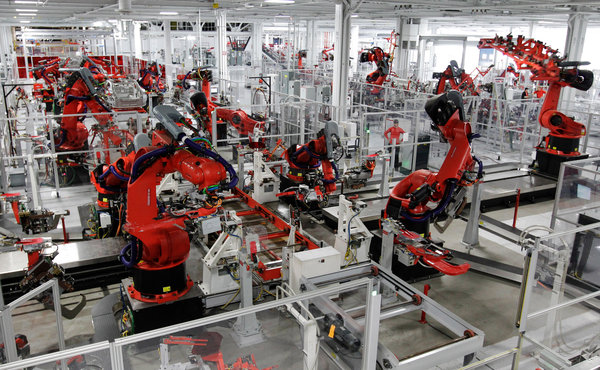
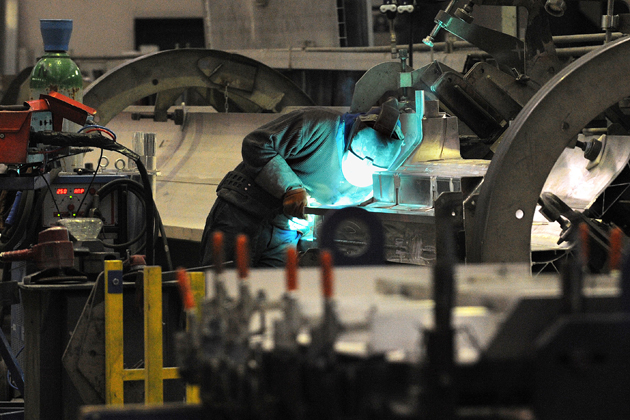
Robotics is just one  topic in our treatment of  technology in Chapter 7, but yesterday’s lead article in the New York Times (Aug. 19, 2012) called “Skilled Work Without the Worker” is worth sharing with your class. The point is that robots have become a lot more sophisticated in the past 2 decades and are now capable of doing very detailed work that only humans could do just a short time ago.

Tesla foctory robots perform not one, but 4 functions at the California auto plant

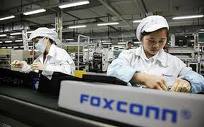
The piece begins by describing two Philips Electronics factories–one in China (where hundreds of workers hand assemble electric shavers)– and the other in Holland (where 128 robots  do the same work, guided by video cameras). The Dutch factory  has several dozen workers per shift, about a tenth as many as the plant in China. And the robots there work, of course, without a coffee break — three shifts a day, 365 days a year.

This is the future, says The Times. A new wave of robots is replacing workers around the world in both manufacturing and distribution. Factories like the one  in the Netherlands are a striking counterpoint to those used by Foxconn , which employ hundreds of thousands of low-skilled workers to make Apple products. Foxconn’s chairman, Terry Gou, has publicly endorsed a growing use of robots. Speaking of his more than one million employees worldwide, he recently said: “As human beings are also animals, to manage one million animals gives me a headache.”

With examples ranging from Boeing’s use of robots on the 787,  to C&S Wholesale Grocers fully automated warehouse, to a California organic farmer who uses them to pack lettuce, this exciting OM technology makes for a good discussion in many chapters of our text. The 4 minute video that accompanies the article is also well done.

Discussion questions:

1. Why have robots become a more powerful force in recent years?

2. What are the plusses and minuses of the new revolution?

OM in Action: Hyundai Workers’ Graveyard Shift Demands

Union members, left, wearing head bands saying “Unity Fight”

Our discussion in Chapter 10 about work schedules, incentive systems, and employee motivation can certainly be enhanced by The Wall Street Journal’s article (Aug.16, 2012) called “Hyundai Strikers Demand End to the Graveyard Shift.”  With a  strike  set for today, the company’s  union demands an end to night-shift work. Hyundai now runs two 10-hour shifts at its domestic assembly plants. But union leader  Moon Yong-moon is pressing for two 8-hour shifts. Mr. Moon has brought a decade long fight to end night-shift production to a head with a series of strikes that have cut Hyundai’s output so far this year by 40,000 vehicles worth $712 million.

While major car makers including GM run plants into the night—as do all of South Korea’s auto companies—Mr. Moon argues that night-shift work is unhealthy. “Working through the night has caused chronic fatigue, sleep disorders and indigestion for workers,” he said in an interview. “In some cases, it is also to blame for family troubles.”

His proposal to replace the current 10-hour shifts with shorter, daytime-only schedules is opposed by Hyundai. Its counter proposal would include 8 and 9-hour shifts each day tied to higher worker productivity. The union wants the company to add workers to maintain output volumes and insists the company agreed in principle in 2005 to end night work and hasn’t matched its promise with any action. Alongside an end to night work, Hyundai workers want a monthly pay increase of $134 and for 30% of the company’s net profit to be used for performance-based pay.

The company and union remain far apart.

Discussion questions:

1. Make the case for each side in this conflict.

2. What are the downsides of graveyard shifts?

Video Tip: A Two-Bin Kanban Inventory System at St. Clair Hospital

This  7 1/2 minute video from Pittsburgh’s St. Clair Hospital is a great tool to use when you are teaching inventory management in Chapter 12. St. Clare started  with a “par level” system  that often led to stock outs for nursing supplies. With the help of an industrial engineer, the hospital converted 28 supply areas over a 10 month period to a much more efficient  two-bin kanban system. With the system in place, St. Clare went to zero stock outs and zero manual requisitions sent to its materials management department.

The video discusses Toyota’s kanban pull model and illustrates a realistic, interesting way that a hospital controls its inventory. It also makes the point that analysis of data is a critical first step of the process of changing any floor plan or stock area. The video closes with interviews of  nurses who are happy that “everything is under budget since the new system” is in place.

Just click below to view the video.

http://www.youtube.com/watch?v=yjSwwPF5BUU

OM in the News: Apple Redesigns the iPhone Connector — The World Freaks Out

This is indeed from the title of Businessweek’s (July 26, 2012) article about the 30 pin connector found in every Apple product for the past 9 years. That was when Steve Jobs  unveiled the third-generation iPod, the first device with a plug design that has become nearly as significant to independent manufacturers as iTunes has to the music industry. The bottom-mounted connector capable of transferring songs and charging the music player is now a standard Apple  component. Makers of mobile accessories use the plug’s specifications when designing chargers, cases, speakers, and stands for iPods, iPhones, and iPads.

That $1.3 billion-a-year market will soon be upended by the connector’s first overhaul since 2003. The new plug will have only 19 connector pins, down from 30 in the port used by more than 600 million iPods, iPhones, and iPads, as well as millions of third-party accessories. Manufacturers who took the design for granted aren’t thrilled.  “There’s an entire ecosystem built around a single connector that’s going to be obsolete,” says one industry expert.

Apple executives are well aware of that. The company sells its own peripherals and enjoys a lucrative relationship with third-party accessory makers, who pay about $4 for each accessory authorized by Apple. Apple has long kept a close eye on the accessory market and in 2010 slapped patent-infringement lawsuits on companies that sold unlicensed iPod cables, chargers, and speakers.

Regardless of the disruption it will cause, the redesign is overdue. Wireless software is making plugs less critical, as new accessories can play music from an iPod, tablet, or smartphone without a physical link. Some companies have stopped making Apple accessories pending a formal announcement.

The bottom line: A design upgrade for Apple’s connector, unchanged for nearly a decade, could mean new peripherals for much of its huge existing user base.

Discussion questions:

1. How is OM a part of this  product redesign?

2. Describe another product’s redesign and its similarity to the impact on the market.

Good OM Reading: Big Medicine vs. The Cheesecake Factory

It was back in January, 2011 that we blogged about Dr. Atul Gawande’s excellent book on health care quality called The Checklist Manifesto .  Gawande’s newest piece, “Big Med,”‘ which appears in the New Yorker (August 13, 2012) is an amazing read as you prepare to teach quality management in Chapter 6. He argues that healthcare can must learn from all high-reliable industries, from aviation, to pit crews, to construction, to the Cheesecake Factory.

Gawande writes: “In medicine, we are trying to deliver a range of services to millions of people at a reasonable cost and with a consistent level of quality. Unlike the Cheesecake Factory, we haven’t figured out how. Our costs are soaring, the service is typically mediocre, and the quality is unreliable. Every clinician has his or her own way of doing things, and the rates of failure and complication (not to mention the costs) for a given service routinely vary by a factor of 2 or 3, even within the same hospital. Big chains thrive because they provide goods and services of greater variety, better quality, and lower cost than would otherwise be available. Size is the key. It gives them buying power, lets them centralize common functions, and allows them to adopt and diffuse innovations faster than they could if they were a bunch of small, independent operations. Such advantages have made Wal-Mart the most successful retailer on earth.”

Physicians, though, have been mostly self-employed, working alone or in small private-practice groups.   But that’s changing. Hospitals  and clinics have been forming into large conglomerates. And physicians—facing  escalating demands to lower costs, adopt expensive information technology, and  account for performance—have been flocking to join them. Only 1/4 of U.S. doctors are now self-employed—an  extraordinary turnabout from a decade ago, when over 50% were independent.

Enjoy Gawande’s description of his tour of The Cheesecake Factory’s kitchen and the disheartening comparison to a hospital’s medical operations. It’s a good 15 minute investment of your time.

OM in the News: If the Japanese Can Make Cars in the U.S., Why Can’t Apple Make an iPad?

As you are preparing for the 1st week of Fall classes, you may want to read the New York Times (August 5, 2012) lead article, which basically asks the question in  our blog title. The story opens in 1983 with Smyrna, Tennessee  farmland  paved over so Nissan could build its first American assembly plant. Eighty miles to the south, a Nissan engine factory was added, and across Tennessee about 100 Nissan suppliers now dot the landscape, making steel in Murfreesboro, air conditioning units in Lewisburg, transmission parts in Portland. Nissan broke with conventional wisdom that Japanese automakers would not build many cars anywhere but Japan, where supply chains were in place, costs were tightly controlled and the reputation for quality was unparalleled. (Nissan’s U.S. quality is now so high that it exports engines to Japan).

Today, high-tech executives continue to argue that the U.S. cannot compete in making electronic devices. Apple, Dell and HP, which rely on huge Asian factories, assert that manufacturing would be too costly and inefficient in America. Only overseas, they claim, can they find an abundance of educated engineers, low-wage workers and at-the-ready suppliers. But the migration of Japanese auto manufacturing to the U.S.  offers a case study in how the transformations can unfold. We today remain one of the top auto manufacturers and employers in the world. Japanese and other foreign companies account for more than 40% of cars built here, employing hundreds of thousands.

When Apple CEO Tim Cook was asked if his company — which once made computers in America, but now locates most assembly in China — would ever build another product in the U.S., he replied:  “I hope so. One day.”  That day, interestingly, came recently for Brazil instead, which cajoled Apple and Foxconn with a combination of financial incentives and import penalties to make iPads and iPhones there.

Discussion questions:

1. Why did Brazil land iPad manufacturing, when the U.S. did not?

2. What is the answer to the question posed in the blog title?

OM in the News: Why It’s Hard to Find Qualified Employees in France

Employers in the U.S. complain they can’t find qualified workers. But, as BusinessWeek (July 23, 2012) reports, the problem is not unique to American industry. While French  unemployment rose to 10% recently, about 43% of French companies were unable to recruit the workers they need. In some industries, 2/3 of the companies encountered difficulties hiring. It’s not just high-level engineers who are in short supply. The shortfall for home nursing and cleaning jobs was the highest, at 67%; it was 62% for engineers, 61% for cooks, and 58% for nurses.

The skills mismatch reflects France’s inability to adapt its educational and vocational training to business needs, as neighboring Germany has done. Every year, half a million German businesses take on teenage apprentices to teach them a trade: The apprentices supplement their on-the-job training with classes at vocational schools. In Germany, not only are vocational training firms obligated to provide details to the government on their job placements, but trainers’ pay is partly dependent on how many trainees find a job, which forces them to build classes around well-identified needs. The result: Youth unemployment  in Germany is 8.5%; France’s is 22%.

France’s educational system, somewhat like ours in the U.S., looks down on vocational training (a topic in Chapter 1), perpetuating the notion that intellectual jobs are more worthy than manual work.  “For years, there has been a deep hatred in the education system regarding manufacturing,” says an industry leader.  The lack of mobility among factory hands even inside France adds to the skills mismatch. French employees are rarely willing to move, compared with the U.S. and the U.K., because the French housing market lacks fluidity. While France spends a bigger piece of its national income on education than Germany—6% compared with 4.8%—it gets less bang for its buck.

Discussion questions:

1. Why don’t we have more apprentice programs in the U.S?

2. Where are there shortages of skilled workers in the U.S., and why?