OM in the News: Looking Back–and Forward–on Productivity

productivityFrederick Taylor revolutionized manufacturing at the turn of the 20th century with a simple insight. Most manufacturing work was a sequence of physical motions. You would load coal onto a shovel, carry it to a furnace, throw it into the furnace, walk back to the coal pile and repeat. In a time and motion study, he quantified each step and how long it took. Then he analyzed how to improve the whole process. He noted, for example, that a typical worker could lift 21 pounds for maximum efficiency. Workers varied in size and strength, but on average this weight balanced the number of shovel lifts per minute against the volume per lift. In those early days, workers used the same shovel for all materials, regardless of the density of the stuff being lifted, so less weight was being lifted for the less dense materials. Taylor’s elegant and simple solution — bigger scoops for shovels used to haul the less dense materials — illustrates how careful analysis of a specific work process can increase productivity.

Today, his time and motion studies seem antiquated. Phone calls and memos have replaced shovels and picks for many workers. “Yet despite its association with early factories, a modern version of the spirit of Taylorism is sorely needed,” writes Harvard’s Prof. Sendhil Mullainathan in the New York Times (Sept. 28, 2014). “It’s time to identify and optimize the specific psychologies that constitute the mental alchemy of productivity,” he says.

In one Stanford experiment, some workers were randomly assigned to work at home, others worked in group call centers. The work habits of both groups were carefully monitored electronically, and the workers knew it. Those working at home were 13% more productive than those in call centers. With modern technology, we now have so many ways to quantify, track and motivate productivity, and are just beginning to scratch the surface of doing so.

Classroom discussion questions:

1. Why is productivity such an important issue in OM?

2. Describe how time and motion studies are conducted (see Chapter 10).

OM in the News: Making American Factory Workers More Tech-Savvy

apprenticeshipGerman robotics company Festo AG wants to make American factory workers more tech-savvy. As robotics take an ever more prominent role on factory floors, training workers and keeping their skills up-to-date has grown in importance, writes The Wall Street Journal (Sept. 10, 2014). Festo sees in the U.S. “a mismatch in the labor market between what businesses need and the kind of education young people are getting,” said its CEO. The firm is banking on growing demand for German-style vocational education in the U.S. In Germany, companies take on full-time apprentices as young as 16 and provide both theoretical and hands-on training in technical skills the companies need. Such programs usually last two years and results in a certification that is recognized across the industry.

About 2 million U.S. jobs go unfilled because of shortfalls in skills, training or education. Of those, roughly 600,000 are jobs that require more than a high-school diploma but less than a bachelor’s degree. One-third of U.S. job openings through 2020 will require such middle skills, with a vocational certificate, industry-based certification, some college credits or an associate degree—but not a classic four-year college degree. “American training in these areas has deteriorated since the early 1980s,” says one Georgetown U. professor.

German companies with operations in the U.S. have complained for years that factory workers lack specific skills they require to get the job done. Executives and American policy makers have said the U.S. could benefit from Germany’s approach to apprenticeships and on-the-job training. But the German approach is hard to transplant. “It’s a question of culture,” said an industry expert. “Parents and teachers tell kids that going to a four-year college is the only path.”

Classroom discussion questions:

1. Why has the German system seen slow acceptance in the U.S.?

2. Is there a relationship between productivity and apprenticeship programs?

Guest Post: Teaching Operations Management On-line at St. Petersburg College

Wende BrownDr. Wende Huehn-Brown is Professor of Business at St. Petersburg College in Florida

Last year I was a guest on Jay and Barry’s OM Blog who shared some tips from my experiences teaching operations management from the Heizer/Render text in on-line courses. Now, a year later, I wanted follow up this discussion with further evidence on the value that pencasts (my Guest Post on January 12, 2013) and screen captured videos (my Guest Post on July 2, 2013) had on student success rates.

To emphasize the impact that these visual and recorded methods had on my students, let me share my student success rates this year in comparison with last year. Student successes are defined here as the portion of students earning a C or better as their final grade.  Please understand as you consider these percentages, I do have a fairly large withdrawal rate in online courses and students that withdraw are in the denominator.

Modality Spring 2013 Spring 2014
Online 56.5% 73.1%
Blended 92.0% 88.0%

Obviously, the value of physical meetings to explain concepts and demonstrate the analytics in the active learning activities I do in blended classes is very vital to student success. However, technology today does enable us to replicate some aspects from the classroom.   Since 2013, my use of these recorded media options in my Operations Management course has grown to a total well over 100 pencasts and videos. I am able to reuse these across courses and I focus on study plan problems that are not used on further graded homework, quizzes, or exams.  At the same time, student evaluations have become more positive on the course.

OM in the News: Robots Work Their Way Into Small Factories

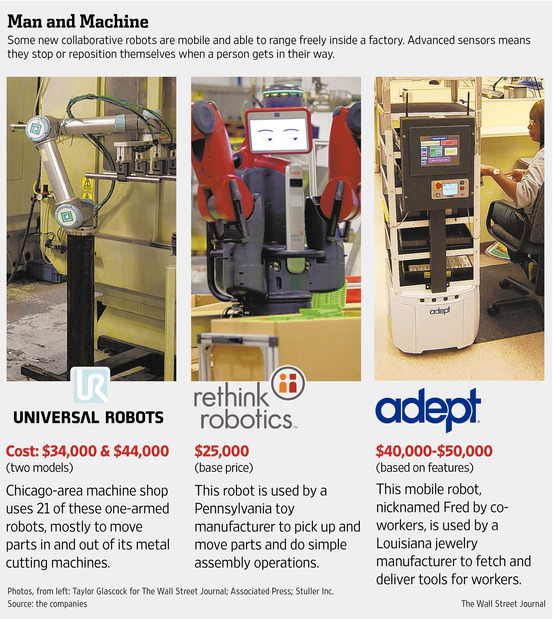
robotRobots aren’t just for the big guys anymore,” writes The Wall Street Journal (Sept. 18, 2014).  A new breed of so-called collaborative machines—designed to work alongside people in close settings—is changing the way some of America’s smaller manufacturers do their jobs. The machines, priced as low as $20,000, provide such companies—small jewelry makers and toy makers among them—with new incentives to automate to increase overall productivity and lower labor costs.

Robots have been on factory floors for decades. But they were mostly big machines that cost hundreds of thousands of dollars and had to be caged off to keep them from smashing into humans. Such machines could only do one thing over and over, albeit extremely fast and precisely. As a result, they were neither affordable nor practical for small businesses.

Collaborative robots can be set to do one task one day—such as picking pieces off an assembly line and putting them in a box—and a different task the next. Some are mobile and able to range freely inside a factory. The use of advanced sensors means they stop or reposition themselves when a person gets in their way, solving a safety issue that long kept robots out of smaller factories.

Classroom discussion questions:

1. Why will factories always need people?

2. What are the advantages and disadvantages of these smaller robots?

OM in the News: Forced Labor in Apple’s Malaysian Factories?

malaysia 2“Nearly 1 in 3 migrant workers in Malaysia’s thriving electronics industry,” writes The New York Times (Sept. 17, 2014), “toils under forced labor conditions, essentially trapped in the job.” The investigation, commissioned by the US government and conducted by the factory monitoring group, Verite, reported that 32% of the industry’s nearly 200,000 migrant workers were employed in forced situations because their passports had been taken away or because they were straining to pay back illegally high recruitment fees.

The report said those practices were prevalent among the migrants from Bangladesh, India, Myanmar, Nepal, Vietnam and other countries who work in Malaysia’s nearly 200 electronics factories. Those factories, which produce consumer electronics, motherboards, computer peripherals and other electronic goods, account for a third of Malaysia’s exports and produce for many well-known companies, including Apple, Flextronics, Samsung and Sony. Verite added that about half of the migrant workers who borrowed for their recruitment fees spent more than a year paying off those fees. The Labor Department commissioned the study because the federal government frowns on the importation of goods made by forced labor.

Thirty percent of foreign workers said they slept in a room with more than eight people, while 22% of the workers said they had been deceived about their wages, hours or overtime requirements during the recruitment process. Almost 46% said they had to pay a bribe, were detained or were threatened with detention or physical harm and 27% of the foreign workers said they could not come and go freely from their housing. Apple’s supply chain, which employs 1.5 million workers worldwide, employs 18,000 in Malaysia, including 4,000 migrant contract workers. Since 2008, Apple said it had helped migrant workers in Malaysia and elsewhere to reclaim $19.8 million in excessive recruitment fees. Apple uses about 30 factories in Malaysia.

Classroom discussion questions:

1. What is the responsibility of Apple and other manufacturers to these workers?

2. Why do these workers come to Malaysia?

OM in the News: Zara Turns to RFID for Inventory Control

zara“For more than a decade, radio frequency identification chips were touted as a game-changer for retailers,” writes The Wall Street Journal (Sept.17, 2014). But when they tried to apply the technology, merchants such as Wal-Mart and JC Penny discovered that what looked good on the drawing board didn’t always work so well in warehouses and stores. Now, apparel powerhouse Zara says it has learned from competitors and is rolling out RFID technology throughout its operations. The chips, about twice the size of a mobile-phone SIM card, help the world’s largest fashion retailer keep better track of its stock and replenish its clothing racks more quickly. “It gives us great visibility, knowing exactly where each garment is located,” says the CEO.

RFID chips can store information about whatever item they are attached to and, when prompted, emit that data via radio signals to a scanner. Zara is burying the chips inside its garments’ plastic security tags, an innovation that allows the chain to reuse them after the tags are removed at checkout. The Spanish retailer says it bought 500 million RFID chips ahead of the rollout, or 1 of every 6 that apparel makers are expected to use globally this year.

A major benefit is inventory-taking, a task that used to tie up a team of 40 employees for 5 hours in a Zara store. Now, 10 workers can sail through the job in half the time, waving scanning devices that detect radio signals from each rack of clothing. Before the chips were introduced, employees had to scan barcodes one at a time, and these storewide inventories were performed once every 6 months. Now Zara carries out the inventories every 6 weeks, getting a more accurate picture of what fashions are selling well and which are languishing. And each time a garment is sold, data from its chip prompts an instant order to the stockroom to send out an identical item. Previously, store employees restocked shelves a few times a day.Traditional retailers usually know where 60% of their inventory is at any time. With RFID technology, accuracy levels exceed 95%.

Classroom discussion questions:

1. What benefits accrue from RFID tags in this industry? What are the downsides?

2. Why did Wal-Mart slow its use of RFID?

Guest Post: Total Team Collaborative Learning of OM in Spain

flammOur Guest Post comes from Phillip Flamm, who teaches OM in the ISQS Department at Texas Tech University

I have recently returned from teaching operations management this past summer in Texas Tech’s Study Abroad Program in Spain. I divided my 24 students into 8 teams of 3 each with these provisos:

  • Each member of the team will get the same final grade for 80% of the class so they will be forced to help each other
  • Grades will be based on 2 exams (taken as a team), 2 or 3 team presentations, and a peer grade (from team members plus an attitude grade from me)
  • One presentation will be a tutorial of quantitative material
  • The second presentation will be the team solution of an OM case scenario

As part of the class, I also arranged tours of 2 manufacturing plants.

Students studying abroad normally want to talk about what they did and saw while traveling. The teams involved in Total Team Collaborative Learning only wanted to talk about how much they learned and how much they retained. The students truly enjoyed the OM class and the lowest group exam grade was 88/100. (I give the exact same tests during Fall and Spring back in Texas and the average is 64.) This seems to suggest that the teams learned faster, and retained more.

In the Summer Study Abroad 2014, we increased from 15 to 24 students over the prior year, with the final grades staying the same. We:

  • Utilized special power point pages with 3 slides per page, with lines for notes; teams reviewed notes together following lectures to clean up any questions they might have
  • Worked daily quizzes together for a team grade
  • Prepared quantitative teaching sessions 3 times during the month long class
  • Worked homework problems together for a team grade

OM in the News: UPS Tries to Increase its E-Commerce Efficiency

uosIn 1998, as much as 85% of e-commerce purchases were shipped between businesses. But along came Amazon, which helped convince a generation of Americans to buy even humdrum household items like diapers and toiler paper online rather than at the store. UPS drivers who used to drop off a bunch of heavy packages each day at one retailer, now make several stops scattered across a neighborhood, delivering one lightweight package per household. The shift required more fuel and more time, increasing the cost to deliver each package.

Last Christmas season, nearly 60% of all U.S. deliveries by UPS were e-commerce packages to consumers, compared with about 40% for all of 2012. Today, UPS’s haul includes much of Amazon’s 2-day-delivery Prime business. On residential routes, as much as 1/3 of trucks are filled each day with Amazon packages. And last Christmas, when UPS was overwhelmed by a pileup of online shipments at its massive Louisville facility, there were hundreds of trailers stacked up filled with Amazon orders.

UPS’s responses, reports The Wall Street Journal (Sept. 12, 2014): (1) Increase spending on new technology and extra manpower by 21% to $2.5 billion in 2014; (2) A pricing change that will encourage UPS customers to use boxes that fit the items being shipped, freeing up space in trucks for additional deliveries, or else pay extra; (3) Major savings from its route-optimization system, Orion. (Orion analyzes millions of pieces of data to predict the most efficient way to deliver and pick up packages along each driver’s route. Every mile cut saves the company $50 million a year, with half of UPS’s delivery routes in the U.S. using Orion by 2015.); and (4) My Choice, a service that alerts customers the day before a home delivery is set to arrive, provides an estimated delivery time and lets customers tell the driver where to leave the package. (Already 10 million customers have signed up for the $40/year service).

Classroom discussion questions:

1. How has OM helped UPS’s efficiency?

2. What new threats does UPS face in its shipping business?

OM in the News: American Airlines Returns to “Peak” Scheduling

Shorter connecting times mean runs of up to 1.1 miles in Miami's airport
Shorter connecting times mean runs of up to 1.1 miles in Miami’s airport

“American Airlines is making its Miami hub more hectic—on purpose,” writes The Wall Street Journal (Sept. 11, 2014). Instead of spacing flights evenly throughout the day, the airline just started bunching them together. The change restores an old format of “peak” scheduling, grouping flights into busy flying times followed by lulls when gates are nearly empty. American next year will “re-peak” schedules at its largest hubs in Chicago and Dallas-Fort Worth.

Airlines shunned peak schedules at hubs more than a decade ago because they meant higher costs such as more people and equipment, created too many delays and forced passengers to sprint through terminals to make connecting flights. Recently though, the industry has gravitated back to peaks and valleys as a way to fill seats and generate more revenue. “An additional person per flight will make a difference,” said American’s CEO. The company will gain $200 million more a year from re-peaking its schedules at hubs.

But travelers may have even less time to make flight connections or to eat. And airlines, airports and federal agencies are re-evaluating how they manage baggage, cleaning crews and security checkpoints with the new highs and lows in foot traffic. Peak scheduling packs planes better because it creates more possible itineraries, with shorter connection times. In Miami, 42 flights depart between 9 and 10 a.m. Then between 10 and 11 a.m., only a handful are scheduled to take off. The process repeats during the day with 10 “banks” of flights that fill about 45 gates at a time.

There are added costs to re-peaking. American hired 67 more gate agents and 150 baggage handlers and other ground workers. It had to purchase more belt-loaders, dollies and tugs that push planes out from gates. There are other pitfalls to airlines’ clumped schedules. If bad weather hits at the wrong time, diverted flights and missed connections can cause widespread delays.

Classroom discussion questions:

1. What are the advantages and disadvantages of this approach?

2. What other OM ideas could American use to increase efficiency?

OM in the News: Apple Again Faces Supplier Labor Violations

apple workerApple has once again been accused of poor and unsafe working conditions at one of its factories in China,” writes The Christian Science Monitor (Sept. 4, 2014). A  report compiled by China Labor Watch, which has previously targeted Apple for labor violations, says that a factory in Suqian has violated Chinese laws in addition to violating policies put in place by Apple and its supplier, Catcher Technology. Labor violations at the factory included “excessive overtime work, long work shifts while standing, a lack of occupational safety training and heavy dust in the workplace.” Subsequent investigations, 16 months after the initial investigations, found that working conditions had not improved and, in some cases, had worsened.

The 22 labor violations documented include discriminatory hiring practices, insufficient safety training, and a lack of protective equipment provided to workers handling toxic chemicals. Fire exits were blocked, while flammable alloy dust and shavings filled the air. Working overtime was mandatory for all workers, who were forced to work up to 100 hours of overtime per month, almost 3 times the 36-hour limit prescribed by Chinese law. Apple replies it has sent a team to investigate operations at the factory.

China continues to be Apple’s largest source of suppliers, in addition to being the place where nearly all Apple products are assembled. But factory safety for workers assembling Apple products has come under close scrutiny in recent years. About 150 Chinese workers at Foxconn threatened to commit suicide 2 years ago unless their working conditions were improved. Earlier this year, an Apple audit uncovered human rights violations at different levels of its supply chain, including abuses of migrant laborers and the use of underage workers. In response, Apple has increased supplier audits from 173 in 2012 to 451 last year.

On a separate note, the release of the iPhone 6 this week is expected to add 1% a month to China’s export growth for the rest of 2014.

Classroom discussion questions:

1. Why do these supplier problems persist?

2. What more can Apple do?

OM in the News: Designing the Perfect Airline Seat–To Maximize Revenue

airplane seatYesterday’s New York Times (Sept. 9, 2014) featured not 1, not 2, but 3 articles on how airlines are addressing the issue of cramped seats! In the 1st, we find that the European budget carrier Ryanair just announced an agreement to purchase up to 200 new Boeing 737s (a $22 billion deal), each of which will allow that airline to squeeze an additional 8 seats into the single-aisle airframe. Ryanair will fit the planes with a whopping 197 seats, stripping out the front and rear galleys to help the redesign.

The 2nd article, titled “In Flight Rage,” confirms that cramped conditions in the back of a plane can severely test passenger equanimity. We have seen this in recent episodes in which pilots have made emergency landings when a few passengers have fought over seat-reclining. One prof, comparing people to livestock, finds that international regulations on flying animals specify the “need space to travel comfortably and on a long journey, the animal must be able to stretch, turn round, drink and groom itself.” Sounds better than a coach seat!

airline seatingThe 3rd piece gets to the heart of the matter–ergonomics, and ties in perfectly to Chapter 10. The real issue, says Prof. Kathleen Robinette at Oklahoma State U., is that airline seats are not designed to fully accommodate the human body in its various shapes and sizes. “We are fighting each other, but the seats are not designed right,” she says. Her study of 4,431 people found that seats are designed for a man in the 95th percentile of measurements.  This means 1 in 20 men will be using seats that are too small for them. “That’s about 10 people on every plane, as well as all the people sitting next to them,” she adds. A big flaw in seat design, however, is that men in the 95th percentile are not necessarily larger than women. For about 1 in 4 women, the seat will be too small at the hips. Of even greater concern is the risk of blood clots, including a potentially deadly condition called deep vein thrombosis, which can occur when sitting in a way so you can’t move for about a 1/2 hour.

Classroom discussion questions:

1. What are the OM tradeoffs here?

2. Why is ergonomics an important issue on planes?

OM in the News: Tesla and the Mother of All Factory Chases

Tesla NevadaAfter pitting five potential host states against one another in a quest for hundreds of millions of dollars in incentives, Tesla Motors reports in The New York Times (Sept. 5, 2014) that it has struck a deal with Nevada for construction of a sprawling factory to build batteries for electric cars and the power grid. To secure the deal, Nevada paid dearly. The package of tax breaks totals about $1.25 billion over 20 years. Gov. Brian Sandoval acknowledged that there were concerns over the deal’s cost, but said that the agreement would “change Nevada forever” and that he expected the enormous tax breaks to pay dividends down the road.

Whether it will work that way is not clear. But the prospect of having such a large plant nevertheless set off “the mother of all factory chases,” according to an industry expert. The deal goes beyond tax breaks. It means Tesla would pay no sales tax for 20 years, no property tax and payroll tax for 10 years, and it would receive other tax credits tied to job creation and development. Nevada will also grant Tesla discount electricity rates for 8 years and make millions of dollars in road improvements around the factory site.

An important element for Tesla is the anticipated cost reduction is moving the fabrication of various components to a single spot, making the factory more of a campus than a single operation. Today, bringing the main components of the battery together is expensive. CEO Elon Musk describes the current system as “being put in a box, and then on a truck and then on a boat, and going through customs and stuff like that.” Still, analysts question whether the plant’s vast size will result in the huge price cut, an essential element of making the factory useful. At the heart of the strategy is to build a kind of battery that resembles the ones used for years in laptops and hand-held electronics.

Classroom discussion questions:

1. Referring to the incentive issue in Chapter 8, discuss Nevada’s decision.

2. Who is taking the most risk in this location decision?

OM in the News: Why Los Angeles Should Read Chapter 17

A recent water main rupture in Los Angeles

We know that not every OM instructor covers Chapter 17, Maintenance and Reliability. It is after all, the last chapter in a long text. But if Jay has told me once, he has lectured me a 1,000 times: “Maintenance is one of the most critical of the 10 OM decisions that managers make!”  And so it appears that the city of Los Angeles should have been reading Chapter 17 for the past 3 decades.

As The New York Times (Sept. 2, 2014) reports: “The scene was apocalyptic: a torrent of water from a ruptured pipe valve bursting through Sunset Boulevard, hurling chunks of asphalt 40 feet into the air as it closed down the celebrated thoroughfare and inundated the campus of UCLA. By the time emergency crews patched the pipe, 20 million gallons of water had cascaded across the college grounds.”

It was just the latest sign of a continuing breakdown of the public works skeleton of the U.S.’s 2nd-largest city: its roads, sidewalks and water system. With each day, another accident illustrates the cost of deferred maintenance on public works, with an estimated $8.1 billion it would take to do the necessary repairs. The city’s annual budget is $26 million. LA’s problems reflect the challenges many American cities face after years of recession-era belt-tightening prompted them to delay basic maintenance. “It’s part of a pattern of failing to provide for the future,” said one UCLA prof.

The average LA car owner spends $832 a year for repairs related to the bad roads, the highest in the nation. Families here routinely spring for expensive strollers to handle treacherous sidewalks. Close to 40% of the region’s 6,500 miles of roads and highways are graded D or F. More than 4,000 of the 10,750 miles of sidewalks are in severe disrepair. More than 10% of the 7,200 miles of water pipes were built 90 years ago. At the current level of funding, it would take the city 315 years to replace them.

Classroom discussion questions:

1. Why is maintenance such an important part of OM?

2. What strategy might LA take at this point?

Good OM Reading: The Pitfalls of Project Management Reporting

mit sloan  coverWill every corporate project be on time and deliver what was promised? Maybe — but maybe not, write four profs in MIT Sloan Management Review (Spring, 2014). Accepting 5 inconvenient truths about project status reporting can greatly reduce the chance of  unpleasant surprises.

 INCONVENIENT TRUTH 1: Executives can’t rely on project staff and other employees to accurately report project status information and to speak up when they see problems. Most executives expect and assume that employees will report when they see problems that might adversely impact a project. In negotiations between the U.S. and the Soviet Union, President Reagan’s signature phrase was “trust, but verify.”

INCONVENIENT TRUTH 2: A variety of reasons can cause people to misreport about project status; individual personality traits, work climate and cultural norms can all play a role. Executives tend to attribute misreporting to poor ethical behavior on the employee’s part. But one of the best remedies is building diverse teams, which can help balance out culturally specific behavior that might inhibit accurate project reporting.

INCONVENIENT TRUTH 3: An aggressive audit team can’t counter the effects of project status misreporting and withholding of information by project staff. The importance of promoting trust between those who report project status and those who receive the reports is the solution.

INCONVENIENT TRUTH 4: Putting a senior executive in charge of a project may increase misreporting. Research actually suggests that the stronger the perceived power of the sponsor or the project leader, the less inclined subordinates are to report accurately.

INCONVENIENT TRUTH 5: Executives often ignore bad news if they receive it. Executives should not only listen to a variety of stakeholders but should also take the warnings they receive seriously. If they do not, they may unwittingly contribute to a climate of silence in which employees grow even more reluctant to report bad news.

This research study nicely complements our treatment of Project Controlling in Chapter 3.


OM in the News: Eight Things Supply Chain Managers Worry About

When a group supply chain managers was recently surveyed about their concerns, Material Handling & Logistics (Aug. 27, 2014) reports that they came up with the following eight:


Talent: Having the right people in the right positions. All companies need better processes to assess, identify, recruit, develop and retain top talent, especially since supply chain talent is increasingly scarce.

The customer: The executives felt the urgency to better understand the current and future needs of their customers. They understand that their customers should lead their supply chain strategies, and they know that their customers should be better educated on the cost-service tradeoffs.

Agility: Given the increasing volatility in the global environment, the group understood the urgent need to plan and prepare for increased supply chain agility. Postponement is one of many enablers of supply chain agility.

Technology: The executives know they need to stay current with technology on many fronts, from warehouse and transportation management systems to network optimization tools and inventory planning systems.

Cost: Cost reduction will always be a priority and supply chain executives know their companies expect them to take the lead in that area. They must reduce cost while simultaneously redesigning their supply chains and leveraging the global environment.

Regulations and Infrastructure: Executives know they need to find efficient ways to comply with the growing list of regulations, as well as the crumbling transportation infrastructure.

Risk: Executives understand they should have a better process to identify, prioritize and mitigate supply chain risks that can seriously damage their companies. Even weather must be considered.

Sustainability: They think it’s time to develop a serious supply chain sustainability strategy. A growing number of companies have already begun that effort.

Classroom discussion questions:

1. Which of these eight do you think is the highest priority?

2. How can supply chain managers mitigate risk?