OM in the News: Lenovo Vertically Integrates, While Competitors Outsource

China’s Lenovo didn’t sell outside that nation until 2005, when it shocked the high-tech world by buying the laptop unit of IBM. Now it is shocking the PC world again by vertically integrating.”Three years ago the whole industry was saying everyone should outsource, that’s the future,” says Lenovo’s supply chain VP in The Wall Street Journal (July 9, 2012). But Lenovo “came to the conclusion that even though all our other competitors are going in the other direction…we can move faster if we’re more vertically integrated.” After poring over charts and analyses of the costs and benefits of in-house manufacturing the company decided to increase the company’s in-house manufacturing to 50% from less than 30%.

“Selling PCs is like selling fresh fruit,” says Lenovo’s CEO. “The speed of innovation is very fast, so you must know how to keep up with the pace, control inventory, to match supply with demand and handle very fast turnover.” The firm gained a tremendous amount of share during the industry’s disk drive shortage crisis when Thai factories flooded “because of the speed of our supply chain,” he said. Lenovo saw its market share climb above 14% in the fourth quarter as it shipped 13 million computers. H-P, the top computer vendor by unit sales for the past five years, saw its market share that quarter drop to 16% from 18%.

Lenovo’s Beijing factory, which assembles desktop computers and servers, resembles thousands of others across China. Robotic arms are in constant motion, moving parts and pieces around. Rows of blue uniformed workers pop parts into place as computers make their way down the line. The factory can churn out about 25,000 machines in a day. The difference: The facility, its equipment and its employees are all part of Lenovo. It is one of 8 company-owned factories around the world with 3 more to be built in China and Brazil.

Discussion questions:

1. What are the advantages and disadvantages of vertical integration for PC makers?

2. What challenge are all PC makers facing in this decade?

Guest Post: Certifying Supply Chain Resiliency

Our guest post today comes from Prof. Matt Liotine in the Dept. of Information and Decision Sciences, University  of Illinois-Chicago. Jay and I had the privilege of lecturing in his MBA classes during the POMS Meeting in Chicago in April.

Supply chain resilience has taken center stage in recent years amidst the many adverse events that are taking place across the globe. We have seen first hand how tsunami, earthquakes, hurricanes, tornadoes, wildfires, volcanoes and other natural disasters can not only cause loss of life and asset damage, but can also disrupt business operations. While is it incumbent upon companies to establish business continuity and disaster recovery plans to continue their operations in light of such events, it is also necessary for them to evaluate or even audit such plans pertaining to their key suppliers.

Several standards have been issued across the globe that businesses can use in this regard, such as ISO 22301, BS 25999 (U.K.), and NFPA 1600 (U.S.), and ASIS SPC.1. Most recently, the U.S. Congress has mandated a voluntary program of accreditation and certification of private entities for business continuity. Called the Voluntary Private Sector Preparedness Accreditation and Certification Program (PS‑Prep), this initiative was an outgrowth of the 9/11 Commission Act of 2007. Companies can use any of the last three standards cited above as a compliance benchmark since these share many similar principles and characteristics. Compliance is evaluated by auditors representing a PS-Prep certifying body. The U.S. Department of Homeland Security has authorized that these bodies be accredited by the ANSI-ASQ National Accreditation Board. While totally voluntary, PS-Prep can provide a mechanism for companies to evaluate and certify their own business continuance as well as that of their suppliers. (AT&T has been the first company to become PS-Prep certified.)

It is important to note that such compliance is not only targeted towards large corporations, but also for small-to-mid size businesses, which in fact constitute a significant portion of the global supply chain. While it may be infeasible for smaller suppliers to acquire a certification, buyers can still encourage or even enforce good business continuance practices by their suppliers through either contract stipulations and/or business processes.

OM in the News: UPS and its Team of Pharmacists

UPS is well-known for its army of brown-uniformed delivery drivers. Less known is that the package-delivery giant has its own team of pharmacists. At UPS’s Louisville headquarters, company pharmacists fill 4,000 orders a day for insulin pumps and other supplies from customers of medical-device company Medtronics. UPS pharmacists  log into Medtronic’s system, fill the orders with devices stocked on site, and ship them to patients, via UPS.

It is one part of the growing reach, writes The Wall Street Journal (June 28, 2012) by UPS—along with rivals FedEx and DHL—into the business of running supply chains for pharmaceutical and medical-device companies. Medtronic and other health-care companies are increasingly outsourcing logistics as they look for ways to cut costs from backroom operations and focus on product development instead (see Chapter 11). UPS’s service has allowed Medtronic to close its own distribution warehouse and see a significant reduction in the costs of processing each order. “If you’re a medical company, logistics isn’t your core expertise,” says an industry analyst.

The parcel-delivery companies are investing in megawarehouses that service multiple pharmaceutical companies at once, with freezers for medicines and high-security vaults for controlled substances. UPS got into health-care logistics in 2006 and the business has grown rapidly, with 33 health-care logistics facilities around the world, including a plant in Brazil opened last year specifically to handle the supply chain in that country for Merck.

Walgreen chose UPS to transport $9 million of donated flu vaccine—375,000 doses, to Laos in March. Fifty UPS “health care logisticians” coordinated the complicated journey. The 8,500-mile flight took five days and included four stops, ending in Bangkok, where the containers were loaded onto a truck for Vientiane, Laos.

Discussion questions:

1. What are the risks to UPS in entering the medical supply chain business?

2. Why would medical companies outsource their order systems to  parcel companies?

Guest Post: Supply Chain Resilience–a Visualized Introduction

Ben Benjabutr, at http://www.SCM-Operations.com, in Thailand, provides an interesting guest post in his Powerpoint explanation of supply chain resilience.
Supply chain resilience is a relatively new subject in supply chain management. During the 1970s, corporate decision making used traditional risk management techniques which have strong roots in financial models. Risks are usually quantified using assumptions based on historical data. In 1982, the term “Supply Chain Management” was coined by  a management consultant in the UK. The  primary goal of supply chain management was to reduce lead-time in distribution channel.

Risks in supply chains come in different terms– like variation, uncertainty, non-conformance, vulnerability and disruption. In the late 1990s, supply chain risk management emerged in academic literature. In 2000, research on the subject was conducted in the UK after transportation disruptions from fuel protests. Another research stream about resilience came in the United States after the 9-11 attacks in 2001. Then, in 2004, Martin Christopher and Helen Peck published their paper  “Building the Resilient Supply Chain.”  They defined resilience as “the ability of a system to return to its original state or move to a new, more desirable state after being disturbed“.

The most interesting year turned out to be 2011, with the tsunami in Japan followed by massive flooding in Thailand. The automotive and electronic industries were hit very hard by the disruptions. Since then, supply chain resilience has gain extraordinary attention from both academia and business professionals. The purpose of the Powerpoints I have created (click below) is to familiarize readers with the concept of supply chain resilience.  I hope this is something useful for instructors teaching from the Heizer-Render OM text.

[gigya id=”preziEmbed_n5tqhy_p-nhm” name=”preziEmbed_n5tqhy_p-nhm” src=”http://prezi.com/bin/preziloader.swf” type=”application/x-shockwave-flash” allowfullscreen=”true” allowFullScreenInteractive=”true” allowscriptaccess=”always” width=”550″ height=”400″ bgcolor=”#ffffff” flashvars=”prezi_id=n5tqhy_p-nhm&lock_to_path=0&color=ffffff&autoplay=no&autohide_ctrls=0″]
Source: SCM-Operations.com

Good OM Reading: Apple Doubles Down on Manufacturing in China

Fortune‘s (June 11, 2012) lead article features Apple’s new CEO, Tim Cook, whom the magazine calls “the master of operational efficiency”.  The article is a good one for your students to read at the start of a semester or when you treat the topic of supply chains (Ch.11).

Cook joined Apple in 1998 to revamp its badly broken system of factories, warehouses, and suppliers. He quickly strengthened Apple’s cooperation with its contract manufacturers in China. But it was a personal blow to Cook when the New York Times ran a prominent article in January critical of the working condition at Foxconn, the company that assembles most of Apple’s products. Though the criticism wasn’t new, the exposé painted a bleak portrait of the lives of workers in the factories. Cook’s response marked a distinct change in tone from Steve Jobs, who had been dismissive of the severity of the problem. The new CEO not only visited Foxconn personally, but Apple  joined the Fair Labor Association, a third-party monitoring group.

The news this week, though, is that Apple is doubling down on its manufacturing in China. Apple disclosed for the 1st time the dollar value of its assets there: $2.6 billion, meaning a massive value of  material and equipment Apple has bought on behalf of its suppliers. The firm is risking  its own capital, another $7 billion, as a way of financing massive upgrades in its manufacturing capabilities in Asia, even though its partners will operate the equipment.

Apple generally is mum on what the investments are for,  but “that’s got to be for volume,” says a portfolio manager at T. Rowe Price. He notes that Apple suppliers like Pegatron and Jabil have been buying sophisticated machine tools and that Japanese drill-bit manufacturers say they are moving into consumer electronics on Apple’s behalf. “The Apple supply chain is doing things no one else can,” given its abundance of cash and manufacturing know-how. Such operational efficiencies have been an underappreciated factor in Apple’s success for the past decade; all the attention has been on its beautiful designs and snazzy marketing overseen by Jobs.

OM in the News: The Shipping Revolution

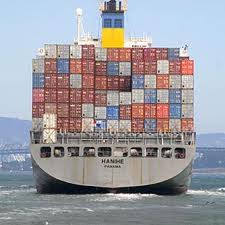
Fortune (May 21, 2012) carries a fascinating analysis of the global shipping industry that fits nicely into a discussion of logistics in Chapter 11. We find in the article that nearly 90% of all goods traded across borders travel at some point by sea.The fastest growing routes are between ports in Asia, accounting for 43% of all maritime trade., with the most heavily trafficked route being between China and the US West Coast. Unfortunately for the trade deficit, 4 times as many goods travel to the US than make the return trip. New, faster routes are opening with the Northeast and Northwest Passages ice-free every summer since 2008.

The real revolution has been in the ships themselves. Back in  the 1956-1970 era, cargo vessels were 443 feet long and hauled 500 twenty-foot “equivalent container units” (called TEUs). Next year, Maersk, the Danish shipping giant, will launch its EEE-Class, the largest cargo ship in history. Length: 1,312 feet. capacity: 18,000 TEUs. Cost: $190 million/ship.

As ships have gotten bigger, economies of scale have improved, and the cost of shipping has dropped dramatically. Here are some typical ocean-crossing costs: TV, $10; DVD player, $1.50; vacuum cleaner, $1; barrel of oil, 80 cents; 6-pack of beer, 6 cents; 100 pounds of coffee, $6.80. (Oil, grain, and iron are more expensive because ships make the return trip empty.)

And the containers themselves are no longer just a steel box. They have doubled to 40 feet, and are often fitted with RFID chips to let ports and owners keep track of them. Some  containers are built to be folded up when empty. Others can float if lost at sea and  come with GPS satellites to make them easier to find in the ocean.

Discussion questions:

1. Why are the ships getting bigger and bigger?

2.  What are the dangers facing the shipping industry?

OM in the News: 3M’s “Hairball” Supply Chain

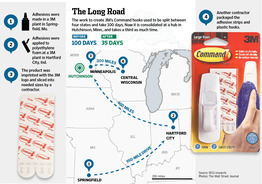
3M’s Command picture-hanging hooks, made of plastic and strips of sticky foam, don’t look complicated. The Wall Street Journal (May 17, 2012) reports, though, that until recently, the Command production process meandered more than 1,300 miles through 4 factories in 4 states.

3M’s recently retired CEO branded such convoluted production trails as “hairballs.” The man in charge of untangling, John Woodworth, 3M’s Supply Chain VP, characterizes the situation this way. “We had long supply chains.  It was and continues to be an issue.”

Every company tries to streamline manufacturing and supplier networks, of course. But few have a task as daunting as Mr. Woodworth’s.  3M makes 65,000 products, ranging from Scotch tape to film for solar-energy panels, dental braces and dog chews. They are produced in 214 plants in 41 countries. Mr. Woodworth, a 38-year veteran of 3M, figures he has been inside half of those plants.

3M’s long-term plan is to have fewer, larger, more efficient plants, and spread them out around the world. More production will be done in what 3M calls “super hubs,” plants capable of making scores of products for a region of the world. 3M now has 10 hubs, including six in the U.S. and one each in Singapore, Japan, Germany and Poland. It plans at least six more, all outside the U.S.

3M’s  stethoscopes, for example, used to be made in steps involving 14 outside contractors and three 3M plants. Now all processes are being brought into a plant in Columbia, Mo. The cycle time will fall to 50 days from 165. The company’s goal is to reduce cycle times—the period needed to go from ordering raw materials to delivering finished goods—by 25%.

Discussion questions:

1. Why did the 3M production process become so complicated?

2. Why is cycle time such an important OM concept?

OM in the News: How Nylon-12 and Xirallic Haunt Auto Supply Chains

For automakers, this past year has been one supply chain trauma after another. Now The Wall Street Journal (April 18, 2012) tells the story of 200 auto execs meeting in Detroit to deal with the looming shortage of Nylon-12, an obscure resin essential to the production of fuel and break lines. Inventories of the resin are being depleted after an explosion last month at an Evonik Industries AG plant in Germany, that killed two employees. Evonik, whose plant will take many months to repair, is the only  maker of the resin. The ricochet effect is global and less than a month’s worth of Nylon-12 inventory exists.

Evonik plant on fire in Germany

Evonik makes 25% of the global supply of the specialty resin and supplies a chemical building block to another company, Arkema SA, that makes a similar amount. Arkema says shortages of the building block means it will not be able to supply customers with the resin. “There will be no quick solutions,” says the Journal. GM has put together a global team from its purchasing, engineering, and supply departments working to allocate resins and prioritize its needs.

Last year, production in Japan of Merck’s Xirallic, the shiny pigment in some automotive paints, was disrupted by the tsunami and subsequent nuclear power plant problems. Auto makers had to limit or stop taking orders for some cars that used the pigment for certain colors because the plant was the industry’s primary supplier of the pigment. The Merck plant was repaired, but disruption rippled through the industry for more than 6 months.

Discussion questions:

1. Why is a replacement for Evonik so difficult?

2. How can global supply chain disruptions be minimized?

OM in the News: Red Lobster’s Vertical Integration Into Lobster Farming

In what could be an underwater gold mine, Orlando-based Darden Restaurants plans to create the world’s largest lobster farm in Malaysia, allowing it to sell the crustaceans in Asia and supply them to its chains such as Red Lobster, according to a story in the Orlando Sentinel (April 9, 2012). The lobster farm would partially shield  Darden from rising seafood prices, while creating a new revenue stream. Lobster farming, a field in its infancy because it has been notoriously difficult, could also keep prices lower for consumers but pose tougher competition for fishermen.

Darden plans to  build the 23,000-acre production facility, which will employ 12,000 workers and eventually churn out 40 million pounds of lobsters each year. That’s about $1 billion worth.

Darden says it will take a while to get to that point — at least 2029. It will take several years to start producing food and at least a decade before lobster sales have a big impact on the company’s bottom line. “There’s a growing world demand for lobster products of all types,” says Darden’s VP of Purchasing and Supply Chain Innovation. The project, which will take an investment of $650 million, will be Darden’s “crown jewel” of environmentally friendly seafood production.

But as we noted in this blog just a few days ago (with regard to Delta Air Lines’ plans to buy a jet fuel refinery), vertical integration (Ch.11) moves most companies outside their core competencies. And lobster farming is a tough business for any company to master. Lobsters take a long time to mature and consume a lot of food. They also cannot make the trip all the way from Malaysia to the US alive.

Discussion questions:

1. Why is Darden venturing outside its expertise in restaurants (its chains also include Longhorn Steak, Olive Garden, and Bahama Breeze)?

2. What other restaurant or fast-food chains have successfully vertically integrated? How and why?

OM in the News: Delta Wants to Pump Its Own Fuel

When we discuss vertical integration in Chapter 11 and core competencies in Supplement 11, we never considered an airline buying an oil refinery to slash its fuel bills. But as The Wall Street Journal (April 6, 2012) reports, that is exactly what Delta Air Lines is trying to do. Delta’s unconventional proposal to acquire a Pennsylvania refinery is a bet that world’s second-largest airline can save $20-$25 a barrel on jet fuel, a big advantage as industry costs now approach $140 a barrel, up 11% so far this year.

Delta’s plan is being dismissed by aviation and energy industry experts, who said owning a refinery is a risky and potentially costly undertaking for an airline. “We are a little uncomfortable about the company going outside its core expertise,” says an analyst who follows Delta. “I can’t recall any other airline buying a refinery.”

The estimated $100 million to $150 million price tag for the refinery is about the cost of a new, wide-bodied aircraft. Delta’s plan would involve using an energy company partner that would handle day-to-day operation of the midsize refinery.  Its deliberations are the boldest step yet in an airline industry struggling to mitigate rising fuel prices that are expected to continue long term. Delta, which paid more than $11 billion for fuel last year–about 36% of its operating cost– has ongoing cost-saving efforts and is investing heavily in more fuel-efficient planes.

Other carriers, of course, also work hard to control their largest cost. Air Canada scours the globe for vessel shipments of jet fuel that it brings to its home airports in an elaborate supply chain of fuel-storage depots, pipelines and docks, leased rail cars, barges, and trucks. Fuel costs are up about 25% over last year.

Discussion questions:

1. What is Delta’s core competency and what are the chances this approach will be successful?

2. What are some other examples of vertical integration in major businesses?

OM in the News: Apple’s Move to Multiple Suppliers for the New iPad

The scene at Apple stores around the world last Friday resembled a rock concert, with large crowds, barricades, food, and cheering  as the company introduced its 3rd generation iPad. But when covering Supply Chain Management in Chapter 11, you and your students may be more interested in what’s going on under the hood of the new iPad tablets. The Wall Street Journal (March 17-18, 2012) writes that Apple “heavily hedged its bets on suppliers of key components, a strategy aimed at holding down costs and risks. The strategy allows a customer to play one supplier off another for lower prices, and minimize disruption if a single factory runs into production problems.”

How do we know the contents and supplier names?  The research firm UBM TechInsights, it turns out, bought and took apart several iPads on Friday, and found components with the same functions made by at least 3 manufacturers in different tablets. Some teardowns revealed memory devices from Micron Technology, some from Hynix Semiconductor, as well as others with chips  from Toshiba. The distinctive high-resolution displays came from  Samsung, LG Display, and Sharp.

The desire to diversify supply sources has taken on added importance with recent natural disasters, including the 2011 earthquake in Japan and  flooding in Thailand. “The multiple suppliers in the iPad suggest Apple is more actively trying to mitigate such risks,” says a UBM executive,  adding that  the strategy is credited to Apple CEO Tim Cook who “made his name at the beginning as the master of the supply chain.”

After opening the new device, UBM estimated that Apple paid $309 for the components in the iPad (that sells for $629). This compares to a current cost of $248 for the iPad 2, which was released last year. Here is the link to a 3 min. video on the iPad teardown.

Discussion questions:

1. Why do many electronics industry companies seek multiple suppliers?

2. Why did component costs increase in this new iPad?

OM in the News: Ford’s Secret Battle to Save Its Supply Chain

Late in 2008, Ford was just months away from running out of cash. With the auto industry careening toward ruin, Congress offered the Big 3 a bailout. GM and Chrysler grabbed the taxpayer lifeline, but Ford decided to save itself. Under CEO Alan Mulally, Ford had already put together a bold plan to unify its global operations, transform its product lineup, and overcome a dys­functional culture. It was an extraordinary risk, but Mulally applied the principles he developed at Boeing to streamline Ford’s operations, force its executives to work together, and convince the UAW to join his fight for the soul of American manufacturing.

It wasn’t just the Big 3 struggling to stay in business though. In a very interesting article in The Wall Street Journal (March 9, 2012), we learn of the secret “Project Quark”, a move to save Ford’s suppliers, most of whom were also on the brink of bankruptcy. Without parts, nothing else Ford did would matter. In a high-tech room that looked like it belonged in a NASA facility, Ford created a risk profile for each supplier. It might be easy to find another company to make plastic trim, but finding one for exhaust systems might be impossible, as such firms are highly engineered and have proprietary technology.

Ford pared the list down to 850 suppliers it had to keep in business. It also recognized that the world’s automakers had become mutually dependent on a complex web of suppliers. Although GM and Chrysler bowed out of cooperating, Toyota, Honda, and Nissan did not. With the web in danger of collapsing in late 2008,  Ford started dealing with suppliers that were vital to Toyota, in exchange for Toyota buying from American parts companies, like Delphi, which were vital to Ford.

This is a wonderful article that you might ask your students to read when you teach Ch.11, Supply Chain Management.

Discussion questions:

1. Why did GM refuse to participate?

2. Why did the Japanese auto makers join Ford?

OM in the News: Ship by Air or by Sea From Asia?

One of our topics in Chapter 11, Supply Chain Management, is “Cost of Shipping Alternatives,”  in which we compare the cost of  shipping providers from Asia (see Example 3). The Wall Street Journal (Feb.28,2012) just provided a perfect example of this issue to share with your class. The article describes how retailers like Abercrombie & Fitch (A&F) are shifting away from air delivery in favor of bringing more goods to the US by slower, but cheaper, ocean freight.  A&F has slashed the percentage of its inventory flown into the US to 12%  from 60%, a level its supply chain VP says was “crazy.”

The choice involves a trade-off. It cuts shipping costs drastically. But it can take weeks, rather than days, to transport clothes or other goods from manufacturing centers in China and other Asian countries. That leaves retailers with less control of their inventory, making them more vulnerable to fashion changes. But while the switch  to ocean freight lowers average unit costs,  retailers typically take possession of finished goods when they leave the factory. That means the goods spend more time on a company’s balance sheet and tie up cash.

Partly to reduce those risks, US firms that outsource production to China are starting to move operations closer to home. Hampshire Group, for example, which manufactures for brands such as Geoffrey Beene and Levi Strauss, chose a site in Honduras. This means it can ship to distribution centers through the Panama canal in 6 days vs. 27 days from China. Although faster shipping can make sourcing to Central America competitive with Asia, many of these countries “don’t have the fabric mill infrastructure in volume like China,” says the A&F VP.

Discussion questions:

1. What will it take to make Central America more competitive with Asia for clothing manufacture?

2. What are the 2 main reasons why US firms choose air freight over ocean shipping?

Good OM Reading: The Greening of the Chinese Supply Chain

Given how much of the world’s manufacturing takes place in China, and the damage it has wrought on that country’s environment, more and more multinationals are under pressure to clean their supply chains, writes MIT Sloan Management Review (Winter, 2012). For companies that ignore the problems, the costs can be considerable. Just last August, a group of 5 Chinese environmental NGOs focused attention on our beloved Apple for using suppliers with public pollution problems. The international headlines forced Apple to immediately tackle its–and its suppliers’– act.

This  excellent article says that even industry green leaders such as Nike and Adidas may never completely cleanse their supply chains . But rather than just monitoring Chinese suppliers compliance with health, safety, and environmental standards, top US firms are giving them tools and incentives to improve independently, helping use energy, water, and materials more efficiently. They are also reaching deeper into 2nd and 3rd tier suppliers, where the greatest damage occurs. Nike, for example, sends environmental engineers to 40 footwear suppliers to help them set targets to reduce waste and scrap, and improve efficiency. Instead of auditing, the Nike team spends 80% of its time driving new green initiatives.

The MIT Sloan piece points out that audits alone are very limiting, as factories have become adept at hiding problems from auditors. There is even an indigenous consulting industry designed just for that purpose. (Auditors are also commonly susceptible to bribery.) “Corruption is widespread,” says a former rep for Wal-Mart, which has 20,000 tier 1 suppliers in China alone!

The lengthy article includes a 12 point plan for companies to follow to deal with this major supply chain issue. It makes for valuable reading as you cover Chapter 11.