OM in the News: How to Make a Ship Bigger–Cut it in Half First

What’s a cruise company to do when it needs a bigger ship? Apparently, just saw it in half and add an extra 49 feet. Silversea Cruises began the lengthening process of its Silver Spirit ship this month as part of a $100 million renovation, USA Today reports (March 20, 2018).

The transformation is currently underway at Fincantieri Shipyard in Italy. This type of lengthening has never before been employed for the extension of a luxury cruise ship. An extension is much cheaper than ordering a brand new ship, which can cost upwards of $1 billion.

The project will create more space in public areas and will enhance Silver Spirit’s facilities, including adding increased space to the dining area, making room for additional outdoor seating, expanding the pool deck, a new spa, two new public spaces and a new aerobics area.

The massive expansion will require 500 workers who will spend approximately 450,000 hours in the job. The project will be complete in May, 2018. (Construction of the new section began 10 months ago). When finished, the Silver Spirit will measure 691 feet in length and have an increased capacity of 12%. About 846 tons of steel, 360,892 feet of cabling and 26,247 feet of piping will be put to use in the lengthening.

Classroom discussion questions:

  1. Compare the Silver Spirit to Royal Caribbean’s brand new Symphony of the Seas.
  2. Is this project more or less complex than building a ship from scratch? Why?


OM in the News: The Nuclear Waste Challenge at Fukushima 6 Years Later

Six years after the largest nuclear disaster this century, reports The New York Times (March 13, 2017), Japanese officials have still not solved a basic problem: what to do with an ever-growing pile of radioactive waste. Each form of waste at the Nuclear Power Station presents its own challenges. It is a massive OM issue worthy of class discussion when you cover the chapters on Project Management and Sustainability. Here is a rundown on the complexity of this $188 billion project:

400 Tons of Contaminated Water per day. Japan is pumping water nonstop through the reactors to cool melted fuel that remains too hot and radioactive to remove. The 1,000 storage tanks already hold 962,000 tons of contaminated water, but the plant is running out of room to store it.

3,519 Containers of Radioactive Sludge. The process of decontaminating the water leaves radioactive sludge trapped in filters, which are being held in thousands of containers.

64,700 Cubic Meters of Discarded Clothes. The 6,000 cleanup workers put on new protective gear every day. These hazmat suits, face masks, etc., are thrown out at the end of each shift. The clothing is stored in 1,000 steel boxes stacked around the site.

Branches from 220 Acres of Deforested Land. The plant’s grounds were once dotted with trees, and a portion was even designated as a bird sanctuary.

200,400 Cubic Meters of Radioactive Rubble have been removed so far and stored in the equivalent of about 3,000 standard 40-foot shipping containers.

3.5 Billion Gallons of Soil Have Been Bagged. Japan will eventually incinerate some of the soil, but that will only reduce the volume of the radioactive waste, not eliminate it.

1,573 Nuclear Fuel Rods. The condition and location of this molten fuel debris are still largely unknown. The plan is to use robots to find and remove it. But the rubble, the lethal levels of radiation and the risk of letting radiation escape make this exceedingly difficult. A robot inserted into one of the reactors detected radiation levels high enough to kill a person in less than a minute.

Classroom discussion questions:

  1. How does this cleanup project compare to other massive ones like those discussed in Chapter 3?
  2. Why is this a sustainability issue?

Teaching Tip: Our New Project Management Classroom Simulation

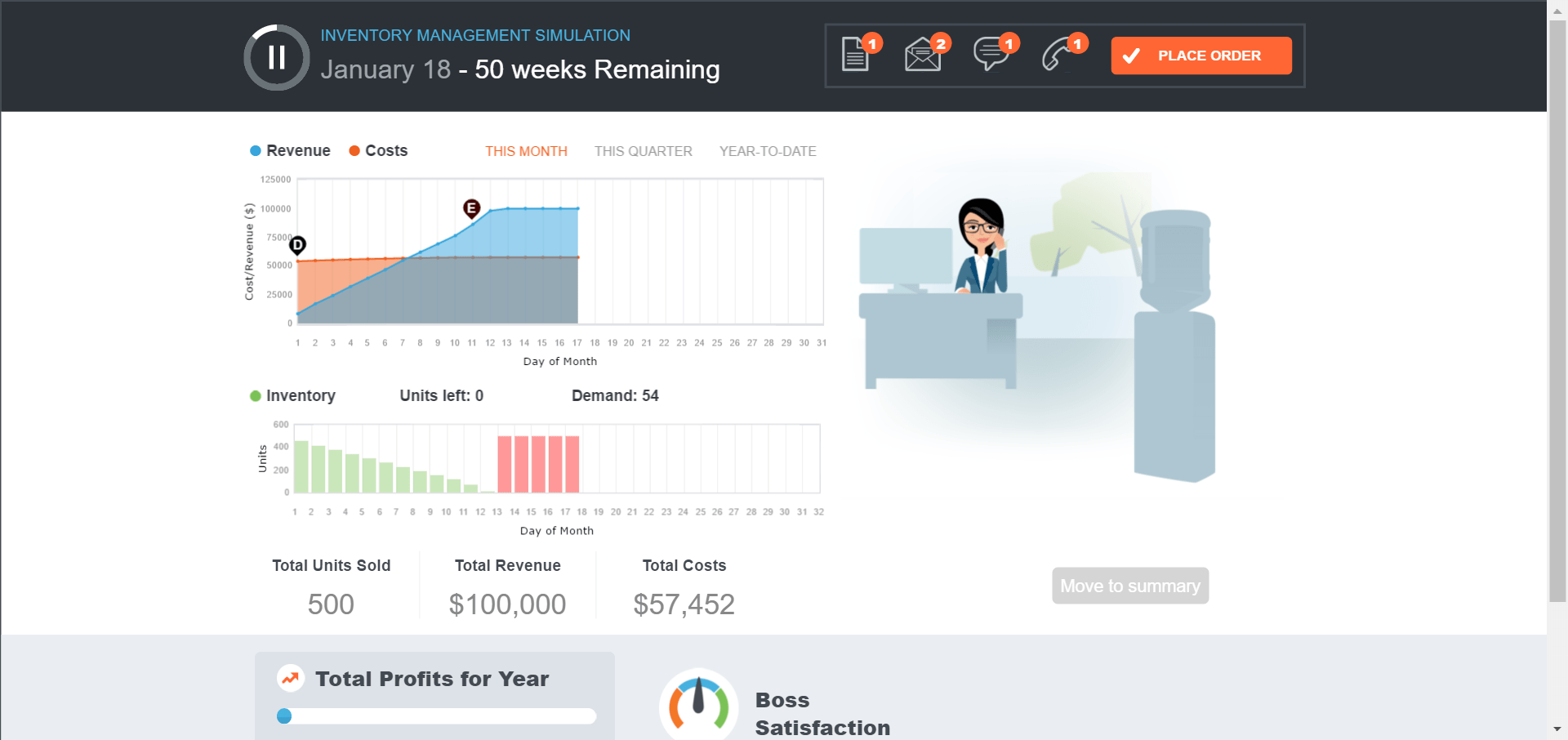
This Project Management Classroom Simulation is the 2nd of our new classroom gaming exercises. It accompanies Chapter 3, Project Management, and is free within our MyOMLab learning system.

Activity Brief

Select and manage subcontractors to achieve schedule and profitability goals of home-building project.

You are the general contractor for a high-end, private residence construction job. You manage teams of subcontractors who work on various aspects of the house, from plumbing and electrical to drywall and landscaping. The homeowners, Robert and Maggie Applebaum, want to be in their new house in 7 months and will check in with you regularly about its progress. It is your job to make sure daily operations at the site are running smoothly and that the house is completed on time and within budget, without negatively affecting your other building projects

 Industry: Constructionproject managemnt sim 2project management sim 1

MyOMLab: Our Four New OM Simulations

We are thrilled to announce that our learning package now includes some pretty sophisticated OM simulations. Here is a bit of background information.

  • How many simulations will be part of OM Simulation?  We have four gaming simulations: inventory management (chapter 12), quality control (chapter 6), forecasting (chapter 4), and project management (chapter 3). A fifth, supply chain management (chapter 11), will be available in late Fall.
  • Are these simulation to be done in class or outside of class?  The OM simulations are fully assignable through MyOMLab, so students could complete this as homework presumably after completing their reading. It would also work as an in-class activity, either working as an individual or as part of a team.
  • Are the OM simulations smartphone compatible?  The OM sims are compatible for mobile devices including smartphones in landscape orientation.  However the simulations are optimized for desktop/laptop devices.  Our research suggests that for activities of this length, most students still prefer desktop/laptop use.
  • Are the OM simulations accessible?  Yes, the OM simulations have been developed with a number of accessibility features including compatibility with screen reader devices.
  • Can you pause the simulations?  Yes, you can pause all of the simulations to review the artifacts (documents, emails, voicemails, texts) or make a decision.
  • What is the price of the OM simulations?  Access to simulations is through MyOMLab and included in that purchase cost. There is no additional fee to purchase these simulations on top of the MyOMLab purchase.simulation


OM in the News: How the Panama Canal Project Collided With Reality

Construction on the new locks in August 2014. They were supposed to be completed for the original canal’s 100th anniversary that year
Construction on the new locks in 2014. They were supposed to be completed that year.

The New York Times is at its best when it tackles journalistic investigation, as it did with its front page, 5 page feature called “The New Panama Canal: A Risky Bet” (June 23, 2016). The article is the perfect way to introduce the critical topic of project management (Chapter 3). It is the tale of an intense 2-year competition, and how Sacyr, a Spanish company in severe financial distress, learned that its rock-bottom bid of $3.1 billion had won the worldwide competition to build a new set of locks for the historic Panama Canal.

What can go wrong in a massive project like this–or like so many of the others we note in Chapter 3’s Global Company Profile featuring Bechtel (which lost the bid they thought they had wrapped)?  Here are just a few answers: (1) disputes over how to divide responsibilities; (2) executives who did not fully grasp how little money they had to complete a complex project with a tight deadline; (3) a multicultural team whose members did not always see things the same way; (4) work stoppages, porous concrete, a risk of earthquakes, and at least $3.4 billion in disputed costs (more than the budget for the entire project)!

For more than 100 years, the canal has been a vital artery nourishing the world economy. The new locks were sold to the nation and the world as a way to ensure that the canal remained as much of a lifeline in the hyperglobalized 21st century as it was in the last. But 7 years after the contracts were signed, and the locks declared ready for use, the expanded canal’s future is cloudy at best, with its safety, quality of construction and economic viability in doubt. The bid by the winner was 71% lower than that of Bechtel. Shocked Bechtel executives were incredulous, saying Sacyr “could not even pour the concrete for their bid amount.”

Classroom discussion questions:

  1. Where did the project go wrong?
  2. What ethical issues did the project managers face?

OM in the News: Shell Oil’s Artic Project Gamble

shell oil“In a windowless conference room in Anchorage,” writes BusinessWeek (Aug. 5-12, 2015), “a dozen Royal Dutch Shell employees report on the highest-profile oil project in the multinational’s vast global portfolio.” Warmed by mid-July temperatures, Arctic ice in the Chukchi Sea, northwest of the Alaskan mainland, is receding. Storms are easing; helicopter flights will soon resume. Underwater volcanoes are dormant. “That’s good news for us,” said Shell’s top Alaska executive.

Overhead, a bank of video monitors displays radar images of an armada of Shell vessels converging on a prospect called Burger J. Company geologists believe that beneath Burger J—70 miles offshore and 800 miles from the Anchorage command center—lie up to 15 billion barrels of oil. An additional 11 billion barrels are thought to be buried due east under the Beaufort Sea. All told, Arctic waters cover 13% of the world’s undiscovered petroleum–enough to supply the U.S. for more than a decade.

Surprise lurks in the Chukchi, whose frigid waters span from Alaska to Siberia. Logistical and legal obstacles have repeatedly delayed the Arctic initiative, on which Shell is spending more than $1 billion a year—more than $7 billion so far and counting. The single well in Chukchi that Shell aims to excavate this summer could be the most expensive on earth, and it hasn’t yielded its first barrel.

Activists have sued; judges have intervened. In 2010, work stopped when the Obama administration temporarily suspended offshore drilling throughout the U.S. Back in action in 2012, Shell suffered a maritime fiasco when ship engines conked out and a massive drill barge ran aground, requiring a Coast Guard rescue. Even against this challenging economic backdrop, Shell won’t postpone or downsize its Arctic dreams. The offshore Alaska field has the potential to be multiple times larger than the largest prospects in the U.S. Gulf of Mexico. But to put it mildly, Shell is assuming immense project management operational risks to drill in the Arctic.

Classroom discussion questions:

  1. Why are project management tools so critical to Shell?
  2. Why is Shell carrying out such a vast project?

OM in the News: Collaboration as an Operations Tool

collaboration2We discuss the importance of collaboration in Chapters 3 (Project Management), 5 (Product Design), 10 (Human Resources), and 11 (Supply Chain Management). Is collaboration at work all it’s cracked up to be? Recent research by profs at BU, Harvard, and Northeastern concludes that collaboration sometimes hinders problem solving because individuals in big groups tend to parrot one another, resulting in a narrow set of solutions. “We just get caught up in our own gospel around collaboration,” says one author in The Wall Street Journal (May 20, 2015).

The researchers broke down problem solving into 2 parts—gathering facts about a situation and devising solutions—and divided study participants into groups of 16. Some of those groups were connected to each other in a clear team structure. Other groups were less connected, and information wasn’t shared among the entire group. The highly clustered groups were better than the loosely connected ones at gathering facts about a problem. Yet those collaborative groups came up with fewer solutions than the more isolated groups did. People tend to copy each other and agree more when they are trying to come up with solutions together. The phenomenon is similar to “group think,” although the authors said it could also be described as “cognitive laziness,” since members seem to lack the will to argue with the group.

The trick for companies is to figure out how to divide problem solving into two parts: fact gathering and generating solutions.That isn’t always intuitive or easy to do, especially under tight time constraints. Consulting firms such as McKinsey and Boston Consulting Group tend to remix team structures at various points in a project. Larger teams are good at the start of brainstorming sessions, where workers can share widely what they know. When it comes time to refine those ideas employees could do well to break into smaller groups.

Classroom discussion questions:

1. Why do the consulting firms reconfigure their teams during a project?

2. Make the case for more collaboration. Against it.


OM in the News: Stuck in Seattle With Big Bertha

Inside the Seattle tunnel last year

Megaprojects almost always fall short of their promises—costing too much, delivering underwhelming benefits, or both, reports BusinessWeek (April 6-12, 2015). Yet from the London-­Paris Chunnel to Boston’s Big Dig, cities still fall for them, seduced by new technologies and the lure of the perfect fix.

Back in Seattle, everything about the new project to build a tunnelled roadway though the heart of the city is gargantuan, starting with the underground drilling machine called Bertha. Bertha is as tall as a 5-story building. Her job is to bury a highway that runs on a structurally unsound elevated road smack in the middle of an earthquake zone. The viaduct, as it’s called, follows the shoreline, effectively barricading downtown Seattle from what could be a beautiful waterfront. Bertha runs on a 25,000-horsepower motor and has a head weighing 1.7 million pounds, with 260 steel teeth designed specifically to chew through Seattle’s silty soil.

But Bertha broke abruptly in December 2013 after boring through just 1,000 feet, a small portion of her job. Her seals busted, and her teeth clogged with grit and pieces of an 8-inch steel pipe left over from old groundwater tests. She stopped entirely. Now the tunnel, with a budget of $1.4 billion and originally scheduled to be finished in November 2015, is 2 years behind schedule. The contractor has spent months digging to reach Bertha and crane her to the surface, where a weary Seattle awaits. After Bertha got stuck, she couldn’t back up because she builds the concrete walls of the tunnel as she drills forward.

Bertha may be a lemon, but there is no Plan B. The state and the contractor say they’re not abandoning ship. Bertha has become too big to fail. Nine times out of 10, though, massive infrastructure jobs go over budget. Tunnels on average cost 34% more than anticipated. No country or state is any better at predicting costs, and over the past 70 years, less than half of the world’s megaprojects have delivered their promised monetary benefit.

Classroom discussion questions:

1. Why do large projects tend to run late and over budget?

2. What tools in Chapter 3 can be used to control projects better?

Good OM Reading: What Successful Project Managers Do

mit coverIn today’s dynamic and competitive world, a project manager’s key challenge is coping with frequent unexpected events. Despite meticulous planning, the manager may daily encounter such events as the failure of workers to show up at a site, the bankruptcy of a key vendor, a contradiction in engineering guidelines, or changes in customers’ requirements. Some of these events were anticipated but whose impacts were much stronger than expected, some could not have been predicted, and others could have been predicted but were not. All three types of events can become problems. A new research article in MIT Sloan Management Review (Spring, 2015) describes how successful project managers cope with these challenges with 4 approaches.

1. Since project progress depends on individuals who represent different disciplines and parties, collaboration is crucial for the early detection of problems as well as the quick implementation of solutions. But the various parties to the project are loosely coupled, whereas the tasks themselves are tightly coupled. When unexpected events affect one task, many other interdependent tasks are quickly affected. Thus, project success requires both interdependence and trust among the various parties.

2. Project managers faced with unexpected events employ a “rolling wave” approach to integrate planning/reviewing with learning. Recognizing that firm commitments cannot be made on the basis of volatile information, they develop plans in waves as the project unfolds and information becomes more reliable. They develop detailed short-term plans with firm commitments, while also preparing tentative long-term plans (that include redundancies, such as backup systems or human resources).

3. Successful project managers never stop expecting surprises, even though they may effect major remedial changes only a few times during a project. They’re constantly anticipating disruptions and maintaining the flexibility to respond proactively. The book Great by Choice describes one of the core behaviors of great leaders as “productive paranoia.” 

4. When unexpected events affect one task, many other interdependent tasks may also be quickly impacted. Thus, solving problems as soon as they emerge is vital. Corrective action is possible only during a brief window. One study of construction project managers found that they addressed 95% of the problems during the first 7 minutes following problem detection.

Good OM Reading: The Pitfalls of Project Management Reporting

mit sloan  coverWill every corporate project be on time and deliver what was promised? Maybe — but maybe not, write four profs in MIT Sloan Management Review (Spring, 2014). Accepting 5 inconvenient truths about project status reporting can greatly reduce the chance of  unpleasant surprises.

 INCONVENIENT TRUTH 1: Executives can’t rely on project staff and other employees to accurately report project status information and to speak up when they see problems. Most executives expect and assume that employees will report when they see problems that might adversely impact a project. In negotiations between the U.S. and the Soviet Union, President Reagan’s signature phrase was “trust, but verify.”

INCONVENIENT TRUTH 2: A variety of reasons can cause people to misreport about project status; individual personality traits, work climate and cultural norms can all play a role. Executives tend to attribute misreporting to poor ethical behavior on the employee’s part. But one of the best remedies is building diverse teams, which can help balance out culturally specific behavior that might inhibit accurate project reporting.

INCONVENIENT TRUTH 3: An aggressive audit team can’t counter the effects of project status misreporting and withholding of information by project staff. The importance of promoting trust between those who report project status and those who receive the reports is the solution.

INCONVENIENT TRUTH 4: Putting a senior executive in charge of a project may increase misreporting. Research actually suggests that the stronger the perceived power of the sponsor or the project leader, the less inclined subordinates are to report accurately.

INCONVENIENT TRUTH 5: Executives often ignore bad news if they receive it. Executives should not only listen to a variety of stakeholders but should also take the warnings they receive seriously. If they do not, they may unwittingly contribute to a climate of silence in which employees grow even more reluctant to report bad news.

This research study nicely complements our treatment of Project Controlling in Chapter 3.


OM in the News: Bertha–A Project Within a Project

Bertha, before drilling began in July 2013

The world’s biggest tunnel-boring machine, nicknamed Bertha — which hit a pipe and was damaged in mid-December after only 1,000 feet of excavation — is down there in the dark, awaiting what may well be the world’s biggest industrial rescue operation. Engineers around the world were closely watching Seattle’s tunnel even before Bertha ran into big trouble. The largest diameter tunnel-boring machine ever built — about five stories across, or 57.5 feet — Bertha was designed to dig under Seattle’s waterfront to allow the city to replace an aging viaduct. The project was given urgent priority after an earthquake in 2001 revealed instability in the elevated roadway, which was built in the 1950s. Tearing down the viaduct will also open up the city’s waterfront to new development.

On paper, the complex plan looks like a cross between a ballet and a monster-truck pull in its combination of delicate details and heavy-torque engineering. First, a rail-mounted crane will be inched up to the shaft’s edge. Then, a 2,000-ton piece of the boring machine’s front assembly will be raised up and laid down on the waterfront. There it will be repaired under the supervision of Japanese managers from the company that built it, reinforced with 200 or so tons of new steel and slowly lowered back down into the 120-foot-deep pit.

And then things really get tricky. “Project managers,” writes the New York Times (Aug. 2, 2014), “liken reattaching Bertha’s front end to putting a rebuilt, souped-up engine into the family Volvo.” If all goes according to schedule, tunnel work could resume next March, 16 months after tunneling was stopped. Until then, the rescue itself — the cost of which, along with delays, could surpass $125 million — has become its own drama within the broader saga of the tunnel.

Classroom discussion questions:

1. Why is this a project within a project?

2. Why is this project so closely watched?

OM in the News: Behind The Tour de France


This is a sample master schedule which shows every event, staff member, team vehicle

The large behind-the-scenes operations which support a football World Cup or Formula One racing team are well-known, but a Tour de France team also needs major support, reports BBC News (July 6, 2014). “A Tour de France team is like a large traveling circus,” says the coach of the Belkin team. “The public only sees the riders but they could not function without the unseen support staff.” The base to the team’s cycling pyramid includes everything from osteopaths to mechanics, from logistics staff to PR people. Their task is to ensure that riders are in peak physical, nutritional and psychological condition. This can mean deciding which snack bars to give the cyclists before, during and after race stages, while ensuring there are scientifically-based cooling regimes in place for the riders. The team’s huge truck, coach, 3 vans and 5 cars resemble the sort of traveling convoy more associated with an international music act. Here are just some of the supplies the project management team for Belkin handles:

  • 11 mattresses
  • 36 aero suits, 45 bib shorts, 54 race jerseys, 250 podium caps
  • 63 bikes
  • 140 wheels, 220 tires
  • 250 feeding bags, 3,000 water bottles
  • 2,190 nutrition gels, 3,800 nutrition bars
  • 10 jars of peanut butter, 10 boxes of chocolate sprinkles, 20 bags of wine gums, 20 jars of jamBelkin team
  • 80 kg of nuts, raisins, apricots and figs, plus 50 kg of cereals

The OM behind a world-tour team is complex:  These top teams often compete in 2-3 races simultaneously, in different countries and sometimes on different continents. Each team has 25-35 riders (9 compete in any single race), coming from different parts of the world, going to different races at different times, each with his own physique and strengths.  They have customized bikes, uniforms, and food preferences. The support staff can include another 30 people.

Classroom discussion questions:
1. Why is project management important to a racing team?

2. Why does each team have 9 riders in one race?


Guest Post: Using POM for Windows’ Powerful Normal Distribution Calculator

Our Guest Post today comes from Prof. Howard Weiss, at Temple University. Howard is the developer of the superb POM for Windows and Excel OM problem solving software that we provide free with our OM texts.

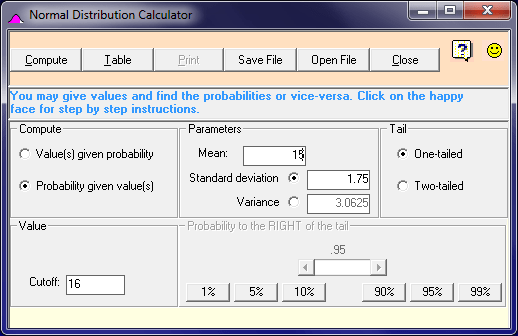
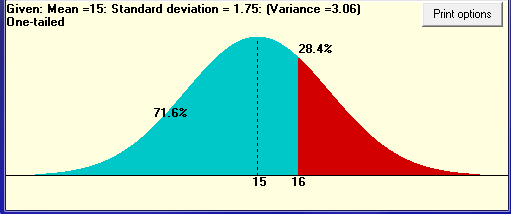
One of the very useful features of POM for Windows is a Normal Distribution Calculator. This tool makes these computations much easier than using a calculator. It is also more meaningful for your students than using Excel because of the graph that is presented. The Normal Distribution Calculator can be found in the Tools menu in POM or on the toolbar and is useful for solving problems in the Project Management, Forecasting, Quality Control and Inventory (safety stock) chapters.  Example 10 from Chapter 3, Project Management, is displayed below.

The students indicate the type of problem – compute a probability as in this example or find cutoff values given a probability, enter the mean and standard deviation, indicate whether the problem is one or two-tailed,  and either give the cutoff(s) or give the probability. POM displays a very readable, meaningful curve which enables the students to quickly identify the answer.

Video Tip: Watching The Chinese Build a 30-Story Hotel in 15 Days

Here is a great 6 minute video to show your class when covering Project Management (Chapter 3), as we watch a 30-story hotel being built in a record 15 days in the Hunan Province of China. The Los Angeles Times (March 7, 2012) describes the process and provides the video link.

Builders in China completed the 170,000 square foot, prefabricated hotel, ending on New Year’s Eve – and posted a time-lapse video (above) to show off their impressive feat.

Construction workers bolted together the new hotel from pre-made modules put together in a factory and then placed them on steel structures at the construction site.  It can reportedly withstand an 9.0-magnitude earthquake.


The Chinese company behind the speedy process, Broad Sustainable Building Corporation, has some former success with building quickly. Once the world’s largest producer of air conditioning equipment, it previously built the 15-story Ark Hotel in Changsha, China, in just six days.

The implications of the latest project go beyond simply adding to the Chinese skyline in a speedy fashion. “Construction is just about the only industry that has not been exported,” one architect explained. “But now the Broad Sustainable Building Corporation has designed a system that will let them build anywhere, to construction tolerances of +/- 0.2 mm. It completely changes the way buildings are constructed and, I believe, is about to change the entire industry.”

Will this mean that American hotels will soon be added to the growing list of things that come with a “made in China” stamp?

Video Tip: Project Management at Arnold Palmer Hospital

From talking to OM professors around the country, I have found that the 7 video case studies dealing with Arnold Palmer Hospital for Women and Children are probably the most popular in the video series we created for you to show in class. The other videos cover Hard Rock, Frito-Lay, Wheeled Coach Ambulance, Regal Marine, and Darden Restaurants. (But wait till you see what we have in store for the next edition of our OM texts: an inside look at OM in an NBA team!)

If you teach Project Management (Ch.3) in your course, here is a great 8.5 minute video to show– with a case full of real data to assign. Some of the points to make with the building of  the new 11 story Arnold Palmer Hospital addition are: (1) planning took place for over a year before the first dirt was shoveled; (2) there were a thousand plus meetings  to allow doctors, nurses, patients, staff, and others have a say in what the new facility should look like; (3) a warehouse a mile away was turned into a mock floor of the hospital so visitors could walk in and evaluate the placement of beds, bathrooms, windows, and even electrical outlets; and (4) MS Project was used to manage the whole project.

This latter point is important. In today’s weak job market, I encourage students to take advantage of the copies of MS Project (full-blown, but time-limited) that Pearson-Prentice Hall  provides with our book. Included is a self-paced tutorial , which together with the printouts at the end of Ch.3, can help students master this useful software–and beef up their resumes at the same time. You might even give extra credit to a student who solves the case study using MS Project, as opposed to using Excel OM or POM for Windows, the other free programs that come with the text.