OM in the News: Meet the Electric School Bus

“Forget the Prius”, says today’s Wall Street Journal (Dec.28,2011). “The future of electric is the school bus”. It seems that Americans just love long drives in fast cars too much for electric cars to be our country’s solution to green transportation.  But the routine runs of electric school buses are another matter. Whereas most current school buses run on diesel fuel, have the aerodynamic profile of a box, and get mileage in the single digits (5-6 mpg), a new generation of zero-emission, hybrid buses may be slowly taking over.

School buses, it turns out, are perfectly suited to be electric vehicles. They cover short distances on daily runs, follow set and predictable routes (making it unlikely their batteries die during the route), and spend a lot of the day sitting in depots, giving them plenty of time to recharge. They also make frequent stops, which while bad for fuel efficiency in a conventional bus, actually helps recharge electric vehicle batteries while  brakes are applied.

Money is the prime obstacle, in that a hybrid costs 60% more than a diesel school bus. But hybrids can improve fuel economy by 65% and if budgets were not hurting so badly in many school districts, fleets would be expanding rapidly.  School districts can recover the $30,000 price differential in 3-5 years through  fuel savings once the investment is made.

Navistar Int’l, Trans Tech, and Smith Electric Vehicles are three of the major players in the electric school bus industry.

Discussion questions:

1. Why is this an OM issue?

2. In what other ways can a school district use sustainability (Ch.7) to actually save money?

Teaching Tip: How Technology Almost Ruined the World Series for the Cardinals

Everyone loves a good baseball story, but how often can you find one to tie into your OM lecture? In case you don’t follow the sport, here is a quick summary of how a lack of technology (a topic in Ch.7) cost the St. Louis Cardinals Game 5 of the 2011 World Series, as reported in The Florida Union-Times (Oct.26,2011). In an age of texting, email, iChat and Skype, baseball, it seems, remains mired in the Civil War era of flannel uniforms. St. Louis manager Tony La Russa conveyed his decision to the bullpen to change pitchers (in the 8th inning with the score tied 2-2 against opponent Texas Rangers) using the old-fashioned dugout phone (shown in the photo).

La Russa’s call to bullpen coach  Derek Lillquist to warm up two pitchers, Rzepcynski and Motte,  was perhaps drowned out by the screaming crowd of 51,459 fans. So Lillquist thought La Russa only said Mark Rzepczynski.  La Russa called back to confirm and asked for Motte again. This time, Lance Lynn started to throw, even though he was supposed to be resting from the previous game and used only in an emergency. The series of miscommunications wound up putting Rzepczynski on the mound against Mike Napoli with the bases loaded, a lefty-righty matchup that clearly favored Texas. The Rangers catcher delivered with a two-run double that sent Texas to a 4-2 victory.

For all the magnificent scoreboards in each ballpark, and all the computers that track each pitch, it seems baseball is stuck with land lines. “It’s amazing “, says TV commentator Keith Olbermann. “With all the technology here, they can’t get a call completed from one part of the building to another? You go to an Apple store, the communications device the salesman is carrying is capable of launching a nuclear device”.

A happy ending, by the way, for the Cardinals, winning the 7th game by 6-2.

OM in the News: More Jobs For Machines–Less For People

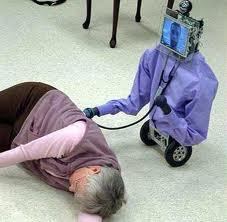
Yesterday’s New York Times (Oct.24,2011) reports that a faltering economy explains much of the job shortage in America, but advancing technology has sharply magnified the effect . “Many workers are losing the race against the machine”, state two MIT researchers. Adds the current issue of the McKinsey Quarterly: “Technology is quickly taking over service jobs, following waves of automation of farm and factory work. This last repository of jobs is shrinking–fewer of us in the future may have white-collar business process jobs”.

Technology in production and  services is an important topic in Chapter 7, and this Times article can contribute to your class discussion of the issue. The MIT profs argue that the pace of automation has picked up in recent years because of robotics, NC-controlled machines, computerized inventory control, voice recognition, and e-commerce. Their new e-book, “Race Against the Machine”, states that automation is moving rapidly beyond factories to jobs in call centers, marketing, and sales, which are the parts of the service sector providing most jobs in the economy.

Since the recession started , corporate spending on equipment and software has increased 26%, while payrolls have been flat. Corporations are expected to report record profits of $927 billion this year, a 50 year high.

But technology has always displaced some work and jobs. As early as 1930, the economist John Maynard Keynes warned of a “new disease” that he called “technological unemployment”, the inability of the economy to create new jobs faster than jobs were lost to automation. Yet computers tend to be narrow and literal-minded, good at assigned tasks, but low at intuition and creativity. The key, writes the Times, “is not to compete against machines but to compete with machines”.

Discussion questions:

1. Is this a major change in business, or just a slow, continuing trend towards automation?

2. Do students believe that less and less service-oriented jobs will be available to them?

OM in the News: China Discovers the Dangers of Reverse Engineering

It has been almost a year since we wrote a blog on how China has pulled ahead of competitors by reverse engineering many high-tech products, including bullet trains. It turns out though, that such an approach is not without dangers as The Wall Street Journal  (Oct.3, 2011) points out under the front page headline “China Bullet Trains Trip on Technology” (with a 5 min. video clip embedded in the article). As you may recall, during a July lightning storm, two of China’s bullet trains collided in Wenzhou, killing 40 and injuring 100’s. More recently, two trains collided in Shanghai, injuring 280.

 Thus arises the issue of deep international distrust over China’s questionable use of foreign technology, including weak intellectual property protections. For in fact, key components in China’s high-speed rail system come from Japan’s Hitachi Ltd. Fearful that Chinese technicians might reverse engineer and steal their signaling technology, Hitachi locked many components in a “black box” design. This approach made it harder to copy, but as a downside, made it harder to understand during testing and use. By withholding technical blueprints, known in Japanese as zumen, troubleshooting the gear was also more difficult. “Providing zumen means we completely trust the buyer of our technology”, says a Hitachi exec. He adds, we do not want  a buyer who would “become a competitive threat in other markets”.

In less than 7 years, China has built a bullet-train network larger than the ones Japan and Germany took decades to construct. According to the CFO of the company working with Hitachi on the signaling systems, China has made it a “very clear mandate of localizing the product. Basically, foreign players are not allowed to bid independently for high-speed rail projects”.

Discussion questions:

1. Why don’t all companies transferring technology to China protect their “zumen”?

2. How has corruption played a factor in China’s rail system?

OM in the News: Reversing Self-Service Technology in Supermarkets

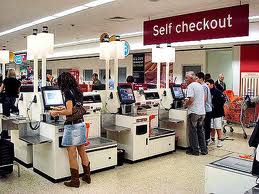
Supermarket chains started introducing self-service lanes about 10 years ago, touting them as an easy way for shoppers to scan their own items’ bar codes, pay, bag their bounty and head on their way. Retailers also anticipated  labor savings, potentially reducing the number of cashiers as they encouraged shoppers to use the do-it-yourself technology (one of our topics in Ch.7, Process Strategy). But Forbes (Sept. 26, 2011) is reporting that some grocery chains nationwide are bagging this “wave of the future” option by eliminating self-serve lanes.

Big Y, a Northeast US chain, just announced it was phasing out self-checkout lanes. Albertsons is also reducing its unstaffed lanes and adding more clerks to traditional lines. Why? Because a recent Food Marketing Institute study found that only 16% of supermarket transactions in 2010 were done at self-checkout lines in stores providing that option–down from a high of 22% three years ago. Overall, people reported being much more satisfied with their shopping experience when they used cashiers. Big Y  found that its self-service lines caused delays because of coupons and payments. Intentional and accidental theft  and misidentifying products also helped reach the tipping point.

Other chains plan to keep the self-service option in place because they think giving shoppers that choice is an important part of customer service. “People shop in different ways”, says a Stop & Shop spokeswoman. Home Depot and some other businesses that cater to a do-it-yourself mentality, have had more success with their self-service lanes. And it may all come down to demographics–such as whether the store is in a tech-savvy region. “It is a match between technology and the customer base”, says a St. Joseph U. prof.

Discussion questions:

1. What other businesses have reversed direction in terms of new technology?

2. Why have ATMs succeeded at airports and banks?

OM in the News: Technology Puts the Brakes on Truckers

Who doesn’t remember the romantic age of the US trucking industry? Powered by cheap diesel, drivers could do pretty much as they pleased on the open road. The days of open-throttles were made famous by Bert Reynolds’ 1977 movie, “Smokey and the Bandit”. Using his CB radio to skirt police traps, the  hero shreds speed limits on a cross-country beer run. Well, those days are gone.

The Wall Street Journal’s article (July 11,2011), “Firms Put Brakes on Truckers”, describes the technology trucking companies are using to wring better fuel economy from their fleets.  Firms are putting computerized governors on trucks’ engines, cutting top speeds from 70 mph to 65 mph. Titan Transfer is even paying bonuses to drivers who get the best fuel economy–and chewing out drivers who don’t. Every decline of 5 mph improves an 18-wheeler’s fuel use by 1/2 mile per gallon–big savings to the shippers.

Today, a driver’s every move is electronically recorded and relayed back to dispatch centers. The black box in the cab is wired to a satellite dish near the roof that beams the truck’s location, its speed, and even what gear it’s in back to the company in real-time. When one driver tried to shift into neutral going down a hill, to override the truck’s governor, a red light immediately flashed telling him to pull over and call HQ for a tongue-lashing.

Drivers, understandably, are not happy about covering less distance each day, as they are paid by the mile. This cuts take-home pay and makes the old-time,  cross-country run stretch from 3 days (at 80 mph) to 4 or 5 days. But even some reluctant drivers agree that 65 mph saves not only fuel, but lives.

Discussion questions:

1. What are other ways that technology can help make the trucking industry more efficient?

2. Make the case, from the driver’s perspective, why the changes are not efficient.

OM in the News: Pilots and the iPad–Efficiency in the Airlines, Part 2

Yesterday’s blog was on building efficient airplanes that weigh less and pollute less. With jet fuel  prices at near record high prices, we noted that every pound lighter a plane can be made saves 30 gallons of fuel a year. It’s interesting that the very next day, The New York Times (July 5, 2011) reported that 1.5 pound iPads are replacing 60 pounds worth of   flight manuals that pilots currently drag around.  The FAA has started to authorize airlines to use the tablet computer as an electronic flight bag to take the place of bulky paper manuals that contain operations instructions, checklists, log books, navigation charts, weather information and airport diagrams.

The flight director at Alaska Airlines says: “The iPad allows pilots to quickly and nimbly access information. When you need to make a decision in the cockpit, 3 to 4 minutes fumbling with paper is an eternity”.  Every one of Alaska’s pilots is now using the device — and  American Airlines, which just got FAA approval, is not far behind. The e-manuals include hyperlinks and color graphics. And pilots skip the tedium of updating manuals by swapping out old pages with new ones. Switching to the iPad is also expected to reduce absenteeism from shoulder and back injuries associated with hoisting the heavy bags (which also tear up the seats, according to one AA pilot).

There are now over 250 aviation apps for the iPad, including some that are easier to use than avionics technology installed in the planes. As we discuss in Ch.7, technology can play a major role in increasing operational efficiency. With American’s fleet at about 620 planes, the airline stands to save over 1 million gallons of fuel per year just with the iPads!

Discussion questions:

1. How else does technology save the airlines time and money?

2. Can the iPads be used when the plane is in flight?

OM in the News: UPS Turns to Lighter Trucks for Efficiency

For as many times as it has tested electric, hybrid, and other alternative powertrains for its trucks, UPS has run into the same issues of complexity and cost. Now it’s trying a simpler route  to fuel savings. Although competitor FedEx and other fleet deliverers such as Staples, At&T, and Frito-Lay have turned to electric (see our blog on electric trucks on Dec.10, 2010), UPS is looking lighter. Using light-weight composite materials, the delivery company  is able make trucks 1,000 pounds (about 10%) lighter than today’s familiar brown “package cars”.

USA Today (June 9,2011) reports that with less weight, the new trucks can have smaller diesel engines that save 40% on fuel use–without the complexity of high-tech batteries, hybrid systems, or other advance technologies that can run up total costs. “This technology is available to us today. We don’t have to worry about plugging it in or getting propane”, says UPS’ engineering director.

The first batch of trucks is being built by Utilimaster, in Indiana, using an Isuzu chassis, powered by a simple Isuzu 150-horsepower clean-diesel engine. Isuzu, which no longer sells cars in the US, maintains a vigorous truck operation here. It sees the new diesel as a chance to trump hybrids because “we didn’t think people were going to be able to afford a hybrid or electric vehicle”. The fuel savings don’t just come from lower weight and a smaller engine. With a sleek  new look, the trucks are 13% more aerodynamic than competitors.

Comparing this approach with electric/hybrid alternatives shows once again that there is more than one way to skin the cat of increased operations efficiency.

Discussion questions:

1. What are the advantages and disadvantages of the alternatives discussed?

2. Why doesn’t every company switch to one of these new technologies?

Good OM Reading: Our “Big Thirst” for Water

Of the dozens of papers presented at the POMS meeting that dealt with sustainability, not one focused on the critical manufacturing resource of water. But Charles Fishman’s newly published book, The Big Thirst: The Secret Life and Turbulent Future of Water (Free Press, 368 pp.), may very well raise our awareness of what he calls a “silent revolution” in water usage in the biggest economy in the world.

Why is this a sustainability topic worth discussing in class? Perhaps because of a 2007 UN study predicting: “Major cities in the West, like Phoenix and Las Vegas, may have to be abandoned as badlands”? Las Vegas, which has one of the biggest water shortages in the country, now pays residents $40,000 an acre to take out their lawns and put in rocks and local plants.

The golden age of water, as Fishman calls it, was the last 100 years, where we lived in a “kind of aquatic paradise…our water has been abundant, safe, and cheap”. He writes: “We don’t take it for granted because we don’t notice it enough to take it for granted”. But the new scarcity of water may take us “from the golden age of water to the revenge of water”. Water is the key ingredient in making computer chips, blue jeans, iPhones, kleenex, rice, and steel. A 2-liter Coke takes 5 liters of water to produce. The population increase by a factor of 4 during the past century was marked by a water consumption increase by a factor of 7. Here in Florida, we use 50% of our water in gardening!

The good news is that we getting the message. US farmers use 15% less water than 30 years ago, with a 70% bigger yield. GE and IBM are not only reducing water usage, by have created new divisions to teach towns and companies how to manage it.

You can  listen to Fishman’s NPR interview at npr.org.

OM in the News: Recycling Leftover Hotel Soap?

Ever wonder what happens to leftover soap and shampoo at hotels like Sheraton, Westin, Marriott, and Hilton? USA Today (April 26,2011) describes how a non-profit organization called Clean the World recycles used soap for distribution in developing countries and homeless shelters.

Most bars of soap, about a million, are thrown out each day by US hotels. But Clean the World, and other groups, are taking in  1.6 million pounds of soap a year through agreements with about 1,000 hotels. Clean the World charges hotels 65 cents a room to clean and redistribute soap and shampoo bottles. It has built recycling centers in Orlando, Las Vegas, Toronto, and Vancouver. Soap is sterilized in its plants and reformed into 2-ounce bars.

In the past 2 years, Clean the World has distributed more than 8 million bars of soap in the US and 40 countries, including Haiti, Uganda, Zimbabwe, and India. Its efforts have diverted 550 tons of waste from landfills. “Each day, 9,000 children die from diseases that can be prevented by washing with soap”, the organization says.

Sustainability in hotels is a topic we discuss in both Ch.5 and Ch.7. Here is a good example to bring to your students.

Discussion questions:

1. Why doesn’t every hotel practice this recycling strategy?

2. How else can hotels be “green”?

OM in the News: Tracking Your Bags Online at Delta Airlines

Under  pressure from the federal government to deal with lost luggage issues, airlines are responding with some unique customer service  approaches–thanks to OM. For example, we noted in this blog a few months back that Alaska Airlines has set up new processes that guarantee bags will arrive within 20 minutes after the plane parks at the gate–or else customers get $20 or 2,000 points.

The Wall Street Journal (April 23-24,2011) just reported that Delta Airlines has started a new online service to let customers track the whereabouts of their checked bags. Launched a few weeks ago, passengers can follow their bags from scanning at check-in, to the flight they are loaded on, and then to arrival at baggage claim. Delta says, “Letting passengers see where their bags are can cut down on worries and calls when a bag doesn’t show up on the carousel on time”.

Tracking can be done on Delta’s website with a mobile phone or a laptop. And if a bag is lost, the passenger can now file a claim online at the same site. If you have ever had to wait for a bag that never arrived, then queued up for an hour to file a claim —and who hasn’t— this use of technology in service (see Ch.7) is a clever advancement.

The concept, of course, is not new. FedEx has been tracking packages for decades. United Airlines has for a year used FedEx to offer overnight delivery of golf bags, skis, and suitcases ($79-$99 each way), and allowed passengers to track their possessions online. And Ford used to offer buyers a chance to track their car through the production process.

Delta, by the way, is already well below the industry average for lost bags, and has improved 27% from last year’s 4.04 mishandled bags per 1,000 passengers.

Discussion questions:

1. Is this really a critical new service? Or does it resemble the Ford marketing tool?

2. What are some other service technologies the airlines can employ?

3. Why do airlines have vastly different lost baggage rates?

OM in the News: The Pressure on Hospitals to Improve Efficiency and Curb Waste

As the White House and Congress debate how to contain runaway medical costs, equipment maker GE is embarking on its own quest to help hospitals reduce wasteful spending and treatment errors. As much as $500 billion out of the $2.2 trillion spent on health care is wasted on duplicate processes, bad coordination, and out-of-date scheduling, says GE, in the latest Businessweek (April  18-24, 2011). “It’s generally accepted that for every $100 spent on health care, $20 or more is waste”, adds the CEO of GE’s health-care/IT unit.

GE’s plan takes two approaches. The first is to cut costs of medical imaging, with 80 new products coming on-line in the next 2 years, including an MRI that scans only extremities. This frees up whole-body machines for more complex scans, which both cuts a hospital’s costs and raises its revenues.

Although improving molecular imaging , which helps catch diseases earlier, is the most glamorous way to save money, the US health-care overhaul is also looking at a second source. For GE, that means branching into information technology and consulting. The 2010 law signed by Obama  requires hospitals to use more IT to reduce costs and medical errors. As a result, hospitals are looking for outside expertise. GE  Healthcare plans to do $1 billion annually with its new consulting unit, analyzing patient data and digitizing medical records.

OM is again at the center of these changes, leading the way with new technology (Ch.7), process improvements, and quality tools. Many profs have asked us to keep an eye out for health-related examples such as this one.

Discussion questions:

1.Why are so many expensive devices used in hospitals?

2. How can OM help make hospitals more efficient?

3. How can medical records increase the quality of healthcare?

OM in the News: GE’s Move to Solar Power

As global demand for solar panels and power continues to explode (from 2 gigawatts in 2007 to 15 gigawatts this year to 75 gigawatts forecast in 2016), GE has just announced that it plans to open the largest solar panel factory in the US in 2013. The company wants its solar energy business to match its $6 billion wind-turbine unit.

Today’s Wall Street Journal (April 8,2011) reports that the new plant will employ 400 people and produce thin-film solar panels sufficient to generate 400 megawatts of electricity annually. This is enough to power 80,000 homes a year. SolarWorld AG (of Germany) currently operates the biggest solar-panel plant in the US (in Oregon) and generates 350 megawatts.

GEs investment of $600 million in solar technology adds to its $3.2 billion deal to buy Converteam, a French power-conversion company. Converteam complements GEs solar effort by converting sunlight into grid-ready electricity. GE says it already has 100 megawatts for its thin-film technology on order.

The move is not only good news for the economy, but means the US will be fighting hard to keep from losing this vast market to China’s government-subsidized solar industry (see our earlier blog on the topic).

Discussion questions:

1. How will GE be able to compete successfully with low-cost Chinese firms?

2. Why is GE entering this market?

3. Why is sustainability an important OM topic (see Ch. 7)?

OM in the News: Seven Jobs Humans May Lose to Robots

“Are humans becoming obsolete in the workforce”, asks Business Insider (March 22, 2011). Some signs say “yes” in a diverse number of areas. By 2013, there will be 1.2 million industrial robots working around the world–about 1 for every 5,000 people. Here are 7 jobs they may be doing:

Pharmacists: The UCSF Med School recently launched its robot-controlled pharmacy at 2 hospitals. They not only pick, pack, and dispense individual doses of prescribed pills, but also compound sterile chemo doses and IV bags with medicines. So far, 350,000 doses with no errors.

Lawyers and paralegals: Software can now review documents in a fraction of the time and cost as an army of lawyers and paralegals. Blackstone Discovery can analyze 1.5 million documents for less than $100,000.

Store clerks: Looking for ways to sell more goods with fewer employees,  companies are using more ATM-like machines at banks, airports and McDonald’s— and more self-service check-outs  and automated answering systems. In 2010, $740 billion was transacted through self-service machines, up 9% from 2009.The number is expected to rise to $1.1 trillion by 2014.

Soldiers: Drones and other machines are increasingly being used in both reconnaissance and combat missions.The MAARS armed robot, for example, has been used in Iraq to open doors and drag out injured bodies.

Babysitters: Aeon, the Japanese retailer, employs a 4-foot tall yellow and white robot whose job is to babysit children while their parents shop.

Rescuers: The Japanese have also developed a snake-like robot that can reach areas inaccessible to humans to assist in rescuing victims of disasters. Useful in collapsed buildings, the robot can enter tight spaces and use a camera to survey them.

Sportswriters: Even reporters can be replaced according to Narrative Science, which specializes in machine-generated stories. Clients, such as The Big Ten Network, have scorekeepers e-mail game data to the company, which can churn out an article in minutes, at a fraction of the cost of having a person reporting.

Discussion questions:

1. What other areas in OM (see Ch.7) lend themselves to automation?

2. Ask students to name some services  that have successfully integrated robotics.

OM in the News: Recycling Water–“From Toilets to Tap”

I have held off on blogging about USA Today’s cover story (March 3, 2011) for a week because of the yuk factor. Your students will moan you when you bring up the title “From Toilets to Tap”, but sustainability is an important OM topic (which we treat in Chapters 5 and 7). And as the article says: “Water is going to be the oil of the 21st century”.

Clearly something needs to be done. One-eighth of the world (884 million people) still lacks safe drinking water…and its not just in remote/poor regions. Singapore, dependant on Malaysia  for the strategic resource of water, has built recycled wastewater plants that now serve 1/3 of its people. Orange County, CA (which has to import water from the northern part of the state and Colorado), uses treated wastewater to serve 1/5 of its 2.4 million residents. The Northern Virginia suburbs of D.C. use purified sewage for 5% of  the area’s drinking water.

But other parts of the world, from San Diego to Australia, have had to back away from recycling plans amid public outcry. “The gross out factor is a big barrier”, admits a UC prof. Despite the nickname —“toilets to tap”–only about 10% of household wastewater comes from toilets, while the rest is from showers, sinks, and laundry. And the resulting water is often cleaner than what you would buy in a store, as the EPA’s standards are very strict.

Here is briefly how it works: first  microfiltration traps bacteria; then reverse osmosis blocks salt, drugs, and viruses; and finally, ultraviolet light and hydrogen peroxide kill organics. Besides alleviating drinking water shortages, the technology is used  for recycling in factories (see our video on Frito-Lay’s sustainability), for agriculture, and  it means less waste discharged into the ocean.

Discussion questions:

1. Why is recycling water an OM issue?

2. What are the advantages of this method of reclaiming wastewater?