OM in the News: The March of Robots into China

Welding robots at Great Wall's Tianjin plant
Welding robots at Great Wall’s Tianjin plant

Step into the factory of Chinese SUV and truck maker Great Wall Motors, writes Businessweek (Nov.30-Dec.6,2102), and it’s easy to forget you’re in China. Swiss-made robots pivot and plunge, stamping metal door frames and soldering them to the skeletal vehicle bodies of a mini-SUV. Workers in hard hats are few and far between. “With automation, we can reduce our head count and save money,” says Great Wall’s manager, who has invested $161 million (about $50,000/robot) into mechanizing 4 plants with 1,200 robots. “Within three years, this cost will be completely paid for in savings from reduced worker wages.” After the robots were added, the number of welders dropped from 1,300 to around 400.

Last year sales of industrial robots in China reached 22,577 units, up 51% over 2011. That puts China just behind Japan and S. Korea, but ahead of Germany and the U.S., in the purchase of new robots. China is on track to become the world’s largest robot market by 2014. One factor driving the switch to robots is demographics. Next year China’s labor force will peak at 1 billion before starting to shrink. Labor shortages are already common and are driving wage inflation– up around 20% annually recently.

For the textile industry, facing ever-narrower margins, automation may be the only alternative to shutting down or moving. While some factories relocated to lower-wage Cambodia and Vietnam, sweater maker Milo’s Knitwear upgraded. After spending $1.9 million for 29 Japanese stitching machines, its factory has reduced staff from 140 workers to 6. Worker protests have also sped up the automation trend. Labor unrest at Foxconn has forced shutdowns at several of its facilities. Last year the company announced the ambitious goal of adding a million robots within three years. Foxconn will have at least 30,000 robots in China by year-end.

Discussion questions:

1. Why is automation such an important OM decision in China?

2. How has automation impacted manufacturing jobs in the U.S?

Teaching Tip: Pigs and Operations Management Ethics

 The Ethical Dilemmas at the end of each of our 17 chapters are a popular feature that many OM instructors assign as homework or use for lively class discussions. Some colleges, such as Benedictine University,  view ethics as an important part of their OM curriculum (as noted in their linked syllabus).  If you look over the Ethical Dilemma in Chapter 7, which deals with the trade-off between increased productivity/ lower costs of pork vs. the comfort of the pigs, you will appreciate the article in the New York Times (Oct.6, 2012) on this very sensitive subject.

The article opens: “Sow 44733 had broken the shoulder of one of her pen mates, rousted another who was huddled in the corner and was chewing on the ear of a third. Other sows in the pen sported abrasions, torn ears and bloody tail stumps. It was that kind of behavior that led hog farmers like Tom Dittmer to isolate sows in individual stalls called gestation crates that are barely bigger than the pigs themselves.”

“The reason the industry switched to crates wasn’t because we wanted to harm our animals,” Mr. Dittmer said. “We did it because we thought it was what was best for the animals.” The move also kept the price of pork reasonably low for consumers, he said.

Now, hog farmers are under increasing pressure from corporate pork buyers and animal rights groups to return to the old way of doing things: putting sows in group housing. In September alone, three companies — Dunkin’ Donuts, ConAgra Foods and Brinker (Chili’s) — announced that they would no longer buy pork derived from pigs housed in gestation crates. Farmers resent the tactics, saying they worry that the move will be unsustainably costly for them and result in soaring pork prices for consumers.

Research is mixed about which type of housing is best for the animals’ welfare, according to the American Veterinary Medical Association.

Want to ask your students what they think?

OM in the News: Baxter–The Smarter Robot

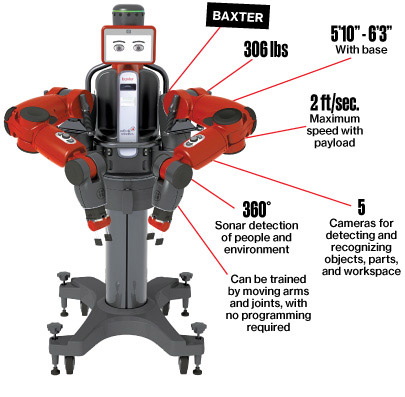
Robots are always an interesting technology topic in Chapter 7, and the latest Businessweek (Sept. 23-30, 2012) describes Baxter, a super smart robot that Rethink, Inc. believes will spark a manufacturing revolution. The firm hopes the robot, adept at the mindless repetitive tasks common on most assembly lines, can increase the productivity of U.S. manufacturers and help them retain business that would otherwise migrate overseas.

With 5 cameras, a sonar sensor that detects motion 360 degrees around it, and enough intelligence to learn tasks within an hour, Baxter is designed to work safely alongside humans and do simple jobs such as picking items off a conveyor belt. It’s also cheap enough, at $22,000 a unit, so that the investment math works: If Baxter performs 3 years of 8-hour shifts, it’s the equivalent of labor at $4 an hour. “We are spending hundreds of billions of dollars doing this kind of work in China,” says Rethink’s chief technical officer. “We want companies to spend that here, in a way that lets American workers be way more productive.”

Traditional assembly line robots made by companies like ABB in Switzerland and Yaskawa Electric in Japan, which can cost more than $200,000 apiece, do a few things extremely well, such as painting and welding, but require carefully organized and controlled environments. Most wouldn’t know if a human wanders close by, so they are often isolated in cages away from employees. Baxter, though, sits on a gurney and can be set down safely just about anywhere on a factory floor. Its eyes are on a swiveling computer screen and greet any worker who approaches. To teach Baxter a job, a human simply grabs its arms, simulates the desired task, and presses a button to set the pattern.

Discussion questions:

1. How can Baxter change manufacturing?

2. What is Rethink’s plan for the next generation robot?

OM in the News: Harley Goes Flexible

Our Global Company Profile that opens Chapter 7 describes the manufacturing process at Harley-Davidson’s plant in York, PA. The Wall Street Journal (Sept. 22-23, 2012) writes that “until recently, the company’s sprawling factory here had a lack of automation that made it an industrial museum. Now, production that once was scattered among 41 buildings is consolidated into one brightly lighted facility (see photo) where robots do more heavy lifting. The number of hourly workers, about 1,000, is half the level of three years ago and more than 100 of those workers are “casual” employees who come and go as needed.”

This revamping has allowed Harley to quickly increase or cut production in response to shifting demand. Harley got serious about cutting costs when Keith Wandell became CEO in 2009. On his first visit to the York plant, he declared the layout and working methods unsustainable and began scouting sites for a new plant to replace York. When the company notified its union that the plant would move unless it approved a new contract giving Harley more control over costs, union members voted overwhelmingly to make concessions, and Harley stayed in York.

Instead of 62 job classifications, the plant now has 5, meaning workers have a wider variety of skills and can go where needed. A 136-page labor contract has been replaced by a 58-page document. The pace of work is faster now, but managers and workers work together more smoothly, according to the Journal. In the paint department, for example, people used to do the same chore all day but now rotate through several tasks to avoid body strain and boredom.

Some items formerly made in York, such as brackets and screws, come from outside suppliers. Production fluctuates depending on day-to-day sales, so the company doesn’t have to stock up well ahead of the spring peak-selling period and guess which models and colors will be popular.

Discussion questions:

1. What major OM changes did Waddell make to turn Harley around?

2. What is the impact of job classification changes (a topic of Ch.10)?

OM in the News: Wal-Mart Checks Out Mobile Checkout

How can operations management play a role in cost savings at Wal-Mart? Check out this quote from The Wall Street Journal (Sept.1-2, 2012): “The company says it spends $12 million per second on cashiers’ wages in the U.S.”  At $12 million per second, it is no wonder that Wal-Mart is testing a checkout system that allows shoppers to use their mobile phones to scan items as they walk through stores and pay at self-service kiosks, skipping the cashiers’ lines.

Called “Scan and Go,” the mobile-payment app is the latest attempt by the Wal-Mart OM group to reduce long checkout lines.  The system does not yet allow customers to pay with their mobile device, but is meant to make scanning easier for them. Wal-Mart also just announced plans to add more self-checkout lanes, as only 1,600 of the 4,500 Wal-Mart and Sam’s Club stores in the U.S. include this option.

Retailers have been using self-checkout for more than a decade to try to reduce labor costs and speed up transactions, but not all chains have been happy with their experiences. Companies like grocery chain Albertsons and housewares giant IKEA  are actually eliminating self-checkout, citing lost revenue, theft, and lack of interaction with customers. Many shoppers also complain the self-service systems are balky.

The scanning idea could serve as a loyalty program for Wal-Mart, which does not issue discount cards to customers in exchange for the ability to collect data on their shopping habits. Scanning will allow the firm to collect data on what customers buy and how long they spend in stores–and to send shoppers coupons for competitive products in real-time as they scan items. “If you scan peanut butter and immediately a $2-off coupon pops up to buy a competing brand, Wal-Mart can change customer’s behaviors right there in the aisle,” says an industry consultant.

Discussion questions:

1. What are the advantages of mobile scanning/checkout?

2. Why are self-checkouts not universal?

OM in the News: Starbucks Process Improvement with Apps

Businessweek (Aug.23-30, 2012) provides a great example of business process improvement (Chapter 7) through Starbucks’ mobile payment plan program. Even before its recent $25 million investment in startup company Square, Starbucks had been processing a million mobile-phone transactions per week. “What mobile payments allows is an unprecedented relationship between us and our customer,” says Starbucks’ chief digital officer.

Starbucks released its first mobile app in 2009; it helped customers find stores, learn about coffee, and get nutrition information. In 2011, the chain released a more powerful Starbucks Card Mobile App, which also lets consumers pay at the register by waving a bar code on a phone’s screen in front of a scanner. Customers can load Starbucks’ digital prepaid card with an existing credit card.

Starting this fall, coffee lovers will be able to use smartphones to pay via an account linked directly to their credit cards. The mobile payment options also promise a profit boost for Starbucks. By letting its customers make purchases with their smartphones, Starbucks pays fewer fees—which sometimes top 2%—on credit-card transactions. Square says it can now process Starbucks payments at a lower rate than other payment networks.

From an OM perspective, the apps can also help sales by making store lines move 10 -20% faster during peak hours. Each 1% increase in a store’s capacity during rush hour translates into a revenue boost of up to 1%. “Current payment solutions don’t meet the expectations of customers or merchants,” says Wal-Mart’s VP. Since selling through a mobile app can cut transaction fees in half, the cost savings can make a big difference in retail, where operating margins are in the single digits (about 6% for Wal-Mart). The bottom line: Starbucks has created a successful mobile payments model that other retailers are following in an effort to reduce transaction fees.

Discussion questions:

1. What other mobile phone apps can increase OM efficiency?

2. How else has Starbucks increased productivity, as discussed in OM in Action boxes in the text?

OM in the News: Skilled Work Without the Worker (with Video)

Robotics is just one  topic in our treatment of  technology in Chapter 7, but yesterday’s lead article in the New York Times (Aug. 19, 2012) called “Skilled Work Without the Worker” is worth sharing with your class. The point is that robots have become a lot more sophisticated in the past 2 decades and are now capable of doing very detailed work that only humans could do just a short time ago.

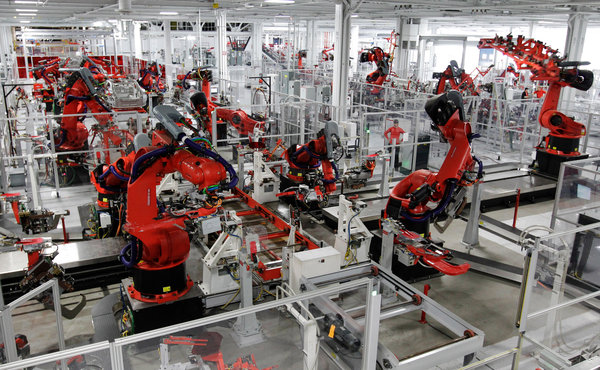
Tesla foctory robots perform not one, but 4 functions at the California auto plant

The piece begins by describing two Philips Electronics factories–one in China (where hundreds of workers hand assemble electric shavers)– and the other in Holland (where 128 robots  do the same work, guided by video cameras). The Dutch factory  has several dozen workers per shift, about a tenth as many as the plant in China. And the robots there work, of course, without a coffee break — three shifts a day, 365 days a year.

This is the future, says The Times. A new wave of robots is replacing workers around the world in both manufacturing and distribution. Factories like the one  in the Netherlands are a striking counterpoint to those used by Foxconn , which employ hundreds of thousands of low-skilled workers to make Apple products. Foxconn’s chairman, Terry Gou, has publicly endorsed a growing use of robots. Speaking of his more than one million employees worldwide, he recently said: “As human beings are also animals, to manage one million animals gives me a headache.”

With examples ranging from Boeing’s use of robots on the 787,  to C&S Wholesale Grocers fully automated warehouse, to a California organic farmer who uses them to pack lettuce, this exciting OM technology makes for a good discussion in many chapters of our text. The 4 minute video that accompanies the article is also well done.

Discussion questions:

1. Why have robots become a more powerful force in recent years?

2. What are the plusses and minuses of the new revolution?

OM in the News: Penney’s Turns to the iPad For a Cash Register

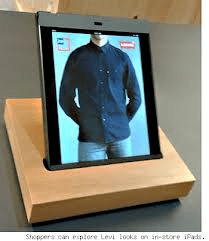
In Chapter 7, Process Strategy, we discuss the impact of new technology and equipment on the customer service experience. USA Today (July 25, 2012) provides a great example to use in class with a front page story that starting this weekend, salespeople in Penney’s new Levi’s shops will use only iPads to check out customers. All of Penney’s 1,100 stores will offer mobile checkout by the end of the year.

More than 6,000 Nordstrom salespeople are already using mobile devices to check people out, just like at Apple stores. “By the end of this year, Nordstrom salespeople will be able to do everything on their handheld devices that they can at a register,” says Jamie Nordstrom, grandson of the chain’s founder. “I believe the future of our point-of-sale systems is completely mobile,” he adds. “It’s hard to know whether it’s in one year or five years because the technology is evolving so rapidly.”

Several grocery stores — Costco and Sam’s Club are two — already use employees armed with mobile devices for “line busting.” The workers scan products for customers standing in lines and print a bar code that they can take to cashiers to pay. Nordstrom salespeople will still be able to make change, but not with the “cash registers of yesterday”. “As long as there is cash, we’ll always be happy to accept cash”, Nordstrom says.

Other stores where customers interact often with salespeople will likely start adopting mobile checkout. “If you go through the whole process of shopping with help along the way, why should you have to stop and be funneled to a line?” says an industry consultant.

Discussion questions:

1. What other technology changes are impacting OM in the retail scene?

2. How does the iPad build flexibility into the store’s operations?

OM in the News: Process Improvement In Hospitals

The New York Times (June 3,2012)  writes that there is some good news about our  health care system. A growing number of hospitals, doctors, employers and insurers are using the process improvement tools of Chapter 7 to reduce the cost of delivering medical care while maintaining or improving quality.

Seattle’s Virginia Mason Medical Center, for example, has conducted reviews to eliminate waste and inefficiency. It says that after doctors were required to use a checklist of the medical circumstances needed to justify a costly imaging test, CT scans for sinus conditions dropped by 27% and M.R.I.’s for headaches by 23%. It placed nursing teams and supplies closer to patients, freeing nurses to spend 90% of their time on direct patient care, far more than the 35% at most hospitals. The time needed to process insurance claims was sharply cut by consolidating steps.

Virginia Mason also collaborated with Starbucks and the company’s insurance provider, Aetna, to find better ways to treat patients with back pain, a costly burden to Starbucks. At the start, all patients complaining of back pain typically waited many weeks to see a specialist, who would then prescribe a costly, unnecessary M.R.I. before finally sending them on to a physical therapist. Using process analysis to separate out the uncomplicated cases,  the medical center was able to send them directly to a therapist on the day the patient requested an appointment, and the vast majority were able to quickly return to work.

Premier Inc., a 2,600 hospital group, has also reduced unnecessary laboratory and screening tests and reduced labor costs by eliminating inefficient processes, like multiple re-entries of the same patient data for admitting, scheduling, discharge and billing. It has started  using administrative assistants rather than nurses to call patients to remind them of appointments. Premier reported  that over a three-year period, 157 of its hospitals in 31 states saved almost 25,000 lives and reduced health care spending by nearly $4.5 billion, a 12% savings.

Discussion questions:

1.  What are the benefits to Starbucks, Aetna, and Virginia Mason from their new approach?

2. Why is OM such an important topic in hospitals today?

OM in the News: The Rise of the Robot Reporter

Here is an application of service technology that we missed in Chapter 7:  Wired Magazine (May, 2012) presents a fascinating tale of how artificial intelligence is taking a prominent role in sports and financial news reporting.

Consider this : Every 30 seconds or so, the algorithmic bull pen of Chicago’s Narrative Science extrudes a story whose very byline is a question of philosophical inquiry. The computer-written product could be a  second-half update of a Big Ten basketball contest, a preview of a corporate earnings statement, or a summary of the presidential horse race. The articles run on the websites of  publishers like Forbes, as well as other  media powers (many of which are keeping their identities private).

And the articles don’t read like robots wrote them: ”  Friona fell 10-8 to Boys Ranch in five innings on Monday at Friona despite racking up seven hits and eight runs. Friona was led by a flawless day at the dish by Hunter Sundre, who went 2-2 against Boys Ranch pitching. Sundre singled in the third inning and tripled in the fourth inning … Friona piled up the steals, swiping eight bags in all …”

It may not win a Pulitzer, but the grandparents of a Little Leaguer would welcome this game summary—available on the web even before the two teams finished shaking hands. Narrative Science’s algorithms built the article using pitch-by-pitch game data that parents entered into an iPhone app called GameChanger. Last year the software produced nearly 400,000 accounts of Little League games. This year that number is expected to top 1.5 million and Narrative’s CEO predicts that  more than 90% of news would be written by computers in 15 years. He also believes that as Narrative Science grows, its stories will go higher up the journalism food chain—from commodity news to explanatory journalism and, ultimately, detailed long-form articles.

Discussion questions:

1. Why is AI of interest to OM managers?

2. How could this be used beyond newspapers and wire services?

OM in the News: Companies Pick Up Used Packaging and Recycling Cost

The New York Times (March 25, 2012) reports : “A growing number of large food and beverage companies are assuming the costs of recycling their packaging after consumers are finished with it, a responsibility long imposed on packaged goods companies in Europe and more recently in parts of Asia, Latin America, and Canada.”  Called “extended producer responsibility”, this is another sustainability task for OM managers to handle as they address the design-to-disassembly decisions  (Chapter 7). There are 3 causal factors:

First, “Environmentally conscious consumers are demanding that companies share their values,” says Starbucks’ director of environmental impact. Second, financially strapped local governments are looking for ways to shift the costs of recycling onto someone, and companies that make the packaging are logical candidates. And third, it is now cheaper to recycle some products (like aluminum cans) than it is to make them from virgin material. (Shredding, melting, recasting and rerolling used aluminum into new can sheet  saves 95% of the energy it takes to make it from raw ore).

Company-sponsored recycling efforts are voluntary in all states, except Maine, at this point in time. But a few big firms are going full-speed ahead. Coca-Cola has a stated goal of recycling 100% of its N. American cans and bottles by 2015 and 50% in the rest of the world. Coke is also trying out nonpetroleum-based packaging material. Dasani and Sprite come in PlantBottles that are 30% plant-based and can go through the same recycling process as oil-based containers.

Starbucks’ goal is to have recycling bins in all its stores in 3 years (it is at 18% right now). It asks customers to throw their cups in the bins, from which they are turned into napkins and new cups. Stoneybrook Farms collected 11 million no.5 yogurt cups last year at collection bins placed in Whole Foods stores. The cups are turned into toothbrushes and razors!

Discussion questions:

1. Why are grocery chains opposed to mandated packaging recycling?

2. What role might Walmart play in the trend?

OM in the News: Amazon Adds That Robotic Touch

“In the battle between man and machine, the robots  just scored a victory in the world of e-commerce,” writes The Wall Street Journal (March 20, 2012). Why? Because Amazon this week bought Kiva Systems, which makes squat orange robots used in shipping centers,  for $775 million. Although Amazon has used some automation in its fulfillment centers in the past, it depended heavily on people, hiring thousands during the peak holiday seasons to cruise through gigantic warehouses to pick items from shelves.

With Kiva, Amazon is looking for a more automated approach. The robots, which we have blogged about earlier, are already used at Zappos.com and Diapers.com, two websites that Amazon acquired. Rather than a worker walking to the shelves, Kiva’s robots bring the product shelves to a stationary warehouse worker. The robots  locate the items in a customer’s order, move the products around the warehouse, and help get packed boxes to the shipping dock. This improves productivity by bringing the products directly to employees to pick, pack, and stow.

Kiva claims that a packer working with its robots can fulfill 3-4 times as many orders per hour, but Amazon, with over 56,000 employees, says it won’t eliminate jobs. The firm now has a total of 69 fulfillment centers (with 19 new ones added last year alone).

The Journal article is accompanied by a short video of the robots in action.

Discussion questions:

1.Compare the old and new Amazon picking  systems. What are the advantages and disadvantages of each?

2.Why did Amazon buy Kiva?

OM in the News: R2D2 Enters the Hospital Hallways

Thousands of “service robots” are entering US hospitals. “Picture R2D2 from ‘Star Wars’ carrying a tray of medications or a load of laundry down hospital corridors'” writes The Wall Street Journal  (March 15, 2012).  As America’s elderly population grows, the country’s health care system is facing cost pressures and a shortage of medical personnel. Administrators are planning to foist some of the less glamorous work onto robots. “We are just not going to have enough human hands to do all the work,” says an industry expert.

The new breed of service robots are self-aware, intelligent (using advanced sensors and motion detectors tied to powerful microprocessors and voice activation), and able to navigate changing environments, even in chaotic hospitals.  InTouch Health, in Santa Barbara, has machines that allow doctors to connect to far-flung patients with videoconferencing. The robots enable a doctor to make rounds virtually and check on patients from miles away. More than 400 hospitals are using the InTouch machines.

 Aethon, in Pittsburgh, has sold robots to over 100 hospitals. These machines haul food trays, linens, medical trash, drugs, and medical records around the hospital, all while staying out of the way of rushing doctors and nurses. While the robots are popular with hospital staff, a union spokesperson at El Camino Hospital (which has 20 robots deployed) says: “We will always advocate for good jobs in which community members could be doing the work.”

(There is a short video on the robots embedded in the WSJ article as well.)

Discussion questions:

1. Ask the class to name some other service applications of robots.

2. What are the advantages and limitations of using robots in hospitals?

OM in the News: Apple Releases Names of Suppliers and Their Compliance

Apple Inc. just released an audit of its major suppliers, saying it found a number of violations including breaches in pay, benefits, and environmental conditions, especially in China. It conducted 229 audits last year, an increase of 80% over 2010. The company, notorious for keeping its supply chain under wraps, also for the 1st time named its major suppliers. Under pressure from activists in the US and abroad, Apple’s 27 page Social Responsibility Report  is the most comprehensive in the firm’s history. It also reflects new CEO Tim Cook’s  departure from the culture of secrecy maintained under Steve Jobs.

Asking your students to read this report and evaluate the firm’s strength and weaknesses may make for a good discussion when you cover Chapters 7 and 11.

The Wall Street Journal (Jan.14, 2012) reports that nearly a third of Apple’s suppliers do not abide by the company’s standards. Five  facilities employed underage workers;  112 were not properly dealing with hazardous chemicals (137 workers were seriously injured cleaning iPad screens with n-hexane); 108 firms did not pay properly for overtime; and 93 had workers exceeding the 60 hour per week corporate cap. Apple did add that all suppliers have stopped discriminatory screenings for medical conditions or pregnancy. Several references are made to one of Apple’s biggest manufacturing partners, Foxconn, and the spate of employee suicides (jumping off the roof) at its Shenzen, China facility.

While Apple has occasionally divulged the names of selected suppliers, the rest have been a secret, long-studied and sought out by industry analysts. The new list of 156 companies represents 97% of the first tier of Apple’s supply chain. It includes such well-known firms as Sony and Intel, along with less-known names like Tianjin Lishen Battery, Zenya Aluminum, and Unisteel Technologies.

Discussion questions:

1. Why did Apple release this report and name its suppliers?

2. What more can Apple do to increase its social responsibility?

OM in the News: How Analytics Will Change Day-to-Day Decisions

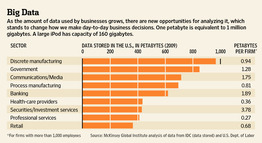
A few months ago, we reviewed an excellent new book called Thinking, Fast and Slow (Oct.22, 2011)  in which author Daniel Kahneman talks about how we make decisions. We see what we want , ignore probabilities, and, as Kahneman writes,  “we are often confident even when we are wrong”. But The Wall Street Journal’s  (Jan.4, 2012) article “What’s Your Algorithm”, says the important theme in business for 2012 will be “how analytics harvested from massive databases will begin to inform our day-to-day business decisions.  Call it Big Data, analytics, or decision science. This will change your world.”

The new algorithms can help us reduce the human decision-making biases that Kahneman fears. These software systems can chew through billions of bits of data, analyze them, and package the insights for immediate use. For example, crunching millions of data points about traffic flows, an analytics system might find that on Fridays a delivery fleet should stick to the highways–despite your devout belief in surface road shortcuts.

Until recently, we have been stymied by the cost of storage, slower processing speeds and the flood of data itself, often spread across different corporate databases. “A few years ago it might take a month to run a project involving 30 billion calculations. Today it can be done in 2 or 3 hours”, says Opera Solutions’  CEO.  HP just spent $11 billion to buy Autonomy Corp., which vacuums up “unstructured data” then applies analytic approaches to it.

Analytics (or as we called it, OR, MS, QA, or Decision Sciences when studying in grad school) is becoming mainstream WSJ reading.

Discussion questions:

1. How has IBM taken a leading role in business analytics?

2. How can massive number crunching help the operations manager?