OM in the News: The Rise of the American Service Robot

It was 50 years ago when a company called Unimation rolled out the world’s first industrial robot—for use in a GM plant in NJ. The American firm’s product weighed in at 4 tons and did a good job at welding. But by 1991, a U.S. Commerce Dept. national security assessment warned: “The U.S. is nearly out of the industrial robot business”. To this day, Swiss-based ABB and Fanuc (of Japan) dominate the $12 billion global market for manufacturing robots.

The U.S. is back, however, in a new, and even larger, service robot market, with 70 of the top 200 firms globally here–twice as many as in Japan or France, according to the latest Businessweek (March 7,2011).

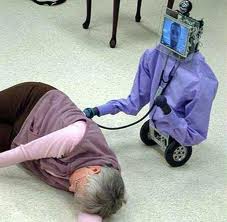
What is a service robot? It’s a robotic machine for defense, space, health care, logistics, consumer products, and e-tailing, among other markets. For example, iRobot makes Roomba floor cleaning machines and PackBot, a robot that searches caves for bomb disposal. Boston Dynamics makes Cheetah, a cat-like robot that runs 40 mph to scout out enemy positions. Aethon’s product is TUG, which automates the movement of medications, equipment, and meals in over 100 hospitals. Intuitive Surgical makes the daVinci robotic surgical system whose arms make (supposedly) more precise incisions than the MDs running them. And Kiva makes mobile robots to move goods and fulfill orders at e-tailers (see our blog on Kiva).

Why the comeback? Government funding, particularly from DOD, has helped. Big defense budgets financed the development of 1,000s of robots for deployment to Iraq and Afghanistan this past decade. But open-software systems have helped as well.  Free software from Microsoft and Willow Garage encourages researchers to develop new applications, while deep venture capital markets have provided the money.

Discussion questions:

1. What are the strengths and weaknesses facing this relatively new industry in the U.S.?

2. How does the use of service robots relate to the field of OM?

OM in the News: Mass Customization, Starbucks, and the Millennials

Blame it on Starbucks. Our students in the millennial group (18-39 years old) seem to be looking for ways to customize everything they buy, according to the Chicago Tribune (Feb.26,2011).  And it’s not just picking apps for their phones, IDs for their Nike shoes, or music for their iPods.

Now Kraft, the food giant, with its first new brand since the DiGiorno pizzas of 1995, has just introduced MiO, a $3.99 squeeze  bottle of flavoring. Consumers can customize their water with flavors like pomegranate or strawberry. Not only will Kraft begin a TV marketing blitz in 3 weeks, but it will give away 100,000 samples through its Facebook page.

Northwestern prof. Alex Chernev points out that consumers derive “additional utility” in doing something themselves. He calls it the “Ikea effect” because buyers got to assemble their own furniture. In the old days, manufacturers made products to meet consumer tastes, he adds. Now they outsource the customization to consumers themselves.

Experts trace the mass customization rage to Starbucks’ success, which pioneered modifiers like “no-whip”, “double-shot”, and “nonfat” to the masses in the 1990’s, removing the stigma of complex orders. (My local Starbucks already knows I only get a “grande decaf iced-mocha with 2 pumps and a dollop of whipped cream”)!

So when you teach mass customization in Chapter 7, consider the quote from a 23-year-old student at Roosevelt U. in Chicago: “Our generation has this sense of entitlement. It’s not only ‘the customer is always right’ but ‘I’m always right’ “.

Discussion questions:

1. What other mass customizations are taking place among products?

2. Why is this an important issue to retailers and manufacturers?

OM in the News: Hi, I’m iPad–May I Take Your Order?

In our Table 7.4 (from the Process Strategy chapter) we list several examples of technology’s impact on services, including “wireless orders from waiters to the kitchen”. I think we may need to update this idea for the next edition! USA Today (Feb.16,2011) just reported that a new restaurant chain is opening soon in S. California in which each of the 60 tables will have an industrial-strength iPad for customers to design and place their orders.  Diners at Stacked: Food Well Built will use the iPads not just as menus and to order, but to pay for the meals as well.

The future of restaurant ordering and design may well be digital. Two-thirds of young people (18-34 year olds) responded to a national survey that they’d favor a restaurant with high-tech gear.

Others have tried iPads already: NY’s Kennedy and La Guardia airports have them at restaurants near Delta Air gates; and Bone’s Restaurant in Atlanta found that wine sales jumped 20% since iPads were added 6 months ago.

Will this be the future for all restaurants? Certainly your students will find the topic interesting for class discussion.

Discussion questions:

1. What are the downsides of this new technology? The advantages?

2. Where else might the iPad concept work besides restaurants?

OM in the News: China’s Solar Overcapacity

In our last blog about China and its solar industry, we noted that vast economies of scale and government subsidies were sending solar panel prices down sharply. China was also grabbing market share not only in the US, but controlled the bulk of the European market. With global demand up, Chinese firms like Yingli Green Energy, Suntech, and LDK Solar were ramping up production capacity–doubling it and running factories 24/7, 365 days  a year in some cases. According to today’s Businessweek (Feb. 9, 2011), “all of the major Chinese producers are engaged in massive, very aggressive capacity-expansion programs.”

But their timing may be off. As the Chinese ramp up, austerity-minded European governments are scaling down their solar subsidies. Germany, France, Spain, the Czech Republic, and others, are reducing support for solar power producers dramatically as they face record-high deficits. This leaves China with capacity way ahead of what the market can take.

It’s not just subsidy cuts, though. The French Environmental Minister says most new solar panels “were made in China with a highly questionable carbon footprint”. She adds:  the policy must “create jobs in France, not subsidize Chinese industry”. Since Yingli made 60% of its income off of Germany last year, and Suntech’s European sales were 74% of total revenue in 2009, the Chinese are learning a painful lesson in capacity management. Their internal market is one alternative, but total Chinese demand is only one-twentieth of what Germany spends on solar in one year. This article ties in well with the discussion of capacity planning in Supp.7.

Discussion questions:

1. Do politics play a role in the solar industries in China? In the US? In Europe?

2. How can overcapacity be avoided?

OM in the News: UPS’ Supply Chain and the No-Left-Turn Rule

For the longest title award, we turn to this week’s Fortune (Dec. 27,2010, pp.44-51) and find Bob Stoffel at UPS. Stoffel is the Senior VP for Supply Chain, Strategy, Engineering, and Sustainability.

With the word Strategy in his title, Stoffel points out that UPS is a lot more than a transportation company. It now has 1,000 engineers who are there just to help customers with their supply chains. Zappos built its whole e-commerce strategy around UPS’ Louisville Worldport. Zappos can take an order for shoes at 10pm and have them in the customer’s hands at 10am the next day.

When a Toshiba laptop comes in for repairs, it is UPS that actually fixes it and has it back to the customer in 24 hours. “It’s a triple win”, says Stoffel. “You’ve saved transportation links, you’ve reduced inventory,… and you’ve reduced your carbon footprint”.

Regarding sustainability, UPS has improved its fuel efficiency by 10% with a fleet of all-electric trucks, hybrids, and natural-gas vehicles. And thanks to telematics, GPS, and other technologies, UPS delivered 350,000 more packages  a day over last year, but drove 53,000 miles less a day. Finally, the firm’s famous “no-left-turn” policy is part of another 20 million miles a year saved through technology by avoiding costly delays from left turns and poor routings. “It drives my wife nuts”, Stossel says. “I won’t turn left (when looking for a gas station).We’ve got to find one on the right”.

My favorite improvement is the new “Eco Responsible Packaging” program to advise shippers how to waste less space in packaging. Just think of all the small items you have received in a big box. “Our vehicles run out of space before they run out of weight capacity”, says Stossel.

Discussion questions:

1. What is UPS’ sustainability strategy?

2. How is UPS part of other firms’ supply chain?

OM in the News: If You Don’t Get Your Bag in 20 Minutes, You Get $20!

We have seen it in the ERs…”we guarantee you will be seen in 30 min. or….”. But did we ever think we would see it in airports as we wait for our checked bags? After decades of mishandled and delayed suitcases arriving to the carousel (which costs the airlines $2.5 billion a year), the quality of service is finally improving dramatically—all because of OM efforts.

The Wall Street Journal (Dec.2,2010) reports that Alaska Airlines has just implemented a 20 min. guarantee. If a customer’s bag does not arrive at the claim area within 20 min. of arrival, fliers get a $20 voucher or 2,000 frequent-flier miles. Alaska has improved its misdirected baggage claims by 52% in the past 2 years. For all airlines the  lost luggage figures are down by a whopping 38%. “If you are going to charge for bags, you better be really reliable”, says US Airways’ COO.

How did OM impact the change? New technology  and revised processes (both in Ch.7) are the keys. Airlines have ramped up use of bar-code scanners to track bags along their journey–something cargo shippers and supermarkets have been doing for years. Delta invested $100 million in its Atlanta operations alone. It gutted the entire infrastructure under Terminal B to make room for an automated baggage system. Belt time is 7-10 min., vs. the old system of driving bags on carts, which took 15-30 min. Payback comes from less mishandled bags, which average $100 each.

Alaska Airlines has changed its processes and a new strict adherence to timeliness. Within 10 min. of arrival, all bags must be offloaded. And instead of measuring when the 1st bag hit the carousel, Alaska tracks when the last bag is delivered, posting scorecards for employees. “It is measuring and setting goals that are very specific”, says the airline.

Discussion questions:

1. Why and how did airlines improve so quickly?

2. What technology drives the changes?

3. What do students think of the 20 min. guarantee?  Will other carriers be forced to match it?

OM in the News: Chrysler’s Gamble with Mass Customization

The year was 1973. Jay and I were both teaching at Boston U.’s brand new European  MBA program, just outside of Pisa, Italy. The most popular car on the Italian road was the “Cinquecento”, a midget of a  vehicle that could easily fit in the back of a Chrysler minivan. The Cinquecento had all the power of about 3 Vespa motorscooters, my vehicle of choice in college. When I left Italy I never thought I would see one again.

So yesterday’s Wall Street Journal article (Nov.22,2010) announcing that Chrysler was bringing the Cinquecento to the US–and planning to sell 50,000 of them in 2011–was a bit of news. The car will be called the Fiat 500 and be manufactured at a retooled Chrysler plant in Mexico. Five feet shorter than a Chevy Impala, the 500 will retail for $15,500. But the reason you may want to bring this topic to your class is Chrysler’s risky strategy of mass customization (Chapter 7). Where the Japanese mastered the global auto market by limiting production options (a typical Honda might have 2 transmission options, 6 paint choices, 2 interiors, etc.), the Fiat 500 will provide a dizzying array of features to choose from.

With 3 versions of body style, 14 exterior colors, 14 seat colors, 6 wheel styles, and so on, there will be about 1 million combinations of the new car. Chrysler hopes the chance to customize the 500 will draw a wide range of customers who may want a “one of a kind”. In the past, US auto makers learned the risks of mass customization: too many choices leave dealers with lots full of cars, but not the exact one a customer may want (and 80% of US customers want to drive their car off the lot the day they buy).

Further, suppliers are being asked to keep more parts on hand so they can more quickly build a seat or interior combination , then ship it to the plant within a few hours.

Discussion questions:

1. How interested are students in a unique, customized car that will take 30 days to deliver?

2. Why is Chrysler taking this approach?

3. What are the competing products and how do they fare?

OM in the News: Planes, Trains, and Drones–China’s Reverse Engineering Controversy

When the Japanese and European high-speed rail companies signed on to build trains for China, they eyed the $ multibillion contracts in the booming new market. What they got was competition from Chinese firms who took their technology and turned it against them within a few short years. Chinese companies, fueled by technology transfer, reverse engineering, and process redesign (Ch.7), are now selling trains even faster than foreign rivals Kawasaki, Bombardier, and Siemens. The national  strategy of boosting state-owned firms and obtaining advanced technology at the expense of foreign powers is challenging the US and other powers doing business in China.

Yesterday’s Wall Street Journal (Nov.18,2010) quotes a China rail official who says they are “learning and systematically compiling and re-innovating foreign …technology” and now have trains that go 37 miles an hour faster (236 mph) than European and Japanese rivals. Kawasaki’s view: a  few tweaks to exterior paint scheme…and a beefed up propulsion system is not a new technology. “Its nothing but deceitful propaganda”, says an exec.  Kawasaki had set up production facilities in China, trained Chinese engineers, and developed a supply chain for components.

Today, the Journal’s  headline addressed China’s advances in pilotless drones— putting the US and Israel at risk in their worldwide dominance. Same story: technology transfer by Israel propelled the 25 different models of unmanned aircraft…a major advance in only 2 years. And last week’s lead story was the unveiling of China’s C919 commercial jet, a direct threat to the Boeing 737.

So how is this different from post-war Japan (and Korea as well) transforming their economies by reverse-engineering foreign technologies in steel, autos, ship building, and computers? China’s share of manufacturing advanced  equipment could climb from 8% today to 30%  of global exports within the decade, writes the Journal.

Discussion questions:

1. Discuss the ethical issues that arise from these articles.

2. What is China’s long-term manufacturing strategy, and how is it changing?

3. How did companies like Kawasaki end up losing their dominance in the Chinese market?

OM in the News: The Shrinking Roll of Toilet Paper

As Fortune points out in its latest issue (Nov.15,2010, p.21), in an article called “When Less is….Less?”, everything shrinks during a recession: GDP, your stock portfolio, and most definitely, products on a store shelf.

In Chapters 5 and 7 we allude to the  choices the OM manager has to help increase profits when price increases are a bad option. Here are three: (1) cut your raw material costs, if possible; (2) cut the quantity—did you notice that OJ and ice cream containers are smaller?;  (3) enhance the product –maybe a richer ice cream, or a stronger rake, or more miles between oil changes?

As one example, here is Fortune’s sad tale of your shrinking roll of  Scott 1000 toilet paper over the past 15 years:

1995 –size of a sheet is 4.5 x 4.5″ when Kimberly Clark buys Scott Paper.

1999–size now 4.5 x 4.1″–called a “softness enhancer”.

2006–size drops to 4.5 x 3.7″–a nice pattern is added.

2010 –size reduced to 4.1 x 3.7″–“a 10% stronger tissue”.

The OM implications: not only less raw material usage, but smaller packages mean 12-17% more units fit on a truck. With fewer trucks, fuel use drops by 345,000 gallons per year.

Discussion questions:

1. Ask your students to name some other products that have “been enhanced” to increase profits or save money.

2. Besides smaller sheet size, what else can be done to reduce costs? (This was an alternative strategy chosen by Georgia-Pacific and P&G’s toilet paper changes).

3. How does sustainability enter the picture as an OM tool?

Video Tip: Flowcharting at Arnold Palmer Hospital

Many of our colleagues think flowcharting is an invaluable tools we should be teaching in OM. I agree, and every semester I show the video Process Analysis at Arnold Palmer Hospital (7 min.).

APH believes that if a process takes place more than one time, it should be documented and flowcharted. There is even a staffer shown in the film, Diane Bowles, with the job title “Clinical Practice Improvement Consultant”, whose full-time work is charting scores of processes.

After I show the video in class, I assign small teams to flowchart the process of maternity patients moving through the hospital (see the video case at the end of Chapter 7). The Solutions Manual shows one possible chart. When you show the video, ask the students about the pre-registration function, how it can be used to streamline the operation, and why pregnant women benefit from it.

The key is that continuous improvement helps both patient and hospital function/efficiency.

OM in the News: Sustainability Means Emptying Your Own Trash Can?

In my 40 years working in industry, government, and academia, I can’t remember anyone ever asking me to empty my office garbage can. Not that it would have been beneath me, as I am personally in charge of all trash disposal in my own home. But yesterday’s Wall Street Journal article “Memo to all Staff: Dump the Trash”, caught my eye as it was packaged to workers as a sustainability issue (see Ch.7).

Its not just in the State of Texas, the City of Phoenix, and Brewer Science (a Missouri semiconductor company) that  employees are being asked to tote their own trash and recyclables to common bins. The idea has also caught on that professors (yes profs!) at the U. of Washington and at Dartmouth College empty their own baskets as part of an environmental initiative.

There are some savings, of course. Texas saves $825,000 annually on labor costs. Brewer’s janitorial staff is now just a quarter of its original size. But Dartmouth presented the new program as part of a broad sustainability package, whose primary goals “are to increase campus recycling and reduce waste”, according to its  VP.

Some question the college’s  rationale. Psych prof Catherine Cramer is quoted as saying: “The real goals here, however prettily wrapped in sustainability rhetoric, are rather obvious”. She wonders if  “its good use my professional time”.

Just to be clear, though. Not everyone in Texas is in the program. The governor and legislators have kept their original trash service.

Discussion questions:

1. Discuss the economics of transferring work from low-paid employees to higher-paid professionals.

2. What is your own campus doing to enable the sustainability/ recycling efforts?

OM in the News: The (Gentler) Chicken-Killing Assembly Line

I was 7 years old when my Dad proudly took me to the Dubuque (Iowa) Packing Co. to show me what he did as a supervisor in the cow butchering department.  I won’t go into graphic detail as to how the animals were queued up to have their throats slit.  They were stunned first to make the process as pain free as possible.

Maybe you can see why yesterday’s New York Times (Oct.22,2010) front page headline, “New Way to Help Chickens Cross to the Other Side”, caught  my attention. It turns out that chicken producers, egged on by animal rights groups, are also switching to a system of killing their birds more humanely. The new process uses gas to render the chickens unconscious before they are hung by their feet to have their throats slit.

“When you grab a chicken, turn it upside down and put it on the line, its stress, stress, stress”, says one chicken producer.  The new system is not only meant to be kinder to the animals, but to plant workers as well. Dealing with struggling, flapping chickens–like dealing with bellowing cows who sense impending doom– makes meat processing plant jobs among the worst in the country.

This topic can fit in your OM course in 3 ways: (1) students have strong opinions about the issue of  how we slaughter animals (see the Ethical Dilemma box on pig production in Ch.7, Process Strategy); (2) when you discuss job satisfaction/motivation in Ch.10, it makes the point that not all jobs are easy to staff/manage; and (3) this is a classic case of an assembly  line, in Ch.9’s photo, at the end of the chapter.

Discussion questions:

1. Does killing chickens this way make you more comfortable with the  production process?

2. How are most chickens raised in preparation for slaughter?

3. Will it be easier to market a chicken as “killed stress-free”?

OM in the News: Solar–Will the U.S. Lose Out to China?

A few days ago, our blog gave the good news that BMW and Mercedes were expanding their manufacturing in the US. For our nation’s standard of living to rise, we indeed need to make things. And such jobs pay well and provide a path for middle class success.

But the New York Times headline (Oct.13,2010), “In the Future, Already Behind” brought me back to reality with a thud. The story is about Silicon Valley and its commitment to transforming the economics of solar panel production. Firms like Solyndra, Nanasolar, and MiaSole bet the farm that their “thin film” technology would make them the Intels and Apples of the exploding global solar industry.

But just as Solyndra flipped the switch on its new $733 million California  factory last month, everything changed. The Chinese, using vast economies of scale and government subsidies, sent the price of panels plunging 40%  and grabbed 40% of the vast California market. They also took the bulk of the European market. What looked like a chance for US manufacturing to dominate a critical growing market has crumbled to the realities of globalization.

“How do you fight against enormous subsidies, low-interest loans, cheap labor and scale, and a government strategy to make you no.1 in solar?”, asks an American CEO.

New technologies (see Ch.7), meant to be cheaper, must get there faster is one lesson we learn here.

Discussion questions:

1. What are the dangers of ceding this industry to the Chinese?

2. How can the US firms counter this threat (see Ch.2 for a strategy discussion)?

3. Should the US provide the same benefits that China does to new companies?

OM in the News: Mass Customization at BMW

BMW at its Spartanburg S.C. plant along with 170 suppliers wants to build a custom  X5 sport utility vehicle for you. The Spartanburg plant thinks they can do it for you as they already export 70% of the vehicles it makes to more than 130 countries; each with its own specifications. And they do it with 18 owner’s manual languages.   The number of custom options includes 500 side-mirrow combinations, 1300 front-bumper combinations, 2,500 possible wiring harnesses, 5,000 seat and 9,000 center-console combinations. 

BMW wants 4 to 6 weeks to make the custom ordered SUV, but orders are locked in with a lead time of only 5 days. Dealer software is closely tied to BMW’s manufacturing and supply chain, with workers getting the word on what car they are building via overhead screens. The frequent changes required by variations in custom orders complicates  every thing from entering the order, to procurement, to moving parts to the line, and balancing the assembly line. Customization is not cheap. But BMW is betting that mass customization for a premium priced car will pay off.

Discussion questions:

Why don’t more auto purchasers request custom-made cars (the car they really want)?

How do we balance an assembly line with many different products coming down the assembly line (the article says the standard time is 106 seconds)?