Video Tip: Inside Tesla’s Robotic Factory

teslaIf you want to show an example of all the high tech manufacturing tools discussed in Chapter 7, here is the perfect video for your class.  In it, Wired Magazine (July 16, 2013) provides a tour of the 5 million-square-foot Tesla Motors factory in Fremont, California to see how CEO Elon Musk is rethinking how cars are built.  Tesla Motors has kicked off production of the gorgeous Model S into overdrive, cranking out some 400 cars a week on one of the world’s most advanced automotive production lines. My wife and I are so impressed that we are scheduled to take the car for a test drive this weekend

A major automaker in Detroit or Japan can churn out 400 cars a day, and in fact the Tesla Motors plant had a capacity of 6,000 cars a week when Toyota and General Motors ran this factory in the 1980s and 1990s. But Tesla’s numbers are impressive when you consider the Silicon Valley automaker started less than a decade ago with a few engineers and mechanics shoving piecemeal components into a rolling chassis made by Lotus.

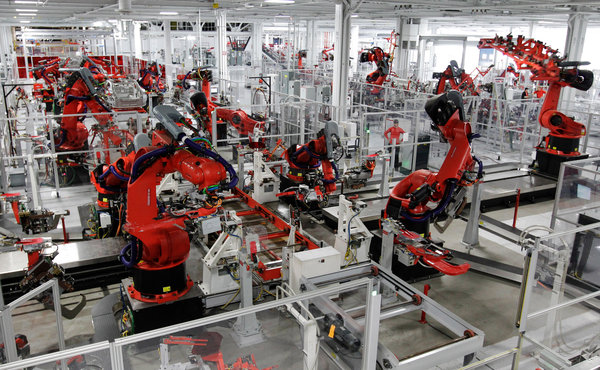
Tesla got the factory for a song from Toyota in 2010, spent about a year or so setting up tooling and started producing the Model S sedan in mid-2012. The automaker brings in raw materials by the truckload, including the massive rolls of aluminum we see in the 5 minute video that are bent, pressed, and formed to create the car. Those lightweight components are assembled by swarm of 160 red robots.

The bare body is shipped off for prepping and paint before joining the assembly line under the power of autonomous robots. The shell is ushered through the line as Tesla’s 3,000 workers work alongside their robotic counterparts to install the battery, motor, interior, and miles of cabling and components that help create the electric sports sedan.
OM in the News: Baxter–The Smarter Robot

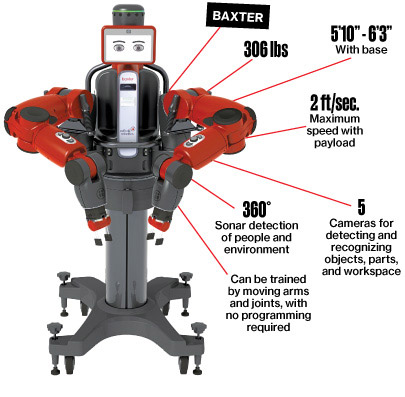
Robots are always an interesting technology topic in Chapter 7, and the latest Businessweek (Sept. 23-30, 2012) describes Baxter, a super smart robot that Rethink, Inc. believes will spark a manufacturing revolution. The firm hopes the robot, adept at the mindless repetitive tasks common on most assembly lines, can increase the productivity of U.S. manufacturers and help them retain business that would otherwise migrate overseas.

With 5 cameras, a sonar sensor that detects motion 360 degrees around it, and enough intelligence to learn tasks within an hour, Baxter is designed to work safely alongside humans and do simple jobs such as picking items off a conveyor belt. It’s also cheap enough, at $22,000 a unit, so that the investment math works: If Baxter performs 3 years of 8-hour shifts, it’s the equivalent of labor at $4 an hour. “We are spending hundreds of billions of dollars doing this kind of work in China,” says Rethink’s chief technical officer. “We want companies to spend that here, in a way that lets American workers be way more productive.”

Traditional assembly line robots made by companies like ABB in Switzerland and Yaskawa Electric in Japan, which can cost more than $200,000 apiece, do a few things extremely well, such as painting and welding, but require carefully organized and controlled environments. Most wouldn’t know if a human wanders close by, so they are often isolated in cages away from employees. Baxter, though, sits on a gurney and can be set down safely just about anywhere on a factory floor. Its eyes are on a swiveling computer screen and greet any worker who approaches. To teach Baxter a job, a human simply grabs its arms, simulates the desired task, and presses a button to set the pattern.

Discussion questions:

1. How can Baxter change manufacturing?

2. What is Rethink’s plan for the next generation robot?

OM in the News: Skilled Work Without the Worker (with Video)

Robotics is just one  topic in our treatment of  technology in Chapter 7, but yesterday’s lead article in the New York Times (Aug. 19, 2012) called “Skilled Work Without the Worker” is worth sharing with your class. The point is that robots have become a lot more sophisticated in the past 2 decades and are now capable of doing very detailed work that only humans could do just a short time ago.

Tesla foctory robots perform not one, but 4 functions at the California auto plant

The piece begins by describing two Philips Electronics factories–one in China (where hundreds of workers hand assemble electric shavers)– and the other in Holland (where 128 robots  do the same work, guided by video cameras). The Dutch factory  has several dozen workers per shift, about a tenth as many as the plant in China. And the robots there work, of course, without a coffee break — three shifts a day, 365 days a year.

This is the future, says The Times. A new wave of robots is replacing workers around the world in both manufacturing and distribution. Factories like the one  in the Netherlands are a striking counterpoint to those used by Foxconn , which employ hundreds of thousands of low-skilled workers to make Apple products. Foxconn’s chairman, Terry Gou, has publicly endorsed a growing use of robots. Speaking of his more than one million employees worldwide, he recently said: “As human beings are also animals, to manage one million animals gives me a headache.”

With examples ranging from Boeing’s use of robots on the 787,  to C&S Wholesale Grocers fully automated warehouse, to a California organic farmer who uses them to pack lettuce, this exciting OM technology makes for a good discussion in many chapters of our text. The 4 minute video that accompanies the article is also well done.

Discussion questions:

1. Why have robots become a more powerful force in recent years?

2. What are the plusses and minuses of the new revolution?

OM in the News: The Rise of the American Service Robot

It was 50 years ago when a company called Unimation rolled out the world’s first industrial robot—for use in a GM plant in NJ. The American firm’s product weighed in at 4 tons and did a good job at welding. But by 1991, a U.S. Commerce Dept. national security assessment warned: “The U.S. is nearly out of the industrial robot business”. To this day, Swiss-based ABB and Fanuc (of Japan) dominate the $12 billion global market for manufacturing robots.

The U.S. is back, however, in a new, and even larger, service robot market, with 70 of the top 200 firms globally here–twice as many as in Japan or France, according to the latest Businessweek (March 7,2011).

What is a service robot? It’s a robotic machine for defense, space, health care, logistics, consumer products, and e-tailing, among other markets. For example, iRobot makes Roomba floor cleaning machines and PackBot, a robot that searches caves for bomb disposal. Boston Dynamics makes Cheetah, a cat-like robot that runs 40 mph to scout out enemy positions. Aethon’s product is TUG, which automates the movement of medications, equipment, and meals in over 100 hospitals. Intuitive Surgical makes the daVinci robotic surgical system whose arms make (supposedly) more precise incisions than the MDs running them. And Kiva makes mobile robots to move goods and fulfill orders at e-tailers (see our blog on Kiva).

Why the comeback? Government funding, particularly from DOD, has helped. Big defense budgets financed the development of 1,000s of robots for deployment to Iraq and Afghanistan this past decade. But open-software systems have helped as well.  Free software from Microsoft and Willow Garage encourages researchers to develop new applications, while deep venture capital markets have provided the money.

Discussion questions:

1. What are the strengths and weaknesses facing this relatively new industry in the U.S.?

2. How does the use of service robots relate to the field of OM?

OM in the News(and Video): Ford’s Lean Auto Plant in Brazil

Ford’s most progressive plant in the world may well be in northeast Brazil, where it uses lean manufacturing, sophisticated supply chains, and a vast array of robotics to produce the EcoSport SUV and Fiesta. A  colleague in that country, who is using the Portuguese edition of our text,  just emailed me the link to a video about which he is justifiably proud.  This 3.5 minute video illustrates all 3 concepts: lean, SCM, and automation and makes a nice presentation in Ch11 or Ch.16. (I do need to warn you that the last few seconds are a bit anti-union).

In 2009, the Ford plant produced over 207,000 vehicles. This South American operation brings so much profit to the parent company in Dearborn,Michigan,that the firm was able to turn down federal loans in 2009 that both GM and Chrysler accepted.

Brazil is becoming a leader in lean auto making, with another plant churning out VWs with a similar layout in which suppliers produce, on-site, with their own employees, the parts that are installed in the final vehicle. If you look at the Global Company Profile that opens Ch.16 in our text, you will see a  layout at the Toyota Tundra plant in San Antonio, Texas that also resembles what we see in the video.

Discussion Questions:

1. Why is it doubtful that this Ford plant will be replicated in the US?

2. How does the supply chain differ from most US plants?

3. Why is this an example of lean manufaturing?