OM in the News: Robots Pick Up More Work at Busy Factories

“Robots are turning up on more factory floors and assembly lines as companies struggle to hire enough workers to fill rising orders,” writes The Wall Street Journal (June 2, 2022). Orders for workplace robots in the U.S. climbed 22% last year to $1.6 billion.

Rising wages and worker shortages, compounded by increases in Covid-19-related absenteeism, are changing some manufacturers’ attitudes about robotics. “Before, you could throw people at a problem instead of finding a more elegant solution,” said the CEO of Delphon Industries. Delphon lost 40% of its production days during January when the coronavirus spread through its workforce. The disruption accelerated the company’s purchase of 3 additional robots earlier this year.

Athena Manufacturing purchased seven robots in the past 18 months.

Manufacturers in the U.S., where workers typically have been abundant and wages stable, have been slower to embrace robotics than those in some other industrialized countries. The number of robots deployed in the U.S. per 10,000 workers has traditionally trailed countries such as South Korea, Japan and Germany. (The use of industrial robots in North America for years had been concentrated in the automotive industry, where robots took on repetitive tasks such as welding on assembly lines.)

Now,  robots are making inroads into other sectors including food production, consumer products and pharmaceuticals. Improved capabilities are allowing robots to be programmed for more-complex tasks requiring a mixture of strength and nimbleness.

At Athena Manufacturing, a fabricating and machining company for metal equipment, customers have been ramping up orders, but Athena has struggled to find enough workers to staff a second weekday shift and a weekend shift. So it recently spent more than $800,000 on robots, including $225,000 alone for the grinding robot shown in the photo. The investments aimed to increase Athena’s capacity to handle orders, more than lowering costs.

“The robots are becoming easier to use,” said the CEO of Fanuc America, a major supplier of industrial robots. “Companies used to think that automation was too hard or too expensive to implement.” But one MIT prof said factories’ increasing reliance on automation will lead to an oversupply of human labor that will drive down wages in the years ahead, unless other U.S. industries can absorb displaced manufacturing workers.

Classroom discussion questions:

  1. Will automation destroy a lot of manufacturing jobs in the U.S?
  2. Why are robots becoming more popular in recent years?

OM in the News: Easing Worker Shortages with Automation

We used to ask whether robots will take over the jobs of humans. But that’s not quite the right question in 2022, as finding workers to fill the large number of jobs currently open in manufacturing is almost impossible. “There aren’t enough workers,” says a 3M exec. “And it’s not just large factories with low mix and high volume that are seeing this, it’s also medium-sized and small companies. Everyone is looking to automation to bridge the worker shortage.”

Operations managers are getting the message and in 2021, factories and other industrial users ordered 39,708 robots (valued at over $2 billion), a 28% increase from 2020. While robots have been in auto plants for a long time, orders from non-automotive companies now represent 58% of the North American totals.

A breakdown of industry orders is as follows:

  •  Food and Consumer Goods:  up 29%
  •  Semiconductors and Electronics/Photonics: up 2%
  • Plastics and Rubber: up 4%
  • Life Sciences/Pharma/Biomed: up 4%
  • All Other Industries:  up 65%

“There is a process we use to engage the operators and manufacturing employees to get them ready for automation,” says 3M. “It’s never about a 1-1 replacement of a worker.  We explain that if someone was doing a certain job and now the robot will do the job, the employee can learn how to operate them and troubleshoot them. This leads to a higher pay grade. It can be a real win-win situation.”

The skills of the workforce have been changing over the past few years, reports Industry Week (March 10, 2022). Manufacturing has tended to pay higher wages than the service sector and is seeing an increasing portion of operators having either associate degrees, technical degrees, or even bachelors degrees. The upskilling of talent was underscored by a 2021 study from the World Economic Forum that predicted that automation would result in an increase of 58 million jobs. And two-thirds of the jobs transformed by automation will become higher-skilled.

These differing degrees of education are going to be essential as U.S. manufacturing will grow. Given the recent supply chain problems, we will see an increase of more companies producing products in the U.S. and automation will play a key role. So it’s an important tool for companies. Contrary to the belief that automation is taking jobs away, it’s automation that will keep companies competitive, and stay in business and protect jobs.

Classroom discussion questions:

  1. Why does 3M say that robots will not replace workers? Is that true in all industries?
  2. Why are manufacturing companies looking for better educated employees?


OM in the News: Robots Go to Bat in Warehouses

Automatons from Nimble Robotics help fill orders at Puma North America’s warehouse

More robots that can pick up separate objects are moving from laboratories to warehouses as the technology improves and labor-strapped logistics operators look to automation to meet surging demand. Businesses are using software-powered robotic arms to sort clothing and e-commerce parcels, pack bread and industrial supplies, and pick electronics and consumer products from larger bins to prepare orders for delivery.

The technology isn’t replacing human workers anytime soon. But the latest steps show warehouse robots are evolving as the computer vision and software that guide them (see Chapter 7 in your Heizer/Render/Munson text) grow more sophisticated, allowing them to take on more tasks that have been largely done by people.

Puma is using several robotic arms to assemble orders of clothing and shoes at a distribution center in Torrance, Calif. The technology uses a combination of cameras, grippers and artificial intelligence to pluck items from bins that another automated system delivers to workstations usually staffed by people. Remote operators are on hand to assist if the robot has trouble picking up an object. The robots perform with about 99% accuracy, about as well as their human counterparts, and can run for two shifts straight.

Interest in robotic picking is up considerably in the pandemic as e-commerce orders have surged and competition for workers intensified, accelerating broader demand for logistics automation, writes The Wall Street Journal (Jan, 11. 2022). Last year SB Logistics opened a highly automated fulfillment center in Ichikawa, Japan. The center uses robotics technology to pick and pack items including electronics, household products and canned goods. The facility stores about 50,000 products, with robots doing about half the picking, and aims to eventually automate all operations.

Some businesses are deploying high-tech mechanical arms for other distribution work. Bimbo Bakeries uses robotic grasping technology to pick and pack bread. GXO Logistics is using a robotic arm equipped with camera vision to help speed up the order fulfillment process at a warehouse in the Netherlands.

Classroom discussion questions:

  1. What are the OM advantages of using robots in warehouses?
  2. The disadvantages?

OM in the News: The EV Microfactory

Arrival, a small EV company, wants to replace the assembly lines automakers have used for more than 100 years with something radically different — small factories employing a few hundred workers, reports the Orlando Sentinel (April 27, 2021). The firm is creating highly automated “microfactories” where its delivery vans will be assembled by multitasking robots, breaking from the approach pioneered by Henry Ford and used by most of the world’s automakers.


The plants would produce tens of thousands of vehicles a year. That’s far fewer than traditional auto plants, which require 2,000 or more workers and typically produce hundreds of thousands of vehicles a year. The advantage is that its microfactories will cost about $50 million rather than the $1 billion required to build a traditional factory. Arrival says this method should yield vans that cost a lot less than other electric models and even today’s standard, diesel-powered vehicles.

arrival


Such vehicles are well suited to electrification because they travel a set number of miles a day and can be charged overnight. Arrival has already won over UPS, which has a 4% stake in the company and plans to buy 10,000 Arrival vans

.
In Arrival’s factories, a motorized platform will carry unfinished vehicles among 6 different robot clusters, with different components added at each stop. The company is also replacing most steel vehicle parts with components made from
advanced composites. These parts are to be held together by structural adhesives instead of metal welds. The use of composites, which can be produced in any color, would eliminate 3 of the most expensive parts of an auto plant — the paint shop, the giant printing presses that stamp out fenders, and the robots that weld metal parts into larger underbody components. Each typically costs several hundred million dollars.


But automating auto plants is notoriously tricky. Tesla blamed overreliance on robots for the troubled start of its Model 3 production line. Manufacturing robots are usually programmed to do 1-2 tasks. Arrival is counting on its robots to handle a variety of jobs.

Classroom discussion questions:

  1. What are the advantages and disadvantages of microfactories such as Arrival’s?
  2. Why are robots the key here?

OM in the News: Microfulfillment Uses Robots to Shrink Warehouses

Smaller is proving bigger in fulfillment centers thanks to increasingly sophisticated robotics technology. Companies looking to get goods to online consumers faster are turning more attention to microfulfillment, writes The Wall Street Journal (Nov. 9, 2020). This strategy puts robots and specialized technology to work in tight space spaces close to where e-commerce shoppers live.

A Brooklyn site fitted out with an automated system from Israeli robotics provider Fabric (formerly CommonSense Robotics) highlights the process in action. The 7,500 sq. ft. warehouse hosts chunky metal machines that shuttle goods from storage racks to the warehouse floor for mobile robots to ferry them along in an intricate dance choreographed by software. The automation allows users to pack goods in narrow aisles that human workers can’t reach, getting more use out of urban real estate that’s too costly for many larger logistics operations. Those economics have companies such as Nordstrom, Albertsons, Walmart, HEB, and FreshDirect, installing microfulfillment facilities.

Bins are stored at a microfulfillment center in Brooklyn, operated by Fabric.

By squeezing those operations into urban warehouses and the backs of stores, businesses pare delivery times so online orders reach their destinations in hours, not days. Fabric’s CEO said companies should be able to get orders picked and packed in 5 minutes or less with only a handful of workers.

For grocers coping with surging online demand during the pandemic, the technology offers a faster ROI than larger robotics-equipped warehouses while allowing retailers to fill orders more quickly than they can with human workers walking store aisles. The microfulfillment sites are becoming a new focus for retailers adjusting to the dizzying changes in consumer markets. Some merchants had been testing such sites in recent years, but the rush to online shopping during the coronavirus pandemic is accelerating moves toward space-saving, automation-powered warehouses.

Classroom discussion questions:

  1. How do these warehouses differ from the typical Amazon distribution centers?
  2. What are the advantages and disadvantages of microfulfillment centers?

OM in the News: Is Fanuc the Most Important Manufacturing Company in the World?

Businessweek thinks there is one clear winner in the manufacturing world: the $50 Japanese billion company that controls most of the world’s market for factory automation and industrial robotics. “In fact,” writes Businessweek (Oct. 23, 2017), “Fanuc might just be the single most important manufacturing company in the world right now, because everything Fanuc does is designed to make it part of what every other manufacturing company is doing”.

At Fanuc’s Mt. Fuji plant, hundreds of bright yellow Fanuc robots are working around the clock to build other Fanuc robots. Some robots will be shipped elsewhere in Japan, where strict immigration policies and a declining birthrate have left manufacturers of all sizes more dependent on factory automation. But most are bound for China.

Automation has been rising in China over the past decade, partly because, as wages and living standards have risen, workers have proved less willing to perform dangerous, monotonous tasks, and partly because Chinese manufacturers are seeking the same efficiencies as their overseas counterparts. More and more, it’s Fanuc’s industrial robots that assemble and paint automobiles in China, construct complex motors, and make injection-molded parts and electrical components.

And as China goes, so goes the rest of the industrial world. Multinationals that are reshoring operations from Asia to N. America and Europe are doing so in part because automation promises sophisticated production methods and labor savings; they are spending more than ever on industrial robots– 32% more than a year earlier, with many of them are ending up in Midwestern steel and auto manufacturing centers. Orders from the U.S., though, are dwarfed by those from China—some 90,000 units, 1/3 of the world’s total industrial robot orders last year. (Researchers estimate that each new industrial robot displaces 5 human workers).

The key to Fanuc’s success may lie in AI. In the past, the selection of a single part from a bin full of similar parts required skilled programmers to “teach” the robots how to perform the task. Now, Fanuc’s robots are teaching themselves. “After 1,000 attempts, the robot has a success rate of 60%,” the company said. “After 5,000 attempts it can already pick up 90% of all parts—without a single line of program code having to be written.”

Classroom discussion questions:

  1. What is the role of artificial intelligence in robotics?
  2. What will be the impact of robotics on U.S. manufacturing?

OM in the News: Robots Picking, Retailers Grinning

An engineer adjusts a robotic arm at RightHand Robotics

“Robot developers are close to a breakthrough—getting a machine to pick up a toy and put it in a box,” writes The Wall Street Journal (July 24, 2017). It is a simple task for a child, but for retailers it has been a big hurdle to automating one of the most labor-intensive aspects of e-commerce: grabbing items off shelves and packing them for shipping. Several companies, including Saks Fifth Avenue and Chinese online-retail giant JD.com have recently begun testing robotic “pickers” in their distribution centers. Robotics companies say their machines can move gadgets, toys and consumer products 50% faster than human workers.

Retailers and logistics companies are counting on the new advances to help them keep pace with explosive growth in online sales and pressure to ship faster. Picking is the biggest labor cost in most e-commerce distribution centers, and among the least automated. Swapping in robots could cut the labor cost of fulfilling online orders by a fifth.

Until recently, robots had to be trained to identify and grab each item, which is impractical in a distribution center that might stock an ever-changing array of millions of products. Now, several automation companies are working on automating picking. Hudson’s Bay is testing startup RightHand Robotics’ robots in an Ontario distribution center.  “This thing could run 24 hours a day,” said Hudson’s SCM VP. “They don’t get sick; they don’t smoke.”

Previous waves of warehouse automation didn’t lead to sudden mass layoffs, partly because order volumes have been growing so fast. And automated picking is still at least a year away from commercial use. The main challenge lies in creating the enormous databases of 3D-rendered objects that robots need to determine the best way to grip new objects. (There is also 4 minute video that accompanies the WSJ article).

Classroom discussion questions:

  1. Compare this change to other advances in warehouse automation.
  2. Why is robotics so important in order fulfillment?

OM in the News: The Automation of Oil Drilling

oil-rigs-2As the global oil industry begins to climb out of a collapse that took 440,000 jobs, anywhere from a 1/3 to 1/2 may never come back. “A combination of more efficient drilling rigs and increased automation is reducing the need for field hands,” writes Businessweek (Jan. 30-Feb. 5, 2017). 

Automation, of course, has revolutionized many industries, from auto manufacturing to food and clothing makers. Energy companies, which rely on large, complex equipment for drilling and maintaining oil wells, are particularly well-positioned to benefit. “It used to be you had a toolbox full of wrenches and tubing benders,” says one south Texas professor. “Now your main tool is a laptop.” During the boom, companies were too busy pumping oil and gas to worry about head count. The two-and-a-half-year downturn gave executives time to rethink the mix of human labor and automated machinery in the oil fields.

Nabors Industries, the world’s largest onshore driller, says it expects to cut the number of workers at each well site eventually to 5, from 20, by deploying more automated drilling rigs. Rigs have gotten so efficient that the U.S. oil industry needs only 1/2 as many workers as it did at the height of the shale boom in 2014 to suck the same amount of oil out of the ground.

The systems, that is all the processes involved in drilling and fracking a well, will be the key. That means an engineer can design an oil well at his desk. With the press of a button, an automated system would identify the equipment needed from a supplier, create a 3D model, send the details to the rig, and tell the rig to do the job.

Classroom discussion questions:

  1. Why the industry push for automation?
  2. What are the plusses and minuses for the U.S?

OM in the News: China’s Factories Turn to Robots

china robotsA Chinese factory near Shanghai is relying on a new breed of workers to maintain its competitive advantage in assembling electronics devices: small robots designed in Germany. China’s appetite for European-made industrial robots is rapidly growing, as rising wages, a shrinking workforce and cultural changes drive more Chinese businesses to automation. The types of robots favored by Chinese manufacturers are also changing, as automation spreads from heavy industries such as auto manufacturing to those that require more precise, flexible robots capable of handling and assembling smaller products, including consumer electronics and apparel.

“At stake is whether China can retain its dominance in manufacturing,” writes The Wall Street Journal (Aug.17, 2016). The rush to buy robots comes in part because China’s population of workers aged 15 to 59 is starting to shrink, forcing manufacturers to turn to automation. The number of the country’s workers peaked in 2010 at more than 900 million and will fall below 800 million by 2050. In addition, the average hourly labor cost of $14.60 in China’s manufacturing heartland has more than doubled as a percentage of U.S. manufacturing wages, from 30% in 2000 to 64% in 2015.

China, in 2013, became the world’s largest market for industrial robots, surpassing all of Western Europe. In 2015, Chinese manufacturers bought roughly 67,000 robots, about a quarter of global sales, and demand is projected to more than double to 150,000 robots annually by 2018. China originally started adopting automation en masse in response to concerns over the quality of goods manufactured in the country. Now, however, Chinese factories—including those that make consumer goods—are buying robots to fill positions that would otherwise sit empty because of high job turnover rates.

Classroom discussion questions:

  1. How does this impact the U.S. drive to regain manufacturing through automation?
  2. How does automation impact the role of OM managers?


OM in the News: With New Self-Driving Robots, A Revolution in Material Handling

ottoA swarm of robots will soon be overtaking John Deere’s Wisconsin  plant, reports New Equipment Digest (March, 2016). A fleet of new-generation AGVs will begin zipping through the lanes of the company’s assembly line, hauling parts and materials across the plant in an efficient, automated buzz. On the face of it, there is nothing too exciting about this news. Automated Guided Vehicles have been scurrying around plants in one form or another for decades already.

But John Deere’s fleet will mark the latest deployment of Clearpath Robotics’ OTTO 1500—a fully self-driving, autonomous robotic vehicle. The machines are capable of transporting up to 3,000 lb of goods through congested plant and warehouse environments without the need for drivers, supervision, or guidance infrastructure.

That last detail is what makes this technology exciting. Traditional AGVs require a lot of work and a lot of free space to run safely and efficiently. In the past, this has meant tying them to magnetic strips or grids of barcodes crisscrossing human-free transport lanes. OTTO taps into the same sensor-driven, high-computing backbone of Google’s self-driving car to safely and efficiently transport supplies along the same plant and warehouse paths populated by workers and equipment.

OTTO is basically off the track–similar to the difference between subway systems and taxis in a busy city. There is a time and a place for a subway system. But when speed and efficiency are needed, there is also a time and a place for taxi cabs. To make that jump, Clearpath had to tap into the full arsenal of today’s technological tools.

Classroom discussion questions:

  1. How do these AGVs differ from Amazon’s Kiva robots?
  2. What are the advantages of using robots in manufacturing?

OM in the News: Reinventing Federal-Mogul’s Supply Chain

Federal-Mogul handles more than 400 million auto parts annually

For more than a century, Federal-Mogul  has handled the gritty task of producing hundreds of thousands of auto parts, sticking them in boxes and shipping them to warehouses or stores across the country. Now—aggravated by how much time is lost in the process—the company is spending $100 million to upgrade its supply chain from end to end. Improvements range from an online parts catalog with 360-degree views of products to “picking robots” in its warehouses to help ensure that parts are delivered to customers on time. The $7 billion company produces everything from pistons and engine bearings to windshield wipers and exhaust gaskets.

Over the years, Federal-Mogul has become a patchwork of IT systems adopted from the companies it acquired, writes The Wall Street Journal (Oct. 14, 2015). The push under the new plan is to move the entire company onto SAP enterprise software. “We are facing a proliferation of parts,” says the supply chain chief. “Cars are staying on road longer, so you need to keep those parts, and meanwhile, auto makers are adding more models.”

So Federal-Mogul has opened additional warehouses that feature robotics systems that allow the company to consolidate storage space and offer all of the parts the company makes under one roof. (Using robotics is a page right out of Amazon’s playbook, which has used robots to speed the picking of individual pieces of merchandise for shipping). Radio-controlled, battery-operated robots run across the grid picking up requested containers when orders are received and put them onto a conveyor that will take them to the sorting area–a much more efficient system than at the older warehouses. “You have hundreds of people walking miles every day within the warehouses to get these parts, and that takes time,” says the head of logistics. “There is also the chance that parts get mixed up or broken. Now we have the parts come to the employees.”

Classroom discussion questions:

  1. Why does the firm need the SAP system, and what will the new software do?
  2. What is the advantage to using robots in the warehouses?

OM in the News: Making American Factory Workers More Tech-Savvy

apprenticeshipGerman robotics company Festo AG wants to make American factory workers more tech-savvy. As robotics take an ever more prominent role on factory floors, training workers and keeping their skills up-to-date has grown in importance, writes The Wall Street Journal (Sept. 10, 2014). Festo sees in the U.S. “a mismatch in the labor market between what businesses need and the kind of education young people are getting,” said its CEO. The firm is banking on growing demand for German-style vocational education in the U.S. In Germany, companies take on full-time apprentices as young as 16 and provide both theoretical and hands-on training in technical skills the companies need. Such programs usually last two years and results in a certification that is recognized across the industry.

About 2 million U.S. jobs go unfilled because of shortfalls in skills, training or education. Of those, roughly 600,000 are jobs that require more than a high-school diploma but less than a bachelor’s degree. One-third of U.S. job openings through 2020 will require such middle skills, with a vocational certificate, industry-based certification, some college credits or an associate degree—but not a classic four-year college degree. “American training in these areas has deteriorated since the early 1980s,” says one Georgetown U. professor.

German companies with operations in the U.S. have complained for years that factory workers lack specific skills they require to get the job done. Executives and American policy makers have said the U.S. could benefit from Germany’s approach to apprenticeships and on-the-job training. But the German approach is hard to transplant. “It’s a question of culture,” said an industry expert. “Parents and teachers tell kids that going to a four-year college is the only path.”

Classroom discussion questions:

1. Why has the German system seen slow acceptance in the U.S.?

2. Is there a relationship between productivity and apprenticeship programs?

OM in the News: Robots Work Their Way Into Small Factories

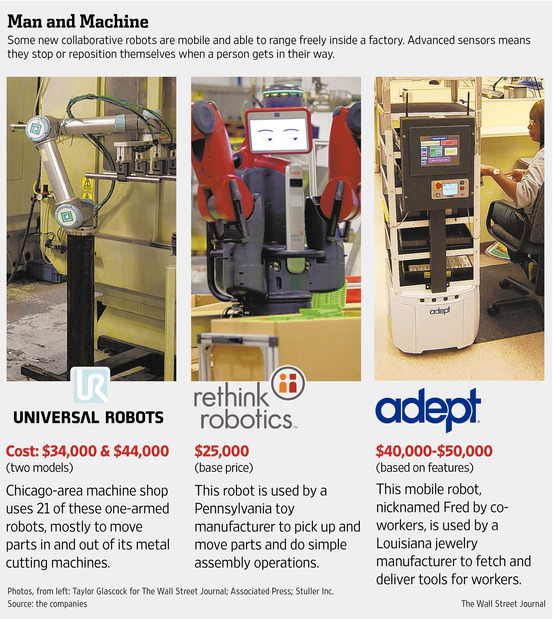
robotRobots aren’t just for the big guys anymore,” writes The Wall Street Journal (Sept. 18, 2014).  A new breed of so-called collaborative machines—designed to work alongside people in close settings—is changing the way some of America’s smaller manufacturers do their jobs. The machines, priced as low as $20,000, provide such companies—small jewelry makers and toy makers among them—with new incentives to automate to increase overall productivity and lower labor costs.

Robots have been on factory floors for decades. But they were mostly big machines that cost hundreds of thousands of dollars and had to be caged off to keep them from smashing into humans. Such machines could only do one thing over and over, albeit extremely fast and precisely. As a result, they were neither affordable nor practical for small businesses.

Collaborative robots can be set to do one task one day—such as picking pieces off an assembly line and putting them in a box—and a different task the next. Some are mobile and able to range freely inside a factory. The use of advanced sensors means they stop or reposition themselves when a person gets in their way, solving a safety issue that long kept robots out of smaller factories.

Classroom discussion questions:

1. Why will factories always need people?

2. What are the advantages and disadvantages of these smaller robots?

Video Tip: Tesla and a Factory Full of Robots

teslaElon Musk recently made the cover of Fortune (Dec.9, 2013) as its 2013 Business Person of the Year for his famous creation of both Tesla and Space X.  The article recalls that just a few years back, the best most people could say about electric cars was that they would be great for sustainability, but for the foreseeable future they’d be horribly limited by range and wouldn’t be very appealing to drive. Battery technology was simply too expensive and too heavy for it to be otherwise. The key breakthrough was to switch to lithium-ion battery technology, an expensive technology used not in cars, but in computers and phones.  Musk believed that if you could combine large enough numbers of lithium-ion cells into a single battery, you could provide not only adequate range for a car but also power capable of turning the humble electric car into an object of desire.

Musk wasn’t the first person to have that insight. His genius was to take that core idea to its logical conclusion and integrate it into a broader picture of how a series of such cars could be manufactured and marketed for ever-shrinking costs, in a sequence that would eventually bring Tesla to the mass market. A full seven years ago, he posted an article titled “The Secret Tesla Motors Master Plan,” which outlined the basics: three generations of cars, first the super high-end sports car, then a sporty 4-door family car, then a mass market car. And underpinning it all, the conviction that the cars wouldn’t just work, but be lusted after.

He had no certainty that the company would succeed. But he was convinced that (a) the laws of physics meant that electric power could deliver a profoundly better automobile, (b) there was a path to possible success via three generations of cars, and (c) the goal was essential if humanity was to have a shot at a sustainable-energy future. This  5 minute video of the Tesla S production is one your students will enjoy as it shows the power of robotics in manufacturing.

OM in the News: Robots vs. Anesthesiologists

J&J's Sedasys system
J&J’s Sedasys system

Anesthesiologists, who are among the highest-paid physicians, have long fought people in health care who target their specialty to curb costs. Now the doctors are confronting a different kind of foe, writes The Wall Street Journal (Sept. 26, 2013): machines.

A new system called Sedasys, made by Johnson & Johnson, automates the sedation of many patients undergoing colon-cancer screenings called colonoscopies. That could take anesthesiologists out of the room, eliminating a big source of income for the doctors. More than $1 billion is spent each year sedating patients undergoing otherwise painful colonoscopies.  Sedasys “is a great way to improve care and reduce costs,” says J&J’s CEO.

Anesthesiologist’s involvement typically adds $600 to $2,000 to the colon-cancer screening procedure’s cost, By contrast, Sedasys would cost about $150 a procedure.

As J&J markets Sedasys, many anesthesiologists are sounding the alarm. They say the machine could endanger some patients because it uses a powerful drug known as propofol that could be used improperly. They also worry that if the anesthesiologist isn’t in the room, he might not be able to get to an emergency fast enough to prevent harm.

But during testing, none of the 1,700 patients sedated by Sedasys required rescuing. This past May, the FDA approved Sedasys for use on healthy patients 18 years of age and older who require mild or moderate levels of sedation during the colon-cancer screenings.

Classroom discussion questions:

1. What are the advantages and disadvantages of technology such as Sedasys?

2.  Why can’t this system be used in more complex surgeries, like heart operations??