
 Professor Misty Blessley raises an interesting AI issue-chip plant scheduling.
Semiconductors have been called the brains of the modern world. Switching between conducting and blocking electricity, they are essentially “on/off” switches that control the flow of power, and this unique characteristic makes them the building blocks of modern technology. They are behind computing, communications, and energy innovation, and our information dependent society is always hungry for more. Leading chip makers, NVIDIA and TSMC, both use an AI to advance semiconductor design, scheduling, and manufacturing, report ElectronicsUSA (June 4, 2026) and NVIDIA News (May 31, 2026).
 TSMC ( Taiwan Semiconductor Manufacturing Company), the world’s largest semiconductor foundry, makes the most advanced chips on the planet. NVIDIA is a global leader in accelerated computing and AI. For decades, TSMC has manufactured NVIDIA’s chips, and this partnership has come full circle. TSMC uses NVIDIA’s AI technologies inside its fabrication plants (“fabs”), which in the semiconductor industry refers to highly specialized facilities where silicon wafers are processed into microchips.
NVIDIA’s AI models are now embedded directly into TSMC’s manufacturing workflow, transforming production scheduling. A single wafer, a subcomponent of a semiconductor, may require hundreds of tools and thousands of tightly sequenced steps. TSMC can now evaluate millions of scheduling combinations in seconds. This optimizes job sequencing, and instantly rebalancing schedules when tools go down or urgent orders arrive. The result is smoother production flows, less idle time, and higher overall fab productivity. AI comes as close as ever to “running the plant.”
AI driven scheduling is also advancing through emerging capabilities such as predictive dispatching, where models forecast bottlenecks hours ahead and reroute wafers to prevent delays. Another is crossfab load balancing, which evaluates capacity across multiple TSMC sites and shifts work to maximize throughput. Both approaches are expected to reduce fab cycle time 5–10%.
NVIDIA’s AI scheduling helped TSMC cut critical chip production workloads 20-50%. This addresses society’s insatiable demand for semiconductors. It also fuels the next wave of breakthroughs in computing, communications, and energy innovation, the domains powered by these tiny on/off switches.
Classroom discussion questions:
- What are the strategic and operational risks if a company relies too heavily on AI to automatically reroute work without human oversight?
- Discuss how AI’s ability to evaluate millions of combinations in seconds changes a manager’s approach to bottleneck scheduling compared to manual or sequential sequencing rules (like SPT or FCFS).

 At that time, Starbucks’ CTO wrote: “The tech is currently live across thousands of coffeehouses, and will be in use across the chain’s entire North American system by the end of September. At cafes using the AI systems inventory is now counted 8 times more frequently, giving us real-time visibility and enabling faster, more precise replenishment.”

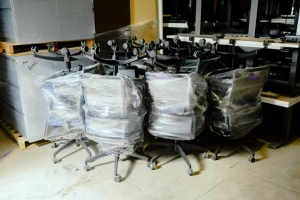


 The first weekend in May, Delta canceled hundreds of flights after minor weather disruptions, while other airlines ran relatively smoothly. Only the now-defunct Spirit Airlines scrubbed more. Delta’s cancellations related to pilot availability are more than 10 times historical levels and account for 35% of mainline flight cancellations, up from 7% in 2024.
 Temple U. Professor Misty Blessley raises a timely issue with her monthly Guest Post.
 Roughly 1/3 of global seaborne fertilizer normally moves through this chokepoint. With passage through the Strait at a standstill, the concern is whether farmers will have access to adequate and affordable fertilizer during this planting season.
 The solution, developed by the company in collaboration with Google Cloud, uses computer vision and the Gemini platform to support quality inspectors in distribution centers.
 In operations management, achieving a competitive advantage relies heavily on a well-executed Operations Strategy. a topic we stress in Chapter 2. When Apple introduced its new $599 MacBook Neo to challenge Google’s dominance in the low-priced laptop market, many asked a familiar question: Why not assemble it in the U.S.?
  Pods are the next step in an ongoing project management organization evolution. In recent decades, so-called scrum teams—cross-functional groups focused on deploying and iterating quickly—have replaced a slower, step-by-step project management methodology known as “waterfall,” which is noted in Chapter 3 of your Heizer/Render/Munson text.
 Now Siemens has just revealed Eigen, an AI agent that can replace manual coding or programming for programmable logic controllers, distributed control systems, and robotics applications, updating code or instructions to reflect new priorities and goals.
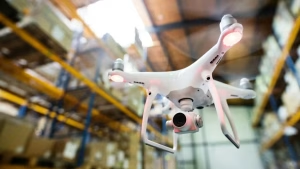 The business impact is measurable: reduced downtime, lower mobilization costs, reduced safety risk and faster response to problem detection. In the energy and utilities sector, drone-based inspection has been estimated to reduce inspection costs by 70% and downtime by 90%.
 Dr. Jon Jackson is Associate Professor of Operations Management at the Providence College School of Business. He has created a series of AI exercises for each chapter in our text.
 ASCS opens Amazon’s vast global logistics network not just to its own marketplace sellers, but to businesses operating across competing marketplaces and in B2B channels. As Peter Larsen, vice president of Amazon Supply Chain Services, puts it, the platform is “available to any business of any shape or size.”
