Video Tip and OM in the News: Why the Other Line Always Moves Faster

wsj-queueQueuing (see Business Analytics Module D) is always a popular topic with students–and evidently with readers of the Wall Street Journal (Oct. 7, 2016) as well. This Journal article is a very basic tutorial on the history (Erlang discussion) and logic of waiting line modeling.
The piece writes: “You’ve probably participated in this familiar dance: Given a choice of checkout lines, you’ve somehow picked the slowest. You could wait it out. You could chassé to another queue. Or you could bail out altogether. After all, no one likes to wait. But are the other lines really faster? When parallel lines feed multiple cashiers, you may not be in the slowest one, but chances are, you also are not in the fastest.”

 Prof. Bill Hammack, at the U. of Illinois (YouTube’s “Engineer Guy”), explains it like this in his 4-minute video: “Imagine three lines feeding three cash registers. Some shoppers will have more items than others, or there may be a delay for something like a price check. The rate of service in the different lines will tend to vary. If the delays are random, there are six ways three lines could be ordered from fastest to slowest—1-2-3, 1-3-2, 2-1-3, 2-3-1, 3-1-2 or 3-2-1. Any one of the three (including the one you picked) is quickest in only two of the permutations, or one-third of the time.”
Classroom discussion questions:
1. Why doesn’t every service provider use the multiple-server, single line approach?
2. Explain Erlang’s theory.

OM in the News and Video Tip: The Psychology and Math of Queuing in Supermarkets

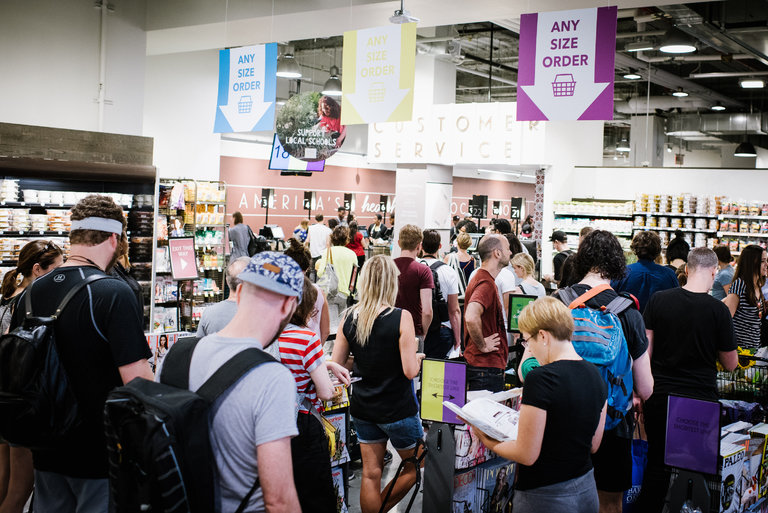
Inside a Whole Foods in Brooklyn

You dash into the supermarket for a few quick items. But when you get to the checkout lanes, they are full. Your plan for a quick exit evaporates. For anyone who has ever had to stand in line at a supermarket, here are some tips from The New York Times (Sept.8, 2016) for picking the line that will move the fastest.

  1. Get behind a shopper that has a full cart. That may seem counterintuitive, but every person requires a fixed amount of time to say hello, pay, say goodbye and clear out. That takes an average of 41 seconds per person and items to be rung up take about 3 seconds each. So getting in line with many people who have fewer things can be a poor choice. (One person with 100 items will take an average of 6 minutes to process. A line with 4 people who each have 20 items will take an average of 7 minutes).
  2. Study the customers ahead of you. It is not just the number, but their age and what they are buying. Older people will take a bit longer because they can have technical difficulties that delay the process. Also consider the number of different items they are buying. Six bottles of the same soda will go faster than 6 totally different items, some of which cannot be scanned, such as vegetables.

  3. Choose a line that leads to several cashiers. In Module D of the text, we show that this approach, known as a serpentine line, is the fastest. The person at the head of the line goes to the first available server in a system often seen at airports or banks. Getting into a single line also provides psychological relief because it eliminates the choice of where to go and second-guessing about the best line to choose. Your students will love this 90 second queuing video.

  4. The psychology of queuing has also found that waits seem shorter when you are distracted. Try talking to the person next to you or reading the magazines in the store’s racks.

 Classroom discussion questions:

  1. Why is the “serpentine” line faster on average?
  2. What does Disney do to keep visitors happy during 45-minute lines?


OM in the News: TSA Turns to OM, and Improves Queue Times

HIDE CAPTION Peak wait times measured by airport officials at Chicago O’Hare International Airport, pictured May 16, fell from 105 minutes in early May to just nine minutes in the two weeks before the Fourth of July
Peak wait times at Chicago O’Hare Airport fell from 105 minutes in May to just 9 minutes in late June

After hours long lines at some airports and public outrage over stranded passengers, the beleaguered Transportation Security Administration (TSA) just pulled off a major restructuring, dramatically reducing wait times even as summer air travel surged to record levels. Nationally, over the 4th of July, wait times averaged 10 minutes and PreCheck lines averaged 5 minutes.

“How TSA dug out of its checkpoint quagmire is both a remarkable story of rare, quick change inside a big government agency,” writes the Wall Street Journal (July 21, 2016)–and it all involved a series of basic OM analyses that your students could have developed. Here are some of the TSA changes:

  1. Put more agents on passenger screening checkpoints.
  2. Provided a barrel to dump out water bottles before they went through X-ray machines and brought screening to a halt.
  3. Added 600 contract workers to move bins and direct passengers so TSA screeners (who used to do that) could go back to screening and open more lanes.
  4. Created a maintenance desk in each command center to quickly dispatch techs instead of the old process of writing a repair ticket and waiting.
  5. Summer vacations for screeners were limited; nonessential training was deferred.
  6. Slightly increased the number of people selected to get PreCheck printed on boarding passes.
  7. Created a Central Command Center which hosts daily conference calls with local directors, airports and airlines. Here they share best practices and coordinate efforts, shifting staff at airports with multiple terminals and regions with multiple airports as needed.

“We completely changed the way we operate,” said TSA’s administrator.

Classroom discussion questions:

  1. Can students expand this list with more suggestions?
  2. What will happen in Fall, when short-term fixes like overtime, delayed vacations and training, etc., dissolve?

OM in the News: Queuing Up for Airport Security

tsa2Queuing up at the Orlando airport last week, en route to giving a lecture at Tulane University, I encountered a 40+ minute wait for TSA security checks. Returning from New Orleans a few days later, the TSA walk through took less than 2 minutes. Reading the Wall Street Journal’s article “Airport Security Lines Grow” that day (March 3, 2016), leads me to believe this is a good topic for class when you cover Waiting Line Models in Module D. Here is what the Journal writes: “Longer lines are the result of a collision of three changes: reduced staffing from federal budget cuts, a surge in travelers at some airports, and efforts to fix significant screening lapses.”

Current staffing is about 41,000 screeners, below the congressional cap of 42,500, and 5,600 fewer screeners than in 2011. At the same time, TSA has been intentionally slowing down security screening to tighten it up. This comes after some failures to identify weapons and other mistakes during covert government testing.

It  is not just Orlando International. Chicago O’Hare has had lines this week snaking through concourses, delaying hundreds of flights. Atlanta has seen peak-time security screening waits of an hour recently because checkpoints are “woefully understaffed.” TSA and airlines have started advising travelers to arrive up to 2 hours before a domestic departure and 3 hours for international flights.

American Airlines says it has had to delay hundreds of flights in January. At Delta’s New York Kennedy terminal, the PreCheck expedited screening line stretched almost out the building door on a recent Friday morning. Airports in Minneapolis, Las Vegas, Denver, Seattle and Miami all say they have seen longer lines at checkpoints over the past two months.

Classroom discussion questions:

  1. What tools in the text could be used to analyze this queuing problem?
  2. Why the vast disparity between Orlando and New Orleans TSA?

OM in the News: The Psychology of Queuing at the Bus Stop

busAnyone who’s ever relied on public transportation knows that waiting can be the worst part. Even with apps that provide arrival estimates, riders can still find themselves at a loss—straining in hopes of seeing train lights in the distance, or checking phones while wondering what on earth is holding up a delayed bus. But a new study, reports The Atlantic (Aug. 18, 2015), suggests that the feelings of frustration associated with waiting can differ significantly depending on how filthy a station is, and that simple improvements could make wait time seem much shorter.

In general, the U. of Minnesota study found that riders typically overestimate shorter wait times and underestimate longer wait times (i.e. riders who waited for about 2 minutes felt like they’d waited for 5, but riders who waited for 10 minutes felt like they’d only stood around for 9.)

But that general principle was beholden to strong external factors: Riders who waited at stops where there was lots of pollution and traffic significantly overestimated their wait times. The effect was especially pronounced for those who were waiting for longer than 5 minutes, with those who waited for their rides for 10 minutes in areas that they felt were noisier and dirtier reporting that they had waited for over 12 minutes. Researchers also found a simple mitigating factor: trees. The presence of mature trees helped make wait times feel less painful, for both short and long waits, and even in areas where other negative factors were present.

Coping with tardy, inefficient, and dilapidated transit is the reality of commuters in many of America’s major metro areas. And in some places, things seem to be getting worse, not better. For instance, train delays increased 45% between 2013 and 2014 in New York City. Improving the experience of public transportation could start with something as simple as sprucing up aging and dilapidated stops, increasing their safety, and adding greenery. It might not lessen the queue time, but it may seem shorter.

Classroom discussion questions:

  1. Provide other examples of how a queue can seem to move faster.
  2. What else can operations managers do to lower the traveler’s frustration level?

OM in the News: Perception vs. Reality in the Supermarket Checkout Queue

supermarketStanding in the supermarket queue, you note that other customers are seamlessly drifting forward in their appealingly shorter lines. Should you should stay put, switch lanes, or just head home empty-handed? One research study found that reduction in wait times for express-lane customers didn’t offset the overall increase in wait times for everyone (Five Thirty Eight, Oct. 16, 2014). So would it be better if the supermarket didn’t have an express lane — or, better yet, if it got rid of multiple lines altogether and had all customers join a single long line where there were no winners and losers. Our math in Module D shows that the single line is the best approach. But is it really?

If single lines reduce wait times by so much, why do stores queue us in separate lines for each cashier? One reason is that models overestimate the difference between single and multiple lines because they don’t take into account some human behaviors. Maybe you know who the fastest cashier is. Maybe you switch lanes (“jockeying”) or simply ditch your items and leave (“reneging”). Those behaviors reduce the average wait time in a multiple-line queueing system and bring it a little closer to a single-line system.

In addition, perceptions don’t always match up with reality. The longer we stand in line, the more the gap between perceived and actual wait time grows. By the time we’ve been in line for 5 minutes, we think we’ve been waiting for 10. (See “Why We Buy,” by P. Underhill). So rather than simply shoving us all into one line, supermarkets are exploring three alternatives to reduce both our actual and perceived wait times. First, customers waiting in line can have their items scanned by roaming tellers with hand-held machines, to reduce their service time once they finally reach the cashier. Second, customers can register their place in line, go away, and come back once it’s their turn (like grabbing a ticket from the deli counter). The 3rd strategy: distraction. You can try to entertain customers with videos and in-line merchandising.

Classroom discussion questions:

1. What is the main reason supermarkets do not use a single checkout line?

2. What other alternatives can stores use to speed up the lines?

OM in the News: Smart Queues at Disney

Toy soldier characters greet Disney visitors

It’s one of theme parks’ biggest challenges, reports the Orlando Sentinel (Oct. 12, 2014): finding ways to ease the pain of waiting in line. Disney tried something unusual last week, when it required FastPass reservations for anyone boarding the Toy Story Midway Mania ride. Amusement parks have plenty of motivation to lessen waits, or at least make them less boring. Guests leave happier — and are more likely to return. Shorter lines at popular rides mean tourists have more time to visit secondary attractions. And time not spent in line means more cash at the registers in a park’s shops and restaurants.

A few years ago, Disney created a new underground center here in Orlando in which employees monitor crowds via computer and video camera, then decide which congestion-fighting weapons to deploy. A ride might launch more vehicles, for example, or a restaurant could open more registers. The parks’ arsenal of crowd-control tactics also includes distractions, which have grown increasingly elaborate. At Disney World’s Fantasyland, for example, kids frolic in an indoor playground until buzzers alert their families it’s time to board the Dumbo ride.

Disney has also encouraged more widespread use of the passes through its MyMagic+ billion-dollar technology project. Guests can now reserve rides and shows up to 2 months before their visits: 75% of Walt Disney World guests use FastPasses now. But don’t expect to see a lineless theme park anytime soon.Ushering guests through too many attractions too quickly, and a new set of problems is created. Visitors might get bored if they see everything too fast. “The flow within a park assumes a certain number of people will be standing in line, more so during peak periods than nonpeak periods,” says a former Disney VP. “You take them out of line, and where do they go?”

Classroom discussion questions:

1. Why are queues such an important OM issue at all theme parks?

2. What other options does Disney have for capacity planning?

OM in the News: Wal-Mart’s “Checkout Promise” to Speed Queues

Wal-Mart's "check-out promise" aims to alleviate chronic long lines
Wal-Mart’s “check-out promise” aims to alleviate chronic long lines

My mother-in-law recently commented that she won’t shop at Wal-Mart anymore, primarily because the checkout lines are too long. It turns out she is not alone. The Wall Street Journal (Aug.15, 2014) writes that “to lure more customers this holiday season, Wal-Mart is promising to staff each of its cash registers from the day after Thanksgiving through Christmas during peak shopping times.” The move, called the “checkout promise,” is aimed at addressing my mother-in-law’s very complaint.

“Taking the possibility of waiting in long lines off the table will attract more people into stores,” says the chief merchandising officer. The move comes as Wal-Mart has struggled to win back U.S. shoppers after 7 straight quarters of falling traffic. Many customers have ditched the chain in favor of quicker trips to smaller rivals. The company also has battled with complaints about too many out of stock items and empty shelves. Refilling shelves alone could bring back $3 billion in sales.

Wal-Mart’s supercenters typically have about 30 traditional checkout lanes—giving it more than 100,000 across the U.S.—but the number that are staffed varies throughout the day. It has made aggressive use of technology to cut back on labor costs and more precisely schedule checkout lanes based on real-time demand. But the drop in traffic and customer complaints have forced it to reassess the economics of that approach. After increasing the number of self-checkout systems across its 4,000 U.S. stores, longer lines began forming at its staffed checkouts to deal with customers with more complicated and time-consuming transactions, such as shoppers who use coupons.

The company also recently nixed “Scan & Go,” a program which allowed shoppers to use their mobile phones to scan items as they walked through stores and pay at self-service kiosks, skipping the cashiers’ lines. Wal-Mart said the process was too complicated for customers.

Classroom discussion questions:

1. How has technology complicated Wal-Mart’s queues?

2. What other approaches could the company try to speed up lines?

OM in the News: Canada’s Psychology of Queuing

Queuing in Canada
Queuing in Canada


When Israeli-born author Ayelet Tsabari first immigrated to Canada in 1998, a strange sight caught her eye on the sidewalks of Vancouver. Beneath every Canadian bus stop sign, as if commanded by an invisible drill sergeant, citizens young and old automatically formed into neat, ordered lines. “I was wondering, ‘Why are people standing like that?’” she said. And the phenomenon is not only baffling to Israelis, writes Canada’s National Post (July 25, 2014). Ms. Tsabari described bonding with an Iraqi friend over the “foreign and strange” practice.

But from Russia to China to Italy to the entire Middle East, there are billions of people around the world who are genuinely confused by the penchant of English-speaking people to constantly form into queues. At the Canadian School of Protocol and Etiquette, lineup training comes on the same day students are taught about North American-style introductions. Students are taught where to line up, how to maintain one’s proper place in the lineup and — most importantly — how close to stand. “In certain cultures, queue etiquette is just not on the radar,” said the school director. Particularly among students from China and the Middle East, Canadian queuing norms simply would not jibe with the crowded train stations and marketplaces of their home countries.

Non-queuing in China

In China, queue-jumping is so widespread that in the lead-up to the 2008 Beijing Olympics, the Chinese Communist Party began posting queue monitors to city streets and establishing “Queuing Days” each month in which citizens were asked to “voluntarily wait in line” at shops and transit stations. Similar anti-queuing norms hold in India, where the simple act of boarding a train can become the scene of a miniature stampede. “We live in a hugely-populated, resource-constrained country … in this environment, he who hesitates is lost for sure,” wrote a New Delhi writer in a 2012 piece for the Wall Street Journal.

Classroom discussion questions:

1. What is the US culture with regard to queues?

2. Why is the psychology of queuing so different across the globe?

OM in the News: Can You Help TSA Shorten Security Queues?

TSA checkpoint in Atlanta

In anticipation that more fliers will be eager to pay for expedited checkpoint screening, the Transportation Security Administration has promised to award $15,000 in cash prizes to whomever can design a faster waiting line system, reports Nextgov (July 18, 2014). The competition is on InnoCentive, a website for crowdsourcing solutions to problems, which enables individuals and teams to submit proposals. “There is a guaranteed award,” the contest overview states. “The total payout will be $15,000, with at least one award being no smaller than $5,000.”

The challenge aims to solve expected problems with TSA PreCheck, a program where passengers who undergo a background check and pay $85 get access to fast lanes that don’t require removing shoes, coats, liquids and laptops. “Current queue layouts at TSA Pre✓ airports will need to adapt to support the increasing population of TSA Pre✓ passengers,” the competition states. “TSA is looking for the Next Generation Checkpoint Queue Design Model to apply a scientific and simulation modeling approach to meet queue design and configuration needs of the dynamic security screening environment with TSA Pre✓.” TSA also is asking for approaches that would help speed standard, “free” waiting lines.

Competitors must supply a proposal that considers physical logistics, peak hours and staffing schedules, among other constraints. The “line” extends from the point where a passenger joins the end of the queue to the metal detector or body scan machine. Wait times cannot be more than 5 minutes for PreCheck and 10 minutes for standard lines. Also, the model should enable TSA to apply a “Computer Aided Design drawing to define the physical space available for queuing.”

Competitors are required to provide an animation of a computer screen that shows passengers flowing through lines. It must display real-time reporting during the animation, and allow a user to pause a simulation run when necessary for analysis or evaluation. What a great example of a complex, real-world queuing problem to ask your students to discuss!

Classroom discussion questions:

1. Why is TSA turning to crowdsourcing?

2. What ideas do you have for speeding the lines?


OM in the News: Queuing Up at Airport Customs This Summer


Automated passport control kiosks for arriving passengers at JFK

Extremely long lines, which in 2013 stretched beyond four hours at times, are forecast to return again for the busy summer travel season, writes The Wall Street Journal (June 11,2014). In May, Washington Dulles, New York Kennedy and Miami International airports all experienced occasional maximum waits over 2½ hours. At San Francisco International’s Terminal A, the average wait time at Customs during the peak 1-2 p.m. hour was still 40 minutes, though that’s far better than the May 2013 average of 57 minutes at the same hour. “The cavalry is on the way, but they won’t arrive in time for this summer,” said the CEO of the U.S. Travel Association. “We just don’t have enough officers right now, and it’s like having one cashier at Costco.”

Budget issues have left staffing largely unchanged for years. As international travel has surged in the U.S., queues at passport control and Customs checkpoints at airports have backed up. Last year, 70 million international passengers arrived in the U.S., up from 55 million in 2009. And last summer the issue boiled over, with airports having to rush in water, chairs and cots for arriving passengers, many of whom got stranded when they missed flight connections.

The Customs department began letting airports and airlines pay to install the new Automated Passport Control kiosks for travelers who aren’t in Global Entry. (Global Entry lets travelers who have undergone fingerprinting, a background check and an in-person interview use a kiosk and bypass long lines.) Travelers scan their passports and answer questions on the kiosk while waiting in line. When they reach a Customs officer, the information can be quickly pulled up on a screen rather than entered manually by the officer. Shaving seconds off the inspection process has significantly sped up lines. At some airports, such as New York’s JFK, Chicago O’Hare, Dallas-Fort Worth and Orlando International, kiosks have helped reduce wait time as much as 40% despite increases in the number of people arriving.

Classroom discussion questions:

1. What options do OM managers have to speed up the Customs queues?

2. Why are airlines very concerned about the long waiting times at Customs?

OM in the News: Queuing Up For TSA’s Fast Security Line

The TSA wants to speed up this line. Really.

Fliers gripe that getting through airport security lines can be too slow. Now, it may be fliers who are slow to sign up for a program to speed them through the lines. The Transportation Security Administration is aggressively trying to encourage more people to sign up for TSA Precheck, reports The Wall Street Journal (April 17, 2014). 

Precheck, launched in 2011, is much-loved among travelers because they don’t have to take off their shoes and jackets, don’t have to pull liquids and laptops out of baggage, and can walk through metal detectors without a full-body scan. By doing background checks on Precheck enrollees and scanning law-enforcement databases, TSA offers what is essentially pre-9/11 screening to “trusted travelers.”

TSA wants lots more people enrolled in Precheck to make better use of its designated security lanes, which currently number 590 at 118 U.S. airports. “It’s one of the last great bargains the U.S. government is offering,” TSA Administrator John Pistole has joked. To entice travelers into Precheck and test TSA’s ability to handle more people, the agency has been selecting regular passengers to go through Precheck security lanes and get it printed on their boarding passes. Selection is based on criteria like passengers’ travel history and the route being flown. TSA officers trained in behavior detection also can move passengers they deem low risk from regular queues into Precheck lanes.

Pistole said he has heard the complaints about Precheck lanes getting clogged, and TSA has already decided to stop moving travelers 75 years of age and older into Precheck service, unless they are enrolled, because they sometimes can take 10 minutes to move through. “It used to be great, but recently the Precheck lines have been the slowest of all the lines,” said Northeastern University OM Professor Fred Van Bennekom, who has timed TSA lines. “Sometimes there’s almost no one in regular lines and we’re all backed up at Precheck.”

Classroom discussion questions:
1. Why is the TSA using the Precheck program?

2. What else can operations managers do to speed up the security screening process?

OM in the News: Queuing Theory at Goldman Sachs?

goldmanGoldman Sachs’ cafeteria has been described as something out of Gattaca, the 1997 science fiction film, reports The Washington Post (Oct.18, 2013).  It’s a wide-open space full of furniture that looks like it was smuggled from a utopian future in which nothing is ever dirty, broken or unintentionally asymmetrical. It isn’t just the physical design of the 11th-floor space that creates this impression. It’s the way Goldman administers it with a clever policy designed to economically engineer efficient eating.

The most crowded time of the day to eat lunch is, naturally, during lunch time. For most people, this falls around noon. This creates the phenomenon of the lunchtime rush hour. Goldman didn’t like the idea of its people waiting on long lines to get their lunch. People are capital to Goldman. It wants to use its capital efficiently. Standing on line waiting for a burger is not an efficient use of Goldman’s capital. So the cafeteria has a set of timed discounts. If you show up before 11:30 or after 1:30, you get a 25% discount on your food.

As it turns out, Goldman folks are both especially attuned to economic incentives and ruthless about capital efficiency. Some take pride that they’ve never eaten lunch inside the “cost penalty window,” as one trader referred to the 2 hours when the discount isn’t in effect. In the cafeteria around 1:20 pm, the lines at the pay registers are empty. So are many of the tables. But the area between where the food is collected and where you pay is quite crowded. The Goldman lunchers are chatting with each other, waiting for the final minutes to tick down until they can save a dollar or two.   When its spokesman was called about Goldman’s lunch market manipulation, neither he nor anyone else in his office was available around 1:30. “Goldman approves of employees using their capital efficiently,” he said later.

Classroom discussion questions:

1. What other restaurants incentivize diners like this cafeteria does?

2. Why is this system not as effective as it could be from the firm’s perspective?

OM in the News: Queuing Up at the Drive Thru

Chick-fil-A averages a whopping 6.09 cars in its drive-thru queue

Since the advent of the modern quick-service drive thru, restaurant operations managers have tinkered with the nuts and bolts to create a drive thru that is as fast, efficient, and pleasant as possible. Innovations throughout the years, from wireless headsets and order-confirmation boards to dual lanes and pre-sell signage, have created a better drive thru capable of handling the 60–70% of business that loops the exterior of most fast food restaurants.  Accuracy has topped out around 90% for most chains. Cleanliness and favorable exteriors are clearly a major investment in the industry. And order-confirmation boards have become a common tool.

Speed of service, though, has slowed at drive thrus, reports QSR Magazine (Oct. 2013). McDonald’s experienced its slowest average speed of service in the past 15 years, at 189.49 seconds; Chick-fil-A’s speed (203.88 seconds) was its slowest showing since 1998, Krystal’s (217.89) since 1999. The decline in speed is a bad thing, but times are changing. Food isn’t so simple anymore. Burgers and fries have become burrito bowls and customizable salad kits.

That could help explain Chick-fil-A’s speed-of-service. The chicken chain had, on average, more than 6 cars in the drive-thru queue, far and away more than competitors and nearly a full vehicle more than last year. The company is investing more in dual-lane drive thrus to better handle capacity issues. But the move toward more specialty sandwiches is also adding seconds to service time.

Speed is still a top priority at fast food restaurants, and they continue to design systems and procedures accordingly. For example, Wendy’s uses a separate grill and sandwich station in the drive thru to maintain its industry-best speeds, and it trains and cross-trains employees repeatedly to ensure the fastest speeds. Taco John’s is revisiting its drive-thru layout to improve little things that might impede the ability to service the drive thru quickly.

Classroom discussion questions:

1. What tools does OM provide to speed drive thru service?

2. How do the various chains differ in handling drive thru customers?

OM in the News: Jumping the Queue at Universal Studios

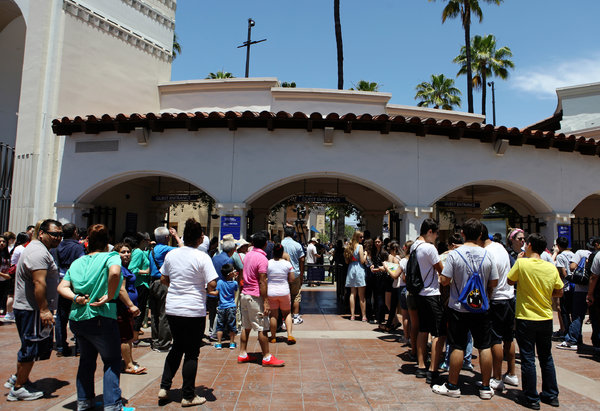
Universal StudiosSince I live in Orlando, the theme park capital of the world, the recent New York Times article (June 10, 2013) “At Theme Parks, A VIP Ticket to Ride”, caught my eye. Theme parks have traditionally been the ultimate melting pots. Tourists, retirees, rowdy teenagers, families and fathers who would rather be golfing are all thrown together in an egalitarian experience in which the queue for one is the queue for all, and cotton candy is the food of the masses. Not anymore.

As stratification becomes more pronounced in all corners of America, from air travel to Broadway shows to health care, theme parks in recent years have been adopting a similarly tiered model, with special access and perks for those willing to pay. Now Universal Studios has pushed the practice to a new level. It has introduced a $299 V.I.P. ticket (the regular admission is about $85), just in time for the summer high season, that comes with valet parking, breakfast in a luxury lounge, special access to Universal’s back lot, unlimited line-skipping and a fancy lunch.

Fearful of puncturing its utopian image, Disney has stuck to a single class of ticket. V.I.P. tour guides are available, but Disney charges an exorbitant price — $380 an hour, with a minimum of six hours — to limit demand. Business is good at both companies. Universal’s 3 theme parks in the U.S. attracted 20 million people last year, a 19% increase from 2010. The Magic Kingdom at Walt Disney World recently recorded the busiest day in its 41-year history.

The amusement park industry urgently wants to expand profits without introducing costly new rides every summer. Universal, which recorded $953 million in profit from its parks in 2012, has no major new attractions planned until next year; the V.I.P. Experience, in the meantime, is a relatively low-cost way to generate revenue and send a message of bigger and better into the marketplace.

Discussion questions:

1. What are the ethical implications in the new VIP system?

2. Explain how Universal’s model relates to Figure D.5, “The Trade-off Between Waiting Costs and Service Costs”.