OM in the News: The Biofuel Controversy

The battle lines are being drawn on the alternative fuel debate and the steps that will contribute to the International Maritime Organizations’s (IMO) emission reduction goals, reports The Maritime Executive (Feb. 17, 2025).  Major shipping lines and non-government groups are calling for the IMO to exclude biofuels from its list of green alternatives to traditional fossil fuels. They argue it would be unsustainable and could produce more harm than good.

Nearly a third of global shipping could run on biofuel in 2030– up from less than 1% today. But the price advantage of biofuels would result in unsustainable demand. Carriers have invested in the use of biofuels derived from used cooking oil and animal fats. With the supplies limited, just 2.5 – 3% of shipping could run out of used cooking oil and animal fat biofuels by 2030. Two interesting facts:

  • The vast majority of biofuels will come from palm and soy (60%), which are heavily linked to deforestation.

  • Close to 300 millions bottles of vegetable oil could be diverted to powering ships every day in 2030, putting pressure on grocery prices.

(There was a doubling of the use of palm oil biofuels in the EU between 2010 and 2020 following the introduction of a law promoting biofuels in cars.)

There is a debate in the EU on the competition for food supplies if the oils were also to be used as biofuels. “As things stand the IMO risks doing more harm than good. Palm and soy biofuels are devastating for the climate and they take up vast amounts of land,” argues one shipping exec. The fuel-intensive shipping industry would need farmland about the area of Germany to produce enough crops to meet its increased biofuel demand.  Land that could be used for farming would need to be converted to growing biofuel crops, while burning vegetable oil in ships will deprive supermarkets of a staple food item.

This could pose a serious climate problem, as palm and soy are responsible for 2-3 times more carbon emissions than even the dirtiest shipping fuels today, once deforestation and land clearance are taken into account.

Classroom discussion questions:

  1. We open the Supp. to Chapter 5 (Sustainability in the Supply Chain) with an example of airlines switching to biofuels. Is this a realistic approach given the above article?
  2. Make the case for and against shippers switching to biofuels.

OM Podcast #31: The Impact of AI on Jobs and on the Environment

In our latest podcast, Barry Render interviews Charlie Render, President of Render Analytics, which helps businesses of all kinds implement AI.  Charlie is also the creator of the popular job-search engine, Apply Genie (ApplyGenie.ai). In this episode, Barry and Charlie discuss the impact of AI on the environment and on jobs.


Transcript

A Word document of this podcast will download by clicking the word Transcript above.


Charlie Render

Have you subscribed to this podcast on Apple podcasts? Just go to your Apple podcasts app, search “Heizer Render OM Podcast,” and subscribe to get all

Prof. Barry Render
Prof. Barry Render

our podcasts on your mobile device as soon as they come out!

Instructors, assignable auto-graded exercises using this podcast are available in MyLab OM. See our earlier blog post with a recording of author and user Chuck Munson to learn how to find these, or contact your Pearson rep to learn more! https://www.pearson.com/en-us/help-and-support/contact-us/find-a-rep.html

OM in the News: Junk Is Needed for the New Electric Era

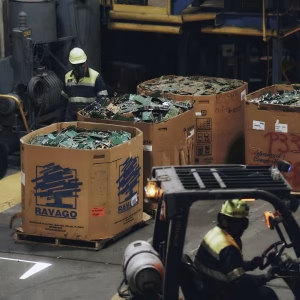
Circuit boards from thousands of different products arrive at Glencore’s Rhode Island facility, where the company determines the copper content and the value of the waste.

One of the world’s largest miners is digging into America’s junk drawers, old phones and landfills. The quarry: bits of copper to meet the needs of the energy transition and data boom.  Shredded cellphones, obsolete computer cables and chewed-up cars are heaped 30 feet high outside Glencore’s 97-year-old copper smelter deep in Canada’s boreal forest. There, the scrap is melted with copper concentrate from mines to produce fresh slabs of metal.

Shifting from fossil fuels to more renewable electricity promises to remake commodity markets, writes The Wall Street Journal (Nov. 21, 2024). If America requires less crude oil and coal, it will in turn need copper for everything electric. “In the next 25 years we will consume more copper than humanity has consumed until now,” says Glencore’s  recycling head.

Data centers being built to facilitate AI and store smartphone videos are full of copper. So are the phones. Even if rich mine deposits are found, it takes decades to bring them online. That prevents miners from responding quickly to new demand, which leaves scrap to balance the market. Copper never goes away and is infinitely recyclable.

Miles worth are strung through homes and cars and along rights of way, carrying electricity and drinking water. But a lot sits in junk yards and landfills. When prices rise, there is more incentive to get it. Copper prices are currently among the highest ever. Nearly half of demand will be met with recycled copper by 2050, up from about a third today.

Germany’s Wieland began construction in 2022 on a $100 million recycling facility in Shelbyville, Ky. Another German firm, Aurubis, is building an $800 million recycling facility in Augusta, Ga. Glencore recently bought a failed electronics recycling facility in Arkansas and will use it, too, to gather scrap. Glencore found that the concentration of copper in landfilled auto fluff can be more than twice that found in geologic mines.

Classroom discussion questions:

  1. Why the demand for copper?
  2. What makes copper recycling attractive?

OM in the News: Plastic Recycling’s Wasted Opportunity

Here at the Render household, we take our recycling very seriously. Each Tuesday, a garbage truck collects the contents of our bin. It contains lots of plastics—shampoo bottles, yogurt cups, milk jugs and more. But how much actually gets recycled?

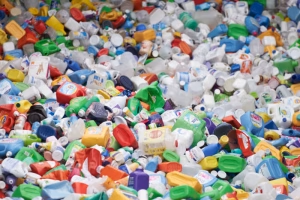
Just 14% of waste plastic containers and packaging are sent to a recycling facility, according to the most recent EPA report. Another 17% gets incinerated. Nearly 70% goes to landfills. Waste paper and cardboard do better: 81% gets recycled. The rate for glass containers is about 31%. For aluminum, including cans and foil, 35%.

Recycling plastic is a challenge because of chemistry…and business, writes The Wall Street Journal (Oct. 22, 2024). The U.S. used to export recycling to China, but the country stopped taking most foreign waste in 2018. If American companies aren’t interested in making new products from recycled plastic, there’s no incentive to develop the infrastructure to collect, sort and reprocess old packaging.

Over five decades after soda makers first turned to plastic bottles, America’s PET bottle recycling rate stands at under 30%

There are seven categories of plastic resins. Most types aren’t even considered for curbside recycling. Meanwhile, businesses have touted their containers as recyclable as they look to keep consumers and regulators happy. Yet for recycling to work, there has to be demand for all the used plastic that we toss. Today virgin plastic is both cheaper and better.

The numbers on plastic items range from 1 through 7. But having a number doesn’t make it recyclable. PET—polyethylene terephthalate, used for soda and other drink bottles—goes by number 1 and is the most highly recycled plastic in the U.S.  at 29%. HDPE—high-density polyethylene, found in milk jugs and detergent containers—is number 2 at 27%. PP—polypropylene, which bears the number 5 and is commonly used in yogurt and butter containers—hasn’t been widely recycled in the U.S.

Most flexible supermarket bags are not accepted in curbside recycling bins. Rigid containers made from polyvinyl chloride (No. 3), polystyrene (No. 6) or multilayer plastics (No. 7) shouldn’t go in blue bins either. Sorting and cleaning a wide assortment of plastic containers is expensive, in part due to the many different pigments and other additives used. Throwing bags, six-pack rings and other flexible plastics into blue bins can mess up a recycling facility’s sorting machinery. And pieces smaller than a credit card won’t be sorted.

Classroom discussion questions:

  1. What is the recycling policy on your campus and is it effective?
  2. What is the solution to this problem?

OM in the News: The Ziploc Bag Dilemma

Billionaire Fisk Johnson has been on a crusade to contain the plastic waste crisis.  He has gone scuba diving among plumes of plastic sludge. He has funded research on how microplastics are damaging for human health. And he has made trips to Congress to ask for regulations placing responsibility on consumer-goods companies to recycle the plastic waste their products generate.

Companies like his! For 20 years, Johnson has been at the helm of one of the biggest consumer companies in the world—and a major manufacturer of products packaged in plastics. He is CEO of family-owned SC Johnson, which makes Ziploc bags, Mrs. Meyer’s Clean Day soaps and Windex cleaners.

“On one hand, I see plastic as one of the most useful, versatile and cost-effective materials developed in the last century,” Johnson testified in Congress. “On the other hand, as a lifelong conservationist, I also have seen how plastic has become one of the more profound emerging global pollutants that is affecting planetary, animal, and human health.”

That paradox is one of the most challenging questions confronting businesses—how to balance the tide of consumerism with escalating environmental concerns? Are consumers prepared to pay more and change the way they get their soap, cleaners and food to drastically reduce plastic waste?

SC Johnson still relies on plastic for packaging many of its products, and single-use plastic films like Ziplocs aren’t commonly recycled. Close to 40% of the world’s millions of tons of plastics produced are used in packaging and 85% of that plastic ends up in landfills, writes The Wall Street Journal (Oct. 13, 2024). Johnson says he has introduced sustainable packaging, including Windex bottles made from recovered plastic, but that regulations and fees on companies using plastics are needed so companies like his can remain competitive. Alternatives like glass can be costly, fragile and leave a bigger carbon footprint, he adds.

“You could say, alright, well, single-use plastics is a terrible business, and we should just get out of it,” says Johnson. “But somebody else who’s less well-intended is going to just take that up. It’s a free market. My argument is that it’s better off in our hands.”

Classroom discussion questions:

  1. Is there a solution to this dilemma?
  2. What would be your strategy as head of OM at SC Johnson?

Guest Post: The Global Initiative for Green Shipping Corridors

Our Guest Post comes from Dr. Drew Stapleton, Professor of Operations Management at the U. of Wisconsin-La Crosse

Last year, the US Department of Energy and the UK Department for Transport simultaneously requested information relating to the establishment of a green shipping corridor (GSC) between the countries. The GSCs are “maritime routes that showcase low- and zero-emission lifecycle fuels and technologies with the ambition to achieve zero greenhouse gas emissions.”

GSCs have been gaining popularity in recent years. In 2021, nearly two dozen nations expressed their support for the zero-emission routes by signing onto the Clydebank Declaration, which sets the goal of establishing at least five GSCs by 2025. Since then, development has begun on two such corridors—one between LA and Shanghai, and the other between Montreal and Antwerp. By sharing cost and risk burdens by the key stakeholders in the production of zero-emission ships and the use of green fuel oils, the GSC is conceived as an effective policy mechanism and logistics strategy to reduce GHG emissions at sea as well as to mitigate business risks in the value chain.

The ports of LA, Long Beach and Shanghai have announced the creation of the first- ever green shipping corridor designed to accelerate emissions reductions at three of the world’s largest container ports and from vessels in transit from China to Southern California. Leaders from the globe’s largest carriers are on board. Maersk, CMA CGM, Hapag-Lloyd and other shipping lines called for an end date to building vessels powered only by fossil fuels.

Maersk established a net-zero emission target to be reached in 2040. The Danish ocean carrier also aims to procure 100% net-zero steel by 2050 for use in its vessels. CMA CGM’s goal to reach net-zero emissions in its operations is set for 2050. As part of its decarbonization efforts, the French ocean carrier launched a program that incentivized shippers to return their containers early in exchange for carbon credits. Hapag-Lloyd has a goal to reach net-zero emissions in its operations by 2045. MSC has set up a goal to reach net-zero by 2050.

The U.S. believes GSCs are a key means of spurring the early adoption of zero-emission fuels and technologies that will help to achieve zero emissions no later than 2050, and calls on all countries to adopt ambitious actions to create a clean maritime future.

Classroom discussion questions:

  1. Are the emission targets realistic?
  2. Provide details regarding the Clydebank Declaration.

OM in the News: Artificial Intelligence vs. Sustainability

Google just released its environmental report. It doesn’t make for comforting reading. Despite the tech giant’s best efforts to operate its business sustainably, GHG emissions rose 13% from a year earlier and are up almost 50% compared to a 2019 baseline.
The reason? Artificial Intelligence. Or rather the expansion of data centers required to service the needs of its insatiable appetite.  But as The Wall Street Journal (July 8, 2024) writes, Google isn’t alone in this. The sustainability reports of other tech firms tell similar stories. 

Of course, it is not just the power demands of data centers that are driving up the emissions numbers. It is the construction of the infrastructure that is also carbon heavy. So we won’t know if any of the efficiencies AI brings truly offset its environmental costs until those centers are all up and running.

Google and Microsoft have vowed to slash emissions by the end of the decade, but new disclosures show their numbers are moving in the wrong direction. The AI boom is substantially responsible for the lack of progress. Large language models like ChatGPT are powered by energy-intensive data centers, and AI is projected to increase electricity demands from data centers by 50% by 2027.

To address the issue, they’re getting creative. Amazon Web Services is pursuing a deal to buy energy directly from a nuclear power plant on the East Coast. Microsoft has eyed small-scale nuclear, too, and unlike many of its peers, it is an enthusiastic purchaser of carbon offsets. Google’s sustainability report was accompanied by an announcement that it had partnered with BlackRock to build a one-gigawatt pipeline of solar capacity in Taiwan. The company also touted its data center efficiency metrics, saying Google-owned data centers are 1.8 times more energy efficient than average.

Despite these efforts, now that the numbers are trickling in, it’s becoming clear that the growth of AI has presented real challenges to tech companies that have long sought to position themselves as climate leaders.

Classroom discussion questions:

  1. High tech firms have long promoted their sustainability goals. What can they do now that AI is demanding massive new sources of power?
  2. How is this an operations management issue?

OM in the News: The Green Energy Transition Isn’t Easy

“Despite extravagant hype, the green-energy transition from fossil fuels isn’t happening. Achieving a meaningful shift with current policies is too costly,” writes The Wall Street Journal (June 25, 2024).

Globally, we spent almost $2 trillion in 2023 to try to force an energy transition. Over the past decade, solar and wind energy use has soared to record levels. But that hasn’t reduced fossil-fuel use, which increased even more over the same period.

Research shows that when countries add more renewable energy, it does little to replace coal, gas or oil. It simply adds to energy consumption. For every 6 units of green energy, less than one unit displaces fossil-fuel energy. While renewable energy sources worldwide will dramatically increase up to 2050, that won’t be enough even to begin replacing fossil fuels—oil, gas and coal will all keep increasing, too.

During the 19th-century transition to coal from wood, overall wood use increased even as coal assumed a greater percentage of energy needs. The same thing happened during the shift to oil from coal: By 1970, oil, coal, gas and wood all delivered more energy than ever before.

With a thirst for affordable energy, oil and coal energy use has doubled, hydro power has tripled and gas has quadrupled in the last 50 years. The use of nuclear, solar and wind power has surged.  During past additions of a new energy source, researchers found it has been “entirely unprecedented for these additions to cause a sustained decline in the use of established energy sources.”

Solar and wind aren’t better, because unlike fossil fuels, which can produce electricity whenever we need it, they can produce energy only according to the vagaries of daylight and weather. They are cheaper only when the sun is shining or the wind is blowing at just the right speed.

When we factor in the cost of 4 hours of storage, wind and solar energy solutions become uncompetitive with fossil fuels. Further, solar and wind are almost entirely deployed in the electricity sector, which makes up only 1/5 of all global energy use. As we struggle to find green solutions for most transportation, we have yet to address the energy needs of heating, manufacturing or agriculture. And we are ignoring the hardest sectors like steel, cement, plastics and fertilizers.

Classroom discussion questions:

  1. What can managers do to help the need for sustainable operations given these statistics?
  2. Will solar, wind, and nuclear take over the bulk of energy production? Why or why not?

OM in the News: Kicking the Plastic Can Down the Road (Again)

In 2020, dozens of major companies joined the U.S. Plastics Pact, signaling a commitment to minimizing plastic waste. Their goals included phasing out plastic straws, cutlery and intentionally-added PFAS, also known as “forever chemicals”; recycling or composting half of their plastic packaging; and making sure 100% of plastic packaging would be reusable, recyclable or compostable—all by 2025.

A NYC parade participant wears plastic bottles to raise awareness of recycling

Signatories include major brands like General Mills, Nestlé, Kraft Heinz and Coca-Cola, the largest known contributor to global branded plastic waste. Retailers like Walmart and Target and packaging and materials suppliers also signed.

Now, with the 2025 deadline close at hand, the U.S. Plastics Pact has pushed back to 2030 many of the target dates, writes The Wall Street Journal (June 11, 2024). It is not the first time companies have pushed back timelines for aggressive recycling targets. Coca-Cola and Nestlé both made public promises as far back as 2007 that didn’t come to fruition.

Today, less than 10% of plastic waste in the U.S. is recycled annually. While companies frequently tout pilot projects for plant-based plastics or paper bottles, the problem is expected to get worse in the future. Companies had hoped to collectively hit 100% reusable, recycled and compostable packaging by 2025, but the numbers remained below 50%. As for the target aimed at eliminating “problematic and unnecessary materials” including cutlery and plastic straws, not a single one of 11 materials singled out for elimination was confirmed for across-the-board removal in time for the deadline.

Three of the five targets outlined in the new road map are very similar to the 2020 version. Commitments to recycle 50% of plastic packaging, produce 100% recyclable packaging and use 30% recycled content in packaging have been pushed to 2030. Some companies cited an unrealistic time frame and potential increased costs as reasons why deadlines are being missed.

Classroom discussion questions:

  1. How can alternative product designs help meet the U.S. Plastic Pact goals?
  2. What international quality standards relate to sustainability? (See Supp. 5 in your Heizer/Render/Munson text).


OM in the News: Why Chocolate Prices are Soaring

Starting the end of 2024, chocolate makers that sell or produce in the EU will have to show that the cocoa they use wasn’t grown on land cut from forests since the end of 2020, reports The Wall Street Journal (May 20, 2024). In practice, it means that each morsel of cocoa that makes its way into the bloc will need to be linked to the GPS coordinates of the farm where it was harvested. Because the EU is the world’s largest chocolate market, the law will also apply to global confection giants like U.S.-based Mars, the maker of M&M’s, or Switzerland-based Nestlé.

A farmer cuts a cocoa pod to collect the beans inside in Ivory Coast

Ivory Coast, the world’s no. 1 cocoa producer, has mapped 80% of the country’s 1.55 million cocoa farms. Failure to map all  farms could take more beans out of the market, worsening current shortages. Farmers have traditionally responded to cocoa shortages by clearing forests to make way for more farmland. That’s not an option under the new EU legislation.

The EU initiative is part of a growing movement (see Supp.5) to make raw materials—including agricultural products and minerals used in smartphones and electric cars—traceable, with the goal of reducing the potential harm they inflict on the environment and local populations.

Ivory Coast was once covered in dense rainforest. But over the past 60 years, 90% of the country’s forest cover has disappeared, making it one of the countries with the highest annual rates of deforestation in the world.

For consumers, the EU law couldn’t have landed at a worse time. Unseasonable weather as well as cocoa-tree diseases have hit harvests across West Africa, the source of 70% of the world’s cocoa beans. Stockpiles this season are the lowest in 45 years, as demand outstrips supply for a fourth consecutive season. Prices for cocoa recently touched a record high of nearly $11,500 a ton, about four times as high as they were a year ago.  Those increases will come on top of a 12% rise in the price of U.S. chocolate candies in 2023 and a 14% increase in 2022.

In times of high prices, companies also often shrink the size of their products or tweak recipes to use less cocoa.

Classroom discussion questions:

  1. What are the advantages and disadvantages of this EU plan?
  2. What options do supply chain managers at Marrs and Nestle have?

OM in the News: Construction Firms Go Circular

Recycled concrete being laid at a construction site in Canary Wharf

Hundreds of feet above the British capital’s Canary Wharf financial district, an office tower under construction grows taller as it draws materials from a source just blocks away. Concrete being poured on to the floor of the 52nd story is made partly with concrete recycled from a building being taken down nearby—part of an initiative to decarbonize office spaces through so-called circular construction practices that aim to maximize the reuse of materials. By putting reduced carbon as a requirement from its suppliers, Canary Wharf helped to transform the supply chain as a whole, largely by giving clarity that this was now a key requirement going forward as a developer.

To produce recycled concrete, waste from demolished buildings is broken down and turned into a powder, after which the aggregates and cements are separated. The cements are processed back into a paste, which makes up about 15% of the final product, while the aggregates are used to make the rest of the concrete, replacing the need for new materials like sand.

Buildings account for 39% of global energy-related carbon emissions, with 11% of that coming from materials and construction, reports The Wall Street Journal (March 27, 2024) . Cement and concrete alone account for 9% of total carbon emissions, so as companies look to lower emissions, the embedded carbon from their offices is a growing concern.

With an increasing world population and urbanization, construction activity will continue to increase. It is estimated that the equivalent of the size of New York City would have to be built every 40 days to meet demand.

Moving to more circular construction methods has shown to be an effective way of cutting emissions. Reusing concrete and cement could help abate 600 million metric tons of carbon-dioxide emissions by 2050. Using recycled concrete reduces carbon-dioxide emissions by about 40% compared with ordinary production.

Construction and real-estate companies are increasingly requesting higher levels of transparency and data. They are asking for Environmental Product Declarations which reveal both the positive and negative impacts of each building material’s life cycle, all the way back to the mine. These give specifiers, designers and tenants a transparent view into a building’s full carbon footprint.

Classroom discussion questions:

  1. In what other ways are buildings “going green?” (Hint: see the Orlando Magic case study in Supp. 5 of your Heizer/Render/Munson text)
  2. How can a building being renovated increase its energy efficiency?

OM in the News: The Growth of Electronic Waste

Supplement 5 in our text, Sustainability in the Supply Chain, stresses the important roles of  product design and circular economy in protecting our planet. But a new report by the U.N. in Earth.com (March 21, 2024) documents the escalating global challenge of electronic waste (e-waste) generation  and how it significantly outstrips the pace at which we are recycling these materials.

E-waste is defined as any discarded product with a plug or battery that harbors toxic additives and hazardous substances, such as mercury. A staggering 62 million tons of e-waste was generated in 2022 –an amount that could fill a line of 40-ton trucks encircling the equator.

Just 22% of this e-waste is known to have been recycled properly, spotlighting the vast amount of valuable resources – worth an estimated $62 billion – that remain untapped, and highlighting the increased pollution and health risks to global communities. The annual rise of 2.6 million tons in e-waste production, with predictions set to soar to 82 million tons by 2030, underscores the problem.

The widening gap between e-waste production and recycling is attributed to several factors, including rapid technological advancements, higher consumption rates, limited repair options, shorter product life cycles, shifts towards EVs, design challenges, and insufficient e-waste management infrastructure. (It is even worse when the extremely dangerous discharged batteries from EVs, not included in the U.N. report, are considered). This complex web highlights the need for integrated solutions that encompass technological innovation, policy reform, and community engagement.

“With less than half of the world implementing and enforcing approaches to manage the problem, this raises the alarm for sound regulations to increase collection and recycling.” writes the U.N. One of the report’s revelations is the current inefficiency in reclaiming valuable materials from e-waste, which presents both an economic loss and a missed opportunity for reducing reliance on rare earth/mineral extraction. “No more than 1% of demand for essential rare earth elements is met by e-waste recycling,” it states.

The report calls for collective action from policymakers, industry leaders, researchers, and consumers to reimagine our approach to electronics consumption and waste management.

Classroom discussion questions:

  1. Why do EVs pose a major challenge?
  2. Identify a product and how its production, use, and end-of-life could be more sustainable.

Guest Post: Sailing Toward Sustainability Transportation

Temple U. Professor Misty Blessley describes a new technology that will uplift sustainability in the shipping industry.

Chemship B.V., a transporter of bulk liquid via its fleet of stainless steel chemical tankers, is the first of its kind to use wind assisted ship propulsion (i.e., sail toward sustainable transportation). Its MT Chemical Challenger, which covers the Trans-Atlantic route between the East Coast of the U.S and the Mediterranean, is the first chemical tanker to be equipped with sustainable wind technology. In a recent article, Chemship’s CEO writes: “We will use less fuel and thus reduce CO2 emissions. For this vessel, we anticipate an annual CO2 reduction of 850 tons. This is equivalent to the yearly CO2 emissions of over 500 passenger cars.”

The technology behind this is four VentoFoils, which have a 30X30 meter sail equivalent. The VentoFoils create a direct wind surface, which when combined with vacuum technology attenuates the force of the wind. The wind sails offer the benefits of easy installation, no needed reinforcements, push-button folding and sail setting, automatic sensing and folding with wind forces over seven and the sails do not obstruct the crew’s line of sight.

Four 16-meter high sails cut fuel consumption by 10-20%

This initiative by Chemship is not only good for the planet, but good for the shipowner’s profits. Since January 1, 2024, due to the expansion of the European Union’s Emissions Trading System (EU ETS) in the shipping industry, shipowners have been paying for the emissions associated with their sea transported goods coming into and going out of European ports.

Classroom Discussion Questions:
1. In Supplement 5 of your Heizer/Render/Munson text, the objective of the EU ETS to combat climate change is discussed. Consider their expansion into the shipping sector.
2. In what ways does Chemship’s adoption of VentoFoils create a competitive advantage? (Note: Water transportation is often preferred when cost is more important than speed).

OM in the News: AI in Manufacturing

Manufacturers are increasingly evaluating and adopting AI solutions to leverage their data, writes Industry Week (Feb. 13, 2024). Here are some key areas that stood out in how manufacturers are adopting the technology:

Quality control enhancement: AI can improve manufacturing quality control through vision systems trained on images and videos, accurately detecting complex product defects. Real-time monitoring identifies issues promptly to prevent future defects, and AI’s continuous learning enhances defect detection.  (See Ch. 6)

Supply chain visibility: Manufacturers deal with enormous amounts of data in their operations, and the integration of AI technology allows real-time observation, quicker trend identification and more accurate forecasting to meet demand effectively. AI algorithms analyze historical sales data, market trends and external factors, enabling more precise demand forecasts and aligning production and inventory levels. In logistics, AI optimizes routes by analyzing transportation costs, delivery times and traffic patterns, enhancing efficiency and cost-effectiveness. The strategic use of AI in the supply chain offers benefits like improved visibility, increased agility and better planning, enhancing overall resiliency and responsiveness. (See Ch. 11)

Energy efficiency and resource utilization: Companies are using AI to optimize energy consumption and resource utilization in manufacturing processes. These capabilities analyze real-time data from sensors, production equipment and other sources to identify patterns and trends in energy usage. This can inform predictive recommendations to optimize energy consumption, reduce waste and enhance overall resource efficiency. (See Supp. 5)

Predictive maintenance improvement: The use of AI in predictive maintenance enables a shift from reactive to proactive strategies, leveraging data-driven approaches. AI algorithms analyze real-time data to predict maintenance needs and failures. AI identifies patterns on the factory floor, detecting anomalies and potential malfunctions. This proactive approach minimizes unplanned downtime, extends equipment lifespan and allows manufacturers to optimize resource allocation through scheduled service activities during planned downtime, enhancing overall productivity and reducing costs. (See Ch. 17)

The use of AI in manufacturing operations in coming years is expected to accelerate. Investment in AI technologies is forecast to rise among 96% of companies by 2030.

Classroom discussion questions:

  1. How will AI become a common tool for operations managers?
  2. Using a search engine, describe a real company example for these applications.


OM in the News and Video Tip: A Circular Economy Hub for Automaker Stellantis

Stellantis opens its first circular economy hub.

Stellantis–the global automaker with brands including Chrysler, Fiat, Jeep, Maserati and Peugeot– has inaugurated a Circular Economy Hub at its manufacturing complex in Turin, Italy, demonstrating its commitment to a “360-degree approach” to automotive production, involving a strategy of remanufacturing, repair, reuse, and recycling (4R‘s.) Stellantis says it is adopting capabilities and facilities “to change its consumption model to reduce the environmental impact and better manage the company’s aggressive decarbonization target of reaching carbon net zero by 2038.”

“Circular economy,” a topic in Supplement 5 of your Heizer/Render/Munson text, describes an economic concept for production and consumption that preserves the value of energy, materials, and labor as products move from design through to end-of-use handling and recycling. The Hub represents a $40 million investment, covering 785,000 sq. ft.  The site will employ 550 workers by 2025.

“The Circular Economy Hub brings together a powerhouse of skills and activities aimed at creating a high-performing center of excellence in Europe,” stated Stellantis in American Machinist (Nov. 28, 2023). “We are industrializing the recovery and sustainable reuse of materials, building new technologies and advanced capabilities as we grow in this area.”

The primary objectives for the Hub are to extend the life of parts and vehicles, ensuring that they last for as long as possible; or, failing that, to recycle those materials and others from end-of-life vehicle dismantling for remanufacturing as new parts and/or vehicles. The goal for the first operation, “Reman,” is to manage over 50,000 remanufactured parts annually by 2025, rising to 150,000 by 2030. For the Hub’s Sorting Center, the target is to process an estimated 2.5 million worn parts annually by 2025, increasing to 8 million by 2030.

The Vehicle Reconditioning activity will undertake aesthetic and/or mechanical repair of remanufactured or used parts and then reintroduce those to the supply chain through Stellantis’ manufacturer-certified used-vehicle program and services network. Last, the Vehicle Dismantling activity will convert end-of-life vehicles into resources for parts to be remanufactured, reused, or recycled.

Stellantis intends for the Hub to generate “efficiencies and synergies” among these activities, and through vertical integration of materials and processes. Here is a 3.5-minute video showing the 4R process in action.

Classroom discussion questions:

  1. What is meant by “circular economy?” Give an example with an iPhone as the product.
  2. What auto parts will be hard to repurpose?