Guest Post: What is a Group Purchasing Organization?

Prof. Howard Weiss explains the topic of GPOs, an important supply chain issue.

Your Heizer/Render/Munson textbook discusses purchasing throughout several chapters and, in particular, in the Supply Chain Management chapter (Ch. 11). Obviously, keeping costs low is a major goal in operations. In order to do that, for the first time in their history, Temple U., Penn State U., and U. of Pittsburgh have entered into a joint agreement for the purchase of office supplies.
The cost savings occur due to the increased negotiating power of the three schools. In addition, the transaction/setup/order costs are reduced because it is not incumbent on each university to manage purchasing contracts and orders. Because this is a more efficient process it could likely lead to savings due to procurement employee layoffs.

There are benefits other than costs. Quality and service can improve because vendors do not want to risk losing the larger contracts. Vendor choices are expanded since some vendors have minimum order sizes that individual schools could not meet.

The three universities are not the first to enter into a joint purchasing agreement. The Wisconsin Association of Independent Colleges has 24 members and, in addition to supplies, offers joint purchasing for property insurance. Its members have saved over $100 million since 2003.

Nor are universities the only institutions with cooperative agreements. In the 1980s, Congress endorsed Group Purchasing Organizations (GPOs) for the medical supply market. The reduced costs save the government money for programs such as Medicare. These GPOs are generally run by an organization that is not necessarily the hospitals themselves.

There are several conditions that must be met for the joint agreement to be legal. For example:
 The agreement must not violate anti-trust laws by creating a buyer cartel.
 The agreement must have the benefit of creating economies of scale or avoiding duplication of effort.
 The total amount purchased by the group must be less than 35% of the total market for the items.
 Participating parties must be allowed to make purchases outside of the agreement

GPOs are useful when the products or supplies are standardized. If a company needs custom products, then the GPO may not be able to help. In addition, if the GPO is run by a private company then the clients may not know how the GPO is prioritizing contracts. Finally, the increased demand might eliminate smaller vendors from consideration.

OM Podcast #26: Operations Management at the Port of Philadelphia

In this latest podcast Barry Render interviews Dominic O’Brien, an executive at the Port of Philadelphia–called Philaport.  Dominic and Barry discuss why the port system is so important to supply chains in the US and worldwide.


Transcript

A Word document of this podcast will download by clicking the word Transcript above.


Did you know our podcast is now available on Apple podcasts? Just go to your Apple podcasts app, search “Heizer Render OM Podcast,” and subscribe to get all our podcasts on your mobile device as soon as they come out!

Instructors, assignable auto-graded exercises using this podcast are available in MyLab OM. See our earlier blog post with a recording of author and user Chuck Munson to learn how to find these, or contact your Pearson rep to learn more! https://www.pearson.com/en-us/help-and-support/contact-us/find-a-rep.html

OM in the News: Mattel Builds a More Nimble Supply Chain

Supply-chain flexibility has been an overarching goal for companies in the wake of the pandemic, with manufacturers looking to build more resilience in their operations. Toy makers like Mattel face a broader challenge as kids’ attention moves toward videogames and smartphone apps, reports The Wall Street Journal (Oct. 14, 2024). 

Mattel’s ‘Weird Barbie’ is meant to look like a doll that’s been ‘played with too much.’

When “Weird Barbie” became an unexpected breakout hit of the “Barbie” movie, Mattel kicked its new supply chain strategy into action. It accelerated the doll’s design and manufacturing process to tap in to the attention to the character, rapidly bringing the doll to store shelves. It was one example of how Mattel has revamped its supply chain, shuttering some factories, outsourcing production at others and fine-tuning work at some sites.

The idea has been to reset a supply chain long focused on relatively predictable seasonal patterns in the children’s toy market to make it more flexible to respond to rapid shifts in consumer demand.

To align its supply chain more closely with event-driven sales, Mattel has closed or sold five factories and invested in its sites in Mexico and Asia. It has cut the number of products it makes by 45% to get rid of less popular items.

Trimming the variety of toys it sells has helped better forecast shopper demand, reduce inventory and improve in-stock levels. Inventories fell to $777 million from $972 million a year earlier. Cutting items that don’t sell as quickly means “there’s less complexity overall in your supply chain, and you’re not having to try to manage so many different inventory items,” said an Auburn U. prof.

The company also moved to outsource more manufacturing. Although using contract manufacturers costs more than making the toys at its own factories, it can help keep Mattel from getting stuck with unused capacity when demand drops off.

Mattel has also adjusted its supply chain to react quickly to unexpected demand when toys go viral online, as it did with “Weird Barbie.” When the company needs to quickly get goods to shelves, it makes some items at its factory in Mexico, close to U.S. customers, and absorbs the higher manufacturing costs, or it airfreights products to the U.S. from Asia.

Classroom discussion questions:

  1. What is Mattel doing to revamp its supply chains?
  2. How has “Weird Barbie” impacted decisions at the firm?

OM in the News: The (Short) Port Strike and Supply Chains

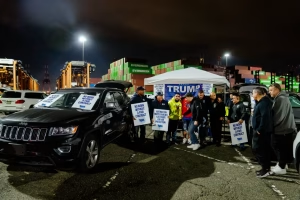
Dockworkers at dozens of U.S. ports in the Eat and Gulf Coasts are digging in for a massive pay increase, seeking to flex their power in a strike that aims to strangle the flow of trade across much of the country, reports The Wall Street Journal (Oct. 2, 2024). “Nothing is going to move without us,” said the head of the longshoremen’s union. The union wants to raise the base hourly rate for its roughly 45,000 members to $69 from $39, a 77% pay increase. It argues that its members deserve a big raise after working through the pandemic.

Members of the Longshoremen’s union began picketing this week.

Dockworkers typically earn a six-figure annual salary because of work rules and overtime requirements. More than half of  dockworkers at the Port of New York and New Jersey earn more than $150,000, with 1/5 earning over $250,000. Republican lawmakers have stepped up calls for the administration to invoke federal law to keep the ports open. After wages are agreed, the two sides still need to bargain over thorny issues such as expanded use of automation, which the union wants to prohibit.

The walkout shuts down some of the country’s main gateways for imports of food, vehicles, heavy machinery, construction materials, chemicals, furniture, clothes and toys. Big retailers, with their busy fall shopping season just starting to kick in, say that for now they can withstand the slowdown because they brought in products earlier than usual this year and diverted other cargoes to West Coast ports in case of a strike. (Container imports into U.S. West Coast ports expanded 22% over last month).

But a walkout lasting a week or longer would push up shipping costs and might trigger product shortages. A strike lasting even one week would tie up ships for much longer periods, which could exacerbate shipping delays, eat up capacity and drive up freight rates, leading to logistical challenges for businesses relying on East Coast and Gulf ports. About 60% of containerized trade moves through these ports where dockworkers last year unloaded about $588 billion of imports.

One Florida importer that sells asparagus to supermarkets is having to fly in vegetables that would usually arrive by containership. It is adding 50 cents a pound to the prices to cover the higher airfreight costs.

Classroom discussion questions:

  1. What can supply chain managers do in a situation such as this?
  2. What are the major issues behind the strike?


OM in the News: Israel, Terrorists, and Global Supply Chains

“Let’s call it Operation Chutzpah,” writes The Wall Street Journal (Sept. 23, 2024). If, as is widely believed, the Mossad detonated pagers and walkie-talkies used by Lebanese Hezbollah terrorists, killing dozens and wounding thousands, it will go down as an intelligence operation for the history books. This strike is the latest in a string of daring operations from the tunnels beneath Gaza to the heart of Tehran by The Startup Nation, as Israel is known in tech circles.

The Hezbollah terrorist group is funded by Iran

The attacks on Hezbollah this week using explosives planted inside electronics highlight the risks and vulnerabilities of technology supply chains. “Every board, every CEO, government, has now woken up today to the fact that products that we buy could be compromised,” said one CEO. “This is weaponizing of the supply chain.”

Many electronics manufacturers outsource production of relatively low-cost items such as pagers, which makes it difficult to track and verify the source of each piece within the final product. Companies often ship their designs for devices off to contract manufacturers who handle sourcing the components and assembly of the final goods.

“There’s multiple distributors, there’s multiple contract manufacturers, there’s multiple boards, there’s multiple locations. It’s just a really confusing array of people” in electronics supply chains, said a UNC prof in The Wall Street Journal (Sept 22, 2024). The complicated, multistep manufacturing process involving often far-flung suppliers introduces risk that parts inside finished products may be counterfeit or manipulated. The added tiers in outsourced manufacturing make it harder for buyers to know where the goods and their components are coming from.

Supply lines for everything from food and medicines to military material are perpetually targeted in armed conflicts, but this week’s attacks mark an audacious effort to embed itself within Hezbollah’s supply chain. Thousands of pagers carried by members of the terrorist group exploded. Then, the next day, walkie-talkies used by the group blew up  in terrorists’ hands across Lebanon. The attack not only damaged communications, but exposed to family and friends that the targeted individuals belonged to Hezbollah.

Western governments have also been cracking down on foreign-made equipment due to national security concerns about spying and cyberattacks. The U.S. just found Chinese cargo cranes used at seaports around the country had embedded technology that could allow Beijing to covertly gain access to the machines.

Classroom discussion questions:

  1. What can be done by the U.S. and other nations to prevent malware or other tools from damaging critical infrastructure?
  2. How was Israel able to manage this feat?

Guest Post: Using AI to Decrease Food Waste and Combat Food Insecurity

Temple University Professor Misty Blessley raises an interesting issue in her Guest Post today.

The Supplemental Nutrition Assistance Program (SNAP), overseen by the U.S. Department of Agriculture (USDA), plays a crucial role in combating food insecurity across the U.S. SNAP offers monthly benefits through an Electronic Benefit Transfer card, enabling food- insecure individuals and families to purchase food at authorized retailers.

Food insecurity, defined as a lack of consistent access to adequate and safe nutrition, affects about 13% of the U.S. population. Delaware recently became the first state to pilot an AI-powered app aimed at linking surplus food with SNAP demand. With over 30% of food wasted during production and distribution, food insecurity is increasingly viewed as a supply chain challenge.

This new AI-powered app is instrumental in combatting food insecurity by addressing the potential for waste along the supply chain.

How it works: The app, called the Smart Shopper app, allows producers and retailers to offer SNAP-approved items at discounted prices in locations where surplus inventories and unmet SNAP demand overlap. SNAP recipients can download digital coupons to purchase food that would otherwise be wasted. Developed by the creators of Priceline, the app operates similarly by offering discounted goods, much like Priceline offers unused hotel rooms and airplane seats. One key advantage is its ability to predict food surpluses at their source, rather than merely reacting to food approaching its expiration date.

The benefit: The app extends the value of SNAP benefits, helping recipients make fewer compromises when deciding which foods to purchase. It also creates a win-win situation.
Delaware noted that “when we help our most vulnerable buy locally grown products, they receive the most nutritious, freshest food Delaware has to offer, and we support small farms, boosting and growing the local economy.” Additionally, the app addresses a $250 billion food waste issue at the retail level. The app is expected to become available nationwide.

Classroom discussion questions:
1. Refer to Introduction to Big Data and Business Analytics in Module G of your Heizer/Render/Munson text. In what ways does the Smart Shopper app move decision-makers from information to optimization?
2. Why is inventory record accuracy important to the proper functioning of the Smart Shopper app?
3. How are agricultural products the same as/different than hotel rooms and airplane seats?

OM in the News: The Fireworks Supply Chain

Last week, all across the U.S. people enjoyed the dazzling displays of Independence Day. Fireworks are pyrotechnic marvels: the heart-stopping booms, the cascade of dazzling colors, the incredible finales. Supply Chain Management Now (July 7, 2024) examines the supply chain needed to create these events:

  1. Manufacturing fireworks is quite labor-intensiveProduction requires a delicate mix of sulfur, charcoal and potassium nitrate, packed into various components including shells, fuses and aerial effects. Skilled technicians must meticulously assemble each firework to ensure a visually stunning experience while prioritizing safety and quality control.
  2. Many fireworks include extra elements to create unique sounds. Layers of an organic salt, combined with an oxidizer, burn one at a time to slowly release gas and create whistling sounds. Aluminum or iron flakes create hissing and sizzling sparkles, and titanium powder gives us those super-loud blasts. Colors too, are attributed to particular materials.
  3. Transporting and storing fireworks is a delicate process. For obvious reasons, fireworks can’t just be carried by any shipping company to the average warehouse. Fireworks-storage facilities are equipped with temperature-controlled environments and specialized storage locations to ensure different types of fireworks are separated to prevent accidental combustion. There are strict rules about transportation, and trained professionals must take precautions to prevent ignition and ensure compliance with multiple regulations.
  4. Weather plays a prominent role in fireworks demand. About 90% of fireworks in the U.S. are manufactured in China, meaning orders are placed well in advance of the 4th. But consumers tend to purchase fireworks just before the holiday, so excessive rain or drought can put a serious damper on sales.
  5. Today’s fireworks are more futuristic than ever. Drones are now commonly used to create dazzling light shows, as more and more cities are retiring colorful fireworks displays in favor of “swarms of illuminated drones.” Drone shows are safer and much more environmentally friendly, as they generate fewer emissions, increase material sustainability and reduce the need for mining operations. The market size for global drone light shows was valued at $1.3 billion in 2021 and is projected to reach $2.2 billion by 2031.

Classroom discussion questions:

  1.  Is the fireworks supply chain unique?
  2. Can the manufacturing process be automated?

OM in the News: Is Blockchain Fading?

The value proposition of harnessing blockchain technology to transform supply chains is not new, as we discuss in Chapter 11 (see pages 451-2). The idea of a distributed ledger, that is transparent and immutable, lends itself to imagining a world where all participants involved in the process of producing, distributing, storing, selling, and consuming a product can view its origin and status in real time. The benefits of such traceability include improved food safety, reduced fraud and optimization in the distribution of scarce resources.

However, like any emerging technology, the early years of blockchain witnessed the launch of numerous projects and a wide variety of use cases with a mixed level of success. Reports conclude that as many as 92% of those early projects in blockchain have failed, writes Supply & Demand Chain Executive (June 4, 2024). While all early technical experiments don’t turn out as planned, it is critical to look at them closely.

There is a wide range of reasons why technology-led transformations fail: a lack of thorough strategy and planning or an inadequate understanding of what the market needs; insufficient time invested in truly understanding the problem definition; underestimating the time and effort needed for new regulatory frameworks; or simply not being able to access sufficient, affordable, talent at the right time.

These are all real challenges that are also applicable in the blockchain world. A major example is the Australian Stock Exchange blockchain project which was built to transform clearing and settlements. It started in 2016, originally planned for 2.5 years but finally dismantled in 2022. The team had set out to build a private blockchain infrastructure which proved too difficult.

Blockchain applications for supply chain rely on two primary elements: token services and decentralization. Token services, established by companies, facilitate real-time visibility throughout the value chain. Meanwhile, decentralization empowers independent entities to exchange and trust supply chain data securely, all while maintaining privacy. This type of visibility simplifies and automates the overall management of the supply chain and, in practice, reduces inefficiencies and intermediaries, which ultimately reduces overall costs.

But the concept of privacy in the context of a distributed ledger is often viewed as a paradox; that there is no room for privacy in a transparent world. Yet the true nature of a public blockchain operates with the goal of confidentiality.

Classroom discussion questions:

  1. Identify a major blockchain project that has failed.
  2. What makes blockchain success so difficult?

OM in the News: The Rocket Fuel Supply Chain

An ammonium perchlorate plant explosion in Nevada demonstrated the vulnerability of a key part of the supply chain for many commercial and military rockets.

In Chapter 11 and Supp. 11, we discuss the importance of having multiple suppliers for critical components/parts. Yet the Pentagon long relied on one U.S. company to make the main ingredient–ammonium perchlorate fuel– that powers its most potent missiles.

Most of that fuel still comes from a specialty-chemicals company in Utah called American Pacific. It is an example of the single-source chokepoints that Pentagon logistics experts have long flagged as a national-security risk, reports The Wall Street Journal (April 28, 2024).

Despite efforts to diversify, many weapon materials have no U.S. manufacturers. Others have only one source or a dominant provider. The supply-chain snarls caused by the pandemic heightened officials’ sense of urgency by exposing other materials only made in adversarial countries such as China.

Northrop, which is best known for making stealth jets such as the B-21 Raider, also makes missile-defense systems and solid-rocket motors that need ammonium perchlorate to fire. It tried to lower the prices it paid for the chemical by investing more than $100 million to build production lines in northern Utah. But its effort has been slow to take off. Cost overruns bedeviled the program, making expense management a priority for the company.

As one of two major U.S. solid rocket makers, Northrop has long been a big buyer of ammonium perchlorate. The company’s rocket motors are used in missile systems such as Lockheed Martin’s Guided Multiple Launch Rocket System. The U.S. has sent thousands of these missiles to Ukraine. The military’s exacting requirements for its arsenal—which include at least a year of testing materials for shelf life and performance before they can be certified for specific weapons—have limited supply of the Northrop-made ammonium perchlorate. Higher prices for materials such as ammonium perchlorate can dent contractors’ profits on so-called fixed-price contracts when they are left on the hook for cost overruns.

Classroom discussion questions:

  1. Which of the risks in Table 11.3 (page 448) of your Heizer/Render/Munson text apply here?
  2. Why can’t Northrop obtain the fuel it needs?

OM in the News: AI in Manufacturing

Manufacturers are increasingly evaluating and adopting AI solutions to leverage their data, writes Industry Week (Feb. 13, 2024). Here are some key areas that stood out in how manufacturers are adopting the technology:

Quality control enhancement: AI can improve manufacturing quality control through vision systems trained on images and videos, accurately detecting complex product defects. Real-time monitoring identifies issues promptly to prevent future defects, and AI’s continuous learning enhances defect detection.  (See Ch. 6)

Supply chain visibility: Manufacturers deal with enormous amounts of data in their operations, and the integration of AI technology allows real-time observation, quicker trend identification and more accurate forecasting to meet demand effectively. AI algorithms analyze historical sales data, market trends and external factors, enabling more precise demand forecasts and aligning production and inventory levels. In logistics, AI optimizes routes by analyzing transportation costs, delivery times and traffic patterns, enhancing efficiency and cost-effectiveness. The strategic use of AI in the supply chain offers benefits like improved visibility, increased agility and better planning, enhancing overall resiliency and responsiveness. (See Ch. 11)

Energy efficiency and resource utilization: Companies are using AI to optimize energy consumption and resource utilization in manufacturing processes. These capabilities analyze real-time data from sensors, production equipment and other sources to identify patterns and trends in energy usage. This can inform predictive recommendations to optimize energy consumption, reduce waste and enhance overall resource efficiency. (See Supp. 5)

Predictive maintenance improvement: The use of AI in predictive maintenance enables a shift from reactive to proactive strategies, leveraging data-driven approaches. AI algorithms analyze real-time data to predict maintenance needs and failures. AI identifies patterns on the factory floor, detecting anomalies and potential malfunctions. This proactive approach minimizes unplanned downtime, extends equipment lifespan and allows manufacturers to optimize resource allocation through scheduled service activities during planned downtime, enhancing overall productivity and reducing costs. (See Ch. 17)

The use of AI in manufacturing operations in coming years is expected to accelerate. Investment in AI technologies is forecast to rise among 96% of companies by 2030.

Classroom discussion questions:

  1. How will AI become a common tool for operations managers?
  2. Using a search engine, describe a real company example for these applications.


Guest Post: Leveraging Operations for Competitive Advantage in 2024

Prof. Misty Blessley, at Temple University, shares her insights with our readers monthly.

“From inventory management to materials requirement planning (MRP), for many years manufacturing leaders have viewed operations as a cost center — one that takes money off the bottom line rather than adding revenue to the top line”, writes Forbes (Jan. 22, 2024).This, in turn, has created a tendency to treat OM as a set of functional areas that must be continually optimized to reduce costs. But industry is at an inflection point. In an era of heightened customer expectations, diversified supply networks, rapidly advancing technologies, and enhanced environmental, social and governance (ESG) scrutiny, firms are challenged to consign this long-standing, cost-driven view to the past.

With the supply chain being where many of these challenges are being addressed, it is the focal point for viewing operations as a firm’s competitive advantage. By taking a more strategic approach, companies can also think outside the box of traditional OM and turn their supply chain into the center of enhanced operations performance.

Here are three questions firms must answer to achieve an advantage through their operations.

1. What does making the supply chain a center of enhanced performance look like? It means leaving behind the use of historical data in favor of taking on new technologies to gather consumer insights for driving customer satisfaction.

2. What happens when firms get strategic operations right? When consumer insights and OM are in harmony, firms do a better job at meeting customer expectations, to the benefit of increased customer loyalty (i.e., sales). The employee experience is also improved.

3. How can strategic operations be achieved? This can be done by integrating the supply chain across multiple enterprise operations in response to demand signals captured across the value chain. For example, rather than just trying to balance demand and supply to avoid a stock-out or excess inventory, companies work to balance operations to deliver the right product to the right customer at exactly the right time.

There is always pressure to control costs, but leveraging technology is the key to using the supply chain to build competitive advantage. This has the potential to positively affect the firm’s top as well as bottom lines.

Classroom Discussion Questions:
1. Chapter 11 of your text states: “The objective of supply chain management is to structure the supply chain to maximize its competitive advantage and benefits to the ultimate consumer.” How is viewing the supply chain as a revenue driver, as opposed to a cost center, in line with this objective?
2. What is the role of business analytics (Module G) in setting the stage for strategic operations in 2024?

OM in the News: JIT Makes a Retail Comeback

Retailers are reviving an old playbook to manage their inventory levels after four years of struggling to find the sweet spot of holding enough merchandise but not too much, reports The Wall Street Journal (Jan. 24, 2024). They have worked through the excess inventory that piled up on store shelves and in warehouses over the past 18 months, and are now focusing on replenishing items rather than stocking up on goods to have on hand in case of supply-chain disruptions.

The shift marks a return to the “just-in-time” inventory management strategy (our topic in Chapter 16) that many companies had employed before pandemic-driven product shortages and volatile shifts in consumer demand prompted a switch to a “just-in-case” stockpiling approach. Companies are now better able to predict shopper demand and feel they can hold leaner inventories amid moderating spending growth and fewer supply-chain disruptions. They prefer not to hold large inventories because the excess stock ties up capital, requires more space and people to manage it, and runs the risk of becoming outdated as trends change.

“Retailers have more confidence in the overall supply chain and the logistics network and the environment, and as a result, they’re saying we’re at a point now where we’re safe to go back to JIT,” says Ohio State U. Prof Terry Esper. The SCM head at Tailored Brands adds: “The ability to react to changes in demand means the company has no need for ‘safety stock’ inventory.”

Retailers such as Walmart have rolled out technology aimed at fixing forecasting tools that were broken during the pandemic as they seek to better understand what consumers are buying and more accurately predict demand. The technology is allowing merchants to have smaller, more accurate shipments than they have in the past. “We’re able to better predict lead times, we’re able to better execute review cycles, and as we do that better, we’re able to hit target inventory levels,” says Walmart’s VP for SCM.

Still, new supply-chain disruptions could prompt a different approach and bring in more excess stock. Recent attacks by Houthi rebels in Yemen on containerships have pushed companies to reroute shipments over longer distances to avoid the Suez Canal, and low water levels at the Panama Canal have slowed some deliveries.

Classroom discussion questions:
1. Why the return to JIT?
2. Will there be less volatility in supply chains from this point on?

OM Podcast #13: An Interview with DuPont’s Chief Procurement Officer

In our latest podcast, Barry interviews Miguel Gonzalez, Chief Procurement Officer at DuPont.  They discuss the increase in uncertainty and the importance of risk management with the growing number of supply chain disruptions caused by things like COVID and geopolitical situations across the globe, and how DuPont has weathered these by relying on strategic relationships.


Transcript

A Word document of this podcast will download by clicking on the word Transcript above.

Instructors, assignable auto-graded exercises using this podcast are available in MyLab OM.  See our  earlier blog post with a recording of author and user Chuck Munson to learn how to find these, or contact your Pearson rep to learn more!  https://www.pearson.com/us/contact-us/find-your-rep.html

OM Podcast #8: Operations Management at Red Lobster

Welcome to a very exciting Operations Management podcast! Today, Barry Render and his guest, Executive Vice President of Red Lobster, Horace Dawson, talk about operations at Red Lobster.  They discuss the most important operations tasks to get right in any restaurant but especially the world’s largest seafood chain: forecasting, scheduling, supply chains, and quality.


Transcript

A transcript in Word of this podcast is available by clicking on the word Transcript above.

Instructors, assignable auto-graded exercises using this podcast are available in MyLab OM.  See our August 21st blog post with a recording of author and user Chuck Munson to learn how to find these, or contact your Pearson rep to learn more!  https://www.pearson.com/us/contact-us/find-your-rep.html

As a footnote, Horace Dawson was promoted to CEO at Red Lobster on Sept. 21, 2023.

OM in the News: Weight Loss Drugs and the “Cold” Supply Chain

Complex logistics are designed to keep Ozempic and Wegovy cold.

The soaring popularity of weight-loss drugs is big business for some of the largest pharm distributors in the U.S. But the profits aren’t soaring, partly because of the complicated and costly logistics involved in shipping the refrigerated medications, reports The Wall Street Journal (Aug. 22, 2023). Drugs such as Wegovy and Ozempic cost around $1,000 for a month’s supply and are in hot demand, but their operating expenses are higher because of the cold-food supply chain nature of the product.

The medications help patients lose weight by mimicking gut hormones. The drugs are once-weekly injections that patients administer on themselves using a penlike needle, similar to using an EpiPen, that must be stored between 36 and 46 degrees Fahrenheit. For wholesalers, it means arranging industrial-scale logistics designed to keep the medications cold throughout transport and storage, including protecting the injections from unpredictable events such as a truck breaking down in a heat wave.

“You need to have the product in refrigerated trucks going from your point A to point B and then when it gets into a location, time from a material handling standpoint to collect the product and then store it in a refrigerator,” says an industry analyst. Shipping refrigerated products such as medicine and food is more expensive than moving dry goods like apparel or appliances.

Trucking companies handle the drugs on specific trucks that keep the shipments in a tightly controlled environment, ensuring temperatures are stable and the goods are also protected from odors that can affect them. The trucks must carry a higher level of insurance and are outfitted to keep the products secure to prevent theft, a particular risk with expensive drugs like Wegovy and Ozempic that are in big demand and have a high street value.

The challenges highlight the complications drug wholesalers face in building out supply chains for medications in high demand.  During the pandemic pharm companies rapidly worked to develop, manufacture and distribute highly fragile Covid-19 vaccines around the world, all while keeping the inoculations at ultracold temperatures. That involved designing special packaging to keep the vials at stable temperatures for long distances.

For additional insights into cold food supply chains, listen to our OM Podcast #7, featuring Temple U. Prof. Misty Blessley.

Classroom discussion questions:

  1. How do “cold food supply chains” differ from traditional supply chains?
  2. List a dozen products requiring a cold food supply chain.