OM in the News: Apple Decides That Two Suppliers Are Better Than One

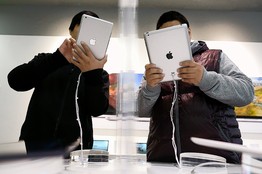
Pegatron began making iPad minis (left) recently, while Foxconn still assembles the larger iPads (right)

For years, nearly all of the world’s iPhones and iPads rolled off the assembly lines of a single company: Foxconn. It was a famous partnership between two outsize personalities— Steve Jobs, Apple’s intense and mercurial co-founder, and Terry Gou, the Taiwanese manufacturer’s equally demanding chairman. But under current CEO Tim Cook, reports The Wall Street Journal (May 30, 2013), Apple is dividing its weight more equally with a relatively unknown supplier, giving the technology giant a greater supply-chain balance. Pegatron will be the primary assembler of a low-cost iPhone expected to be offered later this year. Foxconn’s smaller rival across town became a minor producer of iPhones in 2011 and began making iPad Mini tablet computers last year.

Pegatron’s rise means an end to the monopoly that Foxconn, the world’s largest electronics contract manufacturer—has held over the production of Apple’s mobile products. There are strategic reasons for the shift: risk diversification after Foxconn’s manufacturing glitches last year with the iPhone 5 that resulted in scratches on the metal casings, and Apple’s decision to expand its product lines amid growing competition from Samsung and others. Pegatron also has been willing to accept thinner profits as it courts Apple’s business.

Ironically, Foxconn’s cost advantages from scale have waned as it works to improve factory conditions after a spate of high-profile worker suicides and accidents in recent years. Foxconn, in its growing heft as the world’s largest electronics contract company, was also getting more difficult for Apple to control, with incidents such as changing component sourcing without notifying Apple.

Pegatron, which has about 100,000 employees in Taiwan and China, expects to increase its China workforce in the second half of the year by around 40%. The staffing increase is largely due to expected production of low-cost iPhones.

Discussion questions:

1. Why is Apple diversifying suppliers?

2. What are the disadvantages of this move?

OM in the News: Hershey Goes Sustainable

hersheyIt’s almost Valentine’s Day, the time of year that truly tests logistics and supply chain management at jewelry,  flower, gift shops, and restaurants. But few companies will be challenging their suppliers as seriously as Hershey, writes Food Logistics (Feb. 6, 2013). Just recently, the company announced its intention to use cocoa beans from Rainforest Alliance Certified farms in 100% of its products by 2020, in an effort to promote sustainable, ecologically-sound farming practices and safe conditions for workers and families.

While testing its supply chain, Hershey is trying to improve the quality of its products as it expands business into China, India and Brazil, which are rapidly developing a middle class consumer base.  “We can deliver chocolate to many people around the world that haven’t had it before and create the demand for the cocoa farmers. But the only way those cocoa farmers are going to be able to meet that demand is they’ve got to become better,” says Hershey’s VP of global commodities.

Hershey has been procuring cocoa beans from West Africa for over 50 years and  70% of the world’s cocoa currently comes from West and Central Africa. (There are 800,000 cocoa farmers across the Ivory Coast). In recent years, there has been a noticeable shift toward more environmentally- and socially-conscious sourcing.  Mobile technology usage in West Africa has greatly increased in the last 2-3 years, which is a great tool for farmers to access proper farming practices and also connects farmers with vital information about child labor and safety. The International Cocoa Institute is further creating community-based programming in 550 West African communities. Hershey projects over the next two years it will enroll 100,000 of those farmers to help develop a sustainable supply of cocoa for the world.

“We know it’s very feasible to increase farmer productivity by 50 percent,” says Hershey, “as long as farmers: (1) have access to fertilizers and pesticides; (2) are educated on how to apply them safely; (3) modernize their harvesting methodologies; and (4)  have access to modern information on farming practices.”

Discussion questions:

1. Why is it difficult to create sustainable cocoa operations?

2. Discuss the OM issues involved.


OM in the News: Walmart’s Supply Chain Passage to India

Unrefrigerated truck goes 140 miles in 7 hrs.

Last fall, following a relaxation in India’s foreign-investment rules, Walmart announced it was planning to open its first stores in the country, tapping into a prized $490 billion retail sector. But to cash in, writes The Wall Street Journal (Jan.,12-13, 2013), Walmart will have to solve a fundamental supply chain problem: how to move goods into stores efficiently in a country that offers big retailers little in the way of modern logistics and is plagued by dilapidated infrastructure.

The hurdles are particularly daunting in the food sector. In the world of perishable goods perishing, India has few rivals. Lacking proper storage facilities, enough refrigerated trucks and adequate highways, the world’s second-largest fruit-and-vegetable producer loses about one-third of its produce ($10 billion) each year to spoilage. India also is bogged down by an entrenched system of government-imposed middlemen that can increase costs by 500%.

After passing through the agents and traders in the Chhutmalpur market, for example, produce moves in trucks on a 140-mile journey to New Delhi, often on a 2-lane road so pot-holed and bumpy that top speeds are 15 miles per hour. The trip may include a visit from local thugs demanding bribes for safe passage. It is just one of many human road hazards in India, such as farmer protests.

With a U.S. fleet of 55,000 tractor-trailer trucks, third-party shippers and its own massive distribution centers, Walmart is accustomed to fine-tooth tracking and direct sourcing. In the face of all this it is unlikely Walmart will try to replicate its U.S. supply chain operations, which are focused primarily around massive distribution centers supporting up to 100 stores.”It’s the least mature market they’ve ever had to enter,” says one expert. “They have to create a new playbook.'”

Discussion questions:

1. Compare Walmart’s efforts to those of Hard Rock (noted in Ch.8) when it entered the Russian market.

2. What will be Walmart’s biggest OM challenge in India?

OM in the News: Apple vs. Samsung Is Really About Supply Chains

By now, everyone has heard the results of the law suit out of San Jose in which Apple was awarded $1.05 billion for damages incurred by Samsung’s infringement on  Apple patents (The Wall Street Journal , Aug.25-26, 2012). The  sweeping victory for Apple provides ammunition for more legal attacks on its  rivals in the $250 billion smartphone market–in which Samsung and Apple are #1 and #2. The jury found that Samsung infringed all but one of the seven patents at issue, and also decided Apple didn’t violate any of the five patents Samsung asserted in the case. “Today’s verdict should not be viewed as a win for Apple, but as a loss for the American consumer,” Samsung said. “It will lead to fewer choices, less innovation, and potentially higher prices.”

Apple, which prides itself on the style of its products, broke new ground by heavily relying on patents covering the physical design of its iPhones and iPads. (This is called “trade dress,”  the overall look and feel of a device.) Tech companies have more commonly relied on utility patents, which cover the way products work rather than how they look.

The bigger story from an OM perspective, though, may be in the fact that the rival companies have a $5 billion supply chain relationship. Apple is Samsung’s biggest customer for microprocessors. The current case in many ways resembles the 1996 lawsuit by GM against rival VW. GM’s VP for Supply Chains, Jose Lopez, was accused of  stealing GM’s plans for a new type of factory, dubbed “Plant X”, when he defected to VW. The settlement, in GM’s favor, recognized the role of each company as a supplier to the other. VW paid GM $100 million  and was required to buy $1 billion in parts from GM.

In today’s world, competition–as we say in Chapter 11–is often between supply chains, not between companies.

Discussion questions:

1. Ask students to research details of the GM-VW lawsuit and discuss them in class.

2. The Samsung-Apple lawsuit in Korea played out differently. Why?

OM in the News: Using Malaysia to Balance Supply Chain Disruptions

Jay and I are just finishing up the next edition of our OM text, and have added a good deal of new material on supply chain disruptions. So The Wall Street Journal (July 19, 2012) article on high-tech manufacturers flooding into Penang, Malaysia caught my eye. The journal writes: “Hangar after hangar at the bustling Penang airport is decked out in the liveries of shipping companies DHL, UPS, and FedEx each dedicated to flying out boxes of LED displays, chip sets and other sophisticated electronics. Following last year’s earthquake in Japan and floods in Thailand, global manufacturers are looking to Penang and elsewhere to broaden their supply chains for everything from car parts to semiconductors to hard-disk drives”.

Last year was a watershed for companies operating global supply chains. At the height of the disasters in Japan and Thailand, companies relying on JIT supply chains were left scrambling for alternative suppliers. The hardware industry was hit especially hard by the months of flooding in Thailand. With China’s labor market overheated, countries like Malaysia are seeing billions of dollars in new investments from techs such as Intel, Bose, Agilent, and National Instruments.

Why locate in Malaysia? The nation does carry political risk, as it is a Muslim country entering a period of political turbulence. But as the Journal adds: “Those tensions are relatively minor compared with those of some of Malaysia’s neighbors. The country sits safely away from the so-called Pacific Ring of Fire, mostly unaffected by the earthquakes and volcanoes that can afflict  Japan and Indonesia. Malaysia also is less likely to fall victim to the kind of flooding that left Thailand’s economy flailing last year. Also helping Penang’s appeal are an international air hub and strong logistics infrastructure, including inexpensive and reliable supplies of electricity and pristine water”.

Discussion questions:

1. What location analysis factors do multinationals consider in deciding where to open a new factory?

2. What is the history of US firms locating in Malaysia?

OM in the News: UPS and its Team of Pharmacists

UPS is well-known for its army of brown-uniformed delivery drivers. Less known is that the package-delivery giant has its own team of pharmacists. At UPS’s Louisville headquarters, company pharmacists fill 4,000 orders a day for insulin pumps and other supplies from customers of medical-device company Medtronics. UPS pharmacists  log into Medtronic’s system, fill the orders with devices stocked on site, and ship them to patients, via UPS.

It is one part of the growing reach, writes The Wall Street Journal (June 28, 2012) by UPS—along with rivals FedEx and DHL—into the business of running supply chains for pharmaceutical and medical-device companies. Medtronic and other health-care companies are increasingly outsourcing logistics as they look for ways to cut costs from backroom operations and focus on product development instead (see Chapter 11). UPS’s service has allowed Medtronic to close its own distribution warehouse and see a significant reduction in the costs of processing each order. “If you’re a medical company, logistics isn’t your core expertise,” says an industry analyst.

The parcel-delivery companies are investing in megawarehouses that service multiple pharmaceutical companies at once, with freezers for medicines and high-security vaults for controlled substances. UPS got into health-care logistics in 2006 and the business has grown rapidly, with 33 health-care logistics facilities around the world, including a plant in Brazil opened last year specifically to handle the supply chain in that country for Merck.

Walgreen chose UPS to transport $9 million of donated flu vaccine—375,000 doses, to Laos in March. Fifty UPS “health care logisticians” coordinated the complicated journey. The 8,500-mile flight took five days and included four stops, ending in Bangkok, where the containers were loaded onto a truck for Vientiane, Laos.

Discussion questions:

1. What are the risks to UPS in entering the medical supply chain business?

2. Why would medical companies outsource their order systems to  parcel companies?

OM in the News: 3M’s “Hairball” Supply Chain

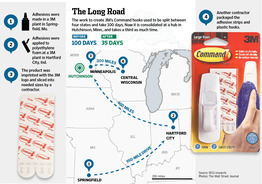
3M’s Command picture-hanging hooks, made of plastic and strips of sticky foam, don’t look complicated. The Wall Street Journal (May 17, 2012) reports, though, that until recently, the Command production process meandered more than 1,300 miles through 4 factories in 4 states.

3M’s recently retired CEO branded such convoluted production trails as “hairballs.” The man in charge of untangling, John Woodworth, 3M’s Supply Chain VP, characterizes the situation this way. “We had long supply chains.  It was and continues to be an issue.”

Every company tries to streamline manufacturing and supplier networks, of course. But few have a task as daunting as Mr. Woodworth’s.  3M makes 65,000 products, ranging from Scotch tape to film for solar-energy panels, dental braces and dog chews. They are produced in 214 plants in 41 countries. Mr. Woodworth, a 38-year veteran of 3M, figures he has been inside half of those plants.

3M’s long-term plan is to have fewer, larger, more efficient plants, and spread them out around the world. More production will be done in what 3M calls “super hubs,” plants capable of making scores of products for a region of the world. 3M now has 10 hubs, including six in the U.S. and one each in Singapore, Japan, Germany and Poland. It plans at least six more, all outside the U.S.

3M’s  stethoscopes, for example, used to be made in steps involving 14 outside contractors and three 3M plants. Now all processes are being brought into a plant in Columbia, Mo. The cycle time will fall to 50 days from 165. The company’s goal is to reduce cycle times—the period needed to go from ordering raw materials to delivering finished goods—by 25%.

Discussion questions:

1. Why did the 3M production process become so complicated?

2. Why is cycle time such an important OM concept?

OM in the News: How Nylon-12 and Xirallic Haunt Auto Supply Chains

For automakers, this past year has been one supply chain trauma after another. Now The Wall Street Journal (April 18, 2012) tells the story of 200 auto execs meeting in Detroit to deal with the looming shortage of Nylon-12, an obscure resin essential to the production of fuel and break lines. Inventories of the resin are being depleted after an explosion last month at an Evonik Industries AG plant in Germany, that killed two employees. Evonik, whose plant will take many months to repair, is the only  maker of the resin. The ricochet effect is global and less than a month’s worth of Nylon-12 inventory exists.

Evonik plant on fire in Germany

Evonik makes 25% of the global supply of the specialty resin and supplies a chemical building block to another company, Arkema SA, that makes a similar amount. Arkema says shortages of the building block means it will not be able to supply customers with the resin. “There will be no quick solutions,” says the Journal. GM has put together a global team from its purchasing, engineering, and supply departments working to allocate resins and prioritize its needs.

Last year, production in Japan of Merck’s Xirallic, the shiny pigment in some automotive paints, was disrupted by the tsunami and subsequent nuclear power plant problems. Auto makers had to limit or stop taking orders for some cars that used the pigment for certain colors because the plant was the industry’s primary supplier of the pigment. The Merck plant was repaired, but disruption rippled through the industry for more than 6 months.

Discussion questions:

1. Why is a replacement for Evonik so difficult?

2. How can global supply chain disruptions be minimized?

OM in the News: Ship by Air or by Sea From Asia?

One of our topics in Chapter 11, Supply Chain Management, is “Cost of Shipping Alternatives,”  in which we compare the cost of  shipping providers from Asia (see Example 3). The Wall Street Journal (Feb.28,2012) just provided a perfect example of this issue to share with your class. The article describes how retailers like Abercrombie & Fitch (A&F) are shifting away from air delivery in favor of bringing more goods to the US by slower, but cheaper, ocean freight.  A&F has slashed the percentage of its inventory flown into the US to 12%  from 60%, a level its supply chain VP says was “crazy.”

The choice involves a trade-off. It cuts shipping costs drastically. But it can take weeks, rather than days, to transport clothes or other goods from manufacturing centers in China and other Asian countries. That leaves retailers with less control of their inventory, making them more vulnerable to fashion changes. But while the switch  to ocean freight lowers average unit costs,  retailers typically take possession of finished goods when they leave the factory. That means the goods spend more time on a company’s balance sheet and tie up cash.

Partly to reduce those risks, US firms that outsource production to China are starting to move operations closer to home. Hampshire Group, for example, which manufactures for brands such as Geoffrey Beene and Levi Strauss, chose a site in Honduras. This means it can ship to distribution centers through the Panama canal in 6 days vs. 27 days from China. Although faster shipping can make sourcing to Central America competitive with Asia, many of these countries “don’t have the fabric mill infrastructure in volume like China,” says the A&F VP.

Discussion questions:

1. What will it take to make Central America more competitive with Asia for clothing manufacture?

2. What are the 2 main reasons why US firms choose air freight over ocean shipping?

Guest Post: The Rise, Fall, and Rise Again of the Bullwhip Effect

Today’s guest Post comes from Kelly Thomas, who is a supply chain management professional and executive at JDA Software.

Demand variability is among the most important challenges facing supply chain managers today. Demand variability that is not properly managed manifests itself in terms of the well-known bullwhip effect, which results in large inefficiencies. Jay Forrester first described the bullwhip effect in his seminal work Industrial Dynamics, published in 1961. This effect says that a change in independent demand at the consumer level leads to increasing swings in dependent demand at each point upstream in the supply chain. This effect held sway over supply chains since the beginning of the industrial revolution.

However, during the mid 2000s, it appeared that the bullwhip effect had been reduced; studies by the Federal Reserve show the bullwhip effect attenuating dramatically from the beginning of the 1990s through the middle 2000s. These studies attributed this to the widespread adoption of improved supply chain management practices and supporting information technologies. These same studies postulated the overall economy had entered a new era of lower variability.

As we know by now, the Great Recession of 2008-2009 and its lingering effects have changed a lot of this thinking. It appears the bullwhip effect has come back with a vengeance. Increasing variability caused by demand uncertainty, globalization, new product introduction, and escalating customer expectations have outstripped companies’ abilities to effectively manage their supply chains. This has led to increased interest in supply chain segmentation, driving the supply chain from independent demand, visibility and synchronization, and optimizing the use of production and inventory resources.

To support these needs, companies are now going through a technology refresh phase to support higher levels of sophistication in such areas as S&OP, demand management, order promising, inventory optimization, and customer collaboration. For example, companies such as Dell and Sony are transforming their supply chains to stay ahead of the variability curve.

OM in the News: The Panama Canal’s “Fat Lane” and US Supply Chains

What do Warren Buffet, the Panama Canal, and products from Asia  to Wal-Mart  have in common?The Wall Street Journal (Nov.11, 2011) writes that they are all part of the complex calculus of changing  global supply chains. Right now, about 70% of US imports from Asia arrive by ship to the West Coast, with much of those goods transferred to Buffet’s Burlington Northern RR for transit to the rest of the nation.

But in 2014, Panama will rock the world of logistics with the opening of its new “fat lane”– a game changer  that  creates a threat to western ports and railroads. It takes about 18 days to make the ship and train journey from Asia to West Coast and then across the country. The all-water route through the canal takes 22 days. But the ship-to-rail route costs 10-25% more.

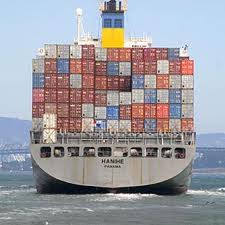
With the expanded Panama Canal, the Wal-Marts and Targets of the world are planning to ship more product to East Coast ports on huge ships that can carry 12,000 standard 20-foot containers–3 times the current capacity. This avoids labor strife in the past decade that clogged West Coast ports, and helps diversify  logistics systems. It has also triggered a raft of upgrades at East Coast ports to accommodate the bigger vessels.

The reaction from western ports:  Our speed of delivery and superior facilities will stem any loss of business. Many customers don’t want time-sensitive inventory sitting on ships traversing all-water routes. If your goods are stuck in the supply chain, they’re not passing the cash register. Besides, future ships (already being ordered) will carry 18,000 containers, which will not fit through the expanded canal.

But the Journal concludes that the expansion will be good for all ports. It will facilitate rising trade with Latin American for commodities, create round-the-world service by larger ships, and make the US logistics system more competitive globally.

Discussion questions:

1. How does the expansion impact East Coast retailers?

2. What are the OM advantages of the wider canal?

OM in the News: What Do China, Mexico, and South Carolina Have in Common?

The answer to this question about Mexico, China, and S. Carolina is good news re American jobs. But specifically, it’s that The Wall Street Journal (Oct.6,2011) just ran three articles in the same issue that are all tied to the  theme of globalization coming full circle.

In the 1st, we find that Otis Elevator is moving production from its plant in Nogales, Mexico (which it opened in 1998) to Florence, S. Carolina. Otis says the move will save money. The cost of producing abroad has risen and Otis has devised more efficient ways to make the product closer to where it sells it. Since designers and engineers had stayed in the US, it meant a lot of cross-border travel. “We needed to rationalize our supply chain”, says the CEO. Net to US: 360 jobs. (Also see the 5 min.video link in the article).

Second, the Journal reports that German tire maker Continental AG is building a new $500 million plant in S. Carolina, bolstering  a major turnaround in the US tire industry. Eventually, 8 million tires will roll out annually, creating 1,600 jobs. The strategic shift comes amid reduced labor costs (partly from new 2-tiered wage plans) and a supply of highly-skilled workers, making the US competitive  globally. As a bonus, Japan’s Bridgestone Corp, also announced a $1.1 billion expansion of its existing tire plant. Where? Why S. Carolina, of course!

 “China is Getting Too Expensive”, talks about a S. Carolina furniture maker who moved production  to China a few years back, only to be bumped aside by his Chinese partners who started selling directly to the US market. The Journal writes: “But with labor, materials and shipping costs rising, the advantage will tip (back) to the US in 4 years” in 7 major industries. Among the forces: rising costs in China, more flexible American unions, state subsidies, higher productivity here, and shorter turnaround times, meaning shorter supply chains. Automation, however, means a furniture maker can accomplish with 135 employees what took 250 to do in the past.

Discussion questions:

1. Why are some US companies  abandoning Mexican production?

2. What factors are working against China?