OM in the News: America is Desperate for Supply-Chain Wizards

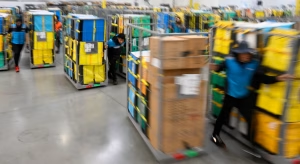
When the U. of South Carolina started its supply-chain program in 2007, there were 30 business-school students in it. Today, the program has grown to over 800.  That’s a function of how logistics has changed the world, especially since the pandemic. Package-delivery trucks constantly weave through neighborhood streets. Porches and mailrooms are crowded with deliveries from Amazon, Target, Walmart, Temu and Shein. DoorDash and Uber Eats drivers ferry burritos, pizza, and sushi. Uber and Lyft have largely displaced yellow taxis. Instacart does your grocery shopping for you.

That explosive growth is likely to continue, as logistics is expected to be one of the fastest-growing sectors over the next decade, with an estimated market size of $22 trillion by 2033 — nearly triple what it was last year, reports Sherwood News (Oct. 18, 2024).

There’s already a shortage of highly qualified talent in the industry, and colleges have been bulking up their programs to ensure there’s a steady supply of workers. A recent survey found that 37% of 1,000 supply-chain decision-makers across North America and Europe said they were experiencing workforce shortages. More than half of respondents said positions for knowledge workers and managers have been “hard or extremely hard” to fill. Transportation and warehouse operations have been most affected by the workforce shortage.

The jobs are also lucrative: pay has increased along with demand. Supply-chain and logistics roles in manufacturing often have the highest salaries, averaging over $120,000 annually.

“The pandemic exposed vulnerabilities in global supply chains, leading to a growing demand for professionals who can manage the complexities of logistics, inventory, and distribution systems,” said a Cal Poly prof. AI is also at the forefront of top candidates’ resumes. “We’ve seen that many retailers need professionals who understand both logistics and advanced technologies like AI and data analytics. These skills allow them to predict inventory needs more accurately and respond to market demands faster,” added an industry CEO.

Still, it’s not all about technology. Workers need to be able to not just handle tech, but also customer relationships. For example, the team might need to work closely with suppliers on the common goal of streamlining processes to make things run more efficiently.

Classroom discussion questions:

  1. What would be the job titles for a new grad entering the SCM field?
  2. Why has this field taken off in popularity?

OM Podcast #26: Operations Management at the Port of Philadelphia

In this latest podcast Barry Render interviews Dominic O’Brien, an executive at the Port of Philadelphia–called Philaport.  Dominic and Barry discuss why the port system is so important to supply chains in the US and worldwide.


Transcript

A Word document of this podcast will download by clicking the word Transcript above.


Did you know our podcast is now available on Apple podcasts? Just go to your Apple podcasts app, search “Heizer Render OM Podcast,” and subscribe to get all our podcasts on your mobile device as soon as they come out!

Instructors, assignable auto-graded exercises using this podcast are available in MyLab OM. See our earlier blog post with a recording of author and user Chuck Munson to learn how to find these, or contact your Pearson rep to learn more! https://www.pearson.com/en-us/help-and-support/contact-us/find-a-rep.html

OM in the News: Mattel Builds a More Nimble Supply Chain

Supply-chain flexibility has been an overarching goal for companies in the wake of the pandemic, with manufacturers looking to build more resilience in their operations. Toy makers like Mattel face a broader challenge as kids’ attention moves toward videogames and smartphone apps, reports The Wall Street Journal (Oct. 14, 2024). 

Mattel’s ‘Weird Barbie’ is meant to look like a doll that’s been ‘played with too much.’

When “Weird Barbie” became an unexpected breakout hit of the “Barbie” movie, Mattel kicked its new supply chain strategy into action. It accelerated the doll’s design and manufacturing process to tap in to the attention to the character, rapidly bringing the doll to store shelves. It was one example of how Mattel has revamped its supply chain, shuttering some factories, outsourcing production at others and fine-tuning work at some sites.

The idea has been to reset a supply chain long focused on relatively predictable seasonal patterns in the children’s toy market to make it more flexible to respond to rapid shifts in consumer demand.

To align its supply chain more closely with event-driven sales, Mattel has closed or sold five factories and invested in its sites in Mexico and Asia. It has cut the number of products it makes by 45% to get rid of less popular items.

Trimming the variety of toys it sells has helped better forecast shopper demand, reduce inventory and improve in-stock levels. Inventories fell to $777 million from $972 million a year earlier. Cutting items that don’t sell as quickly means “there’s less complexity overall in your supply chain, and you’re not having to try to manage so many different inventory items,” said an Auburn U. prof.

The company also moved to outsource more manufacturing. Although using contract manufacturers costs more than making the toys at its own factories, it can help keep Mattel from getting stuck with unused capacity when demand drops off.

Mattel has also adjusted its supply chain to react quickly to unexpected demand when toys go viral online, as it did with “Weird Barbie.” When the company needs to quickly get goods to shelves, it makes some items at its factory in Mexico, close to U.S. customers, and absorbs the higher manufacturing costs, or it airfreights products to the U.S. from Asia.

Classroom discussion questions:

  1. What is Mattel doing to revamp its supply chains?
  2. How has “Weird Barbie” impacted decisions at the firm?

OM in the News: The (Short) Port Strike and Supply Chains

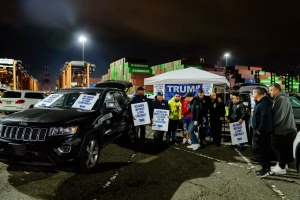
Dockworkers at dozens of U.S. ports in the Eat and Gulf Coasts are digging in for a massive pay increase, seeking to flex their power in a strike that aims to strangle the flow of trade across much of the country, reports The Wall Street Journal (Oct. 2, 2024). “Nothing is going to move without us,” said the head of the longshoremen’s union. The union wants to raise the base hourly rate for its roughly 45,000 members to $69 from $39, a 77% pay increase. It argues that its members deserve a big raise after working through the pandemic.

Members of the Longshoremen’s union began picketing this week.

Dockworkers typically earn a six-figure annual salary because of work rules and overtime requirements. More than half of  dockworkers at the Port of New York and New Jersey earn more than $150,000, with 1/5 earning over $250,000. Republican lawmakers have stepped up calls for the administration to invoke federal law to keep the ports open. After wages are agreed, the two sides still need to bargain over thorny issues such as expanded use of automation, which the union wants to prohibit.

The walkout shuts down some of the country’s main gateways for imports of food, vehicles, heavy machinery, construction materials, chemicals, furniture, clothes and toys. Big retailers, with their busy fall shopping season just starting to kick in, say that for now they can withstand the slowdown because they brought in products earlier than usual this year and diverted other cargoes to West Coast ports in case of a strike. (Container imports into U.S. West Coast ports expanded 22% over last month).

But a walkout lasting a week or longer would push up shipping costs and might trigger product shortages. A strike lasting even one week would tie up ships for much longer periods, which could exacerbate shipping delays, eat up capacity and drive up freight rates, leading to logistical challenges for businesses relying on East Coast and Gulf ports. About 60% of containerized trade moves through these ports where dockworkers last year unloaded about $588 billion of imports.

One Florida importer that sells asparagus to supermarkets is having to fly in vegetables that would usually arrive by containership. It is adding 50 cents a pound to the prices to cover the higher airfreight costs.

Classroom discussion questions:

  1. What can supply chain managers do in a situation such as this?
  2. What are the major issues behind the strike?


OM Podcast #25: Global Supply Chain Disruptions

In our latest, very timely podcast Barry Render interviews David Panzera, Vice President of Purchasing for FXI, who has 30 years of experience in global supply chains.  Dave and Barry discuss disruptions to global supply chains, including increasingly common weather events and the lingering, long-term impacts they have.


Transcript

A Word document of this podcast will download by clicking the word Transcript above.


Did you know our podcast is now available on Apple podcasts? Just go to your Apple podcasts app, search “Heizer Render OM Podcast,” and subscribe to get all our podcasts on your mobile device as soon as they come out!

Instructors, assignable auto-graded exercises using this podcast are available in MyLab OM. See our earlier blog post with a recording of author and user Chuck Munson to learn how to find these, or contact your Pearson rep to learn more! https://www.pearson.com/en-us/help-and-support/contact-us/find-a-rep.html

OM in the News: Israel, Terrorists, and Global Supply Chains

“Let’s call it Operation Chutzpah,” writes The Wall Street Journal (Sept. 23, 2024). If, as is widely believed, the Mossad detonated pagers and walkie-talkies used by Lebanese Hezbollah terrorists, killing dozens and wounding thousands, it will go down as an intelligence operation for the history books. This strike is the latest in a string of daring operations from the tunnels beneath Gaza to the heart of Tehran by The Startup Nation, as Israel is known in tech circles.

The Hezbollah terrorist group is funded by Iran

The attacks on Hezbollah this week using explosives planted inside electronics highlight the risks and vulnerabilities of technology supply chains. “Every board, every CEO, government, has now woken up today to the fact that products that we buy could be compromised,” said one CEO. “This is weaponizing of the supply chain.”

Many electronics manufacturers outsource production of relatively low-cost items such as pagers, which makes it difficult to track and verify the source of each piece within the final product. Companies often ship their designs for devices off to contract manufacturers who handle sourcing the components and assembly of the final goods.

“There’s multiple distributors, there’s multiple contract manufacturers, there’s multiple boards, there’s multiple locations. It’s just a really confusing array of people” in electronics supply chains, said a UNC prof in The Wall Street Journal (Sept 22, 2024). The complicated, multistep manufacturing process involving often far-flung suppliers introduces risk that parts inside finished products may be counterfeit or manipulated. The added tiers in outsourced manufacturing make it harder for buyers to know where the goods and their components are coming from.

Supply lines for everything from food and medicines to military material are perpetually targeted in armed conflicts, but this week’s attacks mark an audacious effort to embed itself within Hezbollah’s supply chain. Thousands of pagers carried by members of the terrorist group exploded. Then, the next day, walkie-talkies used by the group blew up  in terrorists’ hands across Lebanon. The attack not only damaged communications, but exposed to family and friends that the targeted individuals belonged to Hezbollah.

Western governments have also been cracking down on foreign-made equipment due to national security concerns about spying and cyberattacks. The U.S. just found Chinese cargo cranes used at seaports around the country had embedded technology that could allow Beijing to covertly gain access to the machines.

Classroom discussion questions:

  1. What can be done by the U.S. and other nations to prevent malware or other tools from damaging critical infrastructure?
  2. How was Israel able to manage this feat?

Guest Post: How Fastenal Weathers the Storm

Temple U. Professor Misty Blessley shares her insights with our readers monthly.

The Atlantic hurricane season in the U.S. runs from June through November, with most hurricanes making landfall between Florida and Texas. The National Oceanic and Atmospheric Administration (NOAA) has forecasted that the 2024 hurricane season could be one of the busiest on record. Hurricane Beryl, a Category 5 storm that struck Houston on July 8, is the earliest such hurricane in Atlantic history, setting a severe tone for the season. Ensuring access to supplies when and where they are needed is crucial for the region’s ability to withstand and recover from hurricane-related disruptions.

Here is the contingency plan for Fastenal, an international industrial and supply solutions company. The season began with Fastenal’s onsite team stationed at a Phillips 66 refinery in Texas, directly in Hurricane Beryl’s path. Due to the sensitive nature of their operations, refining companies must manage weather events with extreme care, which is why Fastenal staffs these sites with onsite personnel. Hurricane Beryl’s impact went beyond refineries, temporarily halting operations across Houston’s maritime, air, and motor carrier sectors, affecting numerous businesses.
In addition to its mitigation efforts with Phillips 66, Fastenal’s plans to bolster the region’s resilience, include:
 A corporate communication channel for providing rapid support to customers in affected areas.
 Ample stocks of hurricane-specific supplies, such as generators and water, at four major distribution centers (Dallas, Houston, Atlanta, and Jackson, Mississippi).
 Having distribution teams on standby to deliver supplies to affected areas as soon as access is granted.
 A private fleet allowing for quick and flexible response.

As highlighted in Chapter 11 of your Heizer/Render/Munson text, “Companies need to focus not only on reducing potential disruptions but also on how to prepare for responses to inevitable negative events.” Fastenal credits the company’s dedicated staff and advanced technology—such as its warehouse management system, which can handle both planned and unplanned orders—for its ability to respond to crises like Hurricane Beryl.

Classroom discussion questions:
1. In Table 11.3 supply chain risks and tactics are covered. Which of the risk reduction tactics is 2most beneficial in the event of a catastrophic weather event?
2. Review other weather-related disruptions and identify contingency plans. Hint: Icelandic volcano eruptions and Texas snowstorms

OM in the News: What is a a “Monster Train”?

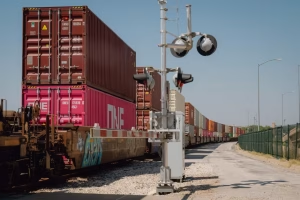
As we note in Chapter 11 (Supply Chain Management), railroads in the U.S. ship 40% of the ton-miles of all commodities, including 93% of all coal, 57% of cereal grains, and 52% of basic chemicals. But freight trains are getting longer—some of them 3 miles or more—and that is making life unpleasant in states like Texas. Sprawling rail yards, like those of Union Pacific in Houston, assemble trains that can pull hundreds of railcars that regularly cut off local roads for residents.

In Fort Worth, Texas, the fire department sometimes sends two trucks from different directions in case there is a blocked crossing

Railroaders call them monster trains. Railroad firms are making trains longer because they generate higher profits, allowing the companies to haul goods with fewer locomotives and fewer crew. writes The Wall Street Journal (Sept. 16, 2024).  Long trains are typically slower, so drivers must wait longer for them to pass. When these trains stop moving, things get worse. School buses, ambulances and firetrucks are delayed. Pedestrians and cyclists clamber under or between train cars to get across—and the results can be deadly.

Blocked crossings in Texas and elsewhere have become a more frequent occurrence. There are no federal limits on train length.  More than a dozen states, including Texas, have introduced bills to limit train length to 1.6 miles, but states can’t enforce them because they are barred from interfering with interstate commerce.

At Union Pacific, which gets the most complaints for blocked crossings, trains can reach around 20,000 feet, or 3.8 miles. Railroads, says Union Pacific’s CEO, seek to balance safety, customer demand, efficiency and the trains’ impact on communities. For his customers to beat competitors, he must maximize efficiency, he adds. “That’s the way I look at it. It’s business.”

Railroads also say the use of long trains reduces the emission of greenhouse gases. Labor unions, though, say long trains increase safety hazards and threaten their jobs.  A 3-mile train traveling at 25 miles an hour takes 7 minutes and 12 seconds to clear a crossing, plus 20 seconds for the gate warning. And monster trains also often come apart, causing crews to take a 1/2 hour to walk their length and recouple them.

Houston is the city hardest hit by blocked crossings in the country. “People can’t get to work on time in the mornings or get back home in the evenings”, says a City Council member.

Classroom discussion questions:

  1. Since trains are a backbone of shipping systems, what can be done to improve efficiency?
  2. Have you had an experience like that of Texas residents?

OM Podcast #24: Andreas Wieland’s New Book–Supply Chain: A System in Crisis

Welcome to our newest podcast.  In this podcast Barry Render interviews Andreas Wieland, a professor of Supply Chain Management at the Copenhagen Business School and Editor of the Journal of Supply Chain Management.  Andreas and Barry discuss Andreas’ new book, Supply Chain: A System in Crisis, as well as other topics such as the circulator economy and the latest trends in journals.


Did you know our podcast is now available on Apple podcasts? Just go to your Apple podcasts app, search “Heizer Render OM Podcast,” and subscribe to get all our podcasts on your mobile device as soon as they come out!

Transcript

A Word document of this podcast will download by clicking the word Transcript above.

Instructors, assignable auto-graded exercises using this podcast are available in MyLab OM. See our earlier blog post with a recording of author and user Chuck Munson to learn how to find these, or contact your Pearson rep to learn more! https://www.pearson.com/en-us/help-and-support/contact-us/find-a-rep.html

OM in the News: The Role Ports Play in Global Supply Chains

I am taping a podcast in a few weeks with an executive of the Port Of Philadelphia (PA), and in preparation have been learning about how ports operate and how efficient they are.

Maritime transport, it turns out, forms the foundation of global trade and the manufacturing supply chain. The maritime industry provides the most cost-effective, energy-efficient, and dependable mode of transportation for long distances. More than 80% of global merchandise trade is transported via sea routes. A considerable and increasing proportion of this volume (35% of total volumes and 60% of commercial value) is carried in containers.

Containerization brought about significant changes in how and where goods are manufactured and processed, a trend that is likely to continue with digitalization. Major container ports, of which there are 405 in the world, are critical nodes in global supply chains and essential to the growth strategies of many emerging economies. The development of high-quality container port infrastructure operating efficiently has been a prerequisite for successful export-led growth strategies. Such ports facilitate investment in production and distribution systems, expand manufacturing and logistics, create jobs, and raise income levels.

But inefficient ports and terminals cause shipment delays, disruptions in supply chains, additional expenses, and reduced competitiveness. The negative effect of poor performance in a port can extend beyond as container shipping services follow a fixed schedule with specific berth windows at each port of call on the route. Poor performance at one port can disrupt the entire schedule. This, in turn, increases the cost of imports and exports, reduces country competitiveness, and hinders economic growth.

Comparing operational performance across ports has been a major challenge for improving global value chains. But new technologies and industry willingness to work toward systemwide improvements now provide an opportunity to measure and compare port performances (such as vessel time in port) in a reliable manner. The World Bank and S&P’s Global Market Intelligence have recently produced the 2023 Container Port Performance Index (CPPI).

The top-ranked container ports in the CPPI 2023 are Yangshan (China), followed by Salalah (Oman), Cartagena (Columbia), and Tangiers (Morocco). Where do U.S. ports fall in the rankings? None are in the top 10%: Charleston (53), Philadelphia (55), Miami (77), Boston (75), Wilmington (81), NY/NJ (92), Jacksonville (99), New Orleans (167), Mobile (173), Baltimore (189), Tampa (219), Honolulu (224), Virginia (301), Houston (312), Seattle (360), Long Beach (373), LA (375), and Savannah (395).

Why don’t our ports rank higher? Good question. Listen to our upcoming podcast and find the answer!

Classroom discussion questions:

  1. Why is port efficiency an important OM issue?
  2. Why do you think the U.S. ports are not the most highly ranked?

OM Podcast #23: Global Supply Chain Management at Ricoh USA

We are in full swing with new podcasts coming every 2-3 weeks for you this semester.  In our most recent podcast Barry Render interviews Todd Ahern, Vice President of Supply Chain for Ricoh, USA, the biggest producer of large printers in the world.  Barry and Todd discuss the complexity of supply chains for a global company with facilities in Asia, Mexico, and the US.


Did you know our podcast is now available on Apple podcasts? Just go to your Apple podcasts app, search “Heizer Render OM Podcast,” and subscribe to get all our podcasts on your mobile device as soon as they come out!

Transcript

A Word document of this podcast will download by clicking the word Transcript above.

Instructors, assignable auto-graded exercises using this podcast are available in MyLab OM. See our earlier blog post with a recording of author and user Chuck Munson to learn how to find these, or contact your Pearson rep to learn more! https://www.pearson.com/en-us/help-and-support/contact-us/find-a-rep.html

OM in the News: Retreating EVs and the Impact on Supply Chains

“Ford Motor’s decision this week to kill a highly touted future electric vehicle is a sign that the industry’s pullback on EVs is deepening,” writes The Wall Street Journal (Aug. 23, 2024).  It is canceling plans for an electric SUV once touted as a “personalized bullet train.” The move added to the drumbeat of news from carmakers of delayed or scrapped investments into EV models, factories and battery projects.

Dealers’ lots are getting pretty crowded as EVs from Tesla, Ford, Mercedes, and more fail to move.

GM, VW, Mercedes and other automakers also have curbed their EV ambitions in recent months. Taken together, the walked-back plans are an acknowledgment that the big investments outlined at the start of the decade got ahead of the consumer’s appetite for a full switch to EVs.

Delaying some EV investments will conserve cash and buy automakers time to lower their battery costs and other EV-related expenses.  EV startups including Rivian, Lucid and Polestar are laying off workers, and Fisker has declared bankruptcy.

But cuts to planned EV output have hurt the parts supplier base, which has had to adjust its business. Magna, one of the world’s largest auto-parts suppliers, had been gearing up to make battery trays, seats and other parts for Ford’s now-scrapped electric SUV. Dana, another large supplier serving Ford and Stellantis, had expected sales of battery-cooling systems and other EV-related components to jump by 1/3 this year. “Like most things that are new or disruptive, a lot of times forecasts and expectations can get ahead of some of the practicalities,” said Dana’s CFO.

The cost of batteries is so high that most big automakers are in the red on their electric offerings. Ford’s EV business is on pace to lose $5 billion this year, with losses averaging $44,000 per electric vehicle sold!

Instead of offering the electric SUV, Ford plans to produce hybrid, gas-electric versions. It also delayed for a second time the opening of a new EV truck factory, the largest investment in its history, which is now set for a 2027 opening, two years later than initially planned.

New emissions rules from the Biden administration will in effect require a heavy dose of EVs in the late 2020’s. To comply, automakers will need to introduce more plug-in hybrid vehicles. Car companies are likely to focus on fully electric systems for small- and midsize vehicles, and hybrids for larger ones.

Classroom discussion questions:

  1. Why has the shift to EVs cooled?
  2.  What is the impact on 1st and 2nd tier suppliers?

OM in the News: Boeing Has Trouble Finding a Big Parking Lot

“Boeing has a parking problem,” writes The Wall Street Journal (July 22, 2024).  Parts shortages and other issues have left the jet maker with about 200 fully or mostly finished airplanes sitting in airfields, outside plants and in an employee parking lot.  Some of the planes are awaiting interiors; others need engines. Dozens more are awaiting delivery to China.

Unable to fly, the planes aren’t delivering much-needed cash as Boeing burns through more than $1 billion a month.

Unable to fly, the planes present a host of logistical challenges. Planes sitting around too long may need software or other updates. Moving unfinished jets is tricky, especially if the part they are missing is the engine, as is the case with a handful of 777 freighters.

The predicament comes as the jet maker grapples with production slowdowns and regulatory scrutiny in the wake of January’s near catastrophe on an Alaska Airlines flight. Boeing has delivered 175 planes through June of this year, compared with 266 through the first half of 2023.

This isn’t the most dire parking predicament Boeing has faced in recent years. Following the grounding of Boeing’s bestselling 737 MAX due to crashes in 2018 and 2019, the company had about 450 of those planes stashed in its facilities. At another point, it had more than 100 787s parked, which presents a space conundrum given the planes’ size. Currently, there are 10-15 787s awaiting inspections to ensure the planes are built to specification. The company added that step several years ago after employees raised concerns about potential production issues.

“This creates constraints,” one industry expert said. “There is a cost and an operational penalty. It’s something you really want to avoid as much as possible.”  Today, more than half of the parked planes are single-aisle 737 MAX’s still awaiting delivery, some of which are now several years old.

The company says it hasn’t become so tight on space that it has to stop or slow production—what is referred to in the aerospace industry as being “jiglocked.” Supplier shortages, lingering from the supply-chain crisis born amid the pandemic, have saddled the company with planes short of parts.  Shipments of the 787 model have slowed as Boeing grapples with a shortage of cabin seating. Seat suppliers industrywide haven’t been able to keep up with demand for cabin premium offerings, amid material shortages and certification delays.

Classroom discussion questions:

  1. What are the main OM issues facing Boeing today?
  2. Boeing has faced quality issues with its fuselages. What has it recently done to solve this problem?

OM in the News: The Rare-Earth Supply Chain Issue

The U.S. and Europe would love to cut their dependence on China for rare earths, reports The Wall Street Journal (July 16, 2024). Standing in the way of that ambition are low prices and Beijing’s willingness to throw its weight around to keep the market down.

Rare earths are a set of 17 metallic elements that are an essential part of many high-tech devices.

Rare-earth prices have plummeted this year and are now hovering at 3-year lows. The price of neodymium, a silver-gray alloy, has fallen by almost 20% this year to $50,000 a metric ton. Other rare earths are down even more.

Today, these neodymium minerals are mainly used in permanent magnets for a range of essential household items such as TVs, refrigerators and headphones. Increasingly, though, the magnets also help turn motors in electric vehicles, wind turbines and robots. By 2030, such high-tech products are expected to account for 2/3 of demand for neodymium permanent magnets.

Yet despite the promise of soaring demand driven by the energy transition, prices of rare earths have spiraled downward since 2022. A glut of Chinese supply is one problem. In recent years, Beijing has ramped up production of rare earths. In 2024, China ordered its state-owned miners to produce 135,000 metric tons of rare earths, up 13% from the quota in 2023.

At the same time, demand for rare earths hasn’t lived up to expectations. EV sales, for example, have slowed globally amid wavering consumer sentiment.

China’s overproduction, with its increasingly negative impact on industry profits, only makes sense as part of a broader economic strategy. The country produces 60% of the world’s mined rare-earth minerals. In recent years, it has also tightened its grip on the entire magnet supply chain: It controls 91% of refining activity, 87% of oxide separation and 94% of magnet production.

One theory is that Chinese overproduction is designed to stymie efforts to develop alternative sources of supply. Low prices of rare earths have squeezed margins for Western producers. This situation has long worried the West. The U.S., European Union, U.K., Canada and Australia have all drafted “critical mineral” strategies. To stand a chance of loosening China’s grip on rare earths, the West will need to deploy the country’s own tactics: unprofitable production and long-term thinking.

Classroom discussion questions:

  1. What options do operations managers have with regard to the rare earth supply chain?
  2. Will China’s strategy work?

OM in the News: GE Appliances’ Supply Chain Overhaul

GE Appliances, one of the largest home-appliances manufacturers in the U.S., says a $2 billion effort to remake its supply chain has helped it double revenue since 2017. The Louisville-based company, now a subsidiary of China’s Haier Smart Home, has added manufacturing capacity, opened seven new distribution centers and implemented digital tools to knit together operations from production through to delivery. It is an example of how companies are resetting their supply chains to be more flexible, moves that come after retailers and household goods companies navigated disruptions, shipping delays and dramatic shifts in consumer demand during a chaotic period marked by waves of stockouts and overstocking.

“A lot of companies are really striving to create increased visibility in their supply chains and also to build greater resilience in their supply chains,” said an N.C. State professor. That includes efforts to “improve coordination and integration and scheduling, and at the same time, try to reduce their inventory.”

One of the biggest changes has been to bring more manufacturing into the U.S. from Asia, reports The Wall Street Journal (July 8, 2024). GE has added 4,000 manufacturing jobs across its nine U.S. plants over the past seven years. Shifting production from overseas has cut shipping costs by reducing the number of bulky appliances that are sent across the Pacific Ocean and has given GE more control over production. When you have something that’s in a container on a boat for six weeks, it’s difficult to change your orders and be able to adjust to shifts in demand.

GE also measures inventory differently today than before the pandemic. The appliance company previously tracked “weeks on hand,” which measures finished products relative to how many units typically sell in a given week. It now tracks customer orders delivered on-time and in-full, a measure that prioritizes existing orders so the company doesn’t spend time manufacturing items that aren’t in demand. To accommodate that change, GE installed digital tools that allow factories to see upcoming customer orders. The plants can then manage production schedules to ensure orders are ready on time, but not too early. Storing bulky, fragile appliances in a warehouse for a long time eats up space, adds storage costs and increases the risk of damage.

Classroom discussion questions:

  1. What is the difference between “weeks on-time” and “on-time and in-full”? Hint: See our Feb, 25, 2024 blog
  2. What major OM moves ae described in this piece on GE Appliance?