Where is the energy to power the hundreds of new data centers that are popping up to run artificial intelligence demands coming from? “In the battle for AI dominance, every engine of the economy is getting recruited into the fight—including jet engines'” writes The Wall Street Journal (Feb. 18, 2026).
Jet engines are a natural fit. Power equipment giants GE Vernova, Siemens Energy, and Mitsubishi Heavy Industries already sell power turbines—known as aeroderivatives—that are modeled after these very jet engines. Aircraft engine companies such as GE Aerospace , Howmet Aerospace and Woodward also sell land-based aeroderivative turbines or components.
Yet designing the turbine, which keeps as much of the original jet engine features as possible, is a roughly 18-month undertaking. Instead, it only takes 30 to 45 days to convert a plane’s jet engine to a power-generating turbine. (There are 2 main modifications to convert an aircraft engine to a land-based natural gas turbine. One is replacing the fuel nozzles to utilize natural gas instead of jet fuel. The other is replacing the large fan on the front of the flight engine with a much smaller fan).
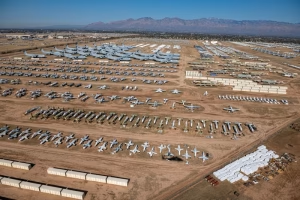
A company can remanufacture jet-engine parts with a few years of remaining life for use in power turbines, where they can operate for many additional years. Narrow-body jet engines experience higher stress from repeated takeoffs and landings. Power turbines can run as peakers—turning on only when demand surges—or continuously as baseload. Either way, they accumulate less wear and tear.
About 1,600 commercial aircraft engines are retired every year. If a third of those engines get converted into turbines, that would represent about 13 GW of capacity, or more than a quarter of the existing global natural gas turbine capacity.
AI-obsessed tech giants are planning to spend more than $700 billion in capital expenditures this year. The lure of that cash pile will generate a lot of creativity in the power sector.
Classroom discussion questions:
- Why is there a need to convert jet engines?
- Discuss the growth of data centers and the demands they create. (See our recent post on that topic.)
 Manufacturing faces a dual disruption. AI, robotics and automation are reshaping production at unprecedented speed, while skilled labor shortages intensify when experienced workers retire, taking decades of knowledge with them.


 Perhaps the most immediate and profound impact of generative AI in industry is its function as a “generative user interface” or “Gen UI.” For decades, interacting with complex industrial software and data systems required specialized training. Engineers needed to learn specific query languages to pull data; operators had to navigate complex, menu-driven screens on a human-machine interface; maintenance staff had to know exactly where to find a specific manual in a labyrinthine document management system. The Gen UI changes everything. It provides a conversational, natural language layer that sits between the human user and complex backend systems. It radically lowers the barrier to entry for accessing critical information.
 Dr. Misty Blessley is a professor at Temple U. She shares her insights monthly.
 More than a century ago, Ford’s moving assembly line reorchestrated work. Instead of a master mechanic walking to each car to perform complex tasks, the car moved to workers, who each executed a single repeatable action. As a result, work became easier, costs fell and return on investment skyrocketed.

 Professor Howard Weiss, developer of our POM and Excel OM software, shares his thought with our readers monthly.
 Self-service fare collection was developed in Europe in the 1960s by transit agencies facing labor shortages and the need to reduce costs. Originally, subway passengers went through a turnstile serviced by someone who collected the fare. In most modern systems turnstiles are unstaffed, and many riders have been jumping half-height turnstiles or sneaking in behind another passenger. On buses, some riders enter through the rear exit or emergency doors.
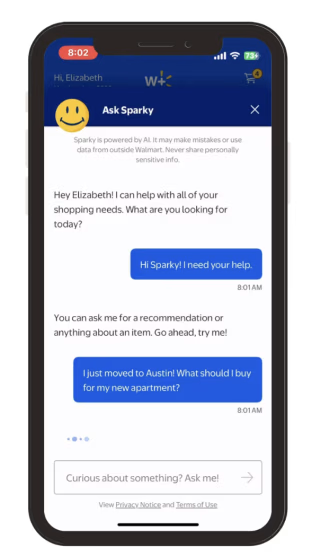 Walmart’s situation is unique, with most companies still figuring out how to deploy even one AI-powered agent that can perform a task autonomously or in coordination with humans.