
Armies of humanoid robots are poised to march into the world’s factories. But before they’re ready to turn a wrench, they must solve what Elon Musk calls “the hands problem.”
 Creating the mechanical equivalent of the human hand is a challenge that has been stumping researchers for years, writes The Wall Street Journal (Oct. 27, 2025) . Replacing muscle and skin with motors and sensors is a critical step in making humanoids a versatile source of labor, potentially unlocking a global market that could reach $5 trillion by 2050.
The robotic hand of the future will need many sensors to emulate a human hand. Holding a pencil, for example, would require sensors along the sides of several fingers.
Tesla’s humanoid robot—called Optimus—is good at walking, but making hands that can match a human’s has been a far tougher job. “In order to have a useful generalized robot, you do need this,” Musk said. “You do need an incredible hand.”
Boston Dynamics has equipped its Atlas humanoids with hands that have only three fingers. They can form a palm that allows the robot to lift boxes or brace itself. One digit also can rotate to serve as a thumb, letting the robot grasp objects. The humanoid can pick up auto parts, pump a dumbbell and pluck a tissue from a box. But a robotic hand must make trade-offs between strength, dexterity, slenderness and ruggedness. Increasing one attribute can diminish another.
Industrial robots have relied on pincerlike hands for decades, and are still the most cost-effective form. MicroFactory (in San Francisco) produces a $5,000 robot that has two arms, one of which typically is equipped with a tool, the other with a 2-digit gripper that holds an object in place. That setup can perform most of the functions needed for electronics assembly, such as soldering, inserting screws or peeling off protective films.
The difficulties of re-creating the human hand lead to questions about why it is being done, given that the real thing already exists in humans. The answer: the shortage of workers for factory and caregiving jobs is driving the need for alternatives.
Classroom discussion questions:
- There are almost a half-million open factory jobs in the U.S. Given the tight job market, will your students be willing to take them?
- Why are humanoid robots so sought after?


 Perhaps the most immediate and profound impact of generative AI in industry is its function as a “generative user interface” or “Gen UI.” For decades, interacting with complex industrial software and data systems required specialized training. Engineers needed to learn specific query languages to pull data; operators had to navigate complex, menu-driven screens on a human-machine interface; maintenance staff had to know exactly where to find a specific manual in a labyrinthine document management system. The Gen UI changes everything. It provides a conversational, natural language layer that sits between the human user and complex backend systems. It radically lowers the barrier to entry for accessing critical information.
 Dr. Misty Blessley is a professor at Temple U. She shares her insights monthly.
 More than a century ago, Ford’s moving assembly line reorchestrated work. Instead of a master mechanic walking to each car to perform complex tasks, the car moved to workers, who each executed a single repeatable action. As a result, work became easier, costs fell and return on investment skyrocketed.

 Professor Howard Weiss, developer of our POM and Excel OM software, shares his thought with our readers monthly.
 Self-service fare collection was developed in Europe in the 1960s by transit agencies facing labor shortages and the need to reduce costs. Originally, subway passengers went through a turnstile serviced by someone who collected the fare. In most modern systems turnstiles are unstaffed, and many riders have been jumping half-height turnstiles or sneaking in behind another passenger. On buses, some riders enter through the rear exit or emergency doors.
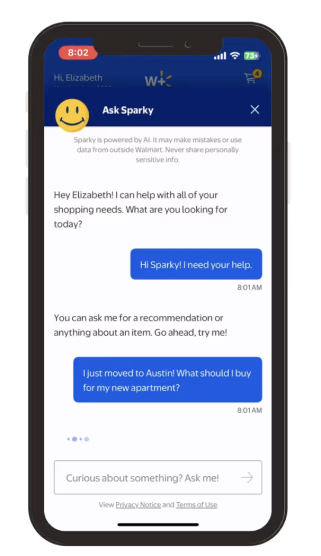 Walmart’s situation is unique, with most companies still figuring out how to deploy even one AI-powered agent that can perform a task autonomously or in coordination with humans.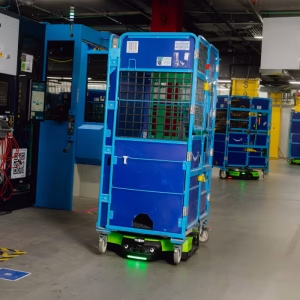
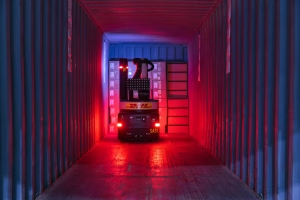
 For over a decade, self-checkout was the retail future, speed, convenience, and cost savings.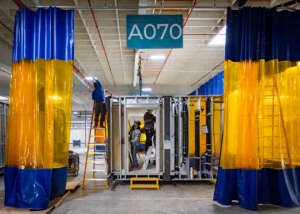

 Starbucks says new technology is helping fix one of its customers’ biggest gripes: waiting too long for their coffee. A technology pilot at dozens of U.S. locations has shaved 2 minutes off the average time to make a beverage ordered inside cafes. Starbucks said 3/4 of orders at the test cafes’ busiest times were completed in 4 minutes or less, nearing its service-time goal, while not delaying mobile orders.