OM in the News: Robots Are Remaking Chinese Industry

Sam Altman wants AI to cure cancer. Elon Musk says AI robots will eliminate poverty. China is focused on something more prosaic: making better washing machines. While China’s long-term AI goals are no less ambitious than ours, its near-term priority is to shore up its role as the world’s factory floor for decades to come, reports The Wall Street Journal (Nov. 25, 2025).

Midea, an appliance maker, deploys robots to work under an AI ‘factory brain’ that acts as a central nervous system for its plant in Jingzhou.

The Chinese push is fueled by billions of dollars in government and private development– transforming every step of making and exporting goods. A clothing designer reports slashing the time it takes to make a sample by more than 70% with AI. Washing machines in China’s hinterland are being churned out under the command of an AI “factory brain.”

Port shipping containers whiz about on self-driving trucks with virtually no workers in sight, while the port’s scheduling is run by AI.

Chinese executives liken the future of factories to living organisms that can increasingly think and act for themselves, moving beyond the preprogrammed tasks at traditionally-automated factories. This could further enable the spread of “dark factories,” with operations so automated that work happens around the clock with the lights dimmed.

The advances can’t come quickly enough for China as its population is shrinking, young people are avoiding factory jobs, and pushback against Chinese exports has intensified.

AI offers a lifeline to head off those risks, by helping China make and ship more stuff faster, cheaper and with fewer workers. China wants to deploy what is available today quicker than the U.S. can, locking in any advantages. It installed 295,000 industrial robots last year, 9 times as many as the U.S. and more than the rest of the world combined. Its stock of operational robots surpassed 2 million in 2024

Today, China’s average factory wages are far higher than in countries such as India. Many young Chinese are unwilling to work in factories.  The shortage of skilled labor in key manufacturing sectors could reach 30 million this year. Since most Chinese are optimistic about AI, this allows the government to deploy the technology quickly. About 83% of Chinese believe AI-powered products and services are more beneficial than harmful, double the level in the U.S.

Classroom discussion questions:

  1. Why the push for robotics and AI in China?
  2. What can the U.S. and Europe do to remain competitive?

OM in the News: Europe’s Move Towards Rare-Earths

Europe is trying to get itself on the global rare-earths map. Estonia, once a textiles hub for the Russian Empire, is now host to Europe’s biggest production plant for the kinds of rare-earth magnets needed in electric cars and wind turbines. It is part of Europe’s push to secure a foothold in a global supply chain dominated at every step by China, reports The Wall Street Journal (Nov. 16, 2025). Financed in part by the EU, the factory is expected to begin deliveries to companies in 2026.

Production of rare-earth magnets is expected to increase at the factory in Estonia, but it still isn’t expected to meet Europe’s projected demand.

The problem: Even at the new factory’s initial planned capacity of 2,000 tons of permanent magnet material, the plant will produce a fraction of what European manufacturers need. There are plans to scale up production to 5,000 tons, but that is still a long way from being enough to break Europe’s dependence on China. Total European demand is forecast to reach about 45,000 tons by 2030.  (Companies in the U.S. are planning to build more than 40,000 tons of capacity by 2030).

After China imposed new export restrictions for rare earths this year, the U.S. stepped up subsidies and other measures to support the industry, spurring a race to build out American mining, processing and manufacturing capacity. Rare earths are also essential to manufacturing many defense systems. European auto suppliers were already eager to diversify their permanent magnet sources before China’s move.

Rare-earth magnets are widely used in products such as electric cars and wind turbines

Europe prospered over recent decades in a global trading system that allowed it to import cheap gas from Russia and rare earths from China, powering its industrial base. But Russia’s invasion of Ukraine and China’s move to restrict rare-earth exports showed how dependent the continent had become on those countries. Europe has some rare-earth processing and recycling facilities but no active rare-earth mining. For now, EU producers are relying on customers being willing to pay a premium to avoid dealing with China’s restrictions.

Classroom discussion questions:

  1. Why does China exert such power over the rare earth supply chain and why is that supply chain so important?
  2. What else can the U.S. and EU do?

OM in the News: U.S. Manufacturing Resurgence Will Be Powered by Cobots

Once a luxury reserved for big manufacturers, smaller, smarter, more flexible and less expensive “cobots”—collaborative robots—are bringing automation to every fabricator, no matter the size. The slow, fragile recovery of American goods production wouldn’t be possible without them, writes The Wall Street Journal (Oct. 11-12, 2025).

The number of U.S. companies that make physical things reached a low point in 2014 and has grown since then. Yet they are trapped in a never-ending labor shortage as skilled workers age out, and young people fail to take their place.

China has the greatest number of industrial robots, including these at a factory in Nanjing.

China has become the de facto manufacturer of the world’s goods, owing not only to its enormous population of engineers, technicians and machinists but also its 2-million-plus army of industrial robots. Now the U.S. is attempting to claw back some of those contracts—called “reshoring”—and robots can in some cases quadruple worker output.

The push to bring manufacturing back to the U.S., and the demand for industrial goods to power America’s AI-fueled economy, are driving automation adoption and innovation. “Automation is key to reshoring, plain and simple,” says one CEO.

Cobots have become radically easier to program over the past decade, and now people can use a simple tablet interface to instruct them to perform specific sequences of actions. Programming the older robots common in automotive factories since the 1960s took years of training.

Cobots are part of a broader trend in robotics: Specialized robots that use sensors to safely navigate human environments. They can cope with more variability than previous industrial robots, which had no sensing abilities. This has been essential to the rise of Amazon and its superfast fulfillment, and now it’s coming to manufacturing.

China is indisputably the leader in high-volume manufacturing, and companies that want the biggest volumes of manufactured parts for the lowest possible price continue to send work there. And though many U.S. manufacturers can’t match their Chinese peers in volume, they are competing by using automation to tackle smaller batches of goods under tight deadlines. Manufacturers in the U.S. are now asking how to reshore the making of critical parts.

Classroom discussion questions:

  1. What is a “cobot” and how does it differ from a robot?
  2. Why has China become such a powerful manufacturing hub?

OM in the News: China’s Rare-Earth Escalation Threatens the Global Economy

China’s newest restrictions on rare-earth materials would mark a nearly unprecedented export control that stands to disrupt the global economy and threaten the supply chain for semiconductors, writes The Wall Street Journal (Oct. 10, 2025). Chips are the lifeblood of the economy, powering phones, computers and data centers needed to train artificial-intelligence models. The rule also would affect cars, solar panels and the equipment for making chips and other products, limiting the ability of other countries to support their own industries. China produces roughly 90% of the world’s rare-earth materials.

A rare-earths production site in China

Global companies that sell goods with certain rare-earth materials sourced from China accounting for 0.1% or more of the product’s value would need permission from Beijing, under the new rule. Tech companies will probably find it extremely difficult to show that their chips, the equipment needed to make them and other components fall below the 0.1% threshold.

“These rare-earth minerals and the ability to refine them are just the basis of modern civilization,” said  one industry expert. “It’s an economic equivalent of nuclear war—an intent to destroy the American AI industry,” added a second. The U.S. and other countries are pouring hundreds of billions of dollars into data centers, making AI a key economic engine. China gaining control of the technology would potentially let it catch up in the AI race and upend the world order.

The semiconductor supply chain is vulnerable to actions like China’s because large chip plants require big capital investments from an ecosystem of companies providing specialized equipment, intricate technical processes and final packaging. Companies in the U.S., Taiwan, Japan and the Netherlands all collaborate with one another.

The Trump and Biden administrations have offered subsidies and other policies to aid the process, but domestic capacity generally remains in its infancy. Some analysts said the new rules will fuel new urgency for big tech companies to invest more in these areas.

Classroom discussion questions:

  1. Why are rare earths so important?
  2. Why doesn’t the U.S. produce and process the minerals needed?

Guest Post: What a Chinese Drone Ban Means for U.S. Farming

Dr. Misty Blessley is a professor at Temple U. She shares her insights monthly.
DJI, a Chinese company and the world’s largest manufacturer of commercial and industrial drones, faces scrutiny in the U.S. over alleged cybersecurity risks. It is now close to being banned here.

One U. S. business that sells spray-drone kits reported that its challenges began last year when importing DJI drones became significantly more difficult. This uncertainty has caused concern across industries that rely on these tools, from public safety and construction to supply chain logistics. For American agriculture specifically, a ban could cut off access to vital equipment, leaving fields unmonitored, untreated, and risking harvest losses.

DJI drones are favored by farmers as they save weeks of labor by spraying seeds, fertilizer and fungicide from the sky.

Agriculture has adopted drones more rapidly than almost any other sector. Monitoring drones help detect disease and water stress early, while spray drones enable precise application of fertilizer and pesticides during narrow weather windows. They have become crucial for reducing input costs (China is accused of subsidizing their drone industry, which might explain some of the cost differences), protecting yields, and facilitating smooth food movement through supply chains. If imports are halted, many farmers could miss critical windows, leading to lower yields and creating issues along the supply chain, from processors to consumers.

Mitigation Strategies
To prepare, farming businesses should apply lessons learned from managing recent supply chain disruptions:
 Diversify suppliers – Start testing U. S. or non-Chinese alternatives, even if they are currently less cost-effective. Early adoption minimizes dependence.

Stock critical parts – As restrictions tighten, building an inventory now provides a safety buffer.

Use mixed fleets – Combine current drones with alternative technologies like ground sprayers to prevent single points of failure.

Plan operational slack – Stagger schedules or adjust operations to account for potential delays.

Collaborate and advocate – Engage with farm bureaus and trade associations to push for phased implementation, subsidies, or funding for domestic options.
 

Classroom discussion questions:
1• What are the challenges and drawbacks of each mitigation strategy?
2• Considering that the Chinese drone ban is likely, how should user decision-making be updated? (Refer to Module A Decision-Making Tools and consider these facts:◦ Drones can cut labor costs by up to 90% and reduce chemical use by 20–30%. ◦ A high-end U.S.-made drone can cost nearly $30,000, compared to a similar DJI unit costing $6,500).

OM in the News: Technology Supply Chains and the Shift From China

Rising costs, geopolitical tensions, and trade disruptions are causing tech giants like Apple, Samsung, Dell, and Nokia  to find suppliers at new locations across Asia, reports Material Handling & Logistics (June 19, 2025).

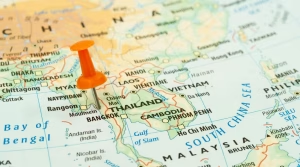
India, Malaysia, Thailand, Vietnam, and Taiwan have emerged as the most prominent alternative suppliers to China for the technology industry, despite Taiwan’s own geopolitical challenges.

The products most affected by these diversification strategies include smartphones, smart watches, computers, and laptops, representing core product lines for the world’s leading technology manufacturers.

Despite the rhetoric in support of nearshoring that was born out of the pandemic, U.S. companies like Apple have kept the largest share of their suppliers in Asia. This is because of the comparative advantage that exists in countries like India, Malaysia, Thailand, Vietnam, and Taiwan.

Here are the regional advantages of each:

India: Offers a large domestic workforce skilled in smartphone and laptop manufacturing at a fraction of the labor cost. The country has rapidly developed its technology manufacturing capabilities, particularly in smartphone assembly, where it has become a major production hub for both Samsung and Apple devices. India’s combination of technical expertise, lower wages, and massive domestic market makes it particularly attractive for technology companies.

Malaysia: Has well-established infrastructure and a low-cost workforce skilled in the back-end processes of semiconductor manufacturing. Malaysia has developed specialized expertise in semiconductor packaging and testing, making it a critical node in the global chip supply chain. The country’s established technology parks and government support for high-tech manufacturing have created a conducive environment for technology suppliers.

Vietnam & Thailand: Government incentives, including tax breaks for technology companies and funding for new facilities, have fostered an innovative environment for new suppliers. Vietnam has emerged as a particularly important alternative for smartphone and laptop manufacturing, while  Thailand has developed strengths in smartwatch and computer production. Both countries have benefited from their proximity to China’s supply ecosystem while offering lower costs and reduced geopolitical risk.

Taiwan: Taiwan is becoming increasingly prominent in the global computer parts supply chain. Taiwan’s world-leading semiconductor industry, centered around TSMC, gives it a unique and difficult-to-replicate advantage in high-end electronics manufacturing. The country’s technical expertise and established ecosystem for advanced electronics production make it an essential partner for many technology companies.

Classroom discussion questions:

  1. Does this article conflict with the the fact that reshoring continues to add jobs in the U.S.?
  2. What do these 5 countries have in common?

OM in the News: The Magnet Supply Chain and Auto Production Problems

In the auto industry, rare-earths are what allow electric-vehicle motors to function at high speed. They are also used in less exotic, though no less critical, functions performed by such parts as windshield wipers and headlights.

Ford shut down Explorer production at its Chicago plant in May because of a rare-earth shortage

China was supposed to have eased export controls on rare-earth magnets as part of a 90-day tariff truce agreement with the White House, but the country has slow walked license approvals for magnets. As exports of rare-earth magnets have virtually ground to a halt, carmakers face hard decisions about whether they can continue to keep some plants operating. Several production lines and plants across Europe have already closed, with more impacts expected in the coming weeks as inventories deplete, reports The Wall Street Journal (June 5, 2025). U.S., Japanese, and Indian vehicle production are also reducing or shutting down without more Chinese rare-earth components.

Car companies are looking at alternative sources for magnets in Europe and Asia, instead of purchasing them directly from Chinese factories as they do currently. But none of these sources would provide enough magnets to support the demand from the  industry. And  China controls almost all of the refining capability that transforms raw minerals into usable forms.

The lack of magnets hits EVs and hybrid vehicles harder than conventional cars and trucks. A typical EV contains far more rare-earths than a gasoline-powered model, but rare-earth magnets are found throughout any modern vehicle.

One option to conserve dwindling magnet supplies is reverting to older electric-motor technology that doesn’t make use of rare-earth magnets. Carmakers stopped using those motors because the current versions are cheaper and more efficient. They are also considering stripping out some premium features, such as adjustable seats, that make use of several tiny electric motors. High-end speaker systems that use rare-earth magnets could also be replaced with downgraded versions.

Classroom discussion questions:

  1. As Ford’s head of supply chains, what are your options?
  2. What is the long-term solution?

OM in the News: Can Apple Change Its Supply Chain?

President Trump recently demanded Apple and other smartphone makers like Samsung make their phones in the U.S. or face a 25% tariff, reports CNN Business (May 23, 2025). But Apple’s CEO, Tim Cook, says its plan is to manufacture iPhones set to be sold here at newly built plants in India, stating “the majority of iPhones sold in the U.S. will have India as their country of origin.”

Unlike Apple, Samsung doesn’t rely on China for smartphone production. The South Korean giant closed its last phone factory in China in 2019. The vast majority of its smartphone manufacturing takes place in South Korea, Vietnam, India and Brazil.

Treasury Secretary Scott Bessent stated: “I think that one of our greatest vulnerabilities are external production, especially in semiconductors, and a large part of Apple’s components are in semiconductors. So we would like to have Apple help us make the semiconductor supply chain more secure.”

The world’s most valuable publicly traded company is flush with cash and rakes in tremendous profit — more than any company in history. But Apple has long contended that it cannot manufacture iPhones here. It has instead invested billions of dollars training millions of skilled engineers abroad, claiming China and India simply have more skilled engineers–and that they cost significantly less.

In 2010, Steve Jobs, Apple’s late CEO, called America’s education system an obstacle for Apple, which needed 30,000 industrial engineers to support its on-site factory workers. “If you could educate these engineers, we could move more manufacturing plants here,” he told then-President Obama.

So, can Apple reshore  iPhone production? The notion is a “fictional tale,” says tech exec Dan Ives at Wedbush Securities. “U.S.-made iPhones could cost more than 3 times their current price of $1,000, because it would be necessary to replicate the highly complex production ecosystem that currently exists in Asia. You build that supply chain in the U.S. with a fab in West Virgina and New Jersey, they’ll be $3,500 iPhones. And even then, it would cost Apple about $30 billion and three years to move just 10% of its supply chain to the US to begin with.”

While moving iPhone production to the U.S. may not be possible, Apple did announce a $500 billion investment to expand its U.S. facilities earlier this year, in an effort to appease the President.

Classroom discussion questions:

  1. Is it true that China and India have more engineering talent than the U.S.?
  2. Discuss the pros and cons of reshoring iPhone production from an OM perspective.

OM in the News: EV Jitters Over a Rare Earth

Mining of rare-earth minerals in China

Caught in the middle of the U.S.-China trade war is a paper clip-size magnet that is vital to every new electric vehicle on the road. The magnet is made with dysprosium– a rare-earth mineral. More than 90% of refined dysprosium comes from China, and it is used in magnets that power everything from medical equipment to EV motors. (The magnets are used in the spinning portion of the EV motor that turns the wheels).

In its retaliation against U.S. tariffs, China slowed exports of several rare-earth minerals and magnets this month, setting off a panic among U.S. automakers. Rare earths, by the way, are used in almost everything that turns on. So far no other country has been able to produce them at the same scale and cost as China.

“You cannot build the motor without the magnet. If we want electric-vehicle production to continue to happen in the U.S., this has to be solved,” said one auto exec. Nearly 900,000 EVs were built in the U.S. last year.

The minerals are abundant in nature but difficult to refine into their pure form. They are the essential building blocks of much of modern technology, forming parts of everything from satellites and jet fighters to CT scanners and iPhone speakers.

The potential chaos related to the slowing of one link in the automotive supply chain illustrates how dependent the modern car industry is on global trade, writes The Wall Street Journal (April 28, 2025).  America’s disadvantage is twofold: There is currently only one large-scale dysprosium mine in the U.S., and processing facilities are only now coming online. The development of a new mine takes an average of 29 years in the U.S.

China’s head start on mining and extracting the precious elements makes it difficult to build alternative sources. A mine in China, to produce from an ore to oxide, costs $11 to $15 a kilogram. For a mine in Brazil, it’s $35 to $40 a kilogram, and even higher in the U.S. or Australia.

Classroom discussion questions:

  1. Why are rare earths so important? Name several products that require them.
  2. What are the alternatives that U.S. auto supply chain managers have?

OM in the News: India Moves Up the Value Chain

The first trade war, in 2018, helped India rise—and this second one could be transformative, writes The Wall Street Journal (April 19-20, 2025). “Is this India’s moment?” says the CEO of a major Indian electronics supplier. “Yes. But the country still needs improvement on the most important quality for a global supply chain: consistency. ”

With most Chinese exporters cut off for now from U.S. consumers by high tariffs, companies are looking for alternative places to produce and export to the U.S.—adding up to a golden opportunity for India. Global high-tech firms and retailers say India is a harder place to do business than China or Vietnam, owing to government red tape, restive labor groups and an often-punitive approach to compliance and taxation. Vietnam, a country of 100 million people, exports $50 billion more in goods to the U.S. than India, whose population is 1.4 billion.

Smartphones offer an example of what India can do when it puts its mind to it.

But now India wants to emulate what has made China the world’s unparalleled manufacturing powerhouse by offering not just manual assembly of goods but also design, parts and other knowhow. “We are looking at building the entire value chain in India itself,” said a government official.

For the moment, most Indian goods face only the 10% tariff the U.S. has imposed globally, and certain exempted electronics such as iPhones have no tariff. The tariff on most Chinese goods is 145% while those electronics items are subject to a 20% rate.

Apple is already moving to export more iPhones to the U.S. from India, and the country currently accounts for about 20% of iPhone production. A decade ago, when India started focusing on building phones, its annual mobile-phone exports were only $250 million. Now the figure exceeds $22 billion.

A second factory operated by Taiwan’s Foxconn is coming on line this year which will add annual production of 20 million phones, rivaling Foxconn’s first Indian plant. Smartphones are benefiting from the government’s attention and support, including manufacturing subsidies and upgrading its freight terminals to address bottlenecks.

A network of suppliers is also growing up to feed the final assembly. New York state-based Corning, which has long made scratchproof glass for Apple phones, plans to start production in India this year.

Classroom discussion questions:

  1. What is needed in India to match China’s manufacturing prowess?
  2. What other companies have made moves to relocate to India?

OM in the News: A Brief History of How the U.S. Lost Its Manufacturing Edge

In the 1950s, 35% of private-sector jobs in the U.S. were in manufacturing. Today, there are 12.8 million manufacturing jobs in the U.S., about 9% of  private-sector jobs. To understand whether restoring manufacturing to the U.S. is possible, it helps to first understand how the U.S. lost its place as the world’s manufacturing powerhouse.

In the early 1900s, the U.S. pioneered the use of interchangeable parts and organizing factors for mass production. World War II prompted a massive increase in manufacturing capacity. In the postwar years, more Americans joined the middle class, driving jumps in spending on the cars and appliances for their newly purchased homes. America was America’s best customer for manufactured goods.

A North Carolina textile mill in 1960, when U.S. manufacturing was still dominant

Many of these goods were high tech for the time, such as dishwashers, TVs and jets, brought about by wartime innovations. Making them in America, as opposed to some other country, made sense because staying on the leading edge required R&D teams working closely with the factory floor. It helped, too, that the U.S. had the most educated workforce in the world.

After the 1950s, manufacturing’s role in the U.S. economy began to slip, writes The Wall Street Journal (April 14, 2025). More people were going to work for service-sector employers such as hotels, banks, law firms and hospitals. Manufacturing employment leveled off, as services jobs grew. Around this time, less developed parts of the world, where labor costs were much lower, began dialing up manufacturing of nondurable goods in Latin America and Asia. The U.S. started importing more and more of those items. Over time, the same thing happened with light durable items, such as blenders.

In the 1980s, things began to change. American manufacturers of nondurable goods had an increasingly difficult time competing with countries where labor costs were lower. That intensified in the 1990s, in part as a result of NAFTA lowering duties on Mexican goods.

There were also job losses at steel producers after developing countries such as South Korea built up their steel industries and left the world awash in excess capacity. But what happened in the 1980s and 1990s pales in comparison to what happened after China joined the World Trade Organization in 2001, opening its country to foreign investment and gaining access to global markets. Manufacturers of low-tech items such as furniture and small household appliances, in particular, suffered.  It was called the China Shock.

The U.S. now exports in excess of $1 trillion-worth of services—far more than any other country.
Classroom discussion questions:
1. How can the U.S. best restore its manufacturing leadership?
2.What makes the U.S. the leader in exporting of services?

OM in the News: The Supply Chain of the Future

“The supply chain of the future will look like a multiheaded dragon,” said the CEO of a Vietnamese industrial-park. “The era of sourcing from one global manufacturing base in the world is completely over.”

Workers stitching apparel at a factory in Ho Chi Minh City, Vietnam

Under the current U.S. tariff plans (which are subject to change, of course), certain countries with lower tariff rates are set to emerge as relative winners. Mexico, Brazil and India would step up to a bigger role linking China’s vast supply chain to the U.S. market. Those countries would draw investment to replace the current “connector states” in Asia, led by Vietnam and Cambodia.

Products vulnerable to tariffs are toys, videogames, computer parts and smartphones. Vietnam and China supply more than half of the furniture imported by the U.S. Vietnam supplies a third of the sports shoes and a quarter of the solar cells imported by the U.S. China, Vietnam and Thailand make much of the world’s portable computers.

 Businesses such as Apple, HP and Nike have invested heavily in Asian countries outside China and moved assembly there, reports The Wall Street Journal (April 6. 2025). This strategy is termed “China plus one.” It was designed to sidestep tariffs imposed by both the Trump and Biden administrations.

Apple, Taiwan Semiconductor, and the South Korean automaker Hyundai have announced large factory investments in the U.S. this year, in line with the administration’s goal of rejuvenating American manufacturing.

But it would be unrealistic to expect labor-intensive businesses such as apparel to return to the U.S. It lacks workers skilled in those industries and a nearby supplier network to keep costs down. U.S. manufacturing employees earned around $103,000 on average in 2023 (including benefits). That is around four times the wage level in China and 2.5 times that in South Korea. Chinese factories could seek to cut costs by sourcing such components as resistors and transformers from parts of China where labor is cheaper.

Many Chinese factories have already relocated to Vietnam. The next place is jumping to India where tariffs are lower.

Classroom discussion questions:

  1. What is your supply chain strategy if you are an Asian manufacturer?
  2. What if you are a U.S. toy company with most production coming from China?

OM in the News: The Challenge for Made-in-America Bikes? Made-in-China Parts

In 2022, Brian Riley (shown in photo) opened a bicycle factory in Seymour, Ind., shifting production of his Guardian Bikes brand to the U.S. from China. The problem for him now: Nearly all the parts still come from China.

Almost all of the bicycles sold in the U.S. are imported, and most of those are made in China or assembled from Chinese parts, writes The Wall Street Journal (Jan. 7, 2025). A typical bicycle is made of 30 to 40 parts, most of them from different Chinese manufacturers.

For now, components from China represent about 90% of the total cost of Guardian’s parts. By the end of next year, Riley hopes that figure will be about 20%. Guardian is starting production of its own bike frames and is working to source parts such as grips and reflectors stateside. As a result of Guardian’s new manufacturing, American-made parts could represent about 60% of the cost.

Riley decided to locate his factory in Indiana because it was close enough to most places in the U.S. for 2-day shipping and because it was near steel mills where the company could source material when it eventually made its own frames.

Opening a factory in the U.S. wasn’t easy. Riley was able to hire a group of skilled workers because a local manufacturer went out of business. At first, workers were slow to build the bikes, putting together 100 a day. It took time and constant tweaking of the assembly line to improve their speed and efficiency. Guardian’s labor costs shot up, though they were partially offset by the lower freight costs of shipping individual components from China rather than mostly assembled bikes.

The factory’s 250 staff can churn out up to 2,700 bikes a day, and Guardian has the scale to begin contracting with U.S. parts manufacturers. Guardian plans to begin making bike frames at the factory this year, using American steel. It has asked its Brazilian rim supplier to consider a facility in Indiana, and is also considering making rims itself. Guardian has approached U.S. suppliers that could provide grips and reflectors. Other labor-intensive parts such as hubs or cranks may be harder to source in the U.S.

Classroom discussion questions:

  1. How did the U.S. lose the bicycle industry years ago?
  2. What will it take for the U.S. to reclaim leadership in this industry?

OM in the News: A Christmas Tree Shortage?

The plant disease phytophthora has presented another setback for some Christmas tree growers.

Millions of Americans will venture out to buy a live Christmas tree this weekend—though growers are having to overcome historic challenges to get them to the lots. Root rot. Scant labor. Foreign competition. Inflation on everything from seeds to tractors. And that was before Hurricane Helene wreaked havoc on the western part of North Carolina, which produces more Christmas trees than any state except Oregon.

Helene’s impact will affect the Christmas tree industry for years to come, writes The Wall Street Journal (Dec. 3, 2024). It takes 10 years to grow a full-size Fraser fir, which grows about a foot a year. Many of the trees that were damaged were several years from maturity, pressuring supply in 5-6 years. Others were seedlings being closely tended to in a nursery for several years before being planted on a mountainside.

The storm made a difficult business even harder. The Fraser fir thrives on the high peaks of the Appalachians, with their cool temperatures and plentiful rainfall. But rain has been unpredictable, not only from the 10 inches of rain dumped by Helene but also by the frequent lack of it. A drought several years ago knocked out much of that year’s crop.

Scant labor is also a problem. North Carolina is one of the biggest users of the H-2A visa program for agricultural workers. The regulations around hiring foreign workers have become increasingly cumbersome. Industry challenges are both external and from within, particularly with the proliferation of phytophthora, a root rot related that is difficult to eradicate.

The industry is also up against shifting consumer habits, such as some aging baby boomers’ preference to stop putting up live trees. There is increasingly stiff competition from China-made artificial trees, which have become easier to assemble and more lifelike, sometimes boasting scents like “white winter fir.” Such challenges have buffeted market size: The number of trees harvested in the U.S. has declined 30% since 2002, even as the American population has grown 16% over the same period. (About 21.6 million real Christmas trees were purchased in the U.S. last year at a median price of $75).

Classroom discussion questions:

  1. Provide a SWOT analysis for a N.C tree farmer. (See page 41 of your Heizer/Render/Munson text).
  2. What percent of your classmates’ families are buying a fresh tree this year? Is it different from 5 years ago?

OM in the News: Taking Nerf Guns Away From China

The Nerf N-Strike Elite Hyperfire

Nerf guns. Monopoly board games. G.I. Joes. Some of Hasbro’s  bestselling toys are getting pricier as the U.S. implements stiff tariffs on Chinese imports. So Hasbro, and others like Barbie maker Mattel, are negotiating with suppliers and considering design changes. The threat of new taxes on toy imports comes amid a long-term shift in the industry away from China, spurred by rising labor costs in that country. Manufacturers have spent years trying to make fewer toys and games in China by relocating to factories in other countries, including Vietnam and India.

Across industries, U.S. companies have been diversifying their supply chains, prodded in part by tariffs implemented during both the Trump and Biden administrations, writes The Wall Street Journal (Nov. 18, 2024). Makers of everything from steel and semiconductors to auto parts are rejiggering supply lines to source components from other countries. Sharpie and Yankee Candle maker Newell Brands, for example, is moving more factory work to the U.S.—the desired result of the tariffs.

Hasbro’s current target is for roughly 20% of its U.S. sales to come from China-made products within four years, down from about 40% today. The challenges the company has faced in achieving a long-held goal underline the pressure facing toy makers. While lower-cost locations are easy to find, switching to a new factory with similar product-quality and safety standards can be a challenge in the toy industry.

Unlike in some industries, automation has yet to make major strides in parts of the toy-making process. Assembly for many toys still relies on skilled workers to put together the latest action figure or hand-paint details. Shifting to a different country requires training a new generation of craftspeople. Smaller factories in South and Southeast Asian countries also might not produce enough units to easily replace Chinese facilities.

Hasbro’s shift away from China is part of a $750 million cost-cutting push that includes negotiating lower prices from suppliers or changing designs to make them cheaper to build, such as Jenga blocks that now use a single type of wood. The change lowered costs and had the added benefit of making the pieces slide more smoothly out of a Jenga tower. Meanwhile, the Chinese government has been pushing for the country to graduate from being a hub for lower-cost work, such as toy making.

Classroom discussion questions:

  1. What other products have been moving away from China?
  2. Have the tariffs been successful?