OM in the News: Retailers Scramble to Ship From Stores As Web Sales Soar


A Black Friday shopper at Toys R Us in Fairfax,VA
A Black Friday shopper at Toys ‘R’ Us in Fairfax, VA

I was meandering the aisles of our local Toys ‘R’ Us store yesterday, and I noticed that not only were the shelves full, but the aisles were stacked with toys as well. Why? It turns out they are trying to avoid a repeat of last Xmas, when online promotions fueled a surge of web orders twice the company’s forecast and beyond what its e-commerce fulfillment centers could handle. Afraid that items wouldn’t arrive by Xmas, management halted some online deals to deter shoppers—a drastic measure during that peak sales period.

To address the issue this year, the company has prepared nearly its entire chain of 870 stores to help ship web orders during the holidays, reports The Wall Street Journal (Dec. 1, 2016). It started cramming its stores with as many goods as possible weeks earlier than last year, and is offering bonuses and better wages to recruit seasonal warehouse workers. Larger items also were shipped to stores earlier to free up its supply chain so it has maximum flexibility during peak times. The $11.8 billion company says it has built in capacity to ship twice as many units from its stores this holiday season, while transporting nearly 25% more from fulfillment centers.

Two decades after Amazon.com was founded, traditional retailers are still struggling to manage hundreds of brick-and-mortar stores, while trying to maximize online sales. The difficulty is amplified during the holidays because online sales spike to 4 times normal volume at peak times.

Across the industry, traditional retailers are taking similar steps. Kohl’s is raising wages and offering bonuses to ensure fulfillment-center employees stick around. Target has more than doubled the number of stores shipping online orders this year to 1,000. Target said enlisting its brick-and-mortar footprint allows inventory in stores to be used for web orders, freeing up online distribution centers to focus on shipping products that stores don’t carry.

Classroom discussion questions:

  1. What OM issues are being addressed by Toys ‘R’ Us and others this season?
  2. How does Amazon differ from traditional stores with regard to distribution?

OM in the News: The Chicago Cubs and Inventory Control

Checks on a Cubs-themed postseason T-shirt Oct. 5, 2016, ahead of the Cubs' first playoff game against the San Francisco Giants
Checking on a Cubs-themed postseason T-shirt, ahead of their first playoff game against the San Francisco Giants

Even though I grew up a few blocks from Wrigley Field, home of the Chicago Cubs baseball team, I was a loyal White Sox fan and never set foot in Wrigley Field! Today, however, I am proud of the Cubs’ success. They won over 100 regular season games and may pull off the real feat of winning the World Series. But what does this have to do with Inventory Management, Chapter 12 of our text? The postseason run can bring big business for local team merchandise companies — if they understand the single-period inventory model.

“Nobody alive has ever seen the Cubs win the World Series, and there were no licensed goods the last time they were there,” said one sports paraphernalia maker. “No one has seen Cubs World Series merchandise in their lifetime, so I believe that every Cubs fan will want something. We can’t not have enough to supply the fans. But what makes me nervous is if there’s a number where you overbuy? The postseason is no automatic moneymaker.” In Chicago, where World Series experience is thin, there’s no precedent to say how much is enough, but not too much, writes The Chicago Tribune (Oct.6, 2016).

By the time a manufacturer is ready to produce T-shirts and hats, the playoff picture may have changed. Then there’s the problem of getting access to retailers. Manufacturers have to worry that the season might end before the products ever make it to stores. So they need to be ready to drop everything and crank up the presses to produce the tens of thousands of products on short notice. And that is where the single-period model comes to play. Companies need to compute the cost of underestimating (shortages) versus the cost of overestimating. This a great example of the real world inventory management.

Classroom discussion questions:

  1. How does the single-period model differ from the EOQ model?
  2. What are the factors that complicate the decision manufacturers must make immediately?

Teaching Tip: Our New Inventory Management Simulation

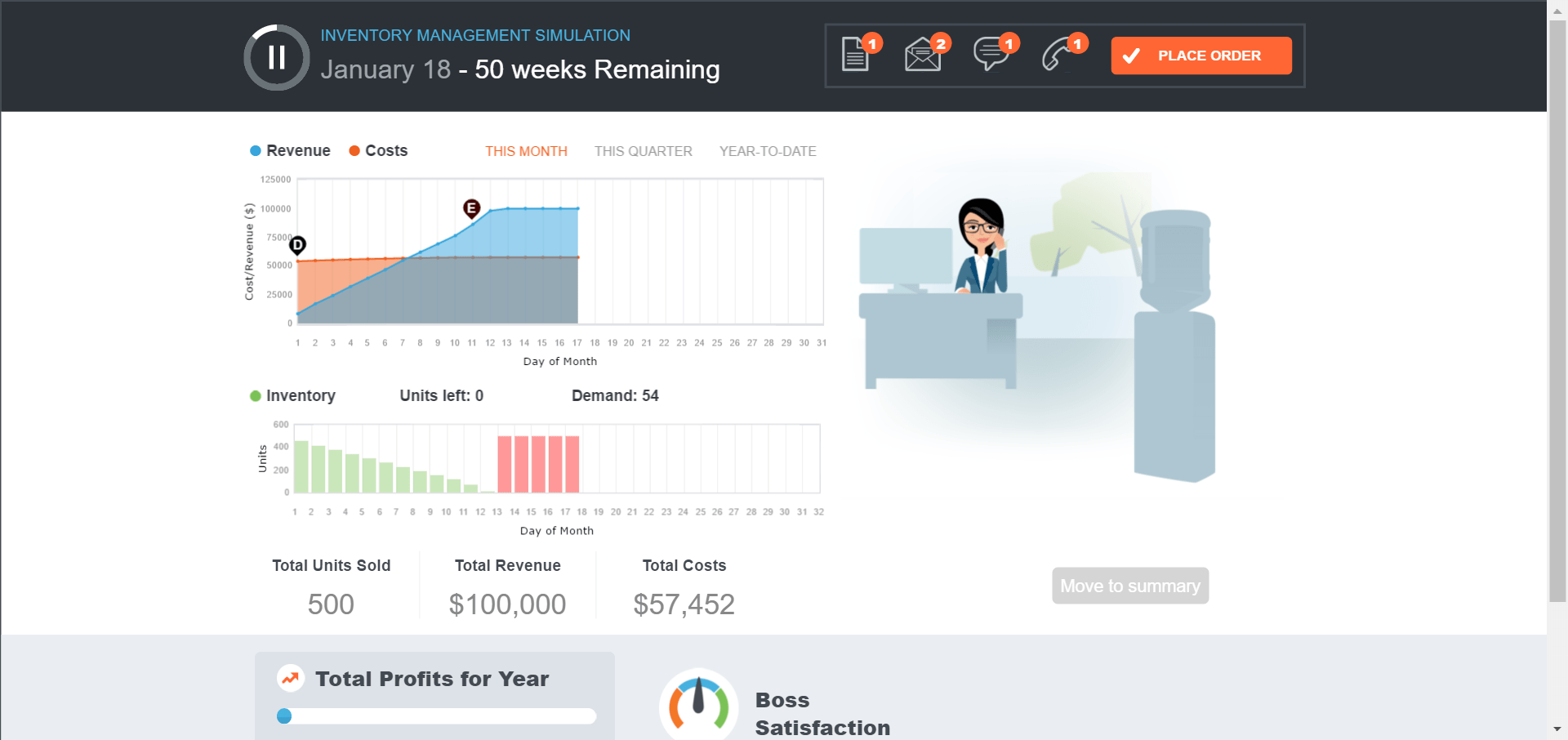
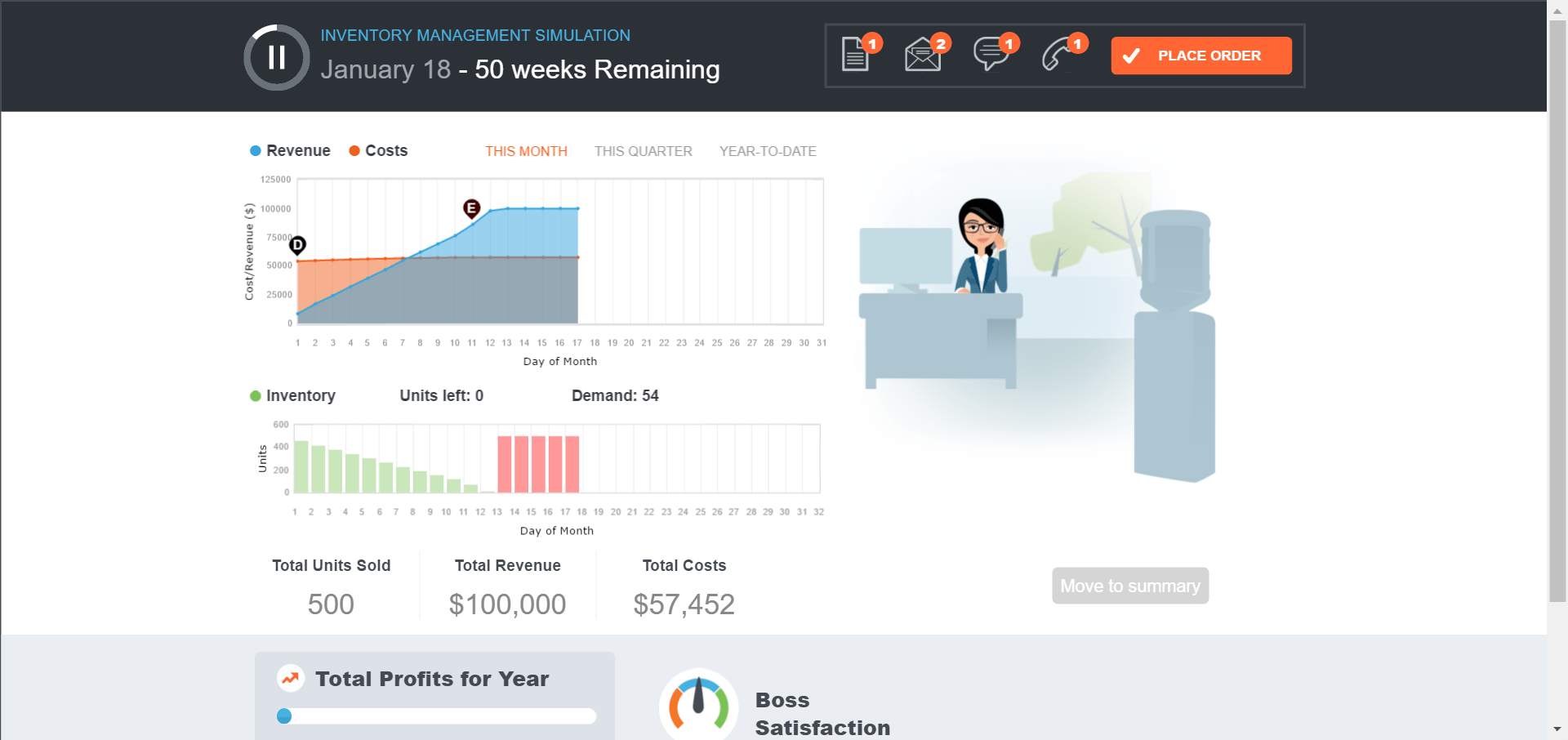
Inventory Simulation is the 4th of our four new classroom gaming exercises. It accompanies Chapter 12, Inventory Management and is free within our MyOMLab learning system.

Goal: Manage stock of electronics device to minimize costs and maximize profits.

You are the store manager at a local branch of DigiLife, a large electronics retail chain. A new version of a popular consumer electronics device called the Amulet is coming out this year. It is your job to sell as many Amulets as you can while minimizing your costs in order to maximize your store’s profits.

Learning Objectives

Primary Objectives:

  • Understanding how EOQ is calculated
  • Understanding the limits of EOQ

Ancillary Objectives:

  • Use EOQ formula = sqrt(2ds/h)
  • Where d = qty demanded, s = ordering/setup cost, h=holding cost
  • Understand what the answer means and what the inputs mean.
  • Knowing how EOQ can help guide you towards better decisions about order size and time between orders.
  • Understand that demand is variable (Sales/marketing give you their best forecast but no one can predict the future. Also, you may be given an average demand where actual demand will fluctuate from day to day.)
  • Understand that h has fixed and variable components (if you already have a fridge you might as well fill it. But if you’re paying for storage by the square foot, that’s going to vary).
  • Understand ordering costs aren’t always obvious (going to the gas station every day to top off your tank doesn’t mean you may more for your gas, but it’s a huge waste of time).
  • Understanding the economic impacts of defects and damage, stockouts and rush orders.
  • Understanding the limitations of using EOQ to guide your decisions–that EOQ doesn’t give you an exact answer, but it gets you close.
  • inventory simulation

MyOMLab: Our Four New OM Simulations

We are thrilled to announce that our learning package now includes some pretty sophisticated OM simulations. Here is a bit of background information.

  • How many simulations will be part of OM Simulation?  We have four gaming simulations: inventory management (chapter 12), quality control (chapter 6), forecasting (chapter 4), and project management (chapter 3). A fifth, supply chain management (chapter 11), will be available in late Fall.
  • Are these simulation to be done in class or outside of class?  The OM simulations are fully assignable through MyOMLab, so students could complete this as homework presumably after completing their reading. It would also work as an in-class activity, either working as an individual or as part of a team.
  • Are the OM simulations smartphone compatible?  The OM sims are compatible for mobile devices including smartphones in landscape orientation.  However the simulations are optimized for desktop/laptop devices.  Our research suggests that for activities of this length, most students still prefer desktop/laptop use.
  • Are the OM simulations accessible?  Yes, the OM simulations have been developed with a number of accessibility features including compatibility with screen reader devices.
  • Can you pause the simulations?  Yes, you can pause all of the simulations to review the artifacts (documents, emails, voicemails, texts) or make a decision.
  • What is the price of the OM simulations?  Access to simulations is through MyOMLab and included in that purchase cost. There is no additional fee to purchase these simulations on top of the MyOMLab purchase.simulation


OM in the News: Terrorists, the Electric Grid, and OM


utilitiesLarge U.S. utilities are joining forces to stockpile critical pieces of electrical equipment that can be rushed to power companies if they are hit by terrorist attacks, earthquakes or other disasters that could cause extended blackouts,” writes The Wall Street Journal (April 7, 2016). The new Grid Assurance Corporation will store circuit breakers, large transformers and other crucial parts at secure, unidentified locations, and sell them to participating utility companies who need them during emergencies. The venture underscores the growing concern about coordinated attacks and natural disasters that could cripple parts of the country’s electric grid. In 2013, gunmen stood outside an electrical substation near San Jose, Calif., and shot up 17 transformers funneling electricity to Silicon Valley. The transformers were damaged but not destroyed. Nevertheless, the incident spread fear that attacks on multiple substations could unleash lengthy power outages that would cripple other services, such as water treatment and police and fire response.

Currently, there is no federal requirement that power companies share equipment. While all utilities keep replacement equipment, some parts, such as spare transformers, typically sit close to where they may be needed because they can weigh more than 500,000 pounds. That makes them vulnerable to being damaged alongside the equipment in use, in an attack or a natural disaster. “The last thing we want is for someone to do a physical attack and wipe out our spares, too,” said one power company VP.

Many electric power components are hand-built, manufacturing capacity is limited, and ordering them anew requires waits of up to 18 months. While that is acceptable for routine replacement, since the gear often lasts 30 years or more, it is too slow for an emergency.The participants in Grid Assurance estimate they will need at least 100 transformers, often costing $2-$10 million each, so the venture will be expensive, but far less costly than a major blackout.

As we note in the text, combining (aggregating)  inventory  can reduce costs, reduce maintenance repair time, and increase up-time.

Classroom discussion questions:

  1. Why is this inventory issue different from other industries?
  2. What OM tools can be used to tackle a problem such as this?

OM in the News: Where To Hold All the Oil Inventory?

Rail tanker cars sit on tracks at the Red River Supply rail yard in Williston, N.D

“The U.S. is so awash in crude oil that traders are experimenting with new places to store it: empty railcars,” writes The Wall Street Journal (Feb. 29, 2016). This is a great story to share with your students when you cover holding costs in Chapter 12, Inventory Management. Thousands of railcars ordered up to transport oil are now sitting idle because current ultralow crude prices have made shipping by train unprofitable. Meanwhile, traditional storage tanks are running out of room as U.S. oil inventories swell to their highest level since the 1930s.

Some are calling the new practice “rolling storage”—a landlocked spin on the “floating storage” producers use to hold crude on giant oil tankers when inventories run high. Energy Midstream, a Texas trading company, stored its ultralight oil on Ohio railcars last month for about 15 days before shipping it to a buyer in Canada. The oil has to go somewhere. The surge in shale-oil production has created a massive glut that the industry is struggling to absorb. BP’s CEO just joked in a speech that by midyear, “every storage tank and swimming pool in the world will be filled with oil.”

The cheapest form of storage—underground salt caverns—can cost 25 cents a barrel each month, while storing crude on railcars costs about 50 cents a barrel and floating storage can cost 75 cents or more. (The cost estimates don’t include loading and transportation.) Railcars hold 500-700 barrels of oil, less than a cavern, tank or ship can store. The plunge in oil prices brought the demand for railcars to deliver oil to a halt. There are now as many as 20,000 tank cars—1/3 of the North American fleet for hauling oil—parked in storage yards or along unused stretches of tracks. The disappearance of available storage is akin to a coloring book where nearly all the white space has been filled in.

Classroom discussion questions:

  1. Compare the options for storage of excess oil.
  2. What are companies doing with unwanted oil already loaded on tankers en route to their destinations?

OM in the News: Wal-Mart Shrinks Its Inventory

Wal-Mart's CEO states: "We are trying to fit 4 pounds of sugar into a 2 pound bag"
Wal-Mart’s CEO states: “We are trying to fit 4 pounds of sugar into a 2 pound bag”

“The average Wal-Mart supercenter—home to 120,000 products—has about 2,500 fewer items than a year ago,” writes The Wall Street Journal (Oct. 26, 2015).  Some of the changes have put Wal-Mart at loggerheads with vendors who worry they will result in tens of millions of dollars in lost sales. The moves are part of a high-stakes pivot to tame the company’s sprawling empire, organize unruly systems for managing inventory and keep stores neat and better stocked—retail basics that Wal-Mart fumbled recently. Wal-Mart is using more and better data to decide which products stay on shelves and where to remove clutter.

Part of the retread involves culling inventory from backrooms, and dropping some products altogether. In a key move that will change the look of the chain’s stores, Wal-Mart is more than doubling the width of aisles—to 10 feet from 4 feet, making it more navigable for multiple carts. The company is making significant changes to how inventory flows through its stores. Employees are starting to restock during the day, when customers are most likely to complain about missing items, rather than late at night.

“It’s the objective of every retailer to grow their inventory slower than sales,” says CEO Greg Foran. “We just carry too much inventory. And so we do have lots of work under way to get that sorted.” Wal-Mart is also experimenting with lowering shelves by about a foot to make it easier for shoppers to see around the store. The subtle change would wipe out hundreds of millions of dollars in annual sales of gum, candy and magazines. Behind the scenes, Wal-Mart is also aggressively pressuring suppliers to spend more money to earn a spot on shelves. Contract renegotiation letters to suppliers are asking many to pay additional fees to store their products in warehouses, as well as give the retailer more time to pay for the goods.

Classroom discussion questions:

  1. What are the changes inventory policies Wal-Mart is pursuing? Why?
  2. What are the layout changes involved?


Guest Post: Quantity Discounts are Everywhere

Chuck MunsonToday’s Guest Post comes from Prof. Chuck Munson, at Washington State University. Jay and I are pleased that Chuck is joining us as co-author on the new edition of our texts, coming out in January, 2016.

We can’t walk down most any aisle of the local grocery store without seeing multiple package sizes for products with (quite often) a quantity discount in the form of a lower price per unit for purchasing the larger size. Companies experience the same thing. Firms responding to a recent survey reported a large level of quantity discount pricing in business-to-business transactions, and 67% of respondents negotiate more than half of their prices.

Some of the most common operations reasons for the existence of quantity discounts include: (1) to receive cost savings due to economies of scale, (2) to increase order size and decrease order frequency, (3) to take advantage of truckload rates and transportation discounts, and (4) to be able to ship in standard package and container sizes. Quantity discounts are used for marketing purposes as well, including: (1) to increase annual demand, (2) to lock in customers for the long term, and (3) to win large orders from business customers.

quantity disct 2quantity disct 1If you’ve ever taught the EOQ model with quantity discounts (Ch. 12 in the text) in your OM class, your students may be like mine. For some reason, many seem to have difficulty grasping the solution technique. Rather than give up, though, I keep teaching it because quantity discounts are so prevalent in industry. Apparently, proper ordering techniques are not yet widespread in practice. Thirty percent of sellers and buyers in the recent survey claimed to base discounts and order quantities on intuition rather than on models and algorithms. Further, 1/4 of the buyers often order at a price breakpoint of incremental quantity discount schedules, which is never optimal. Clearly, companies are leaving a significant amount of dollars on the table.

For more details and a literature review of more than 250 papers on quantity discounts, see: www.cbe.wsu.edu/~cmunson/Research%20Papers/Quantity%20Discounts%20TOM-041.pdf

OM in the News: Walmart’s Inventory Dilemma

At this N.Y. Walmart, the produce section is poorly stocked

The dairy section in the Walmart supercenter near Queens, N.Y., was sparsely stocked. Some gallon jugs of milk were dented, others soiled with what looked like dirt. The meat aisle had run out of ground beef patties and strip steak, and residue streaked some shelves. But the disarray and out-of-stock items at this store appear to be examples of wider inventory problems that Walmart is facing. Last month, the retailer issued a confidential “urgent agenda” memo to its 4,965 U.S. store managers pushing them to improve performance in their grocery departments to maximize the chance that items will sell before their expiration dates. The memo also urges managers to reduce backup inventory to trim costs, but warns them not to exceed weekly employee budgets for their stores.

The inventory problems often stem from Walmart’s failure to have enough employees in its stores to do the many chores needed, like marking down aging items, rotating milk or getting needed goods from the back room to stock shelves.  “The fact that they don’t do some of these things every day, every shift, shows what a complete breakdown Walmart has in staffing and training,” says one industry expert (The New York Times, Nov.12, 2014). And a new investment report writes: “If its employees’ growth had kept up with square footage growth in the U.S. over a number of years, Walmart would have 200,000 more employees than its current 1.3 million.”

A visit to the back of the N.Y. store, as well as various YouTube videos shot by employees, point to great clutter and thousands of cases waiting to be put on shelves. A customer service manager at a Louisiana Walmart said, “Understaffing from the sales floor to the front end has greatly affected the store.” She said substantial staffing cuts began in 2010, and added that there used to be 5 customer service managers per shift, while now is there just one. “That,” she said, “sometimes causes long lines and customers having to wait 30 minutes.”

Classroom discussion questions:

1. Why has inventory control been a major OM issue for Walmart?

2. Is this really an inventory problem?

OM in the News: Zulily’s “Inventory-Lite” Model For E-Commerce

zulilyOne of the Internet’s fastest-growing retailers is also one of its slowest shippers, reports The Wall Street Journal (May 4, 2014). The mom-focused discount site takes an average of 2-3 weeks to get merchandise to customers, well off the pace of online veterans like Amazon.com and ShopRunner Inc., which have been training shoppers to expect delivery in 2 days.

The slow shipping times are the result of a bare-bones distribution system that is enabling 4-year-old Zulily to turn a profit in an industry where some of its peers have struggled. Zulily’s sales have soared thanks to its ability to get women to browse regularly for deals and make what are largely impulse buys before the sales end.

But Zulily’s Achilles’ heel may be shipping. Last year, it took an average of 11.5 days for items to be shipped from Zulily’s warehouses after customers ordered them. The reason: Zulily doesn’t buy in advance most of the products it offers. Instead, it orders the items from vendors after the sales end. Vendors then ship the merchandise in bulk to one of two Zulily warehouses, where the products are sorted and combined with other orders before being shipped back out.

“It’s more efficient to do it this way,” says the company’s COO. It also doesn’t accept returns. He adds: “The inventory-lite model is why Zulily can afford to sell a wide range of discounted merchandise from more than 10,000 vendors.” The company has been investing in automation at the warehouses so that they can handle more inventory more quickly. “We’re always looking to improve speed and efficiency.”

Customers going to Zulily’s website don’t know ahead of time what deals they will find, and the retailer tries to work the shipping lag into its sales—for example, it is currently selling summer apparel for women and children.

Classroom discussion questions:

1. How does the Zulily model differ from the Amazon model?

2. What OM changes would improve the company’s efficiency?

OM in the News: Don’t Even Think About Returning This Dress

Bloomingdales' tag reads "Returns Will Only Be Accepted If All Original Tags Remain Affixed"
Bloomingdales’ tag reads “Returns Will Only Be Accepted If All Original Tags Remain Affixed”

Chapter 12’s discussion of  services inventories notes that shrinkage and pilferage account for 1-3% of retail inventory loss. But BusinessWeek (Sept. 30-Oct.6, 2013) reports on yet another source of loss to retailers. Many merchants have long lived by the mantra that the customer is always right, adopting liberal return policies in hopes of winning the loyalty of free spending shoppers. But with a recent increase in the wearing and subsequent return of expensive clothes—a practice merchants call wardrobing—many retailers are taking a stronger stand against the industry’s $8.8 billion-a-year return fraud problem.

Bloomingdale’s just started placing 3 inch black plastic tags in highly visible places on dresses costing more than $150 as they are being purchased. The clothes can be tried on at home without disturbing the special tag. But once a customer snaps it off to wear in public, the garment can’t be returned. Similarly, Nordstrom uses silver-colored paper tags, similar to price tags, which are affixed high on the outer side seam under the arm of special-occasion dresses. They must still be attached for returns.

The department store chains are not alone in trying to outwit some unscrupulous customers. Electronics retailers have turned to hefty restocking fees to discourage short-term use of expensive electronics to watch events such as the Super Bowl.  Improper returns afflict a wide swath of products. Such “borrowing” also has become prevalent in fine jewelry, seasonal décor, and tools. Ditto for expensive video cameras popular at weddings. After the nuptials, the gear sometimes goes back into the package and off to the store for a refund. Some Victoria’s Secret stores are compiling lists of serial returners. And high-end outdoor goods retailer REI recently announced it’s ending its lifetime return policy after customers took advantage of its lenient rules.

Merchants say the costs are now too great to ignore. About 65% of retailers reported experiencing wardrobing last year, meaning 3.3% of their total returns were fraudulent.

Classroom discussion questions:
1. How is wardrobing an OM issue?

2. What are the risks of cracking down on wardrobing and other frauds?

Guest Post: How Much Inventory is There in the World?

kelly thomasToday’s Guest Post comes from Kelly Thomas, who is a supply chain management professional and executive at JDA Software.

Here is a simple question: “how much inventory is in the world?”  The short answer is that no one knows for sure, and no one keeps track of it at a global level. It’s an interesting question though, because it gives us an understanding of how efficient the world is in turning inventory into economic output.

The Council of Supply Chain Management Professional’s annual report leverages data from the Bureau of Economic Affairs and other sources, and provides great detail on logistics, distribution, and inventory costs in the U.S. According to this report, there was $2.2 trillion in business inventory in the U.S. in 2012. Also last year, there was about $70T worth of economic output globally. The U.S. represented approximately 22% of overall output. Assuming the rest of the world is as efficient as the U.S., a simple pro-rata calculation based on economic output produces a global inventory level of $2.2T/22% = $10T.

This calculation does not account for the relative efficiency of economic activity across countries. China, for example, has twice the logistics costs of the U.S. as a percentage of economic activity or GDP. Given that the combined GDP of the BRIC countries is almost the size of the U.S. economy, and if you assume all of the BRIC countries have logistics costs similar to that of China, this would add almost another $2T to the overall inventory number, yielding $12T in global inventory. This likely understates the actual number since it also does not account for relative inefficiencies in other emerging markets (and does not include government-owned inventories).

This ballpark estimate gives us an understanding of the efficiency of economic output relative to inventory. Based on this information, economic output turns against inventory are about 6 (roughly the same as sales turns). This means there is approximately 2 months of global inventory sitting around at any one time (on an economic output basis). We can do better than 6 turns. If we were able to reduce inventories by just 10%, that would free up $1.2T in capital that could be deployed to growth activities that would benefit companies, countries, and ultimately people.

OM in the News: Wal-Mart’s Disappearing Inventory

walmart shelvesMargaret Hancock has long considered the local Wal-Mart superstore her 1-stop shopping destination, writes BusinessWeek (April 1-7, 2013). No longer. During recent visits, the Delaware accountant says she failed to find more than a dozen basic items, including certain types of face cream, cold medicine, bandages, mouthwash, hangers, lamps and fabrics. The cosmetics section “looked like someone raided it,” said Hancock. “If it’s not on the shelf, I can’t buy it.”

Tim White, a California attorney, added that while long checkout lines irritated him, “the number-one reason we gave up on Wal-Mart was its prolonged, horrible, maddening inability to keep items in stock. The store would go weeks without products he wanted to buy, such as men’s dress shirts, which he found only in very large or small sizes and unpopular colors.”

It’s not as though the merchandise isn’t there. It’s piling up in aisles and in the back of stores because Wal-Mart doesn’t have enough bodies to restock the shelves. In the past 5 years, the retailer added 455 U.S. stores, a 13% increase, but its employee count dropped by about 20,000, or 1.4% to 1.4 million workers. A thinly spread workforce has other consequences: longer check-out lines, less help for shoppers and more disorganized stores. Last month, Wal-Mart placed last in the American Customer Satisfaction Index, the sixth year in a row the company had taken the last spot–and Bloomberg News reported that the company was “getting worse” at stocking shelves. Retailers consider labor — usually their largest controllable expense — an easy cost-cutting target. But eventually, customer service and customer satisfaction deteriorate.

Years ago, Wal-Mart supervisors drilled a message into employees’ heads: “In the door and to the floor.” That mantra now seems impossible to execute as the firm has become entangled in what one expert calls a “vicious cycle” of under-staffing. Too few workers leads to operational problems. Those problems lead to poor store sales, which lead to lower labor budgets.

Discussion questions:

1. Why can’t Wal-Mart keep its shelves fully stocked?

2. What suggestions do you have for dealing with this OM problem?

Guest Post: The Distribution Game– A Perfect Class Engagement Activity

Our Guest Post today comes from Dr. Chuck Munson, who is  Professor of Operations Management at Washington State University.

It’s not always easy to find an activity that combines true learning with fun and competition. For more than 15 years I have been successfully using “The Distribution Game” in undergraduate supply chain management and MBA operations classes. The game was originally designed by Peter Jackson and John Muckstadt at Cornell http://people.orie.cornell.edu/~jackson/distgame.html, and it can still be downloaded for free (although it may require a modern platform conversion).

Each day for 200 days, the player must choose how many units to order for three retail locations and the supplying warehouse (so this is a multi-level inventory problem). It takes 15 days for the product to reach the warehouse from the supplier and 5 days to reach the stores from the warehouse. Demand is random. The animation is a little bit crude by today’s standards, but it’s still quite effective to see little trucks carrying products across the screen each day.

I like the game because it can be played whether or not inventory formulas have been taught. Students can try to use common sense and some can perform quite well doing so; nevertheless, they seldom beat my performance that’s completely formula-driven. Imbedded in the game are issues of safety stock, balancing setup and holding costs, lead time effects, and lumpy demand at the warehouse. We can usually get through about four games during an hour in the computer lab or with laptops in class.

Game parameters can change: I vary the demand distribution, relative holding and setup costs, and lead times. For me, the most important learning outcomes are: (1) equalize total holding and setup costs, (2) the warehouse should order in integer multiples of the combined retailer order sizes, and (3) the pipeline should be empty when time runs out.

Have fun, and consider awarding prizes to the winners!

Video Tip: A Two-Bin Kanban Inventory System at St. Clair Hospital

This  7 1/2 minute video from Pittsburgh’s St. Clair Hospital is a great tool to use when you are teaching inventory management in Chapter 12. St. Clare started  with a “par level” system  that often led to stock outs for nursing supplies. With the help of an industrial engineer, the hospital converted 28 supply areas over a 10 month period to a much more efficient  two-bin kanban system. With the system in place, St. Clare went to zero stock outs and zero manual requisitions sent to its materials management department.

The video discusses Toyota’s kanban pull model and illustrates a realistic, interesting way that a hospital controls its inventory. It also makes the point that analysis of data is a critical first step of the process of changing any floor plan or stock area. The video closes with interviews of  nurses who are happy that “everything is under budget since the new system” is in place.

Just click below to view the video.

http://www.youtube.com/watch?v=yjSwwPF5BUU