OM in the News: Matching Supply (of seats) with Demand at Delta Air Lines

Have you ever been bumped from a flight that was over capacity? It’s a drama that plays out at departure gates every day in airports around the world. Typically, gate agents on overbooked flights embark on last-minute negotiations with passengers who might be willing to take a later plane. The agents broadcast their offers– vouchers worth $200-$400–and keep ratcheting up the price until enough passengers accept. Customers involuntarily bumped get an $800 voucher ( which the Transportation Dept. is proposing to raise to $1,300).

With 541,000 US passengers bumped in the 1st 9 months of 2010 (53,000 involuntarily), there must be a better way to manage capacity (Supp.7) and manage revenue (Ch.13). According to today’s Wall Street Journal (Jan.14,2011),  Delta Air Lines thinks it has the answer.

Delta’s high-tech new system (opened last month) asks passengers who check in online or at kiosks before going through security, what dollar amount they would accept to be bumped from their (overbooked) flight. Delta can then accept the lowest bids, eliminating a lot of uncertainty early. Not only does this give Delta a negotiating edge–passengers won’t know how low others are willing to go. But, in addition, “saving 3 or 4 minutes at the gate has a big operational impact”, according to Delta.  Delta calls it a “win-win” for both consumers and the airline.

Is this good customer service–or do any one of us even expect customer service when we fly? The topic fits well when discussing capacity and yield management issues in both Supp.7 and Ch.13. Given that 8-10% of passengers with reservations do not show for their flights, what other suggestions do students have?

Discussion questions:

1. Which system is better–Delta’s or its competitors?

2. What options do airlines have for capacity and demand?

OM in the News: Recycling is a Necessity at Hitachi

Neodymium. You say you never heard of it?  If you worked at Japanese firms Hitachi, Mitsubishi, Panasonic, or Sharp, your companies would be spending a lot of time trying to find this product, called a “rare earth”. Rare earths are light-weight, malleable  metals that are essential to hybrid cars, cell phones, and hard disk drives. (Toyota Prius batteries use neodymium to power the car).  Hundreds of  other Japanese manufacturers also depend on them. And they had all counted on China, which produces 97% of the world’s supply of neodymium, dysprosium, didymium, and other rare earths, as the supplier.

But the latest issue of Businessweek (Jan.11,2011) describes how China has cut its exports of rare earths by over 3/4, driving up prices more than four-fold this past year. (Neodymium is now at $40/lb.) China wants to free up supplies for its own manufacturers, as well as reign in a very toxic industry.

So what is Hitachi doing ? The firm, which makes everything from nuclear power plants to home appliances to the Prius batteries, uses 600 tons of rare earths per year. The answer is recycling (Supp.5). Hitachi’s new facility in Matsudo City carefully saws open A/C compressors to retrieve rare earth magnets inside. It takes 2 workers 8 minutes to get to the prize inside each used air conditioner—4 wafer thin magnets containing 30 grams of rare earth metal. A separate conveyor belt feeds used disk drives into a massive machine, which pops out rare earth metal ready for harvesting. Other Japanese companies are following Hitachi’s lead in mining discarded products such as washing machines. The bottom line: China’s decision has prompted a whole new recycling industry.

Discussion questions:

1. Why did China cut its supply? What were its motives?

2. How might recycling of rare earths impact the world and its economy?

3. Why are rare earths so important and what other sources are going to be available?

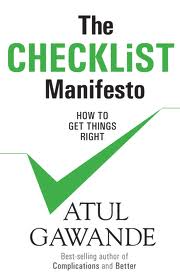
Good OM Reading: The Checklist Manifesto

Here is a popular book that deals with quality issues (Ch.6) in medicine by extolling the use of checklists. Dr. Atul Gawande’s The Checklist Manifesto: How to Get Things Right (Metropolitan Books,2009) will add to your TQM lecture with some interesting examples. Gawande points out that just as airline pilots use checklists before takeoff,  surgeons need checklists, which are proven to reduce mortality from operations.

The medical culture, unfortunately, often includes doctors who are just plain rubbed the wrong way by such a tool. Surgeons, in particular, view themselves as individuals whose skill and reputation are all that is needed in the OR. Gawande uses a WHO study to show that surgical complications dropped by more that one-third when checklists were used.

The checklists includes such items as: making sure everyone in the OR knows everyone else’s name; that blood for a transfusion is on-hand; and that the pre-op was performed correctly. Medicine, he says, has become so incredibly complex that mistakes are virtually inevitable.

The Huffington Post (Jan. 6,2011) has a quick review of the book, followed by a 6 minute video clip of Gawande being interviewed recently on the Steven Colbert show. (Note that you have to scroll down about 6″ to get to the video link). I am not a huge fan of the show, but somehow I think your students will find it hilarious. They seem to understand his humor, and at the same time, Gawande does make  his point about checklists.

Pretest Using Myomlab

To follow-up on last week’s Blog regarding Myomlab, I’ll comment on what I found to be a very successful application.  I use a Pretest. That is, when introducing a new topic, I choose 6 to 10 introductory questions from Myomlab. These are usually multiple choice and perhaps a simple introductory problem. These problems are due via Myomlab prior to class.  All I have to do is select the questions; the grading and posting are done automatically.   I set-up a cutoff time a few minutes prior to class (I find student are often in the lab down the hall doing the problems at the last minute……what a surprise).   With cumulative points on the pretests at 10 to 15% of the course grade, I find I get the attention of most students.  However, a few words in class reminding students that the pretests are a part of the course that is an easy ‘A’ can be helpful.

The pretests can be a real aid in stimulating class interest and enhancing class participation.  Pretests are a win-win. Students are more involved, your classes are more interesting, students are learning more, and your class evaluations go up.   

I think you and your students will like Pretests.  Give them a try.

OM in the News: Jobs for Americans and Pink Slips for the Chinese?

Yes, you read the headline right: “Jobs for Americans and pink slips for the Chinese”, says the quote  in the current issue of Businessweek.  It turns out companies from China are setting up shop in the US to avoid trade barriers, to capitalize on the US government’s alternative energy push, and to pick up on some of our new technologies.

For 20 years, US manufacturers have decamped to China in search of cheaper labor and parts. Now things may be turning the other way. China’s Suntech  just opened  a solar panel plant near Phoenix to bring the company closer to its American customers (which means big savings on shipping costs) and into compliance with “Buy American” government contracts. Tiajin Pipe is opening a $1 billion steel pipe mill near Corpus Christi, Texas, to circumvent 63% US tariffs. Tiajin will employ 500-600 people. Beijing’s Pacific Century Motors just bought Michigan-based Nexteer Automotive, a car part manufacturer, and employs 3,600 workers in Saginaw.

 Letting  in Chinese companies isn’t as controversial now that the US is bleeding manufacturing jobs. With unemployment hovering near 10%, US officials have put aside concerns about unfair Chinese competition. “Chinese companies, thanks to government-backed loans, monopolies, and preferential treatment, are awash in cash and should be a source for investment in the US economy–investment that would help maintain and create jobs in the US”,  wrote the US ambassador to China  in a diplomatic cable on Jan.28,2010, which was recently disclosed by WikiLeaks.

How does this relate to pink slips in China?  Suntech is using more advanced equipment in Arizona than in its home plant in Wuxi.  Here, 30 Americans are producing the same number of solar panels as 100 Chinese. “If it works well, we can integrate the same manufacturing technology in China”, says the plant manager. “This would help Suntech China make a manpower reduction”. Perhaps this is the 1st turnabout in US-Chinese relations.

Discussion questions:

1. What are the benefits and dangers to the US  of  Chinese plants opening here?

2. What happened when  a China oil company tried to buy Unocal for $18 billion in 2005? Why the change?

OM in the News: Terrorism and The Global Supply Chain

It’s not every day that The Wall Street Journal publishes an editorial by the US Secretary of Homeland Security, Janet Napolitano, entitled “How to Secure the Global Supply Chain” (Jan.6,2011).  In it, Napolitano writes, “The complex supply chain that consumers and businesses in the US rely on every day is a target for those who seek to disrupt global commerce”. This is certainly a topic we need to consider adding to our discussions of global OM issues in Ch.2 and Ch.11.

Regardless of where a terrorist event takes place, a significant disruption of our supply chain may follow.  An example was the Oct., 2010 plot to put explosives on a UPS cargo flight bound for the US from Yemen. Following that act, the Dept. of Homeland Security required all cargo on passenger planes within the US to be screened. It also screens all US-bound air cargo that is considered high risk (most likely from terror-sponsoring countries, I would surmise).

Napolitano names 3 elements to the US plan:

1. “Preventing terrorists from exploiting the supply chain to plan and execute attacks”. This means working with customs groups and shippers to keep chemicals out of the hands of terrorists.

2.”We must protect the most critical elements of the supply chain, like central transportation hubs, from attack or disruption”.

3.”We must make the global supply chain more resilient, so that in case of disruption it can recover quickly”.

Incidentally, 2 days after this article, the Journal reported that Secretary Napolitano received a small bomb in a package that exploded in her mailroom (WSJ, Jan.8-9,2011).

Discussion questions:

1. In what ways can a disruption of the global supply chain impact a business in the US, such as IBM, GE, or Boeing?

2. What other events, beside a terrorist strike, can effect the supply chain? How?

Myomlab updates and enhancements

The Guided Solutions for all of the problems in Myomlab are now completed and available for spring semester.  This means that students have the opportunity to click on the 123 tab on the upper left of the problem screen for help (a problem specific tutorial) when solving a bookmatch problem. The Guided Solutions are in addition to the Examples and Videos that are available with many problems. 

As you may know, thousands of questions from the Test Item File are also available in Myomlab. With the good help of Chuck Munson (Washington State University), we have  reviewed all of the True/False and Multiple Choice questions for accuracy. We have also made a special effort to remove any ‘tricky’ problems or problems with any ambiguity. These revisions too, are now available.

Additionally, the Myomlab platform has some enhancements.  Among these are:

Track Time Spent on Media Students now will have to explicitly click the ‘submit’ button after viewing the media relevant to the assignment. This enables instructors to track the time students spent on each media file.

Custom Question Builder Updates For those of you adding your own questions, you are now able to edit table properties in Word-like tables.

Mobile App for iPhones, Pads, and Android phones (or it is a hi-tech world) This enhancement allows students to login and review information from the dashboard of their course.  This means that course announcements, assignments, and results for completed work are readily available. However, students may not complete assignments from their mobile devices.

OM in the News: China’s Drive to Innovate

We have  blogged several times about China’s success at reverse engineering such products as bullet trains, solar technology, drones, jet fighters, wind turbines, and computers. And, indeed, one of our strengths in the US has been the ability to stay ahead of  competition through innovation (See Ch.5 and Figure 5.2).  But The New York Times (Jan.2, 2011) has just reported that China has issued a new government policy aimed at increasing the number of inventions in that country. China’s goal is to have 2 million patent filings/year by 2015. (In 2009, there were 300,000 in China and 480,000 in the US).

So can China become a prodigious inventor?  The answer will play out over decades–but also shape the global economy. “The leadership in China knows that innovation is its future, the key to higher living standards and long-term growth”‘, says the Director of US Patents. But the Chinese approach is an innovation by-the-numbers mentality, says one consultant. It is “emphasizing the quantity of innovation assets more than the quality.”

China’s strategy is guided and sponsored by the state. Should this be  a source of concern  for the US? Despite China’s inevitable rise, the US has a comparative advantage because it is the country most open to innovation. Our culture  forgives failures, tolerates risk, and embraces uncertainty.

Discussion questions:

1. In the 1980’s, Japan was considered a similar threat to American industry. What happened?

2. Will China overtake the US one day as the world’s leader in innovation?

3. Comment on China’s use of metrics to meet the goal. What incentives are they using?

OM in the News: Disney and the Art of Queuing

On Thanksgiving, I  blogged  that our family spent a day (mostly in queues) at Disney World, here in Orlando. My report was from the perspective of a customer being entertained while in lines and touring the park.

Now the New York Times (Dec.28, 2010) presents the inside view of the same theme park, but from the underground control room. This nerve center sits below the Cinderella Castle and has made the art of queuing into a science.

“There has been a cultural shift towards impatience–fed by video games and smart phones”, says a park manager. Customers are simply demanding more action. One response:  at Space Mountain, 87 game stations now line the queue to keep visitors entertained. Each provides 90 seconds of  game challenges.

The operations center monitors all 40 rides at Magic Kingdom, and because of its efforts, the average park visitor can now ride 10 of them (up from 9) in a typical day. For example, if a control center light monitoring the Pirates of the Caribbean ride changes from green to yellow, the operations manager can launch more boats…. or may dispatch Capt. John Sparrow or Goofy to entertain people in line. If Fantasyland  is swamped, but Tomorrowland less crowded, the ops center can relocate a miniparade to siphon guests in that direction.

Discussion questions:

1. Why does Disney expend such effort on queue management?

2. What other approaches could be attempted to shorten waits?

Teaching Tip: Incentive Systems Work in Sports Too!

If you are over 30 and have followed the NBA along the way, you probably remember one of the most colorful players of the game—Dennis Rodman. Green hair, difficult team player, a pattern of not showing up for games, Chicago Bulls NBA championship, and one of the most unusual incentive systems set up outside the C-suite….those are my memories. Rodman’s base was $4.5 million, with another $5.95 million (which he actually collected!) for completing each of the following: playing every game, leading the league in rebounding, having a 1.5 to 1 assist-to-turnover ratio, and hitting over 66% from the free-throw line. (Details from USA Today, Nov.26,1997, p.12).

Since we cover incentive systems in Ch.10, I am always looking for more current examples to use in class that will be of interest to our sports-oriented students–and I found one.  ESPN.com just reported (Dec. 28, 2010) that NY Jets QB Mark Sanchez and Baltimore Ravens QB Joe Flacco stand to make  millions in post-season contract incentives in early 2011.

Sanchez can pick up $1.875 million if he leads the Jets to a Super Bowl XLV victory on Feb.6 in Texas, and also lands the Lombardi Trophy. He  gets $250,000 for every playoff win even if the final victory is elusive.

Flacco will be paid $200,000 per post-season win by the Ravens. This means a maximum of $800,000 for leading his team to the a Superbowl title.

One could question the need for such incentive systems in general. After all,  they are already paid a small fortune to do their jobs. Maybe  it only bothers me because my dean never gave out such bonuses in the B-school!

OM Syllabi: Temple U., Washington State U., Texas Tech U. and Rollins College

Jay and I never cease to be impressed by the variety of ways our colleagues teach OM at their schools.  Some profs spend 2 weeks on LP, others focus on quality and process strategy, while others actually cover all 17 chapters in sequence! We thought you might be interested in how different schools using our text face that challenge. So today we share 4 OM syllabi with you from a wide variety of  schools. Here they are:

Temple University, taught by Howard Weiss, as an undergrad course. MSOM 3101 syllabus. You might note Howard’s use of Excel OM, POM, and MyOMLab in homework assignments.

Texas Tech University, taught by Phillip Flamm, as a large section undergrad course.  ISQS 3344 syllabus. Phillip makes extensive use of “clickers” in his classes, as he noted in his Guest Blog last week.

Washington State University, taught by Chuck Munson, as an undergrad course. Mgt Op 340 syllabus. Note how Chuck integrates The Goal and MyOMLab into his course.

Rollins College, taught by Barry Render, as an MBA core course. POM 503 syllabus. You will notice that I have a lot of guest speakers. I use MyOMLab  for pre-class quizzes, homework, and tests. Because it is a graduate class, there are cases assigned every week.

We invite you to share your OM syllabus with us as well. Just send  it as a Word file or as an internet link to brender@cfl.rr.com.

Video Tip: Inventory at Frito-Lay

If you cover the subject of Inventory Control (Ch.12), you may want to show the (8 min.) video, “Managing Inventory at Frito-Lay”. There aren’t too many more interesting products that students can relate to than potato chips…and this video goes from the farm to the truck to the plant to the truck to the store…in showing the production process. What makes it really exciting is that the whole journey often takes less than one day! We follow the inventory from the time the potatoes (12 semi-trailers full each day, at 50,000 pounds of potatoes per trailer) are loaded at a farm near each plant,  unloaded, washed , sliced, seasoned, baked, bagged, boxed, loaded for delivery, shipped to supermarkets, and put on a shelf. It’s a real eye-opener to see how fresh the product at the store can be.

It’s also important for students to see that there are 4 types of inventory at Frito-Lay (and, of course, at other firms): raw materials (the potatoes, seasonings, packaging material, etc.), work-in-process, finished chips in a bag, and MRO. This may be an unusual product, in that a major raw material decays quickly, but the importance of inventory turns, W-I-P levels,  and smooth production flow are all illustrated in this company’s excellent inventory management.

Jay and I really enjoyed filming this Frito-Lay series (our most recent featured company) and you will see why when you view the closing scene, filmed in my driveway. The company lent us a truck to use for the day and loaded it with hundreds of bags of chips of all brands. At the end of the day of filming our closing comments, we assumed we had to not only return the truck, but the massive quantity of chips as well.  But we got to keep them! Since Jay couldn’t carry many back to Texas, we Renders ate chips for months….a big exception to my wife’s organic/healthy food house rules.