

Prof. Howard Weiss shares his insights monthly. Howard created the Excel OM and POM software that we provide free with our book.
A recent Philadelphia Inquirer article (February 19, 2026) reports that “The grandson of the inventor of Reese’s Peanut Butter Cups has lashed out at the Hershey Co., accusing the candy company of hurting the Reese’s brand by shifting to cheaper ingredients in many products.”
 In prior years consumers expressed dissatisfaction when Nutella reduced the amount of cocoa in its product. One reason for the change in the recipes for these two products is the high cost of cocoa. Clearly, a change in a recipe will affect inventory, material (ingredient) costs, and the supply chain.
The most infamous recipe change is probably “New Coke” which was introduced in 1985. Consumer backlash forced Coke to revert to its original recipe. Recently, Coke announced it will add a new product made with cane sugar rather than corn syrup.
Food taste and recipes can vary for a number of legitimate reasons. The recipe for Twinkies was changed in order to extend its shelf life from 25 days to 45 days. Butterfinger took an alternative approach and double-wrapped its candy. Several food processors have changed recipes in order to eliminate certain food dyes or additives or reduce sodium, including Kraft Macaroni and Cheese and Turkey Hill ice cream.
The same product may have a different recipe for sales at bulk stores rather than supermarkets. Colas may have a different amount of corn syrup in bulk stores.
Sometimes recipe changes are inadvertent. In one case consumers complained about the taste of meals they cooked using 4C Italian Bread Crumbs. 4C investigated and found that trace amounts of cinnamon were in the bread crumbs and should not have been. There are many examples of bacteria being in processed food which would affect the health of the person eating the food. This is different. There is a processing problem but it will NOT cause health issues just taste issues.
The repercussions of food quality are different than the repercussions of food safety. Food safety problems can lead to recalls, liabilities, brand damage and penalties. Failure to maintain taste can result in brand damage and product returns.
Classroom discussion questions:
1. Identify other products in which change resulted in complaints or safety issues.
2. What are the main changes these days to food products?


 Dr. Jon Jackson is Associate Professor of Operations Management and the MSBA Director in the School of Business at Providence College.
 As discussed in Ch. 8 (Location Strategies) in your Heizer/Render/Munson textbook, location strategy involves not only selecting new sites but also making tough calls about which existing facilities to consolidate or close. For FedEx, network streamlining was prompted by significant overlap between Express and Ground operations. Scott Ray, the COO-elect for U.S. and Canada surface operations explained, “The concept is pretty straightforward: Our customers don’t need both an Express and a Ground truck in the same neighborhood on the same day, and they don’t need to separate their Express and Ground packages for two separate pickups.”
 We’re talking about the data centers now being built and financed by some of the world’s biggest companies in the artificial-intelligence boom. Four U.S. tech giants—Microsoft, Meta, Amazon, and Google—are planning to spend $670 billion to build out AI infrastructure this year alone as they scramble to increase the computing power needed to operate and scale their AI-related endeavors.
 This forces a shift from one supply chain to a portfolio of capabilities designed around distinct value propositions including speed, reliability, customization, cost-to-serve, and compliance. Where commercial commitments are made in isolation from operations, the consequences surface later through margin erosion, excess inventory, and lost customers.
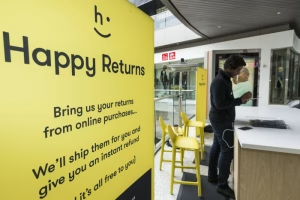 Shoppers last year returned 17.6% of items they purchased online, valued at more than $247 billion and more than double the percentage of goods returned in 2019. Returns have become such an entrenched part of online commerce that companies have sprung up to handle the growing business. UPS acquired one of those specialized operators, Happy Returns, for $465 million.
 We even highlighted this exciting digital-driven advancement in an OM in Action box in Chapter 5 (see page 175). But as we also point out in in our discussion of product life cycles in that chapter (Design of Goods and Services): “Products are born. They live and they die.”
 For two decades, manufacturing has been defined by a relentless pursuit of optimization. We automated assembly lines (Ch. 9), digitized records and built predictive maintenance models (Ch. 17), all in the service of marginal gains in efficiency.
 Dr. Yagmur Arioz recently completed her PhD at Ankara Yıldırım Beyazıt University.
 In this chapter, we have suggested that building quality into a process and its people is difficult. In the old days, inspection was the main form of quality control. But inspection may not catch all the errors, and it may be expensive. To indicate just how difficult inspections can be, ask your students to turn to the OM in Action box on page 234, called “Inspecting the Boeing 787”.
 Geopolitical fragmentation and the strategic use of trade regulations, ranked as the most notable risk for 2026 supply chains, giving it a “threat level” score of 97%. Abrupt geopolitical shifts have the potential to upend political alliances, alter trade relationships, create regional uncertainties and disrupt logistics networks.